
Assessing Performance Performance management focuses on planning for
- Slides: 32
Assessing Performance
Performance management focuses on planning for the future rather than dwelling on the past. Performance assessment is very important for: 1. Performance agreements 2. Development plans 3. Forecasts of potential 4. Career plans
Approach to assessment Mc Gregor approach: Emphasis should be shifted from appraisal to analysis. This is more positive approach Weaknesses along with strengths and potentials must be identified. Focus should be on future rather than past in order to establish realistic targets
Factors affecting assessment Assessment require ability to judge performance Good judgment is a matter of using: 1. Clear standards 2. Considering relevant evidence 3. Combining probabilities in their correct weight 4. Avoiding projections
Assessment mistakes 1. 2. 3. 4. 5. 6. Halo or Horn effect Poor perception Selectivity Poor interpretation Type I and Type II errors Overriding
Assessment corrections Ensure the concept of performance is understood by all concerned managers and employees Encourage managers to define and agree standards Encourage people to avoid jumping to conclusions too quickly Provide managers with practice in exercising judgments to find out their weaknesses.
Methods of assessment 1. 2. 3. 4. 5. 6. 7. Overall analysis of performance Written assessment of performance Rating Forced distribution Forced ranking Quota system Visual assessment
1. Overall analysis of performance An overall analysis is a form of assessment, as it will reveal strengths and possibly weaknesses which indicate where development can usually take place. Businesses with performance on contribution related pay may disagree with this approach.
2. Written assessment of performance A narrative assessment is a written summary of views about the level of performance achieved. Traditionally it was top down process Main problem with this approach is giving bland, and meaningless assessment Problem could be alleviated through: 1. Issuing guidelines 2. Taking comments on objectives
3. Rating Most performance management schemes include some form of rating. “Rating indicates the quality of performance or competence achieved or displayed by an employee by selecting the level on a scale that most closely corresponds with the view of assessor on how well the individuals has been doing. ”
Types of rating scales Rating scales can be defined alphabetically or numerically. The alphabetical or numerical scale points may be described adjectivally. Scales may be defined verbally as: i. Exceptional performance ii. Well balanced performance iii. Barely effective performance iv. Unacceptable performance
Positive negative definitions Traditionally definitions have regressed downwards from a highly positive description to a negative definition. For example: i. Outstanding ii. Superior performance iii. Good iv. Performance not up to requirement v. unacceptable
Positive definitions It emphasize on positive reinforcement. It is in line with the culture of continuous improvement. Factors included are: 1. Very effective 2. Effective 3. Developing 4. Basic
Number of rating levels Three level scales Four level scales Five level scales Six level scales
Rationale for rating 1. It reorganizes an overall view of the performance of people. 2. It is useful to sum up judgments about people 3. It is connected with pay of people. 4. It communicate to people about their performance and can act as a source of motivation.
Problems with rating Ratings are largely subjective It is difficult to achieve consistency between the ratings given by different managers. Rating will be arbitrary and judgmental Average and below average terms are demeaning and de motivating Performance review meeting will be having problems like it will be less forward looking and development focus.
Achieving consistency in ratings Training Peer reviews Monitoring
Conclusion on ratings Organization who want to retain rating perceive its advantages outweigh its disadvantages. Some other organizations focus on overall analysis and assessment
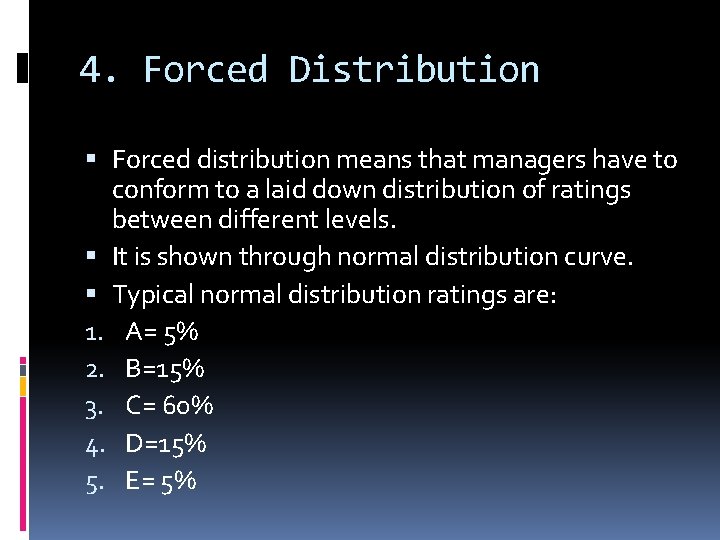
4. Forced Distribution Forced distribution means that managers have to conform to a laid down distribution of ratings between different levels. It is shown through normal distribution curve. Typical normal distribution ratings are: 1. A= 5% 2. B=15% 3. C= 60% 4. D=15% 5. E= 5%
5. Ranking Systems 1. Ranking 2. Alternative Ranking 3. Paired Comparisons
1. RANKING Employees are ranked from highest to lowest.
Alternative ranking A ranking approach in which the rater selects the best overall performer, writes his name on sheet of paper, and crosses the name off the list of ratees. Next, the rater selects the overall worst performer, transfers the name to the bottom of the sheet, and crosses off that name. From the remaining names rater chooses alternately the best & worst performers until all employees have been ranked.
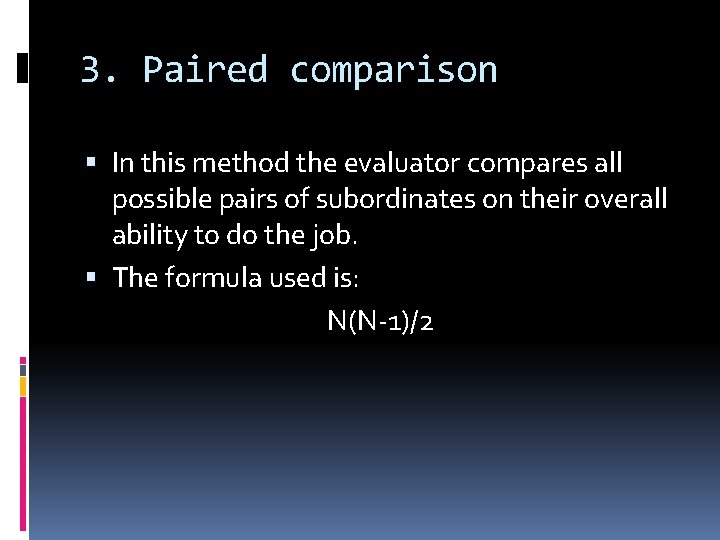
3. Paired comparison In this method the evaluator compares all possible pairs of subordinates on their overall ability to do the job. The formula used is: N(N-1)/2
Benefits of ranking methods 1. Easy to use 2. Intuitively appealing 3. Simple to explain to others
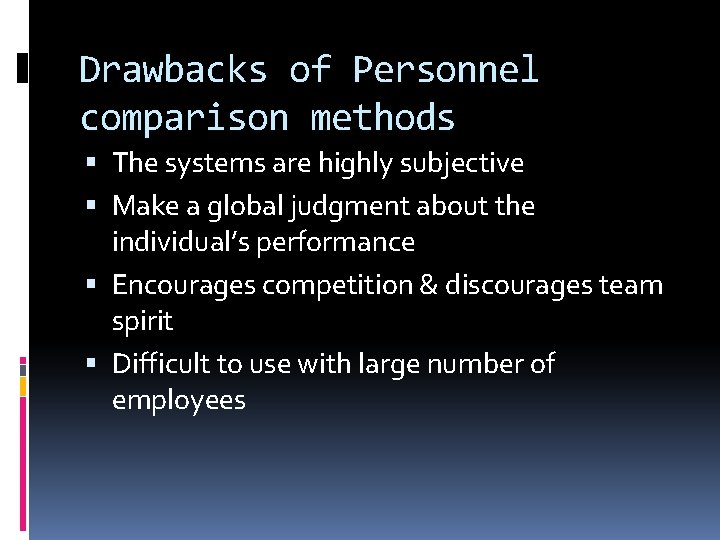
Drawbacks of Personnel comparison methods The systems are highly subjective Make a global judgment about the individual’s performance Encourages competition & discourages team spirit Difficult to use with large number of employees
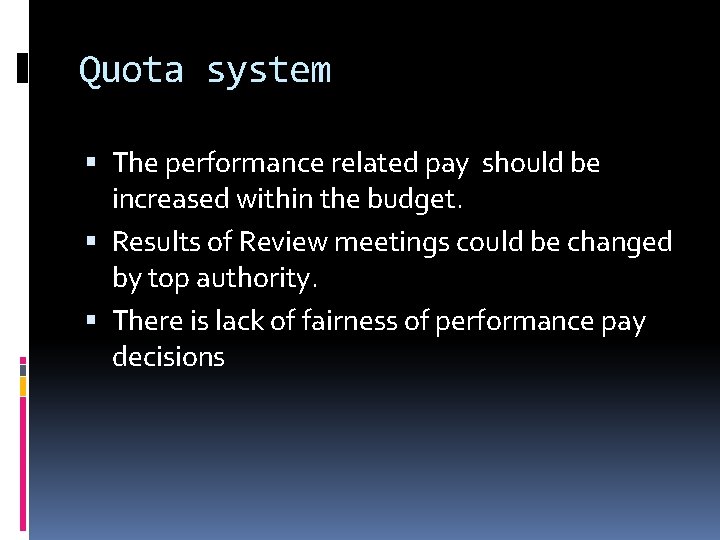
Quota system The performance related pay should be increased within the budget. Results of Review meetings could be changed by top authority. There is lack of fairness of performance pay decisions
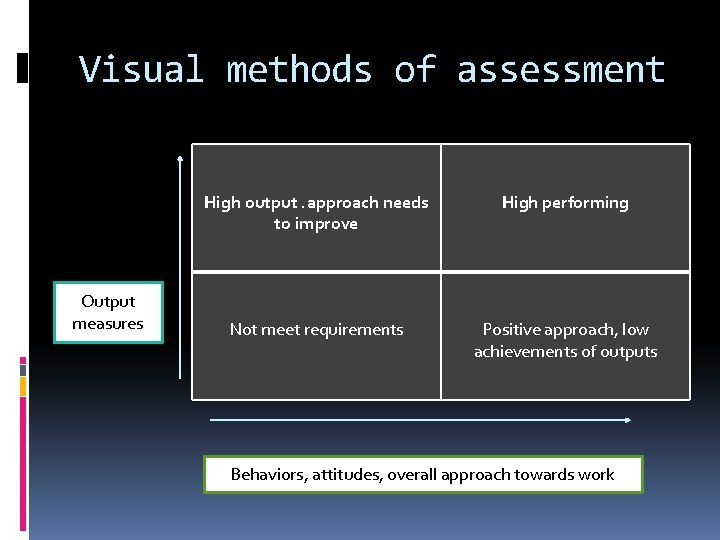
Visual methods of assessment Output measures High output. approach needs to improve High performing Not meet requirements Positive approach, low achievements of outputs Behaviors, attitudes, overall approach towards work
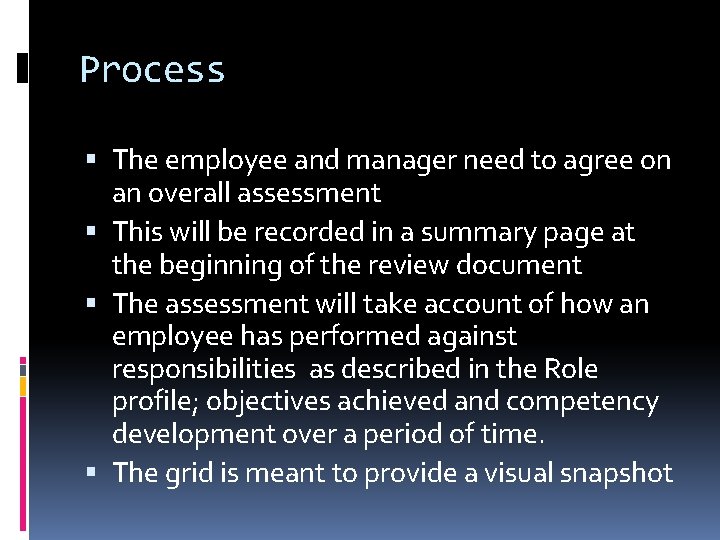
Process The employee and manager need to agree on an overall assessment This will be recorded in a summary page at the beginning of the review document The assessment will take account of how an employee has performed against responsibilities as described in the Role profile; objectives achieved and competency development over a period of time. The grid is meant to provide a visual snapshot
MANAGEMENT BY OBJECTIVES (MBO) It includes mutual objective setting and evaluation based on the attainment of the specific objectives
Benefit of using MBO It increases productivity Prerequisite for MBO Top management support
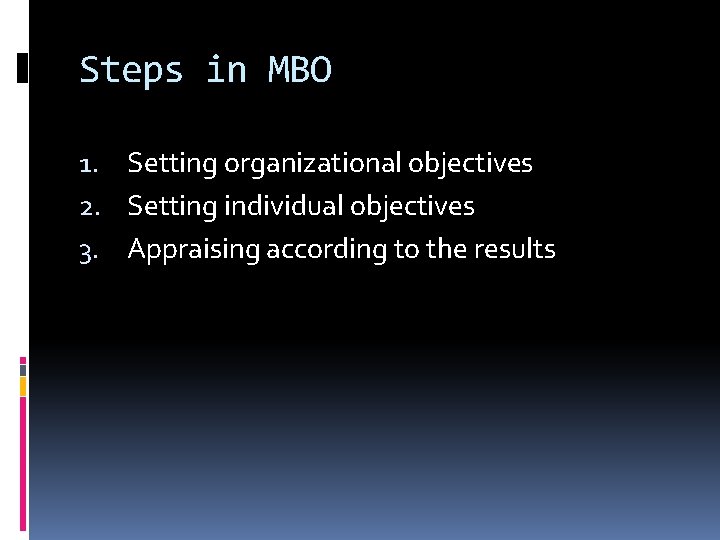
Steps in MBO 1. Setting organizational objectives 2. Setting individual objectives 3. Appraising according to the results
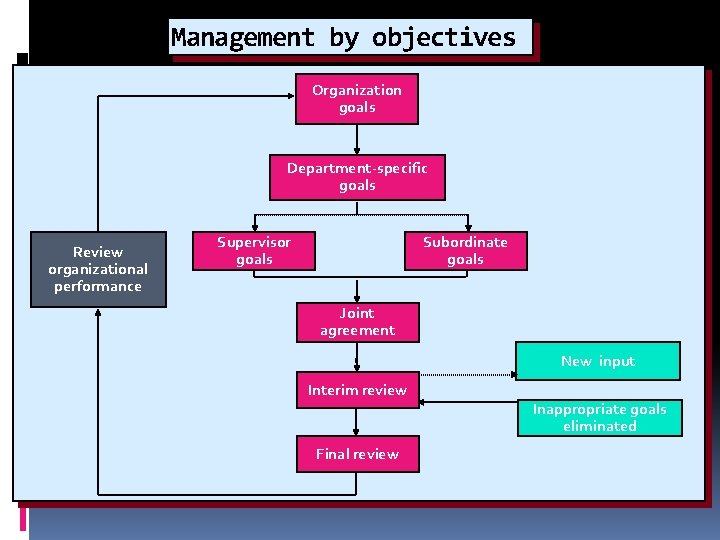
Management by objectives Organization goals Department-specific goals Review organizational performance Supervisor goals Subordinate goals Joint agreement New input Interim review Final review Inappropriate goals eliminated