
Assessing Online Learning Process Maturity the eLearning Maturity
- Slides: 21
Assessing Online Learning Process Maturity: the e-Learning Maturity Model Stephen Marshall, Victoria University of Wellington Ken Udas, Penn State World Campus Janet May, Penn State World Campus
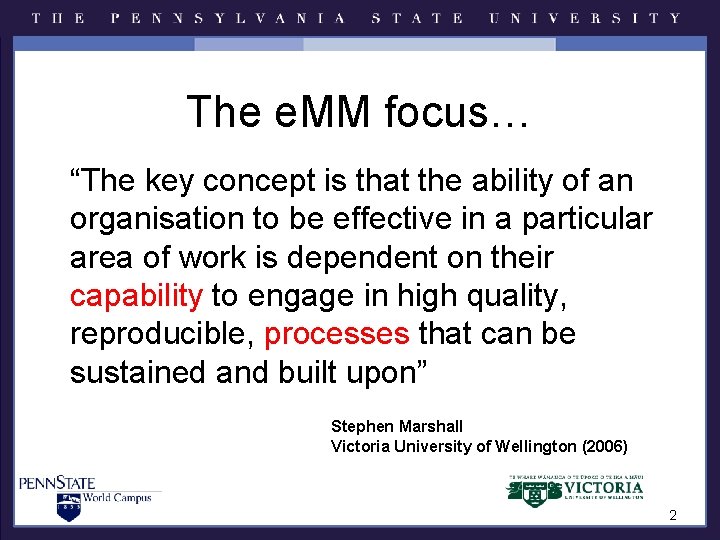
The e. MM focus… “The key concept is that the ability of an organisation to be effective in a particular area of work is dependent on their capability to engage in high quality, reproducible, processes that can be sustained and built upon” Stephen Marshall Victoria University of Wellington (2006) 2
How can the e. MM benefit Penn State World Campus? • Help us better understand our own organizational capacity for sustained success with online learning • Implement change based on that understanding • Benchmark with other Institutions 3
The e-Learning Maturity Model (e. MM) is… • A quality improvement tool that measures an institution’s ability to sustain online learning • Provides a set of key practices that can inform improvement activities 4
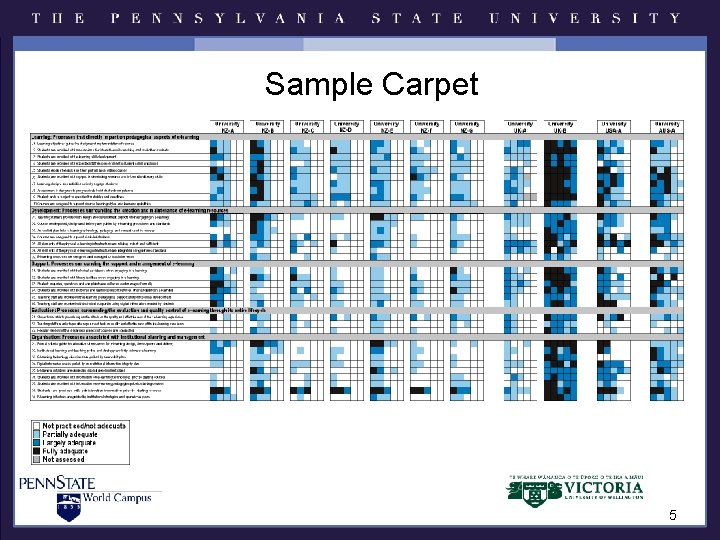
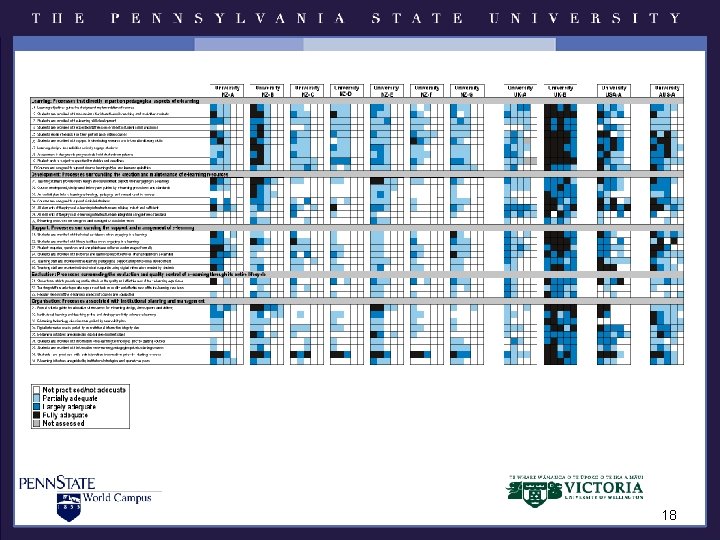
Sample Carpet 5
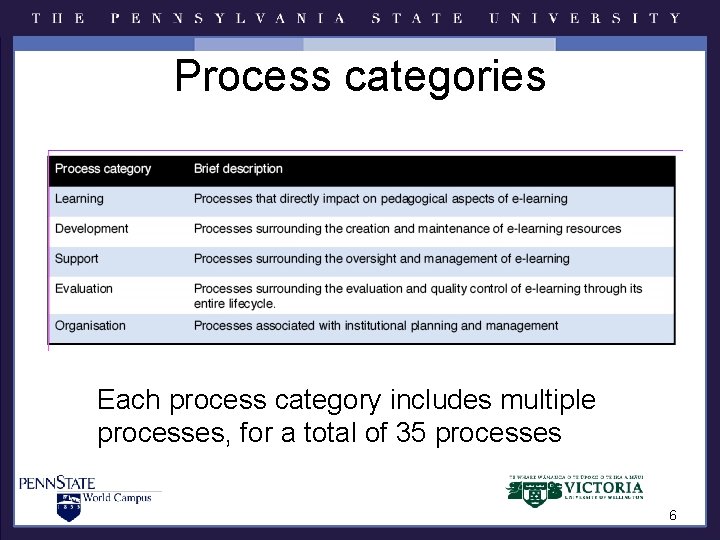
Process categories Each process category includes multiple processes, for a total of 35 processes 6
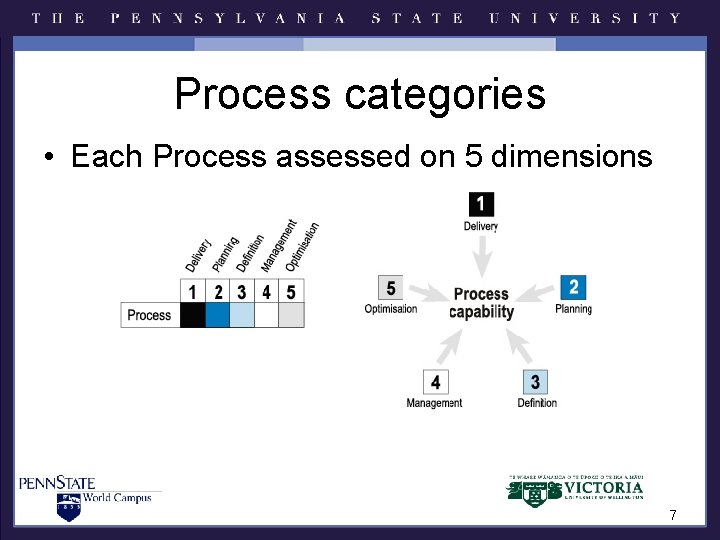
Process categories • Each Process assessed on 5 dimensions 7
e. MM dimensions 1 Delivery ~ creation and delivery of process outcomes • Assess the extent to which the process is seen to operate within the institution. • Without capability in other dimensions, at risk of failure or unsustainable delivery and wasting resources through needless duplication. 8
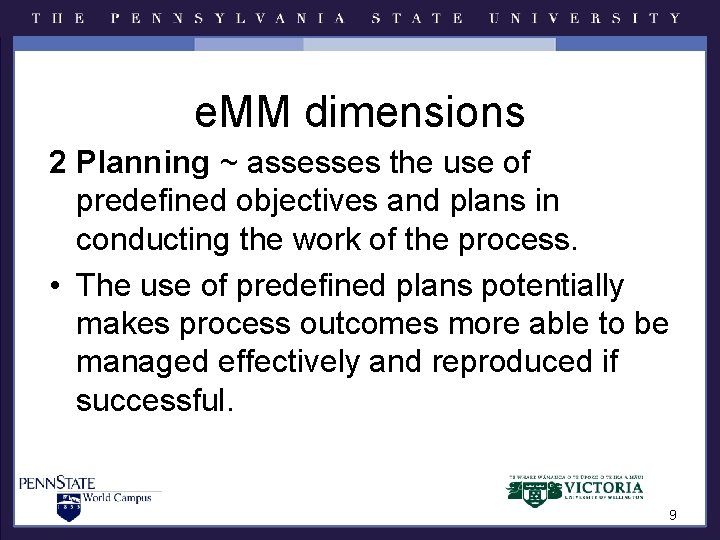
e. MM dimensions 2 Planning ~ assesses the use of predefined objectives and plans in conducting the work of the process. • The use of predefined plans potentially makes process outcomes more able to be managed effectively and reproduced if successful. 9
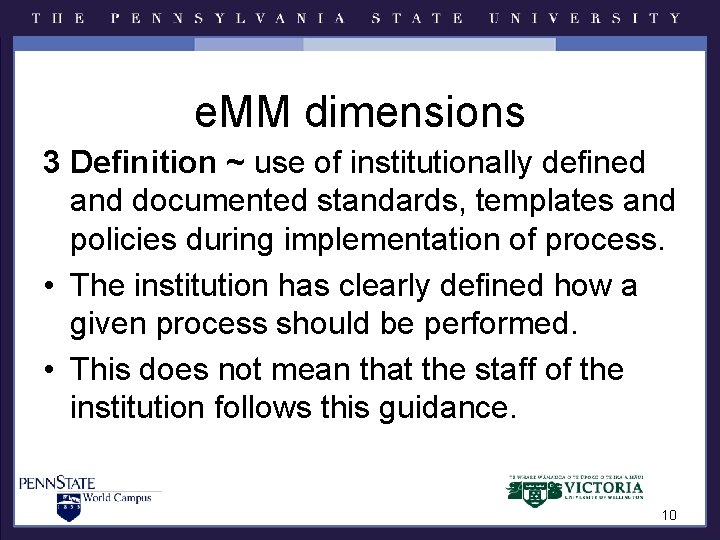
e. MM dimensions 3 Definition ~ use of institutionally defined and documented standards, templates and policies during implementation of process. • The institution has clearly defined how a given process should be performed. • This does not mean that the staff of the institution follows this guidance. 10
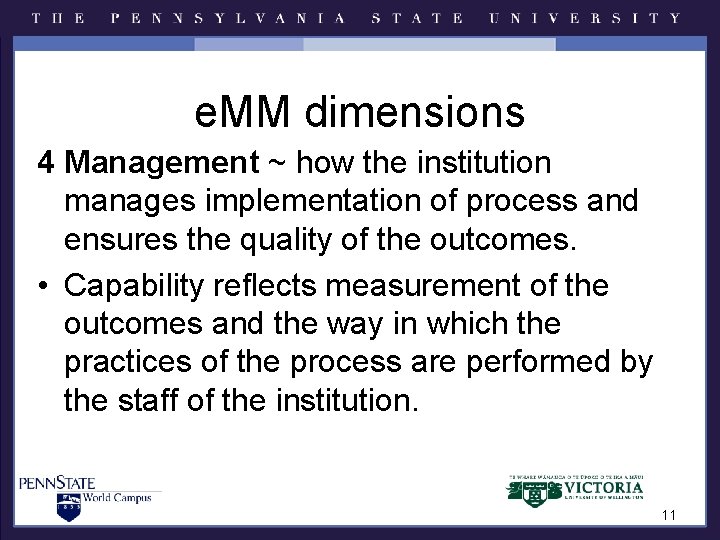
e. MM dimensions 4 Management ~ how the institution manages implementation of process and ensures the quality of the outcomes. • Capability reflects measurement of the outcomes and the way in which the practices of the process are performed by the staff of the institution. 11
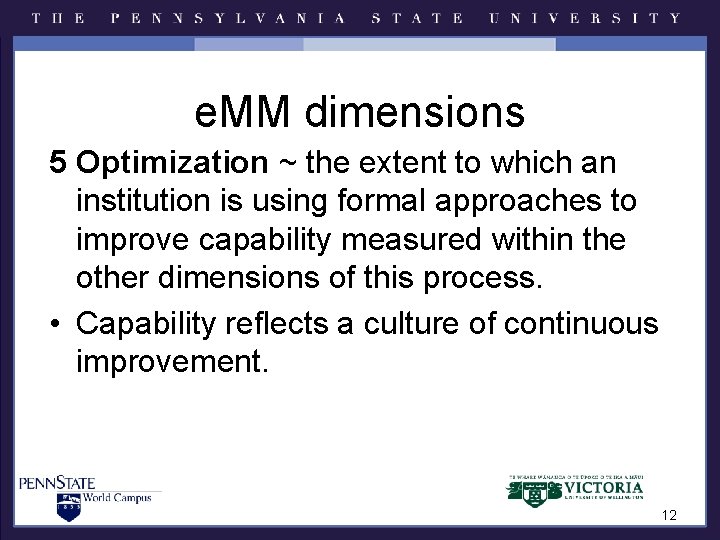
e. MM dimensions 5 Optimization ~ the extent to which an institution is using formal approaches to improve capability measured within the other dimensions of this process. • Capability reflects a culture of continuous improvement. 12
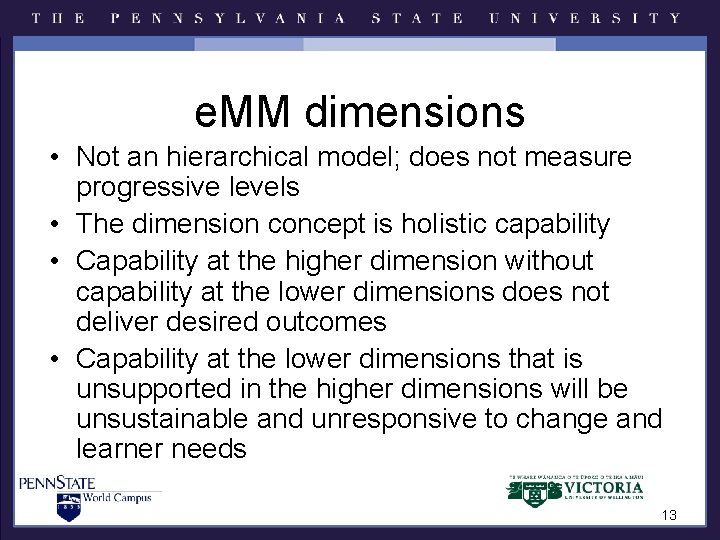
e. MM dimensions • Not an hierarchical model; does not measure progressive levels • The dimension concept is holistic capability • Capability at the higher dimension without capability at the lower dimensions does not deliver desired outcomes • Capability at the lower dimensions that is unsupported in the higher dimensions will be unsustainable and unresponsive to change and learner needs 13
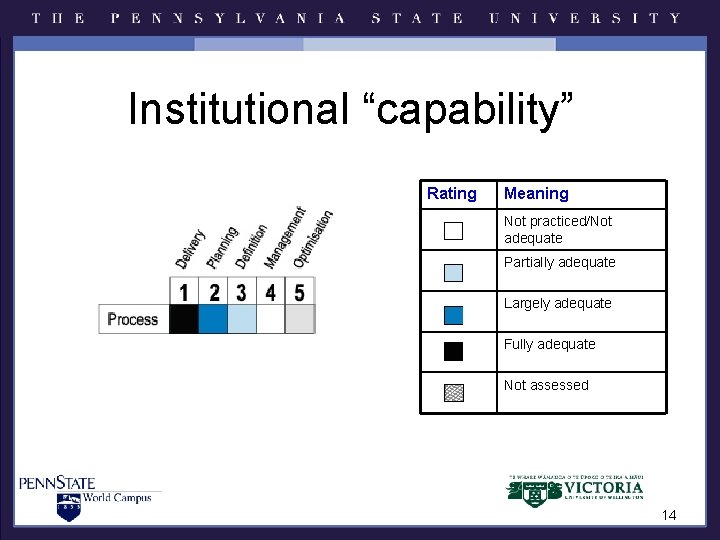
Institutional “capability” Rating Meaning Not practiced/Not adequate Partially adequate Largely adequate Fully adequate Not assessed 14
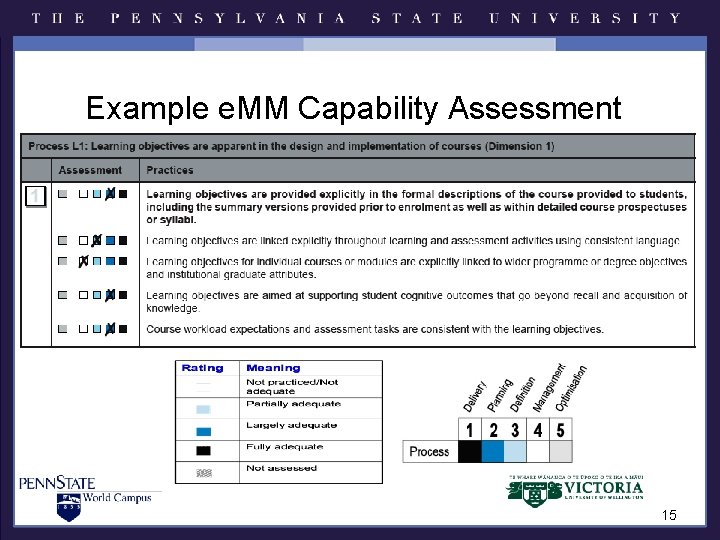
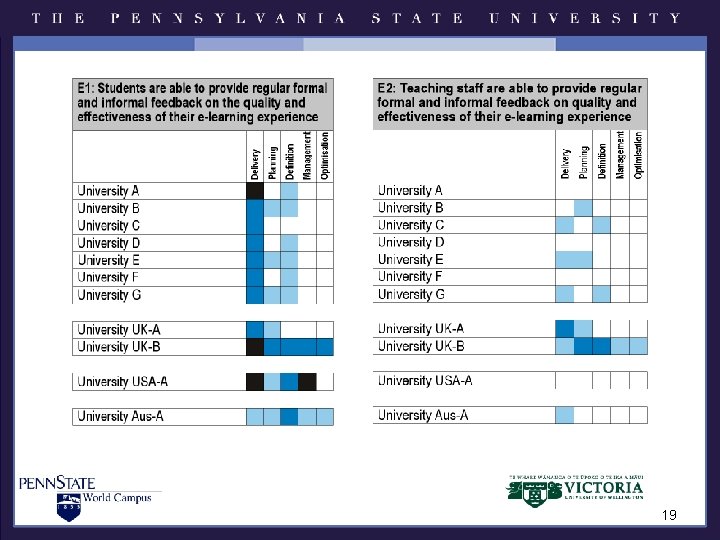
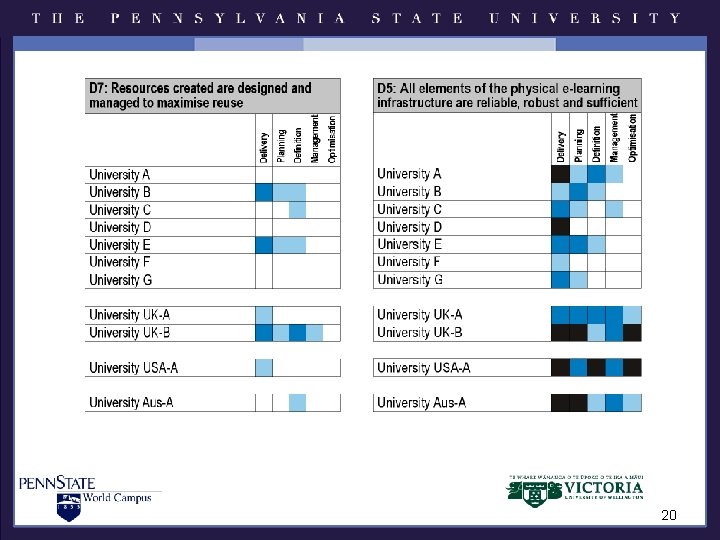
Example e. MM Capability Assessment 15
At Penn State World Campus… • Beginning an e. MM project… – Wanted a mature program, fully developed – Wanted a program that the World Campus had developed, rather than another unit at the University 16
At Penn State World Campus… Selected BS in Turfgrass Science • Working with lead faculty and instructional designer to assess our first course – Completed “round one” • One course initially. Goal is to examine up to a dozen courses, crossing programs. 17
18
19
20
For more information on e. MM… Please contact – Stephen Marshall at stephen. marshall@vuw. ac. nz – Ken Udas at keu 10@psu. edu – Janet May at jam 11@psu. edu Please visit the e. MM web site: – http: //www. utdc. vuw. ac. nz/research/emm/ 21