
Assessing nonEnglish Language Proficiency of Clinicians who Bypass
Assessing non-English Language Proficiency of Clinicians who Bypass Interpreters Lisa Diamond, MD, MPH, Assistant Attending Memorial Sloan-Kettering Cancer Center Immigrant Health and Cancer Disparities Service Department of Psychiatry & Behavioral Sciences/Department of Medicine 646 -888 -4246 Office diamondl@mskcc. org Funding: The California Endowment and NCI R 21 CA 168489
Acknowledgements Coauthors: • Sukyung Chung, Palo Alto Medical Foundation Research Institute (AHRQ K 01 HS 019815 and The California Endowment ) • Warren Ferguson, University of Massachusetts Medical Center • Elizabeth Jacobs, University of Wisconsin – Madison • Francesca Gany, MSKCC
Background • Clear communication between clinicians and patients is essential • Patient-clinician communication associated with patient satisfaction, adherence to physician recommendations, and health outcomes • Patients with LEP often experience poor patient -clinician communication
Background • Language concordance generally leads to better outcomes for LEP patients • Few studies of cancer screening show lower rates for LEP patients with language concordant providers • Few studies have systematically measured clinician language proficiency
Study Objective • To evaluate the accuracy of a structured self-assessment of non-English language proficiency compared to a validated oral proficiency interview for clinicians.
Project Setting • Palo Alto Medical Foundation (PAMF) >10% pts preferred language other than English (mainly Spanish, Mandarin, Cantonese) • Massachusetts Community Health Centers (MA CHC) >30% pts preferred language other than English (mainly Spanish, Portuguese, Vietnamese, French)
Recruitment • Clinicians with any level of proficiency in Spanish, Mandarin, Cantonese, French, Portuguese, Vietnamese • 16 PAMF, 51 MA CHC • Survey - self-reported language proficiency, demographics • Oral proficiency interview • Gift card
Self-Assessment Scale • Interagency Language Roundtable (ILR) Scale • Scale consists of 5 main levels with descriptive explanations of each • Adapted for the study to be used as a selfreporting tool to reflect language proficiency in medical situations

Adapted ILR Scale Excellent Very Good Fair Poor Speaks proficiently, equivalent to that of an educated speaker, and is skilled at incorporating appropriate medical terminology and concepts into communication. Has complete fluency in the language such that speech in all levels is fully accepted by educated native speakers in all its features, including breadth of vocabulary and idioms, colloquialisms, and pertinent cultural references. Able to use the language fluently and accurately on all levels related to work needs in a healthcare setting. Can understand participate in any conversation within the range of his/her experience with a high degree of fluency and precision of vocabulary. Unaffected by rate of speech. Language ability only rarely hinders him/her in performing any task requiring language; yet, the individual would seldom be perceived as a native. Able to speak the language with sufficient accuracy and vocabulary to have effective formal and informal conversations on most familiar topics. Although cultural references, proverbs and the implications of nuances and idiom may not be fully understood, the individual can easily repair the conversation. May have some difficulty communicating necessary health concepts. Meets basic conversational needs. Able to understand respond to simple questions. Can handle casual conversation about work, school, and family. Has difficulty with vocabulary and grammar. The individual can get the gist of most everyday conversations but has difficulty communicating about healthcare concepts. Satisfies elementary needs and minimum courtesy requirements. Able to understand respond to 2 -3 word entry level questions. May require slow speech and repetition to understand. Unable to understand or communicate most healthcare concepts.
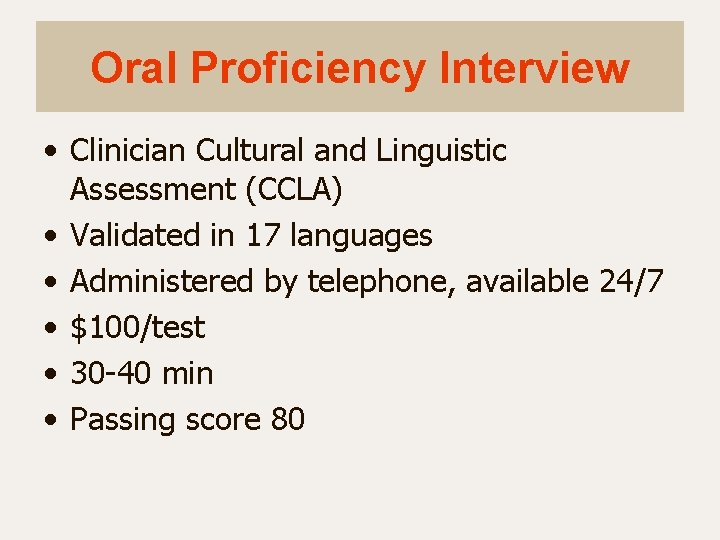
Oral Proficiency Interview • Clinician Cultural and Linguistic Assessment (CCLA) • Validated in 17 languages • Administered by telephone, available 24/7 • $100/test • 30 -40 min • Passing score 80
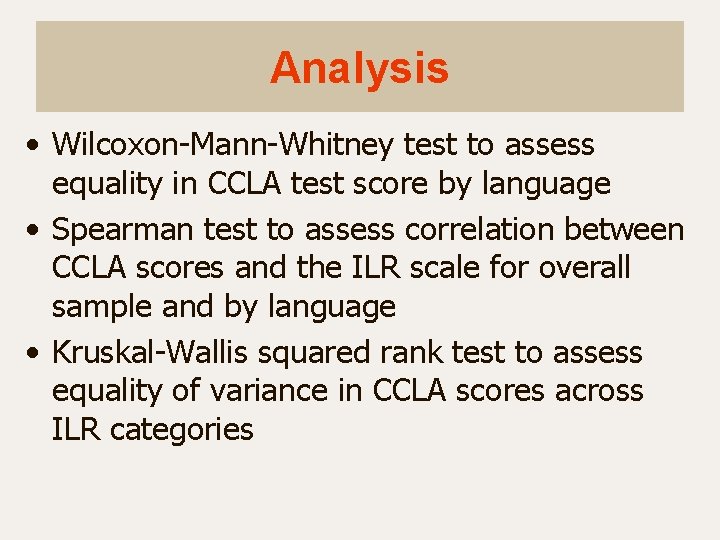
Analysis • Wilcoxon-Mann-Whitney test to assess equality in CCLA test score by language • Spearman test to assess correlation between CCLA scores and the ILR scale for overall sample and by language • Kruskal-Wallis squared rank test to assess equality of variance in CCLA scores across ILR categories
Results
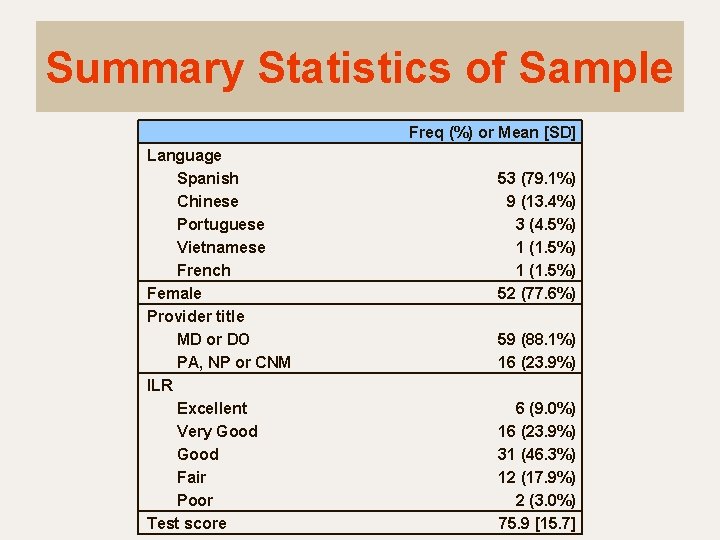
Summary Statistics of Sample Freq (%) or Mean [SD] Language Spanish Chinese Portuguese Vietnamese French Female Provider title MD or DO PA, NP or CNM ILR Excellent Very Good Fair Poor Test score 53 (79. 1%) 9 (13. 4%) 3 (4. 5%) 1 (1. 5%) 52 (77. 6%) 59 (88. 1%) 16 (23. 9%) 6 (9. 0%) 16 (23. 9%) 31 (46. 3%) 12 (17. 9%) 2 (3. 0%) 75. 9 [15. 7]
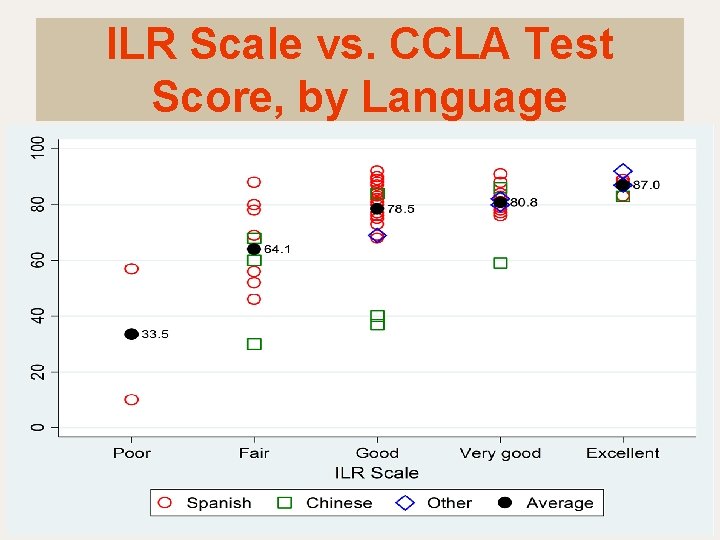
ILR Scale vs. CCLA Test Score, by Language
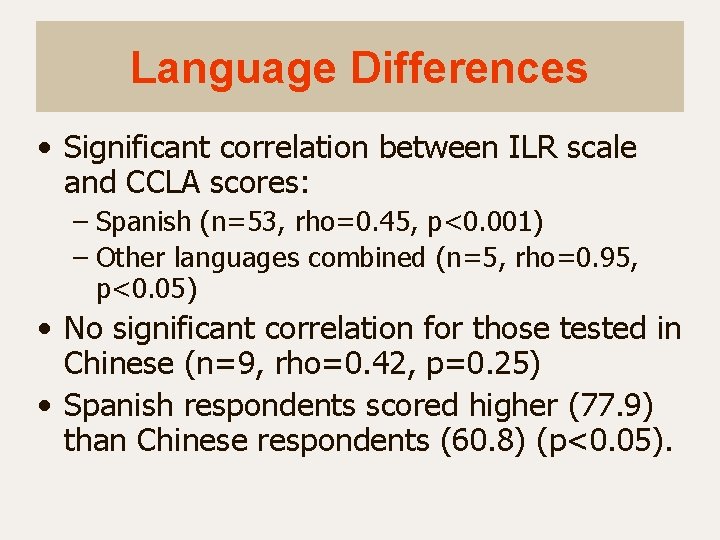
Language Differences • Significant correlation between ILR scale and CCLA scores: – Spanish (n=53, rho=0. 45, p<0. 001) – Other languages combined (n=5, rho=0. 95, p<0. 05) • No significant correlation for those tested in Chinese (n=9, rho=0. 42, p=0. 25) • Spanish respondents scored higher (77. 9) than Chinese respondents (60. 8) (p<0. 05).

Limitations • • • Small sample Focused on language proficiency only Two settings with different populations ILR scale not usually self-administered ILR adapted for this study to address clinician-patient interactions • Unable to assess relationship between clinician non-English language proficiency and quality of care
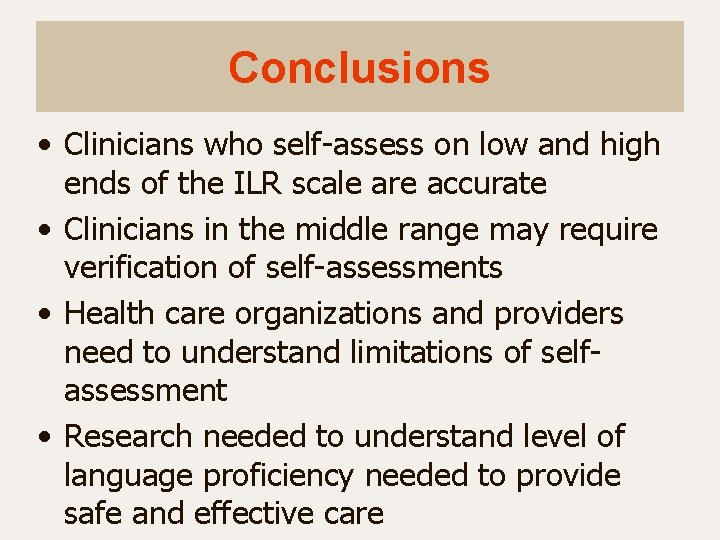
Conclusions • Clinicians who self-assess on low and high ends of the ILR scale are accurate • Clinicians in the middle range may require verification of self-assessments • Health care organizations and providers need to understand limitations of selfassessment • Research needed to understand level of language proficiency needed to provide safe and effective care
References • • • • Institute of Medicine. Crossing the Quality Chasm: A New Health System for the 21 st Century. The National Academies Press, Committee on Quality of Health Care in America; 2001. Stewart M, Brown JB, Boon H, Galajda J, Meredith L, Sangster M. Evidence on patient-doctor communication. Cancer Prevention & Control. Feb 1999; 3(1): 25 -30. Institute of Medicine. Committee on Understanding and Eliminating Racial and Ethnic Disparities in Health Care. Unequal Treatment: Confronting Racial and Ethnic Disparities in Health Care. Washington, DC: National Academies Press; 2003. Lauderdale DS, Wen M, Jacobs EA, Kandula NR. Immigrant perceptions of discrimination in health care: the California Health Interview Survey 2003. Medical care. Oct 2006; 44(10): 914 -920. Wisnivesky JP, Kattan M, Evans D, et al. Assessing the relationship between language proficiency and asthma morbidity among innercity asthmatics. Medical care. Feb 2009; 47(2): 243 -249. Green AR, Ngo-Metzger Q, Legedza AT, Massagli MP, Phillips RS, Iezzoni LI. Interpreter services, language concordance, and health care quality. Experiences of Asian Americans with limited English proficiency. Journal of general internal medicine. 2005; 20(11): 10501056. Ngo-Metzger Q, Sorkin D, Phillips R, et al. Providing High-Quality Care for Limited English Proficient Patients: The Importance of Language Concordance and Interpreter Use. Journal of general internal medicine. 2007; 22(Suppl 2): 324 -330. Manson A. Language Concordance as a Determinant of Patient Compliance and Emergency Room Use in Patients with Asthma. Medical care. 1988; 26(12): 1119 -1128. Baker DW, Parker RM, Williams MV, Coates WC, Pitkin K. Use and effectiveness of interpreters in an emergency department. JAMA : the journal of the American Medical Association. Mar 13 1996; 275(10): 783 -788. Fernandez A, Schillinger D, Grumbach K, et al. Physician language ability and cultural competence. An exploratory study of communication with Spanish-speaking patients. Journal of general internal medicine. Feb 2004; 19(2): 167 -174. Eamranond PP, Davis RB, Phillips RS, Wee CC. Patient-Physician Language Concordance and Lifestyle Counseling Among Spanish. Speaking Patients Journal of Immigrant and Minority Health 2009; 11(6): 494 -498. Carter-Pokras O, O'Neill MJ, Cheanvechai V, et al. Providing linguistically appropriate services to persons with limited English proficiency: a needs and resources investigation. American Journal of Managed Care. Sep 2004; 10 Spec No: SP 29 -36. Jacobs E, Sadowski L, Rathouz P. The impact of an enhanced interpreter service intervention on hospital costs and patient satisfaction. Journal of general internal medicine. November 2007; 22(Suppl 2): 306 -311. Eamranond PP. Patient-physician language concordance and primary care screening among Spanish-speaking patients. Medical care. 2011; 49(7): 668 -672.
References • • • • Jo A, Maxwell A, Wong W, Bastani R. Colorectal cancer screening among underserved Korean Americans in Los Angeles County. Journal of Immigrant and Minority Health. 2008; 10(2): 119 -126. Linsky A. Patient-provider language concordance and colorectal cancer screening. Journal of general internal medicine. 2011; 26(2): 142147. Diamond LC, Luft HS, Chung S, Jacobs EA. “Does this Doctor Speak My Language? ” Improving the Characterization of Physician non. English Language Skills. Health services research. 2011; In press. Diamond LC, Reuland DS. Describing Physician Language Fluency: Deconstructing Medical Spanish. JAMA : the journal of the American Medical Association. 2009; 301(4): 426 -428. Diamond LC, Tuot DS, Karliner LS. The Use of Spanish Language Skills by Physicians and Nurses: Policy Implications for Teaching and Testing. Journal of general internal medicine. 2011; e. Pub ahead of print, DOI 10. 1007/s 11606 -011 -1779 -5. Tuot DS, Lopez M, Miller C, Karliner LS. Impact of an easy-access telephonic interpreter program in the acute care setting: an evaluation of a quality improvement intervention. Joint Commission journal on quality and patient safety / Joint Commission Resources. Feb 2012; 38(2): 81 -88. Better Communication, Better Care: Provider Tools to Care for Diverse Populations. 2010; http: //www. iceforhealth. org/library/documents/ICE_C&L_Provider_Toolkit_7. 10. pdf. Accessed January 5, 2012. Reuland D, Frasier P, Olson M, Slatt L, Aleman M, Fernandez A. Accuracy of Self-assessed Spanish Fluency in Medical Students. Teaching and Learning in Medicine. 2009; 21(4): 305 -309. Tidwell L. Kaiser Permanente-Southern California Physicians Language Concordance Program: Meeting the Needs of LEP Patients. Health Care Interpreter Network: From Ad-Hoc to Best Practices in Healthcare Interpreting; July 16 -17, 2009; Oakland, CA Moreno M, Otero-Sabogal R, Newman J. Assessing dual-role staff-interpreter linguistic competency in an integrated healthcare system. Journal of general internal medicine. 2007; 22(Suppl 2): 331 -335. Language Testing Options. 2008; http: //www. hablamosjuntos. org/resourcecenter/pdf/Language_Testing_Options. pdf. Accessed November 19, 2012. Tang G, Lanza O, Rodriguez F, Chang A. The Kaiser Permanente Clinician Cultural and Linguistic Assessment Initiative: research and development in patient-provider language concordance. American Journal of Public Health. 2011; 101(2): 205 -208. US Census Bureau: Profiles of General Demographic Characteristics, 2000 Census of Population and Housing. 2001; http: //www. census. gov/prod/cen 2000/dp 1/2 khus. pdf. Accessed May 20, 2008. Employment Tests and Selection Procedures. 2008; http: //www. eeoc. gov/policy/docs/factemployment_procedures. html. Accessed July 15, 2009. Conover WJ. Practical Nonparametric Statistics. 3 rd ed: Wiley; 1999.

- Slides: 20