
Assessing measurement invariance in crosscultural research Hans Baumgartner

Assessing measurement invariance in cross-cultural research Hans Baumgartner Penn State University
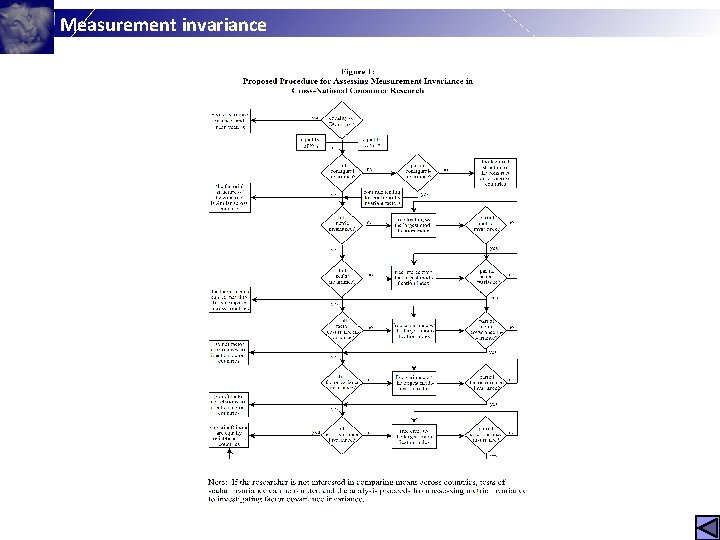
Measurement invariance Jan-Benedict E. M. Steenkamp and Hans Baumgartner, “Assessing Measurement Invariance in Cross. National Consumer Research, ” Journal of Consumer Research, 25 (June), 78 -90.
Measurement invariance Key points § Types of invariance: configural □ metric □ scalar □ § Degree of invariance full □ partial □ § The type of invariance required depends on the goal of the research: comparison of relationships between constructs □ comparison of factor means □
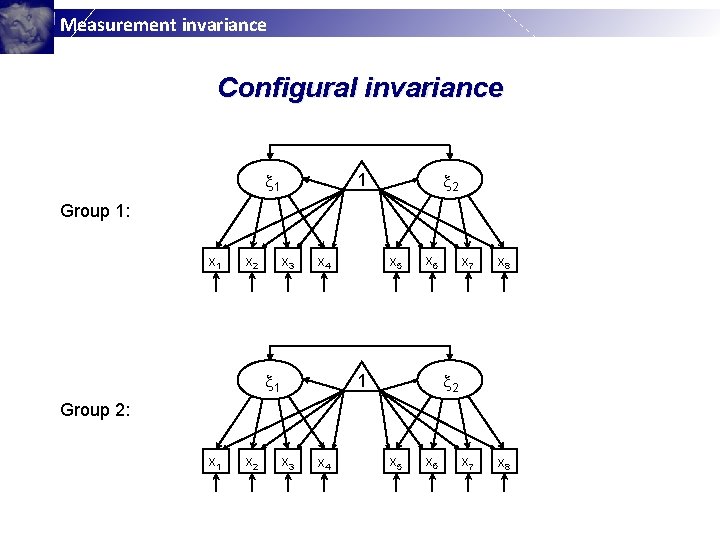
Measurement invariance Configural invariance 1 2 1 Group 1: x 1 x 2 x 3 x 5 x 4 1 x 6 x 7 x 8 2 1 Group 2: x 1 x 2 x 3 x 4 x 5 x 6
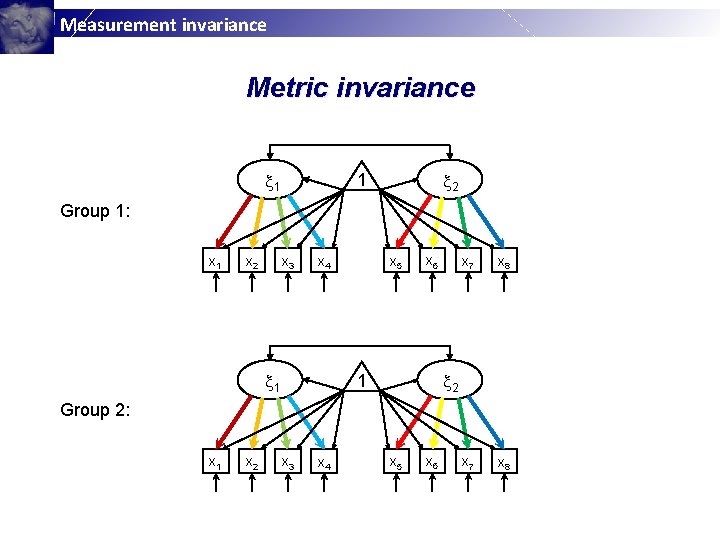
Measurement invariance Metric invariance 1 2 1 Group 1: x 1 x 2 x 3 x 5 x 4 1 x 6 x 7 x 8 2 1 Group 2: x 1 x 2 x 3 x 4 x 5 x 6
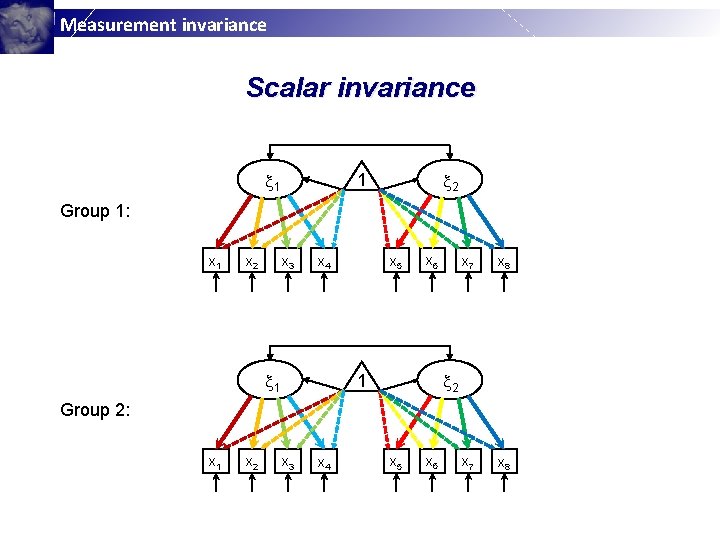
Measurement invariance Scalar invariance 1 2 1 Group 1: x 1 x 2 x 3 x 5 x 4 1 x 6 x 7 x 8 2 1 Group 2: x 1 x 2 x 3 x 4 x 5 x 6
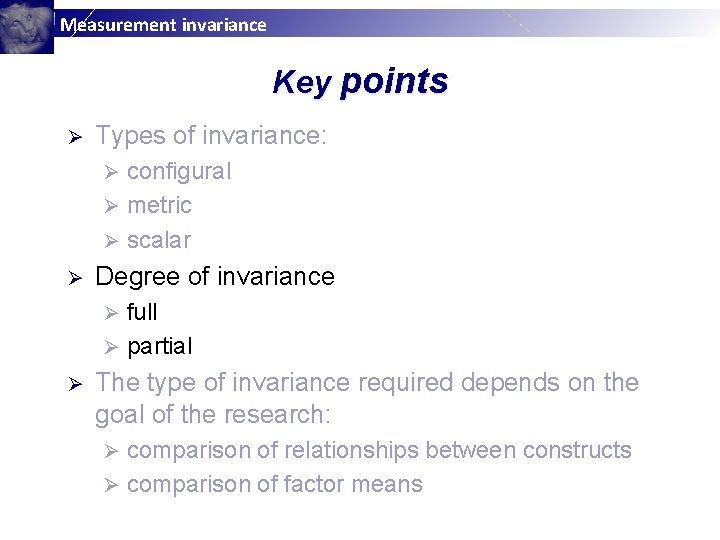
Measurement invariance Key points Ø Types of invariance: configural Ø metric Ø scalar Ø Ø Degree of invariance full Ø partial Ø Ø The type of invariance required depends on the goal of the research: comparison of relationships between constructs Ø comparison of factor means Ø
Measurement invariance Partial measurement invariance § § for identification purposes, one item per factor has to have invariant loadings and intercepts (marker item); the marker item has to be chosen carefully; at least one other invariance constraint on the loadings/ intercepts is necessary to ascertain whether the marker item satisfies metric/scalar invariance;
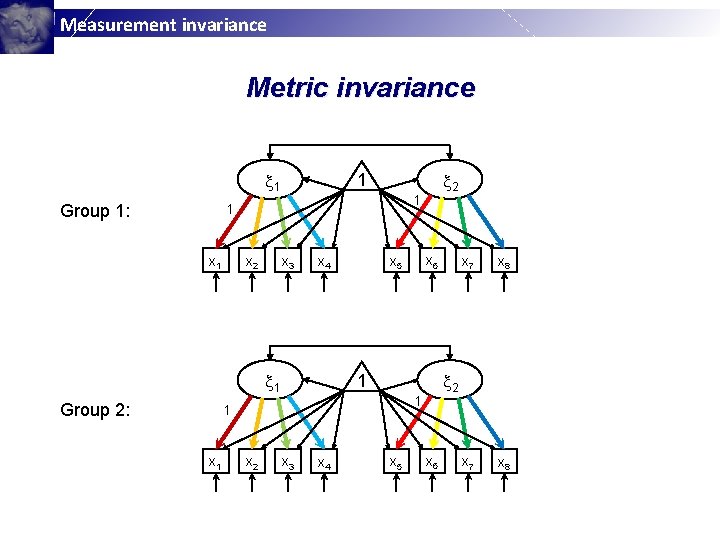
Measurement invariance Metric invariance 1 Group 1: 1 1 x 2 x 3 x 2 1 x 3 x 4 x 5 x 7 x 8 2 1 1 x 6 x 5 x 4 1 Group 2: 2 1 x 6
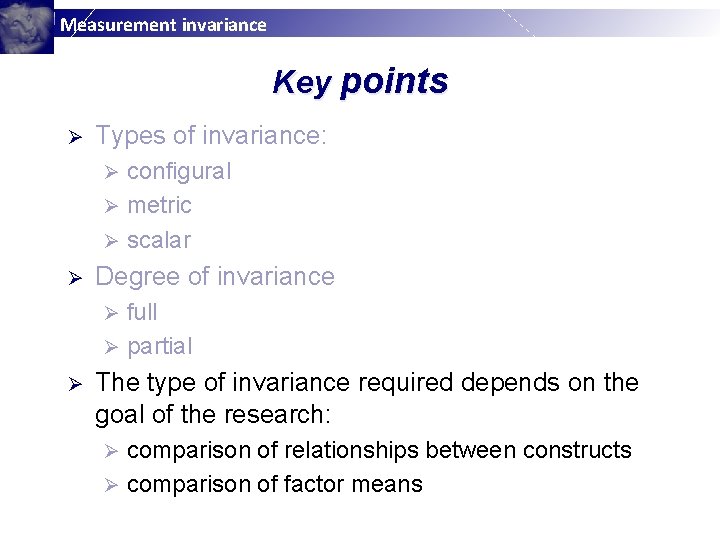
Measurement invariance Key points Ø Types of invariance: configural Ø metric Ø scalar Ø Ø Degree of invariance full Ø partial Ø Ø The type of invariance required depends on the goal of the research: comparison of relationships between constructs Ø comparison of factor means Ø
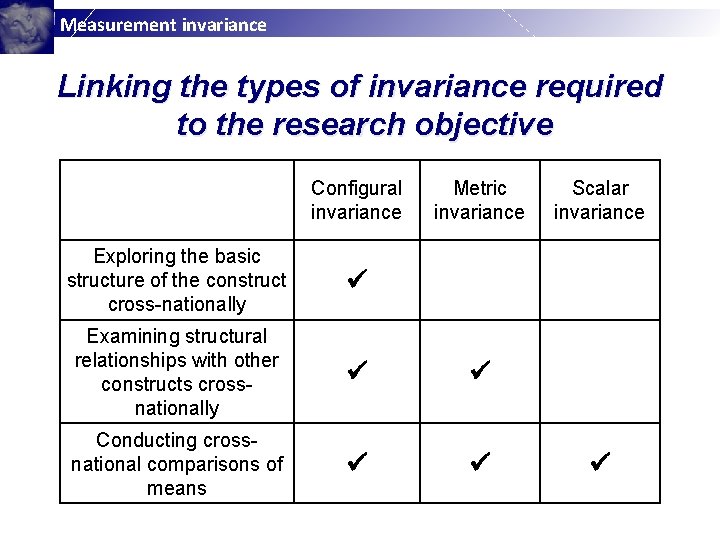
Measurement invariance Linking the types of invariance required to the research objective Configural invariance Metric invariance Exploring the basic structure of the construct cross-nationally Examining structural relationships with other constructs crossnationally Conducting crossnational comparisons of means Scalar invariance
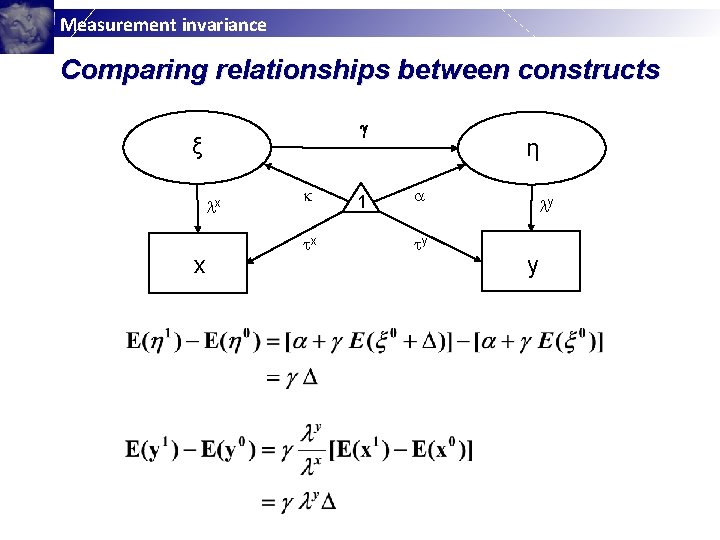
Measurement invariance Comparing relationships between constructs ξ x x x 1 η y y y
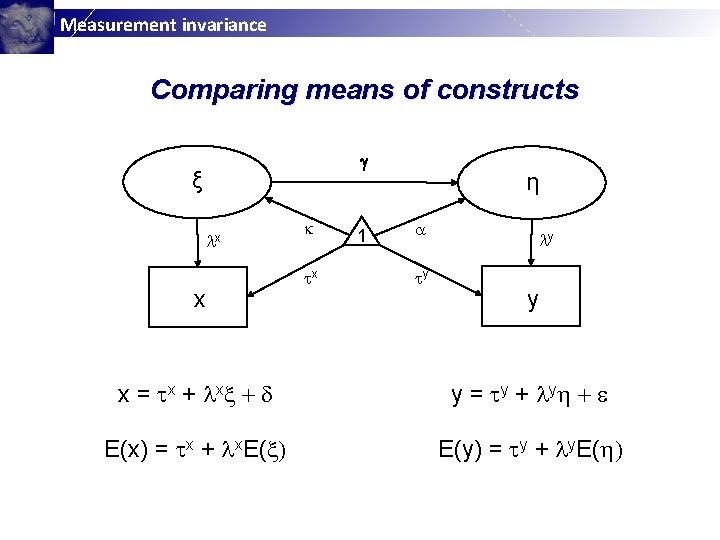
Measurement invariance Comparing means of constructs ξ x x x 1 η y y y x = x + y = y + yh + e E(x) = x + x. E( ) E(y) = y + y. E(h)
Measurement invariance He, Merz, and Alden (2008) § content analysis of 243 cross-nationally focused, empirical marketing articles published between 2000 and 2005 in 15 peer-reviewed journals; § 67 articles (28%) reported assessing MI (in 82% of cases based on CFA); § for 41 articles (17% of the total) the type of MI assessed was consistent with the goal of the study; § assessment of MI was less likely if more countries were involved in the study and if single-item measures were used;
Measurement invariance He, Merz, and Alden (cont’d) § in a follow-up study, 86 authors indicated the following: q self-reported knowledge of MI assessment was relatively low (4. 51 on 7 -point scale); q MI assessment was not viewed as particularly important (4. 12) [although positive correlation with knowledge]; q MI assessment was not reported because o the data were not conducive to it was not viewed as necessary o familiarity with the method was insufficient
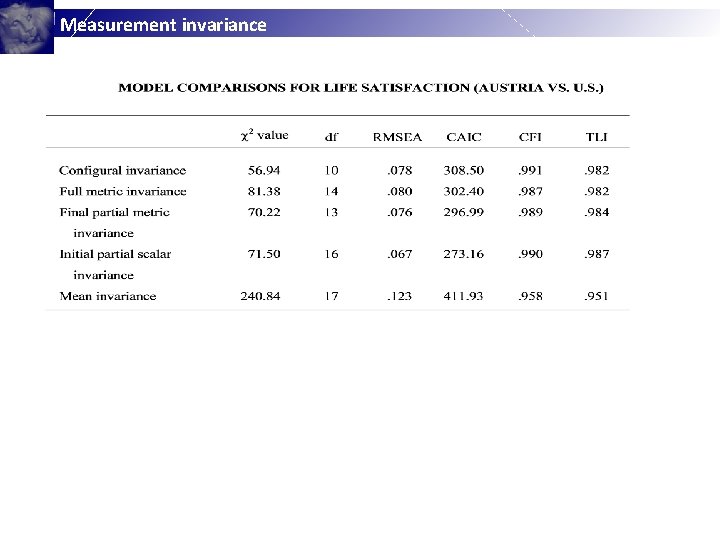
Measurement invariance Life satisfaction in Austria and the US § 393 Austrian and 1181 U. S. respondents completed the Satisfaction with Life Scale (SWLS; Diener et al. 1985), which is a well-known instrument used to assess the cognitive component of subjective well-being. The scale consists of the following five items: q q q In most ways my life is close to my ideal. The conditions of my life are excellent. I am satisfied with my life. So far I have gotten the important things I want in life. If I could live my life over, I would change almost nothing. § Respondents indicated their agreement or disagreement with these statements using the following five-point scale: 1 = strongly disagree, 2 = disagree, 3 = neither agree nor disagree, 4 = agree, and 5 = strongly agree. § Perform an analysis of measurement invariance on the SWLS and test whether Austrian or American respondents are more satisfied with their lives (if possible).
Measurement invariance
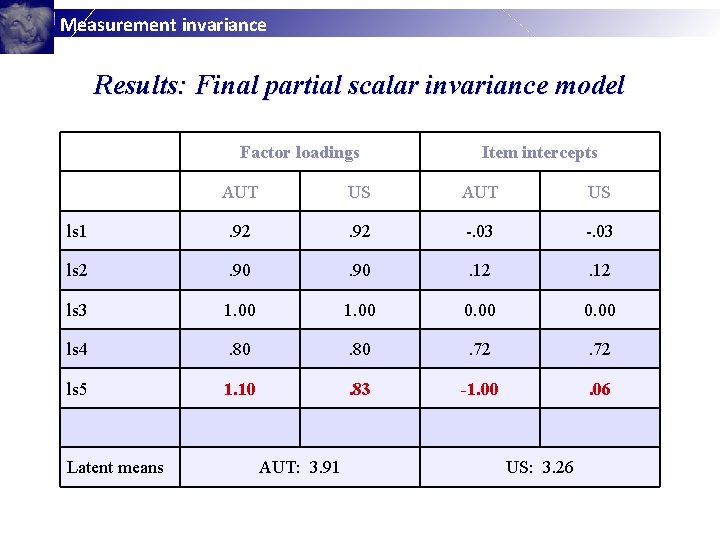
Measurement invariance Results: Final partial scalar invariance model Factor loadings Item intercepts AUT US ls 1 . 92 -. 03 ls 2 . 90 . 12 ls 3 1. 00 0. 00 ls 4 . 80 . 72 ls 5 1. 10 . 83 -1. 00 . 06 Latent means AUT: 3. 91 US: 3. 26
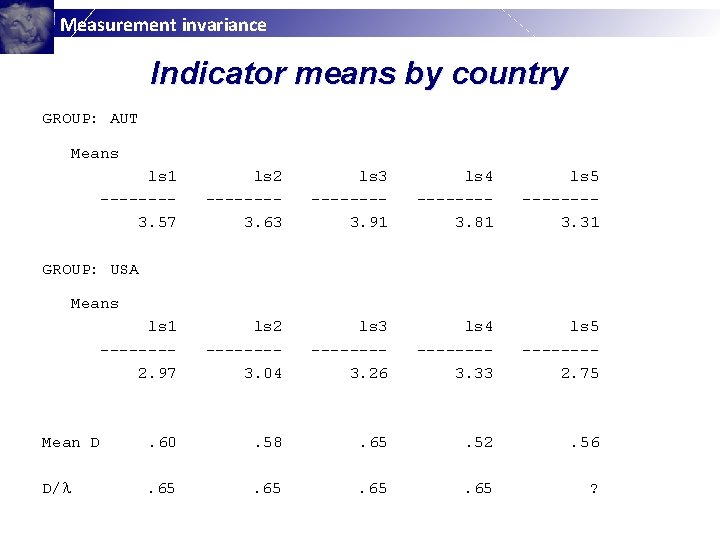
Measurement invariance Indicator means by country GROUP: AUT Means ls 1 -------3. 57 ls 2 -------3. 63 ls 3 -------3. 91 ls 4 -------3. 81 ls 5 -------3. 31 ls 2 -------3. 04 ls 3 -------3. 26 ls 4 -------3. 33 ls 5 -------2. 75 GROUP: USA Means ls 1 -------2. 97 Mean D . 60 . 58 . 65 . 52 . 56 D/ . 65 ?
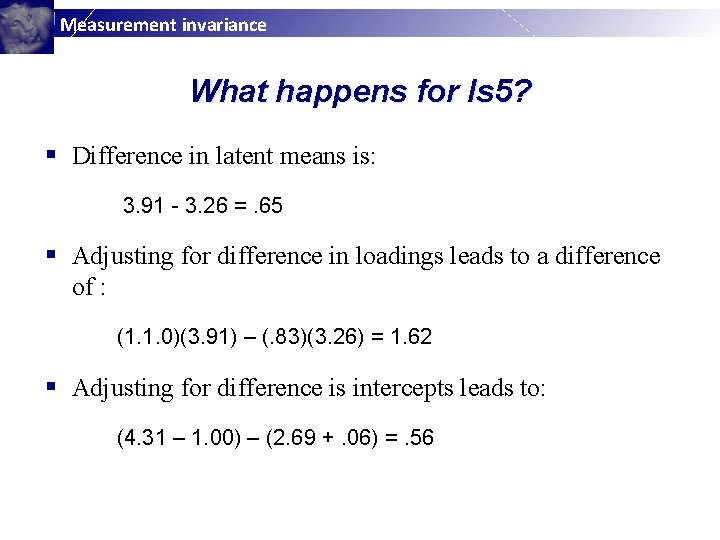
Measurement invariance What happens for ls 5? § Difference in latent means is: 3. 91 - 3. 26 =. 65 § Adjusting for difference in loadings leads to a difference of : (1. 1. 0)(3. 91) – (. 83)(3. 26) = 1. 62 § Adjusting for difference is intercepts leads to: (4. 31 – 1. 00) – (2. 69 +. 06) =. 56
Measurement invariance
- Slides: 21