
Assessing evidence Understand what is meant by evidence
Assessing evidence § Understand what is meant by evidence § Understand the purpose of evidence in reasoning § Identify different forms of evidence § Understand the purpose of numerical data and statististical representation in argument § Identify where further clarification of evidence is needed
§ Fact: Information that can be verified and that is held to be true. We treat factual claims as true but our acceptance of their truth is suspended until we check the facts. e. g. Ahmad’s old car is dangerously rusty and it breaks down almost every day. He has got a wellpaid summer job at the local solicitor’s office. Ahmad should get a new car. All three reasons are facts, we can check if they are correct or not. § Now go back to your handout and do activity 2.
§ Evidence: Something that is used to develop or support a reason. It is often in the form of statististical/ numerical data, an example, an estimate, personal observation, a statement from a source or witness, or a factual claim.
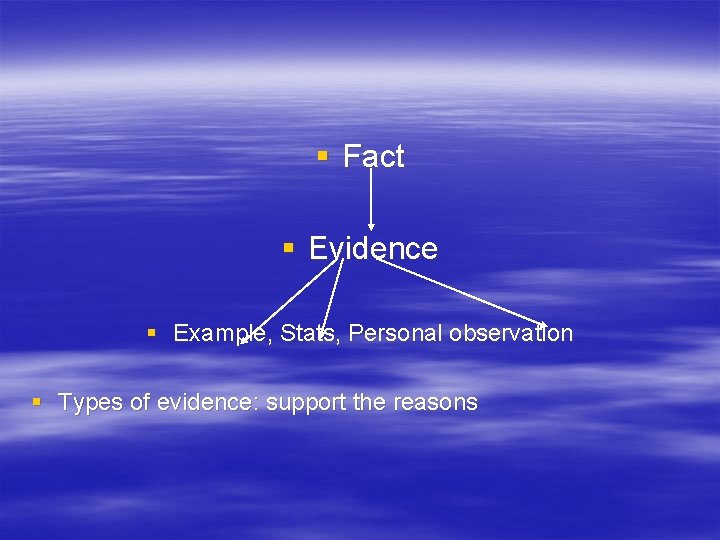
§ Fact § Evidence § Example, Stats, Personal observation § Types of evidence: support the reasons
In groups do activity 3. You have five minutes § A. The examples strengthen the reason by providing an image to develop it. The example does not count as part of the reason. Identifying reason means leaving out examples and even re-wording it. Fruit that can be grown in the UK has many advantages. B. The author illustrates a general idea through a more developed example. § Activity 4: Work individually (5 mins)
Evaluating evidence. § In the exam you might be asked to evaluate evidence presented in different forms (surveys or research data, percentages, proportions, averages). § Can you think of any situations in which you may use (evoke) surveys to establish a point or make a decision or persuade someone to do something? § What problems might there be in using a sample to find out about students’ opinions of the college where they study? (Classroom discussion)
Activity 5 (5 mins in groups) § Who funded the research? A specialist university department or a company that sells learning packs designed for parents to use with their children? § How many children were sampled? 2, 2000? § Were the day care centres in similar social areas to the children who were observed at home? § How well educated were the parents and the day acre staff? § Answers to the questions could show that the sample was unrepresentative.
Percentages and proportions § Percentages can be a valuable tool for representing data. The results of research surveys are often presented as percentages. However they can be presented in ways that are misleading. § Do activity 6 100% privacy, do similar services provide only 75% privacy? The 100% privacy offered by Celesta is not a useful example.
Consider the following: § Gleam washing-up liquid is 50% more effective. § What do we need to ask here? § Answer: More effective than what? § Do activity 7 individually. You have 5 mins.
The average or mean § How is the word average used in these examples? In recent school tests of 11 year olds, 49% of children failed to reach the average level for their age group. § The average amount spent on lottery tickets is about £ 3 a week. This represents only 0. 65% of the average income in Britain. Such a small amount completely undermines the idea that expenditure on the lottery is at the expense of more important and essential items such as nutritious food.
What do you need to know when you are assessing evidence § Meaningful – if we know how to evaluate it (geographical, historical, standard) § Relevant- from the argument, the context § Representative: who was asked § Reliable: source Pass rate for a course is 75%. Is this meaningful? Geographical: What is the pass rate for other courses in the same year? Historical: What was the pass are for the same course in previous years? Standard: What is the standard for a good pass rate?
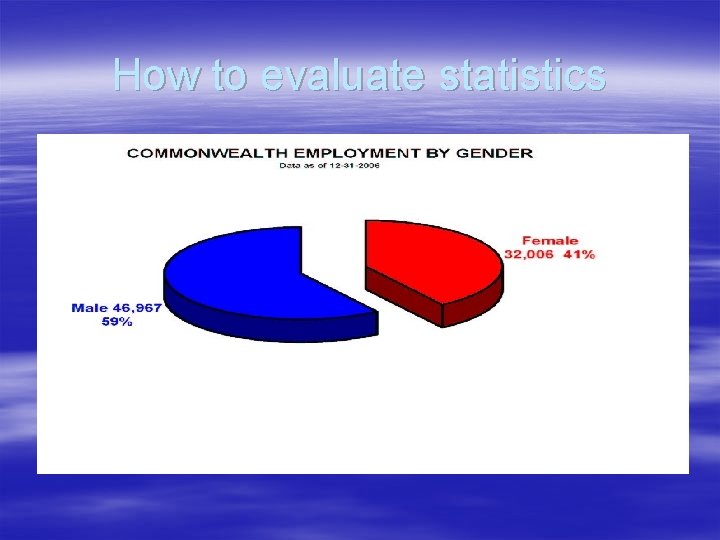
How to evaluate statistics
Homework for next week § You should find an argument that includes statistical evidence to support its reasons. Don’t forget to glue the argument and the evidence (pie chart, graph, etc) together Don’t forget to assess the evidence (Ask the right questions and answer them) 1 Is the evidence meaningful? 2. Relevant? 3. Reliable? 3. Representative?
- Slides: 13