
Assessing Business Process Maturity Chicago ABPMP October 2011
Assessing Business Process Maturity Chicago ABPMP October 2011
Agenda Topic Speaker Time Round Table Discussion Todd 20 minutes BPM Maturity Overview Brett 10 minutes Forrester Model (BPMMM) Jeanne 20 minutes The Process and Enterprise Maturity Model (PEMM) Todd 20 minutes Process Strategy Group Model (PBMMM) Pat 20 minutes Networking Break All 30 minutes Group Exercise All 20 minutes Group Exercise Report Out All 20 minutes Group Findings & Discussion Todd 20 minutes Best Practices, Recommendations & Closing Brett 10 minutes © 2011 ABPMP 2
Round Table Discussion • Are you using a maturity model? Why or why not? • If you are using one – which one are you using? • How are you using it and what value does it provide you? © 2011 ABPMP 3
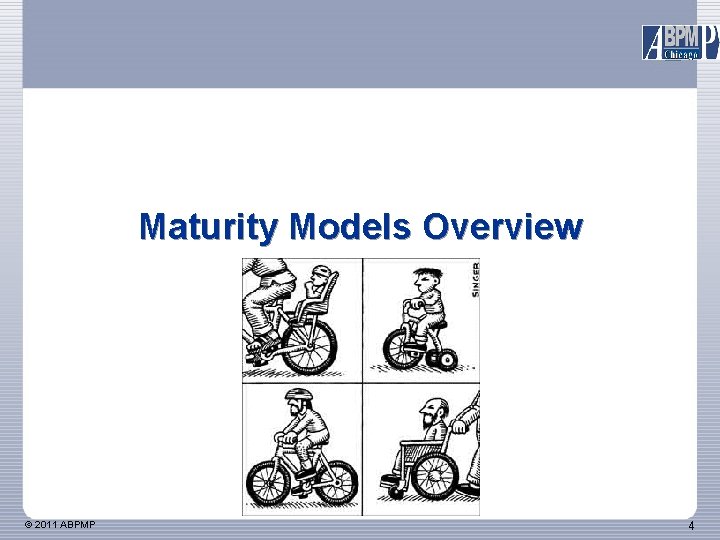
Maturity Models Overview © 2011 ABPMP 4
Maturity Models • Stages of Growth Models • Manufacturing Maturity Model • Capability Maturity Model (CMM) • Other IT Maturity Models • Proliferation of Maturity Models © 2011 ABPMP 5
Meta Model • Levels (Stages of Growth) • Categories • Characteristics • Assessment Models • Prescriptive Models © 2011 ABPMP 6
BPM Maturity Models • • • • AIIM Amentra Appian APQC Becker, Jorg BPMG (8 levels) BPTrends/Harmon Cordys (Saa. S BPMM) EABPM (European Association for BPM) EDEN Forrester Gartner Global 360 © 2011 ABPMP • Hammer • • • Huffner, Tapio IBM IDS-Sheer (Software AG) Innovation Value Institute Knowledge Partners International Mc. Queen Consulting OMG (BPMM 1. 0) Oracle Queensland University of Technology SMS Management XMPro 7
Forrester Business Process Council Maturity Model Jeanne Strepacki Director, Business Process Council Forrester Research October 12, 2011 8 © 2009 Forrester Research, Inc. Reproduction Prohibited © 2011 Forrester Research, Inc. Reproduction Prohibited
BPM maturity is about achieving the right balance for your organization. 9 © 2011 Forrester Research, Inc. Reproduction Prohibited
Agenda § What is the Business Process Council? § Why did we launch a Maturity Model for the Council? § What does the model include and why? § How do our members use it? 10 © 2011 Forrester Research, Inc. Reproduction Prohibited
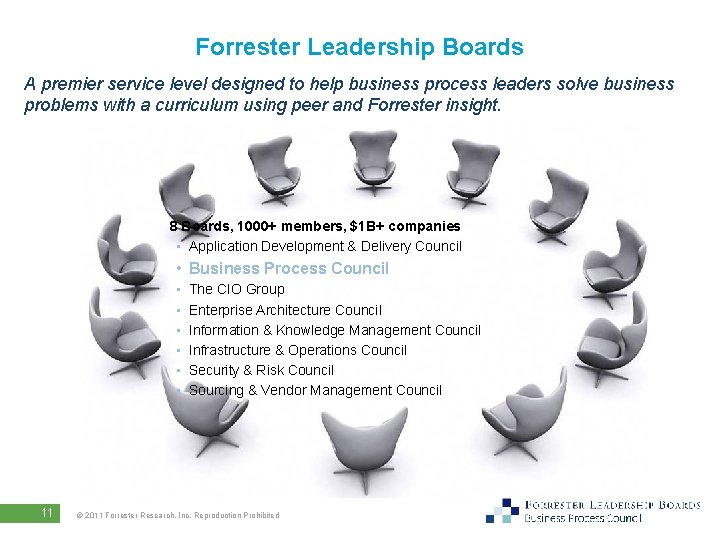
Forrester Leadership Boards A premier service level designed to help business process leaders solve business problems with a curriculum using peer and Forrester insight. 8 Boards, 1000+ members, $1 B+ companies • Application Development & Delivery Council • Business Process Council • • • 11 The CIO Group Enterprise Architecture Council Information & Knowledge Management Council Infrastructure & Operations Council Security & Risk Council Sourcing & Vendor Management Council © 2011 Forrester Research, Inc. Reproduction Prohibited
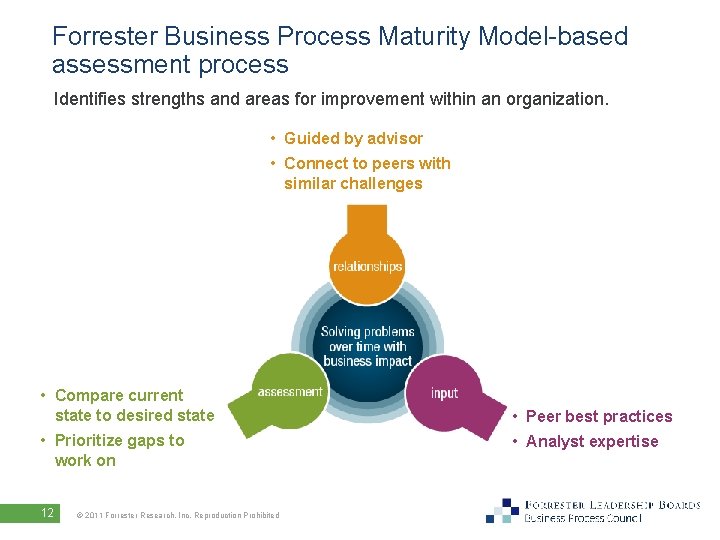
Forrester Business Process Maturity Model-based assessment process Identifies strengths and areas for improvement within an organization. • Guided by advisor • Connect to peers with similar challenges • Compare current state to desired state • Prioritize gaps to work on 12 © 2011 Forrester Research, Inc. Reproduction Prohibited • Peer best practices • Analyst expertise
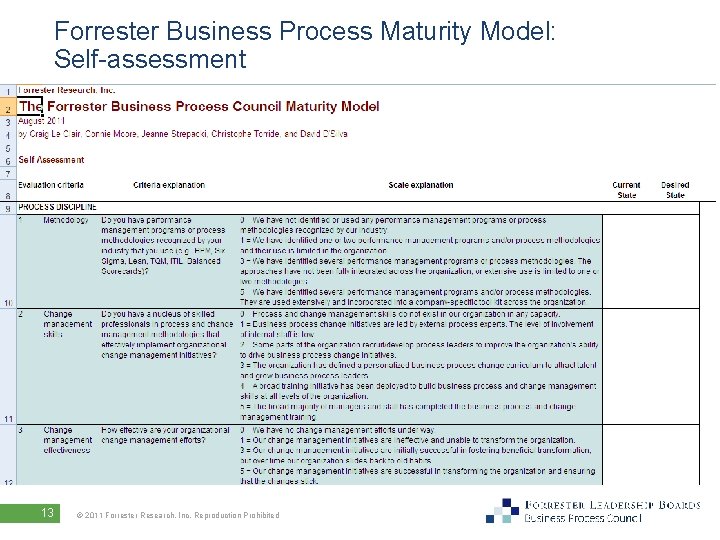
Forrester Business Process Maturity Model: Self-assessment 13 © 2011 Forrester Research, Inc. Reproduction Prohibited
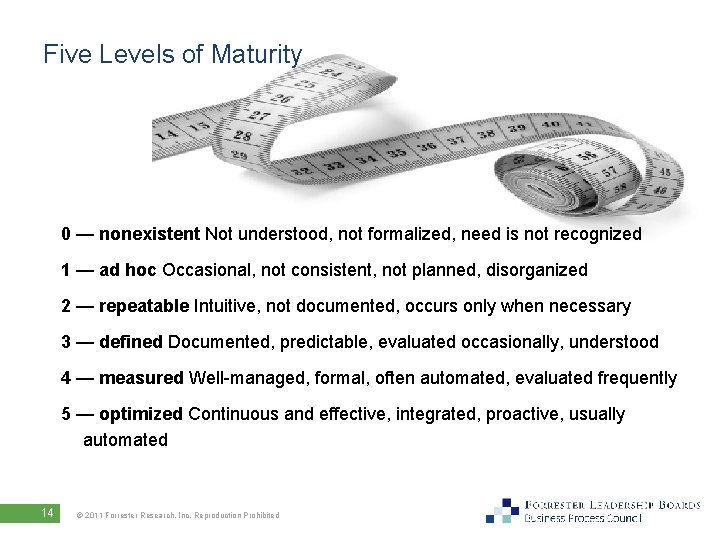
Five Levels of Maturity 0 — nonexistent Not understood, not formalized, need is not recognized 1 — ad hoc Occasional, not consistent, not planned, disorganized 2 — repeatable Intuitive, not documented, occurs only when necessary 3 — defined Documented, predictable, evaluated occasionally, understood 4 — measured Well-managed, formal, often automated, evaluated frequently 5 — optimized Continuous and effective, integrated, proactive, usually automated 14 © 2011 Forrester Research, Inc. Reproduction Prohibited
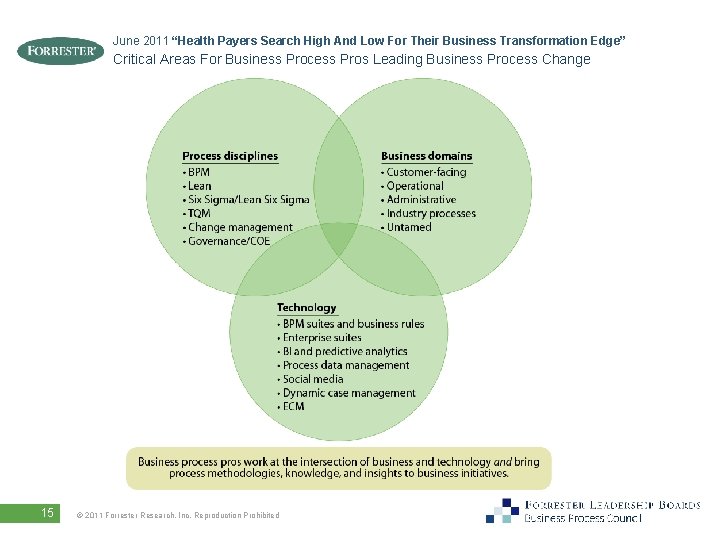
June 2011 “Health Payers Search High And Low For Their Business Transformation Edge” Critical Areas For Business Process Pros Leading Business Process Change 15 © 2011 Forrester Research, Inc. Reproduction Prohibited
Business Criteria § Strategic objectives § Cross-domain consistency § Customer empowerment § Competitive forces § External impact on process § Business architecture § Transformation project portfolio 16 © 2011 Forrester Research, Inc. Reproduction Prohibited
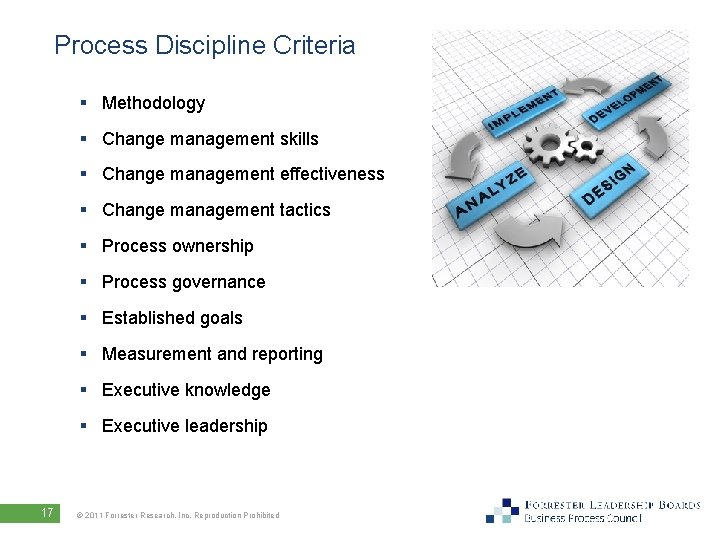
Process Discipline Criteria § Methodology § Change management skills § Change management effectiveness § Change management tactics § Process ownership § Process governance § Established goals § Measurement and reporting § Executive knowledge § Executive leadership 17 © 2011 Forrester Research, Inc. Reproduction Prohibited
Technology Criteria § IT-business process alignment § Business process tools § Technology skills § Alignment with MDM § App Internet/mobile strategy § Social and cloud strategy 18 © 2011 Forrester Research, Inc. Reproduction Prohibited
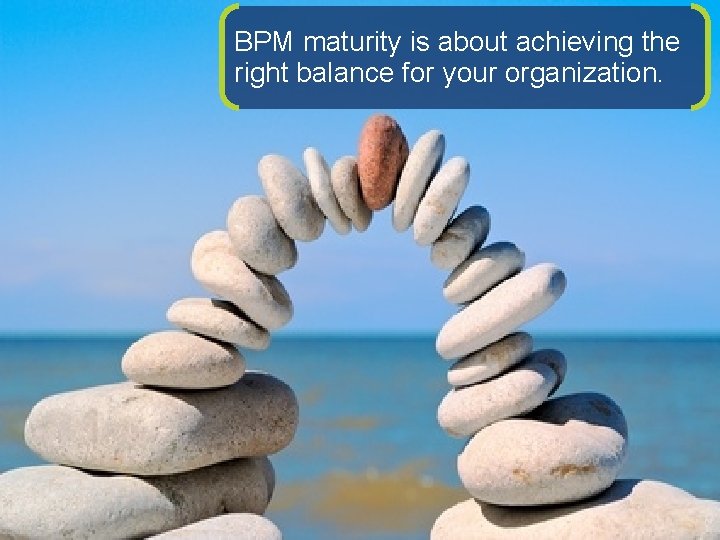
BPM maturity is about achieving the right balance for your organization. 19 © 2011 Forrester Research, Inc. Reproduction Prohibited
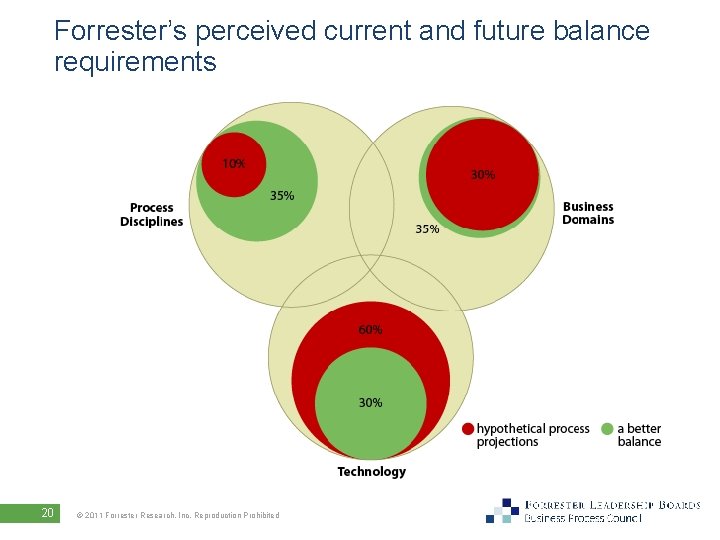
Forrester’s perceived current and future balance requirements 20 © 2011 Forrester Research, Inc. Reproduction Prohibited
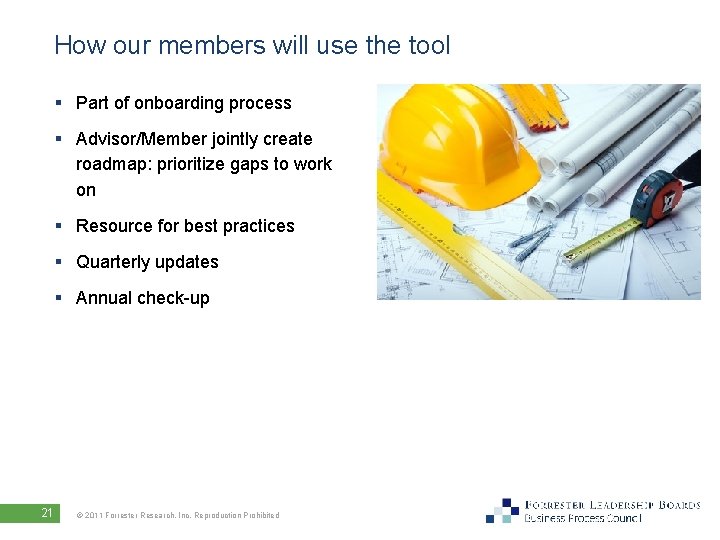
How our members will use the tool § Part of onboarding process § Advisor/Member jointly create roadmap: prioritize gaps to work on § Resource for best practices § Quarterly updates § Annual check-up 21 © 2011 Forrester Research, Inc. Reproduction Prohibited
Thank You! Jeanne Strepacki Christophe Torride Global Council Director Senior Advisor, EMEA +1 617/613 -8110 +33 1 4758 9342 jstrepacki@forrester. com ctorride@forrester. com David D’Silva Associate Advisor +1 617/613 -6165 ddsilva@forrester. com 22 © 2011 Forrester Research, Inc. Reproduction Prohibited
Todd Lohr Michael Hammer’s Process & Enterprise Maturity Models (PEMM) © 2011 ABPMP 23
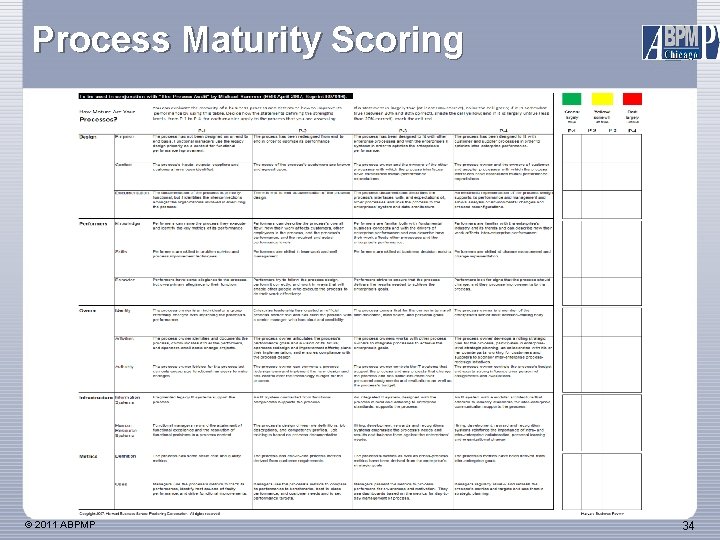
Process Maturity • Process Maturity provides a methodology to assess the ability of our processes to provide optimized performance to the business • More mature process capabilities will drive enhanced business results • Process Maturity provides the framework to establish our process structure and guides development of a process roadmap • The process maturity framework reviewed here is based on the Process Enterprise Maturity Model (PEMM) developed by Michael Hammer and summarized in The Process Audit, Harvard Business Review, April 2007 © 2011 ABPMP 24
Process and Enterprise Maturity Model Process Maturity Models – A tool to help organizations plan and manage their transitions to process. Consists of: § a framework for assessing the maturity of any particular business process and § another for assessing the maturity of an enterprise as a whole. PEMM – a framework that helps executives comprehend, plan and assess process-based transformation efforts. Companies need to ensure that their business processes become more mature – that they are capable of delivering higher performance over time. Companies must deliver process enablers which pertain to individual processes and enterprise capabilities which apply to the entire organization. © 2011 ABPMP 25
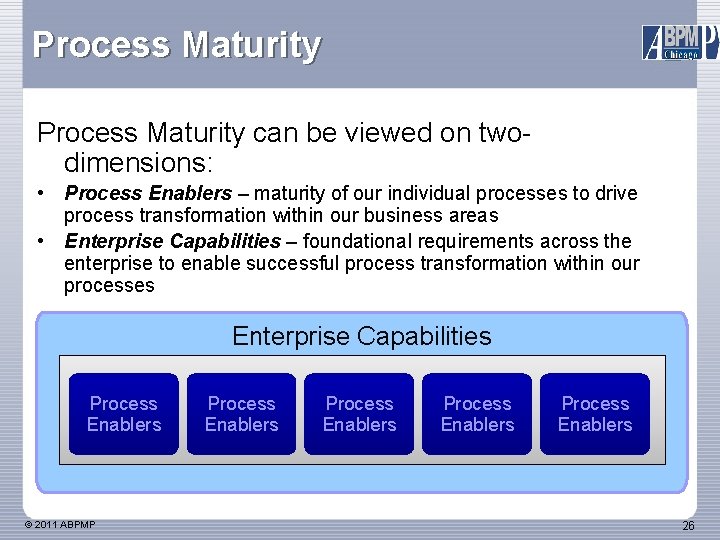
Process Maturity can be viewed on twodimensions: • Process Enablers – maturity of our individual processes to drive process transformation within our business areas • Enterprise Capabilities – foundational requirements across the enterprise to enable successful process transformation within our processes Enterprise Capabilities Process Enablers © 2011 ABPMP Process Enablers 26
Prerequisites of Process • Effective process organizations require capabilities within the enterprise to sustain their efforts • These are things that as an enterprise need to be in place to sustain process transformation and are the responsibility of the central Process Competency Center driven through the Process Owners • The Enterprise Capabilities are: – Leadership to authorize and enable the effort – Culture a value system receptive to what process entails – Expertise capability to plan and execute process transformation – Governance a system to manage the effort and ensure it doesn’t fall apart © 2011 ABPMP 27
Enterprise Capabilities - Key Aspects • Leadership – – Knowledge Alignment Behaviors Style • Culture – – © 2011 ABPMP Teamwork Customers Responsibility Change • Governance – Process Model – Accountability – Integration • Expertise – Personnel – Methodology 28
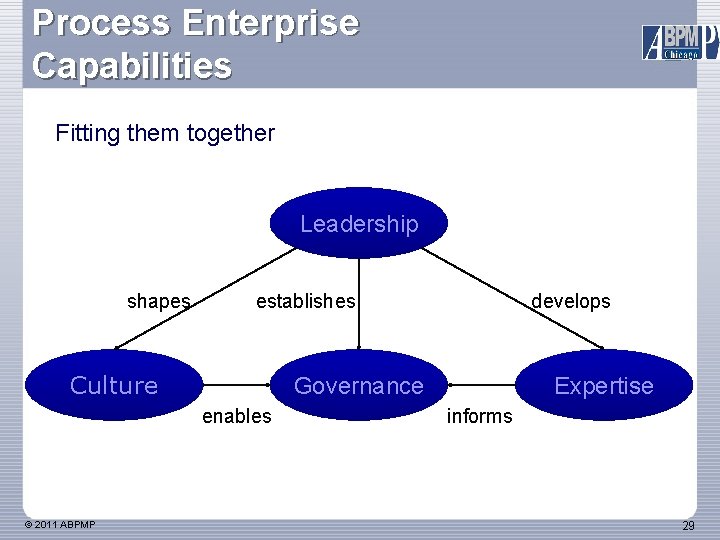
Process Enterprise Capabilities Fitting them together Leadership shapes establishes Culture Governance enables © 2011 ABPMP develops Expertise informs 29
Enterprise Capabilities • Stronger organizational capabilities makes for stronger enablers, which allow for better process performance. 13 different dimensions across • E-1 • E-2 • E-3 • E-4 © 2011 ABPMP 30
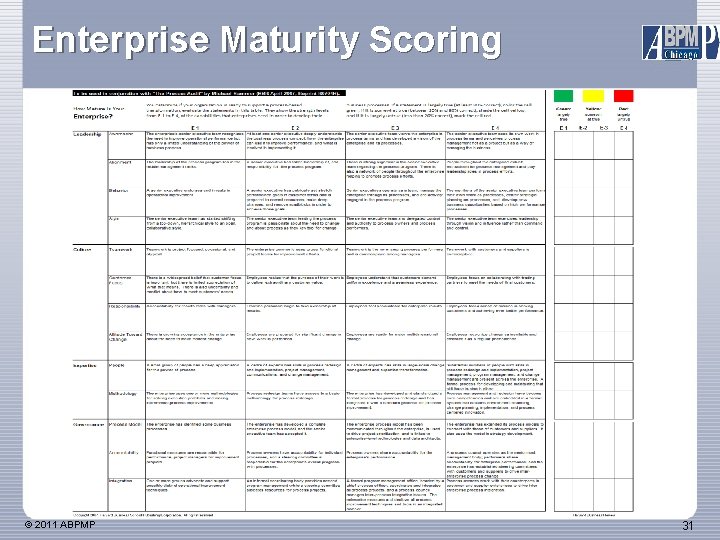
Enterprise Maturity Scoring © 2011 ABPMP 31
Process Enablers • Process enablers are required for each process for sustained performance • These are things that each process team needs to focus on for their respective process – Design specification of how the work is performed – Metrics used to assess and assure performance – Owner required to manage E 2 E view of the process – Performers knowledgeable users to ensure execution – Infrastructure required supporting mechanisms © 2011 ABPMP 32
Process Enablers • Determine how well a process is able to function over time. They encompass • the comprehensiveness of a process’s design • the abilities of the people who operate the process • the appointment of top-level process owner to oversee the process’s implementation and performance • the match between the organization’s information and management systems • the process’s needs and the quality of metrics that the company uses to measure process performance. • Enabler’s strength determines how mature a process is • P-1 process is reliable, predictable • P-2 process delivers superior results because the company has designed & implemented it from one end of the organization to another • P-3 process delivers optimal performance because executives can integrate it with other internal processes to maximize company’s performance • P-4 process is best in class extending back to suppliers and forward to customers © 2011 ABPMP 33
Process Maturity Scoring © 2011 ABPMP 34
Process Strategy Group Model Process Based Management Assessment and Roadmap Model Pat Dowdle-Process Strategy Group © 2011 ABPMP 35
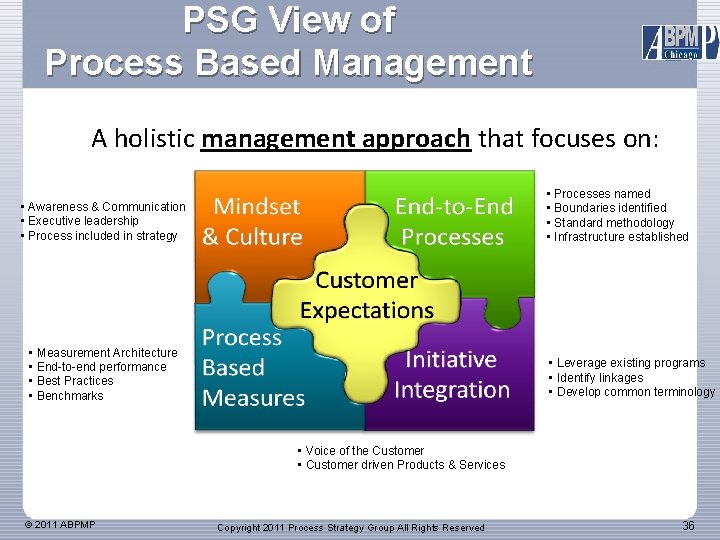
PSG View of Process Based Management A holistic management approach that focuses on: • Processes named • Boundaries identified • Standard methodology • Infrastructure established • Awareness & Communication • Executive leadership • Process included in strategy • Measurement Architecture • End-to-end performance • Best Practices • Benchmarks • Leverage existing programs • Identify linkages • Develop common terminology • Voice of the Customer • Customer driven Products & Services © 2011 ABPMP Copyright 2011 Process Strategy Group All Rights Reserved 36
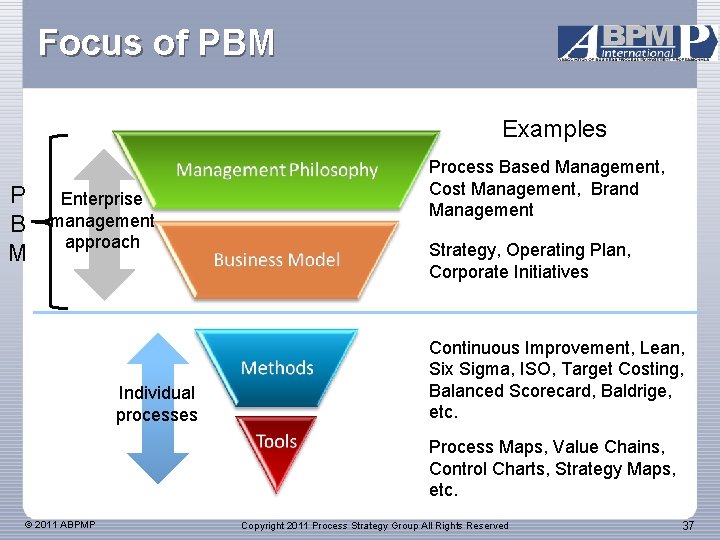
Focus of PBM Examples P B M Enterprise management approach Individual processes Process Based Management, Cost Management, Brand Management Strategy, Operating Plan, Corporate Initiatives Continuous Improvement, Lean, Six Sigma, ISO, Target Costing, Balanced Scorecard, Baldrige, etc. Process Maps, Value Chains, Control Charts, Strategy Maps, etc. © 2011 ABPMP Copyright 2011 Process Strategy Group All Rights Reserved 37
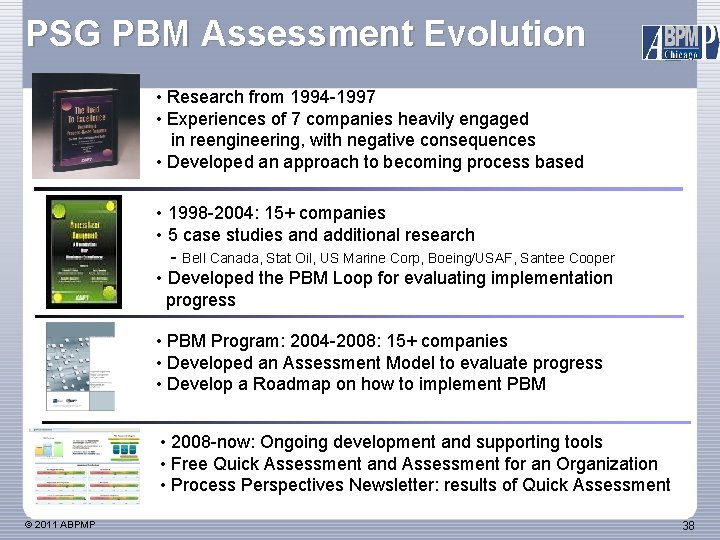
PSG PBM Assessment Evolution • Research from 1994 -1997 • Experiences of 7 companies heavily engaged in reengineering, with negative consequences • Developed an approach to becoming process based • 1998 -2004: 15+ companies • 5 case studies and additional research - Bell Canada, Stat Oil, US Marine Corp, Boeing/USAF, Santee Cooper • Developed the PBM Loop for evaluating implementation progress • PBM Program: 2004 -2008: 15+ companies • Developed an Assessment Model to evaluate progress • Develop a Roadmap on how to implement PBM • 2008 -now: Ongoing development and supporting tools • Free Quick Assessment and Assessment for an Organization • Process Perspectives Newsletter: results of Quick Assessment © 2011 ABPMP 38
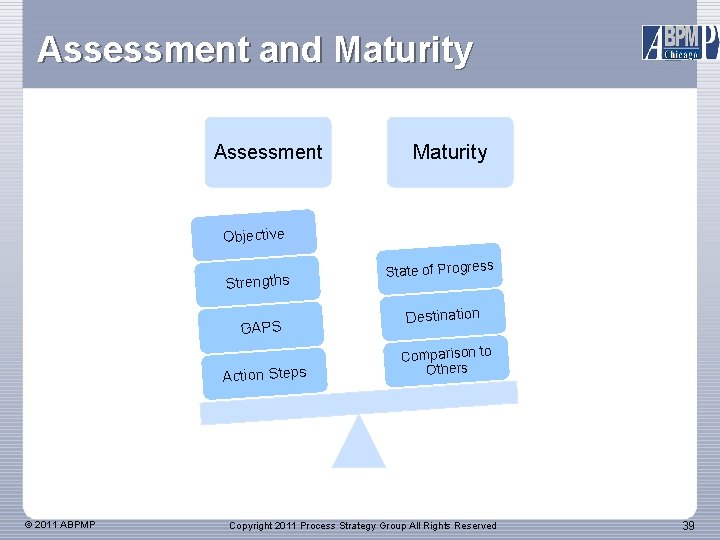
Assessment and Maturity Assessment Maturity Objective Strengths GAPS Action Steps © 2011 ABPMP State of Progress Destination Comparison to Others Copyright 2011 Process Strategy Group All Rights Reserved 39
Why do an Assessment? • Enlist and secure management support • Engage staff in adapting to new process culture • Establish a baseline • Identify and address Gaps • Leverage Strengths • Create actionable plans • Alignment of strategy to process © 2011 ABPMP Copyright 2011 Process Strategy Group All Rights Reserved 40
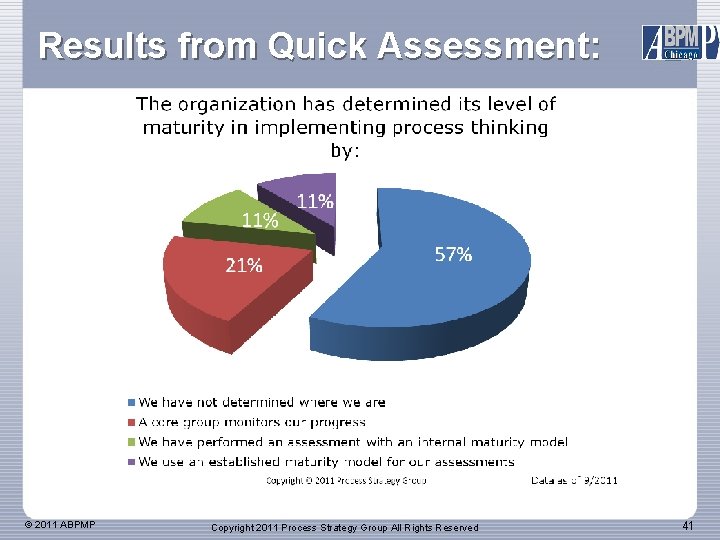
Results from Quick Assessment: © 2011 ABPMP Copyright 2011 Process Strategy Group All Rights Reserved 41
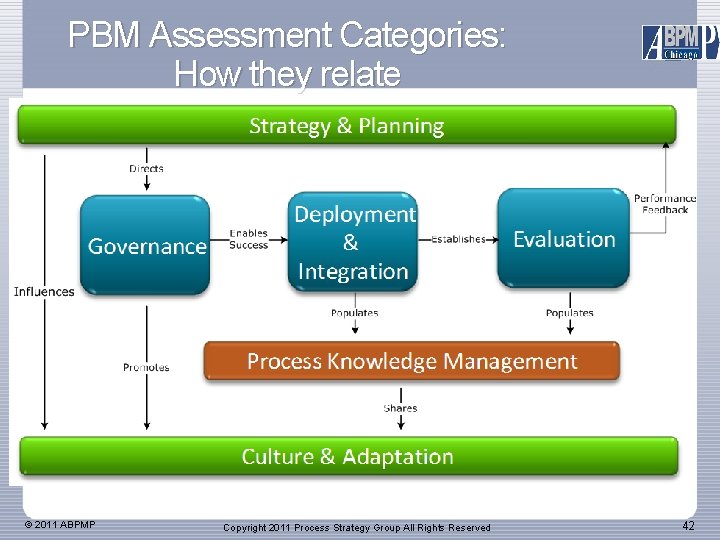
PBM Assessment Categories: How they relate © 2011 ABPMP Copyright 2011 Process Strategy Group All Rights Reserved 42
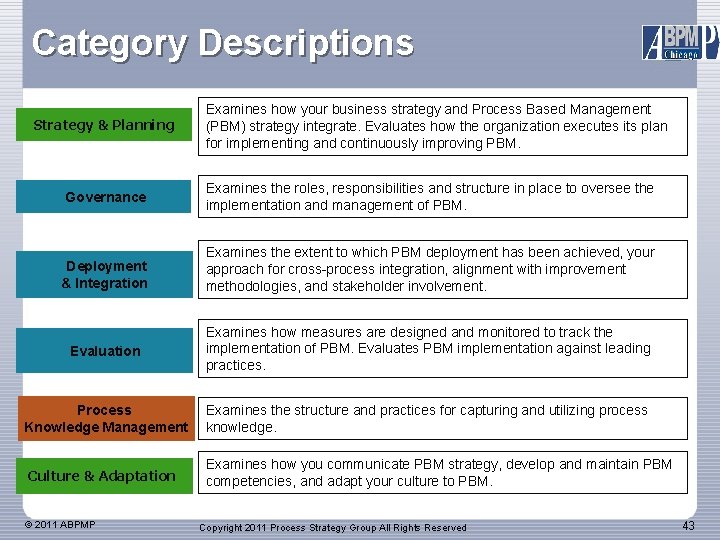
Category Descriptions Strategy & Planning Examines how your business strategy and Process Based Management (PBM) strategy integrate. Evaluates how the organization executes its plan for implementing and continuously improving PBM. Governance Examines the roles, responsibilities and structure in place to oversee the implementation and management of PBM. Deployment & Integration Examines the extent to which PBM deployment has been achieved, your approach for cross-process integration, alignment with improvement methodologies, and stakeholder involvement. Evaluation Examines how measures are designed and monitored to track the implementation of PBM. Evaluates PBM implementation against leading practices. Process Knowledge Management Examines the structure and practices for capturing and utilizing process knowledge. Culture & Adaptation © 2011 ABPMP Examines how you communicate PBM strategy, develop and maintain PBM competencies, and adapt your culture to PBM. Copyright 2011 Process Strategy Group All Rights Reserved 43
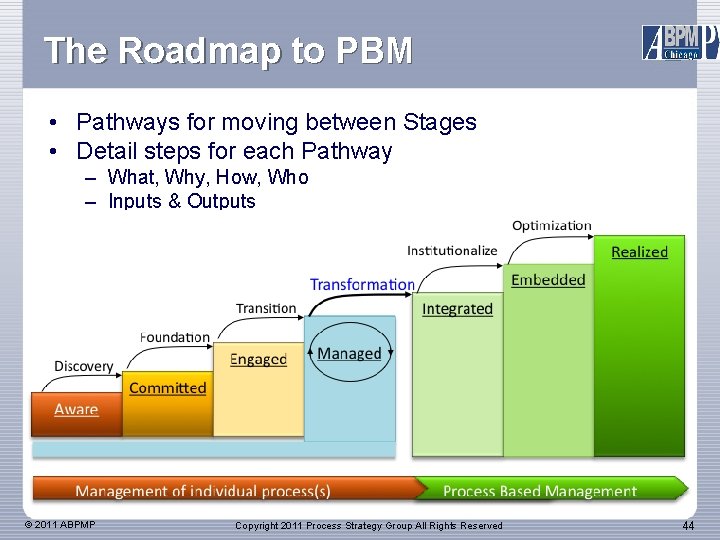
The Roadmap to PBM • Pathways for moving between Stages • Detail steps for each Pathway – What, Why, How, Who – Inputs & Outputs © 2011 ABPMP Copyright 2011 Process Strategy Group All Rights Reserved 44
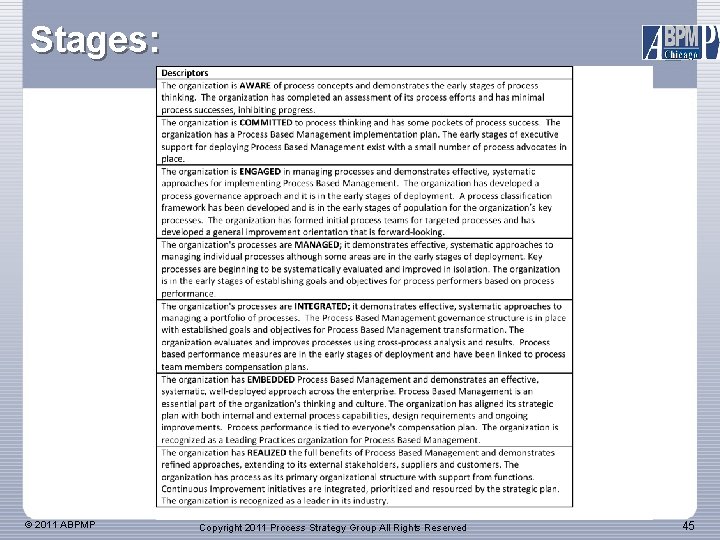
Stages: © 2011 ABPMP Copyright 2011 Process Strategy Group All Rights Reserved 45
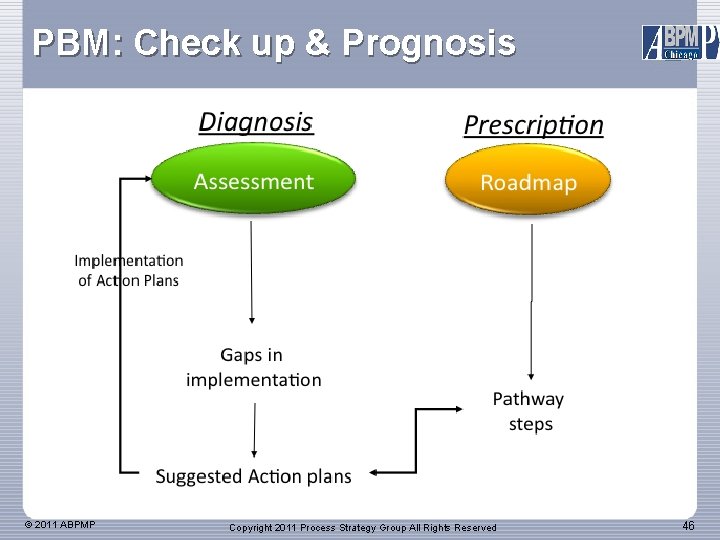
PBM: Check up & Prognosis © 2011 ABPMP Copyright 2011 Process Strategy Group All Rights Reserved 46
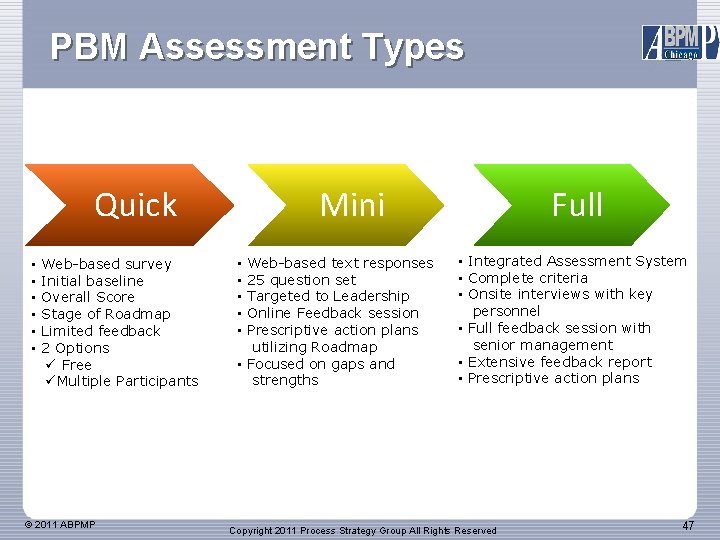
PBM Assessment Types Quick • • • Web-based survey Initial baseline Overall Score Stage of Roadmap Limited feedback 2 Options ü Free üMultiple Participants © 2011 ABPMP Mini Web-based text responses 25 question set Targeted to Leadership Online Feedback session Prescriptive action plans utilizing Roadmap • Focused on gaps and strengths • • • Full • Integrated Assessment System • Complete criteria • Onsite interviews with key personnel • Full feedback session with senior management • Extensive feedback report • Prescriptive action plans Copyright 2011 Process Strategy Group All Rights Reserved 47
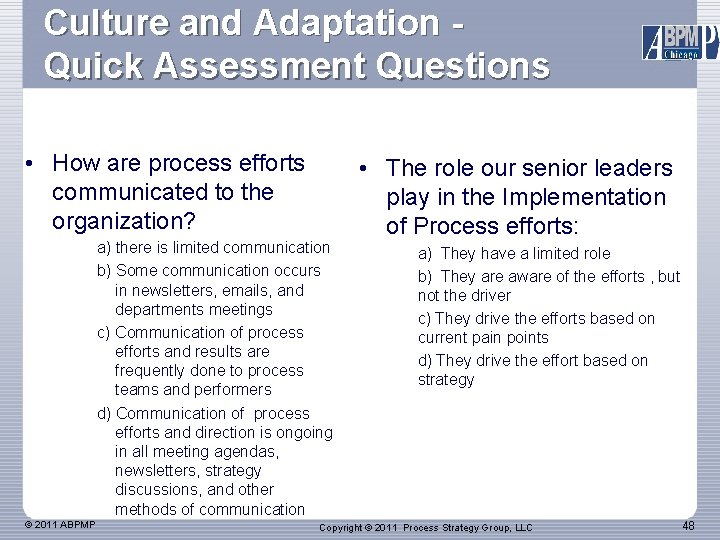
Culture and Adaptation Quick Assessment Questions • How are process efforts communicated to the organization? • The role our senior leaders play in the Implementation of Process efforts: a) there is limited communication b) Some communication occurs in newsletters, emails, and departments meetings c) Communication of process efforts and results are frequently done to process teams and performers d) Communication of process efforts and direction is ongoing in all meeting agendas, newsletters, strategy discussions, and other methods of communication © 2011 ABPMP a) They have a limited role b) They are aware of the efforts , but not the driver c) They drive the efforts based on current pain points d) They drive the effort based on strategy Copyright © 2011 Process Strategy Group, LLC 48
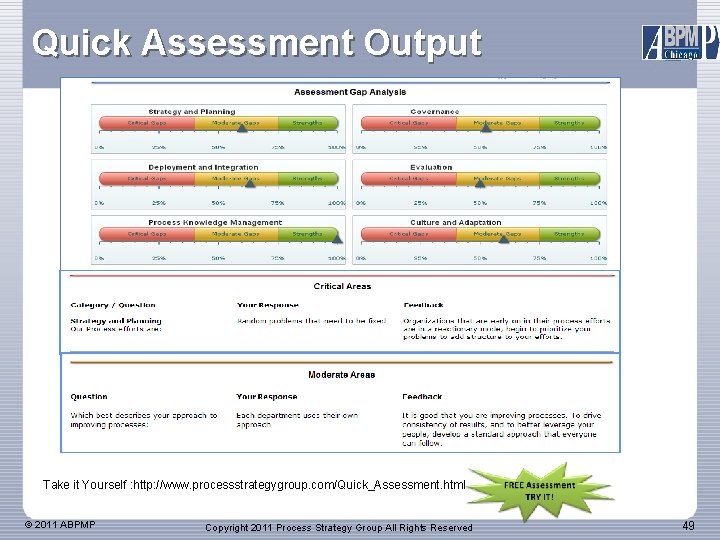
Quick Assessment Output Take it Yourself : http: //www. processstrategygroup. com/Quick_Assessment. html © 2011 ABPMP Copyright 2011 Process Strategy Group All Rights Reserved 49
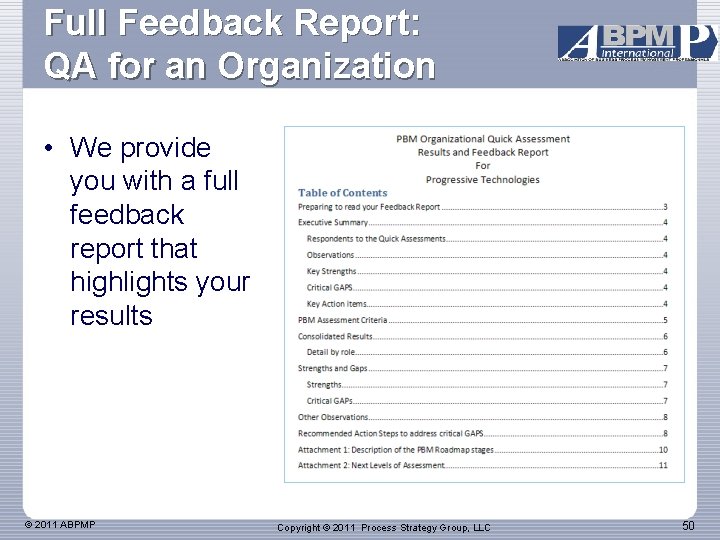
Full Feedback Report: QA for an Organization • We provide you with a full feedback report that highlights your results © 2011 ABPMP Copyright © 2011 Process Strategy Group, LLC 50
Process Strategy Group • www. Process. Strategy. Group. com • Learn more or take the Free PBM Quick Assessment at • Learn more on the PBM Quick Assessment for an Organization at © 2011 ABPMP 51
Group Exercise Self Assessments Break Into Groups Pick a Model © 2011 ABPMP 52
Group Findings & Discussion • What did you find? • How easy was it to use? • What value do you think your organization could get from using a maturity model? • Do you think you have enough management maturity to begin using a BPM maturity model? © 2011 ABPMP 53
Conclusion Using Maturity Models © 2011 ABPMP 54
Why Use a Maturity Model • Assessment • Improvement • Transformation • Management Framework © 2011 ABPMP 55
How to use a maturity model • Choosing/customizing/building a model • Process Improvement/Transformation • Process Management • Internal (Productivity, Quality, Control) • External (Positioning, Differentiation, Strategy) © 2011 ABPMP 56
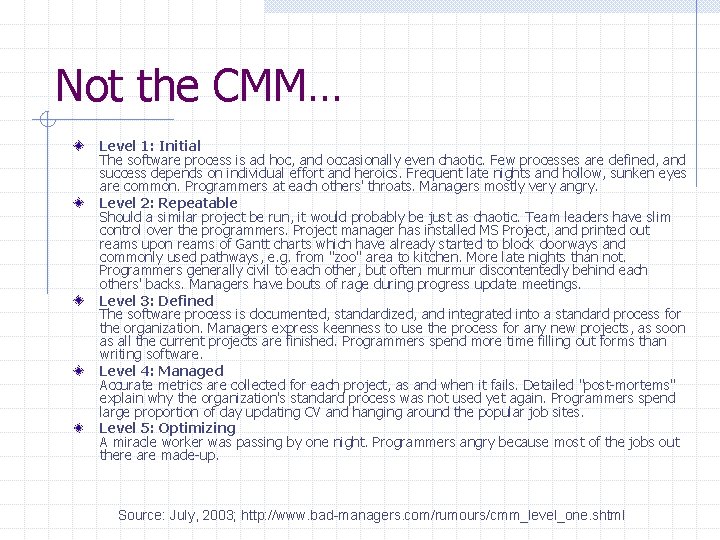
Not the CMM… Level 1: Initial The software process is ad hoc, and occasionally even chaotic. Few processes are defined, and success depends on individual effort and heroics. Frequent late nights and hollow, sunken eyes are common. Programmers at each others' throats. Managers mostly very angry. Level 2: Repeatable Should a similar project be run, it would probably be just as chaotic. Team leaders have slim control over the programmers. Project manager has installed MS Project, and printed out reams upon reams of Gantt charts which have already started to block doorways and commonly used pathways, e. g. from "zoo" area to kitchen. More late nights than not. Programmers generally civil to each other, but often murmur discontentedly behind each others' backs. Managers have bouts of rage during progress update meetings. Level 3: Defined The software process is documented, standardized, and integrated into a standard process for the organization. Managers express keenness to use the process for any new projects, as soon as all the current projects are finished. Programmers spend more time filling out forms than writing software. Level 4: Managed Accurate metrics are collected for each project, as and when it fails. Detailed "post-mortems" explain why the organization's standard process was not used yet again. Programmers spend large proportion of day updating CV and hanging around the popular job sites. Level 5: Optimizing A miracle worker was passing by one night. Programmers angry because most of the jobs out there are made-up. Source: July, 2003; http: //www. bad-managers. com/rumours/cmm_level_one. shtml
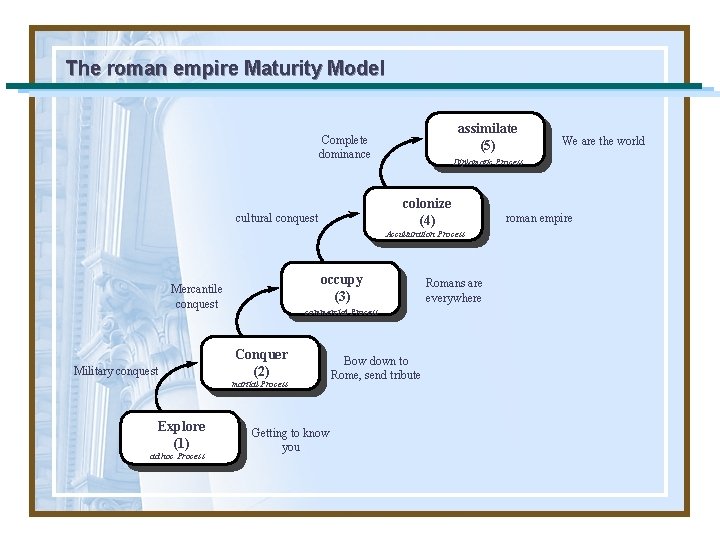
The roman empire Maturity Model assimilate (5) Complete dominance Diplomatic Process colonize (4) cultural conquest Acculturation Process occupy (3) Mercantile conquest Military conquest martial Process Explore (1) ad hoc Process Romans are everywhere commercial Process Conquer (2) We are the world Bow down to Rome, send tribute Getting to know you Presented at ISACA, January 8, 2004 roman empire
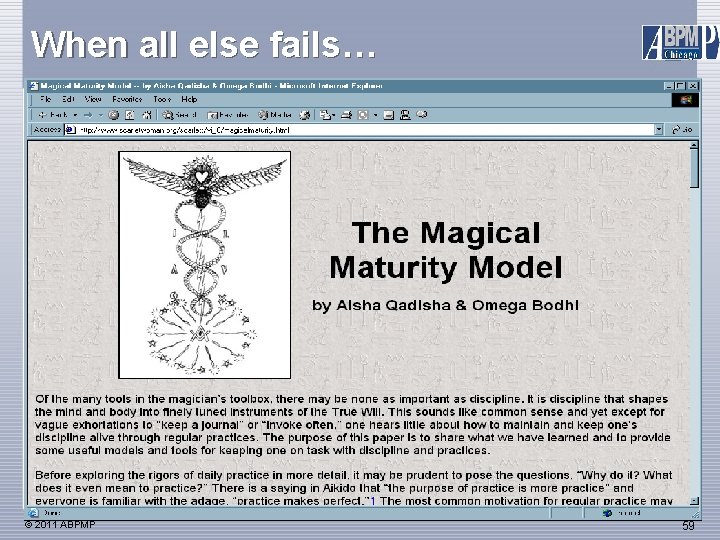
When all else fails… © 2011 ABPMP 59
Your Feedback Is Important • Does this workshop format work for you? • Topics for future workshops • Speakers/Topics for talks • Anything else • Send to: Officers@ABPMPChicago. org © 2011 ABPMP 60
- Slides: 60