
ASSESSING AND MAPPING WATER SCARCITY LEVEL IN JORDAN
![Water Poverty Index (WPI) Five Components [Resources] + [Access]+ [Use] + [Capacity] + [Environment]](https://slidetodoc.com/presentation_image_h/fb11223f993e7b6f0fe192f47c78535e/image-12.jpg "Water Poverty Index (WPI) Five Components [Resources] + [Access]+ [Use] + [Capacity] + [Environment]")

- Slides: 26
ASSESSING AND MAPPING WATER SCARCITY LEVEL IN JORDAN USING WATER POVERTY INDEX Jordan Ayat A. Hazaymeh Royal Scientific Society For Jordan Since 1970
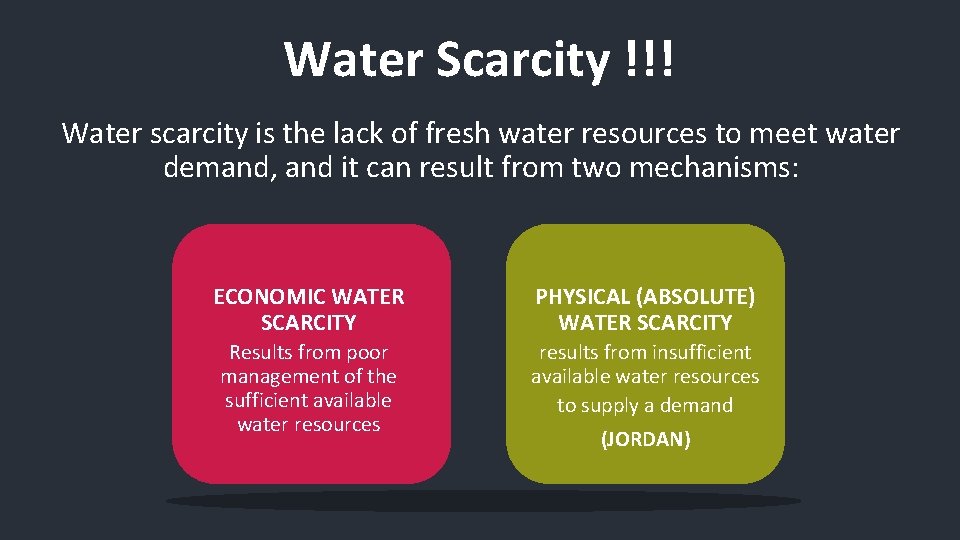
Water Scarcity ǃǃǃ Water scarcity is the lack of fresh water resources to meet water demand, and it can result from two mechanisms: ECONOMIC WATER SCARCITY PHYSICAL (ABSOLUTE) WATER SCARCITY Results from poor management of the sufficient available water resources results from insufficient available water resources to supply a demand (JORDAN)
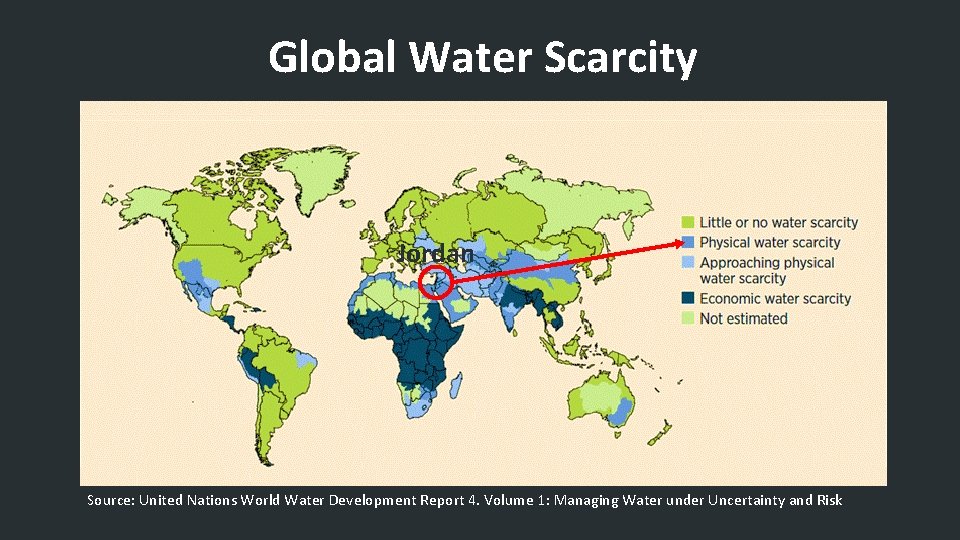
Global Water Scarcity Jordan Source: United Nations World Water Development Report 4. Volume 1: Managing Water under Uncertainty and Risk
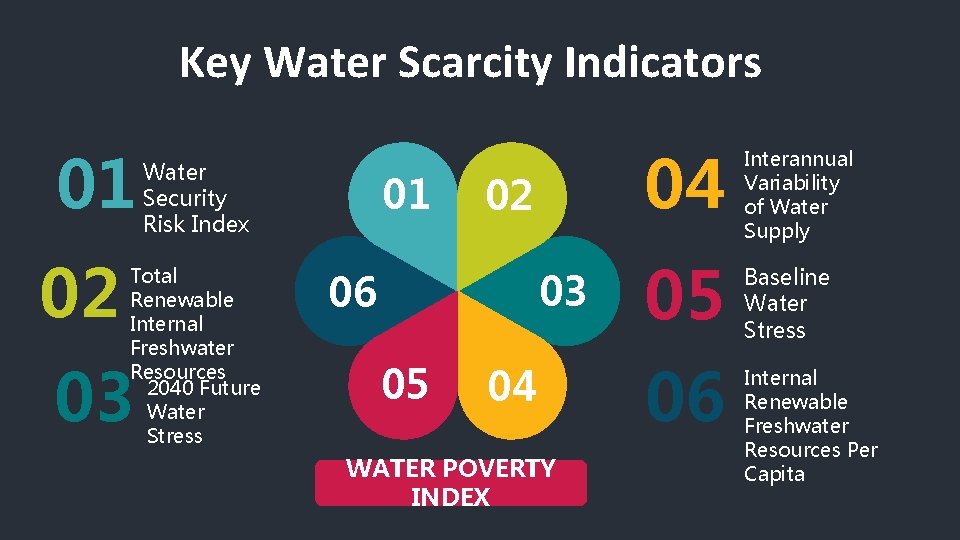
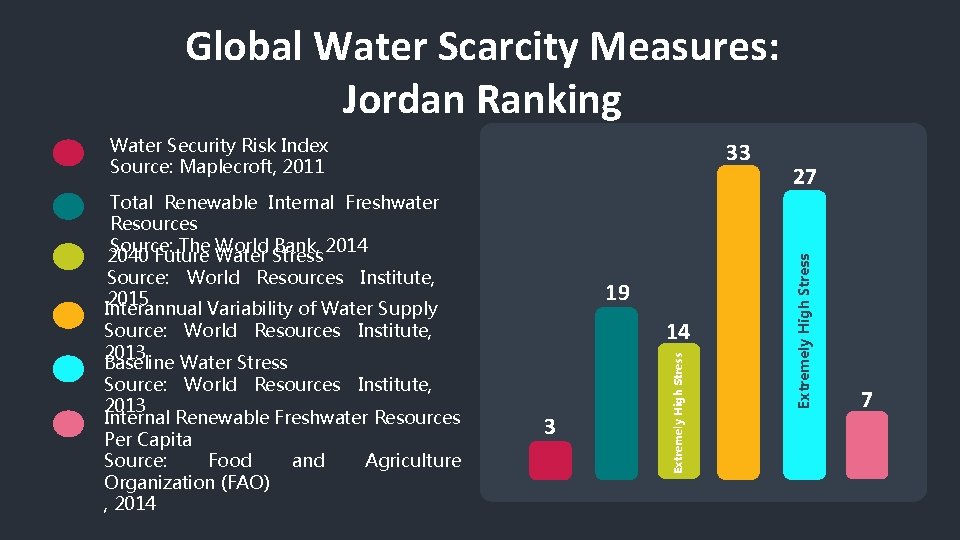
Key Water Scarcity Indicators 01 02 Water Security Risk Index Total Renewable Internal Freshwater Resources 2040 Future Water Stress 03 01 04 02 03 06 05 04 WATER POVERTY INDEX 05 06 Interannual Variability of Water Supply Baseline Water Stress Internal Renewable Freshwater Resources Per Capita
Global Water Scarcity Measures: Jordan Ranking 19 14 3 Extremely High Stress Total Renewable Internal Freshwater Resources Source: The World Bank, 2014 2040 Future Water Stress Source: World Resources Institute, 2015 Interannual Variability of Water Supply Source: World Resources Institute, 2013 Baseline Water Stress Source: World Resources Institute, 2013 Internal Renewable Freshwater Resources Per Capita Source: Food and Agriculture Organization (FAO) , 2014 33 27 Extremely High Stress Water Security Risk Index Source: Maplecroft, 2011 7
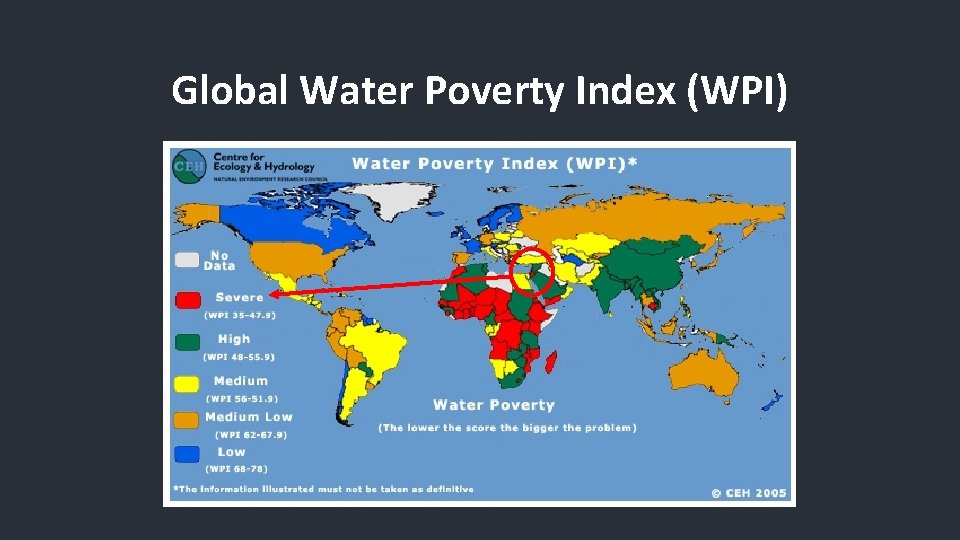
Global Water Poverty Index (WPI)
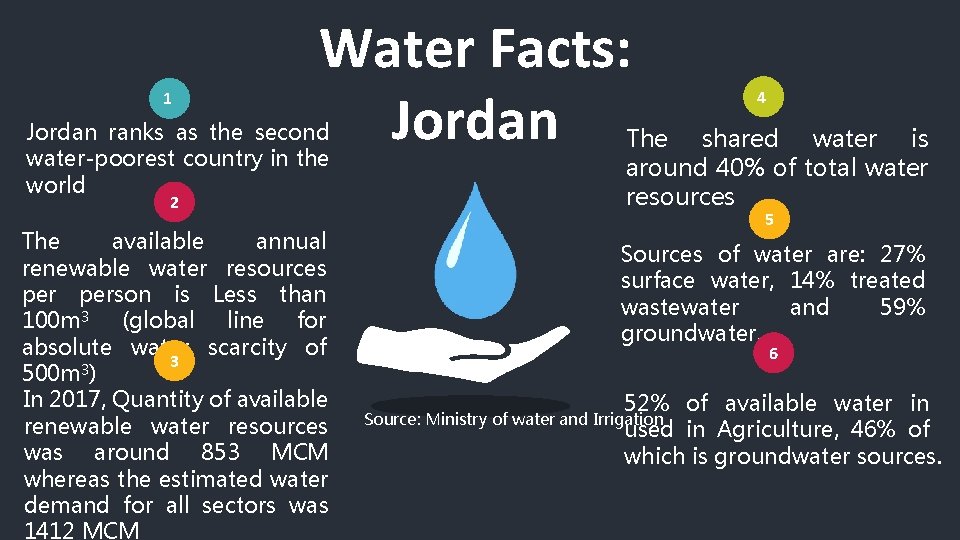
1 Water Facts: Jordan ranks as the second water-poorest country in the world 2 The available annual renewable water resources person is Less than 100 m 3 (global line for absolute water scarcity of 3 3 500 m ) In 2017, Quantity of available renewable water resources was around 853 MCM whereas the estimated water demand for all sectors was 1412 MCM 4 The shared water is around 40% of total water resources 5 Sources of water are: 27% surface water, 14% treated wastewater and 59% groundwater. 6 52% of available water in Source: Ministry of water and Irrigation used in Agriculture, 46% of which is groundwater sources.
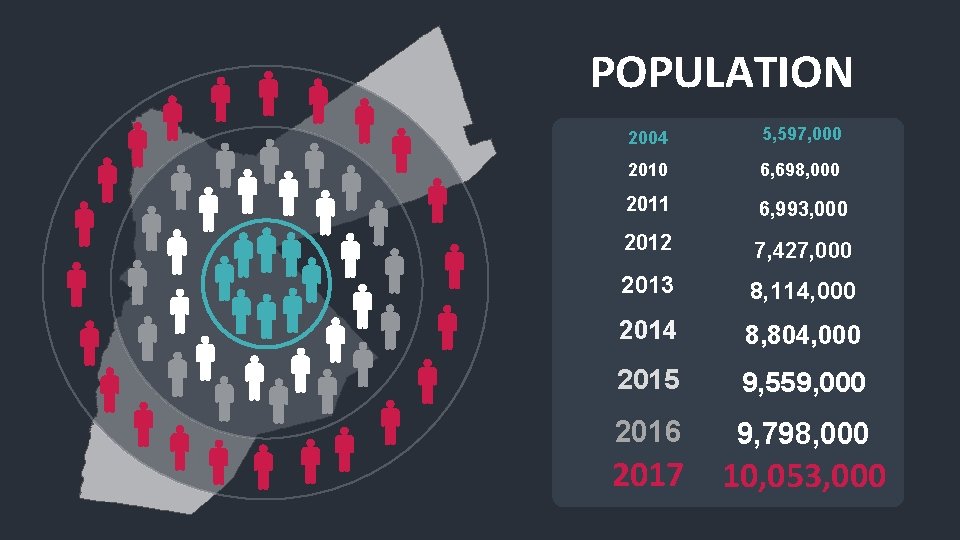
POPULATION 2004 5, 597, 000 2010 6, 698, 000 2011 6, 993, 000 2012 7, 427, 000 2013 8, 114, 000 2014 8, 804, 000 2015 9, 559, 000 2016 9, 798, 000 2017 10, 053, 000
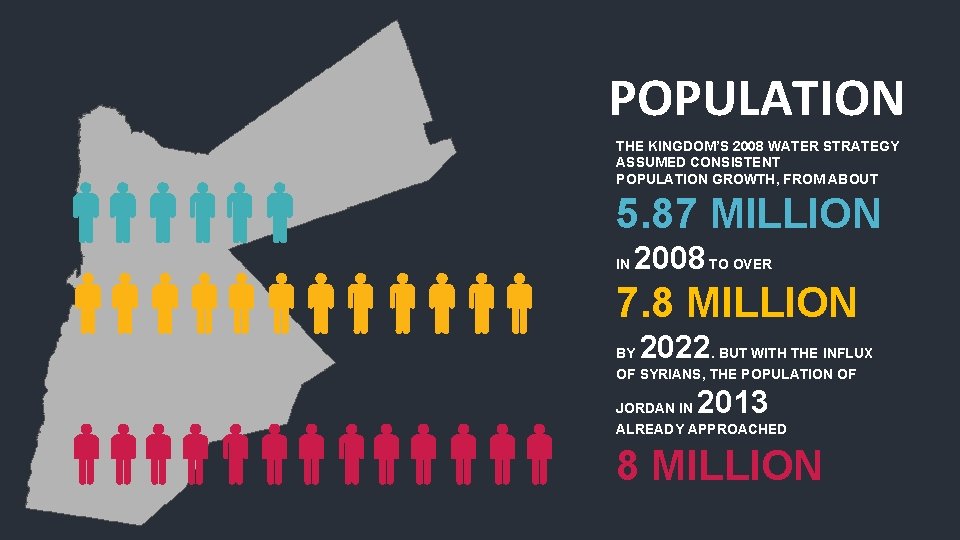
POPULATION THE KINGDOM’S 2008 WATER STRATEGY ASSUMED CONSISTENT POPULATION GROWTH, FROM ABOUT 5. 87 MILLION IN 2008 TO OVER 7. 8 MILLION 2022 BY. BUT WITH THE INFLUX OF SYRIANS, THE POPULATION OF 2013 JORDAN IN ALREADY APPROACHED 8 MILLION
Objective of This Study This study aims to evaluate the changes of water poverty and scarcity level in Jordan during (2010 -2017) using the Water poverty Index (WPI) to better understanding the challenges that facing water sector in Jordan B J E O C T I V E
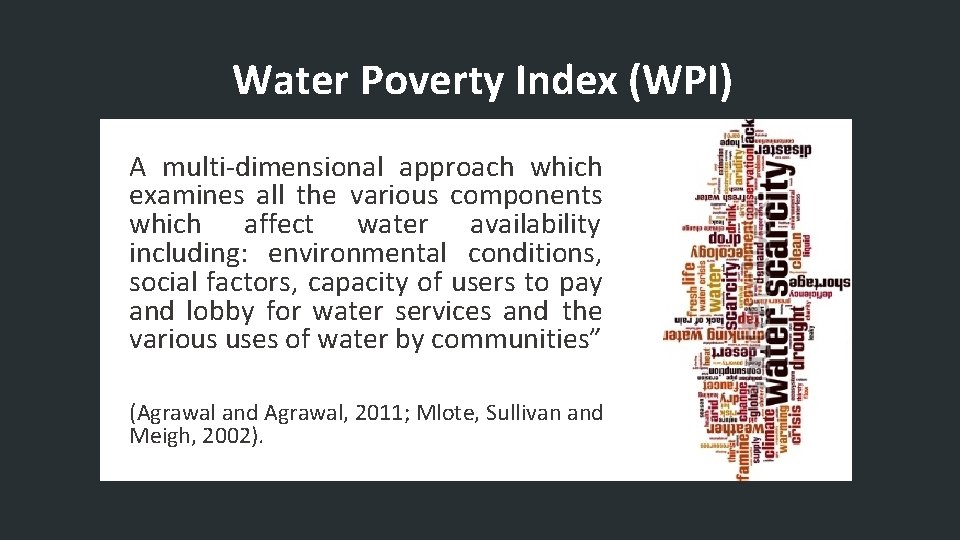
Water Poverty Index (WPI) A multi-dimensional approach which examines all the various components which affect water availability including: environmental conditions, social factors, capacity of users to pay and lobby for water services and the various uses of water by communities” (Agrawal and Agrawal, 2011; Mlote, Sullivan and Meigh, 2002).
Water Poverty Index (WPI) Five Components [Resources] + [Access]+ [Use] + [Capacity] + [Environment] Resources Access Use Capacity Environment
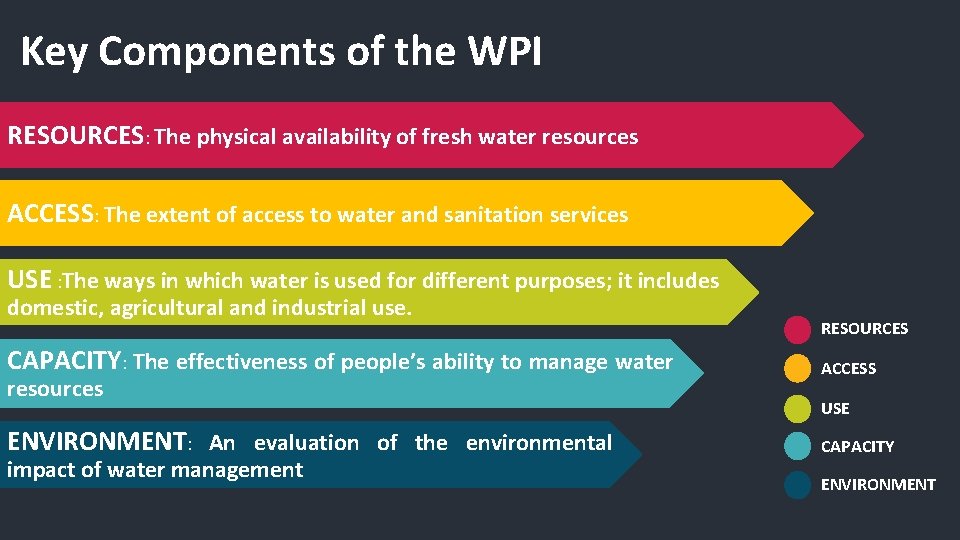
Key Components of the WPI RESOURCES: The physical availability of fresh water resources ACCESS: The extent of access to water and sanitation services USE : The ways in which water is used for different purposes; it includes domestic, agricultural and industrial use. CAPACITY: The effectiveness of people’s ability to manage water resources ENVIRONMENT: An evaluation of the environmental impact of water management RESOURCES ACCESS USE CAPACITY ENVIRONMENT
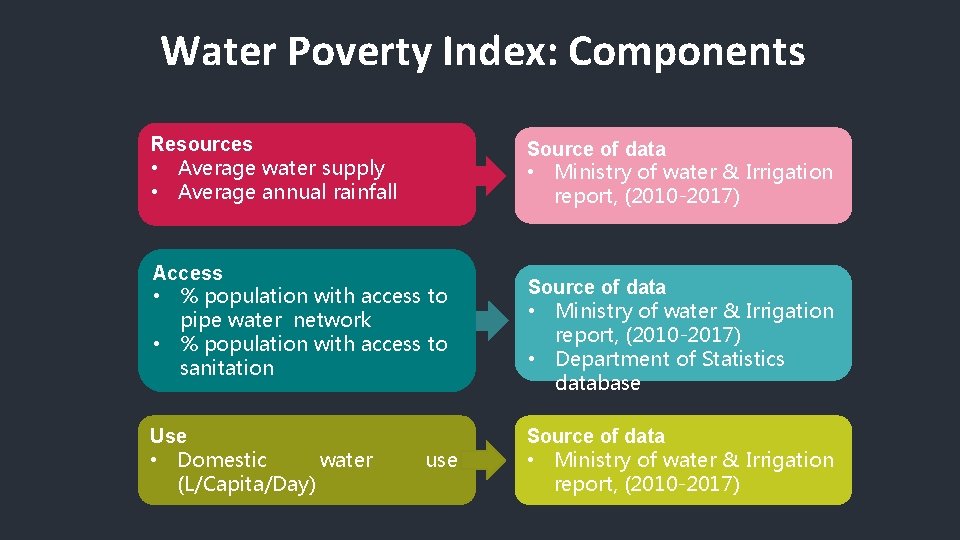
Water Poverty Index: Components Resources • Average water supply • Average annual rainfall Source of data • Ministry of water & Irrigation report, (2010 -2017) Access • % population with access to pipe water network • % population with access to sanitation Use • Domestic water (L/Capita/Day) use Source of data • Ministry of water & Irrigation report, (2010 -2017) • Department of Statistics database Source of data • Ministry of water & Irrigation report, (2010 -2017)
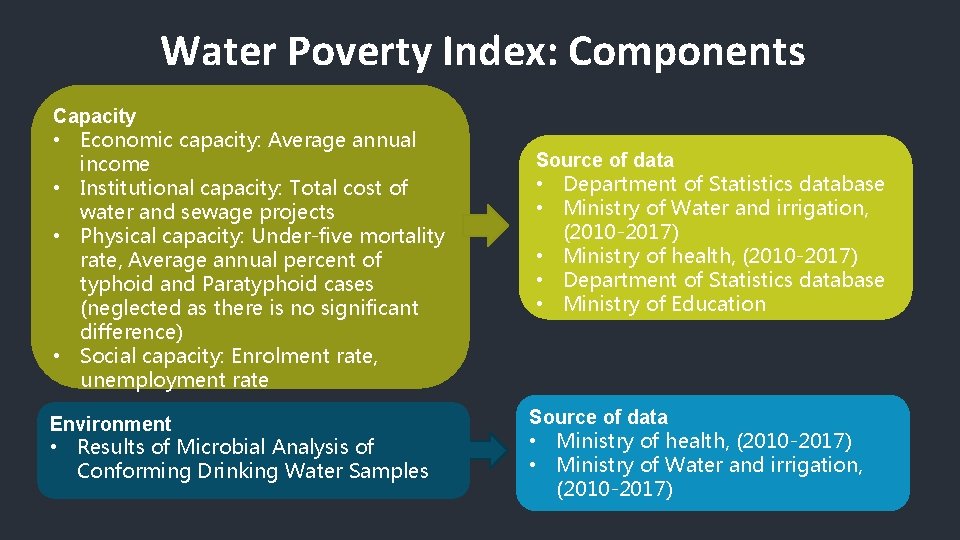
Water Poverty Index: Components Capacity • Economic capacity: Average annual income • Institutional capacity: Total cost of water and sewage projects • Physical capacity: Under-five mortality rate, Average annual percent of typhoid and Paratyphoid cases (neglected as there is no significant difference) • Social capacity: Enrolment rate, unemployment rate Environment • Results of Microbial Analysis of Conforming Drinking Water Samples Source of data • Department of Statistics database • Ministry of Water and irrigation, (2010 -2017) • Ministry of health, (2010 -2017) • Department of Statistics database • Ministry of Education Source of data • Ministry of health, (2010 -2017) • Ministry of Water and irrigation, (2010 -2017)
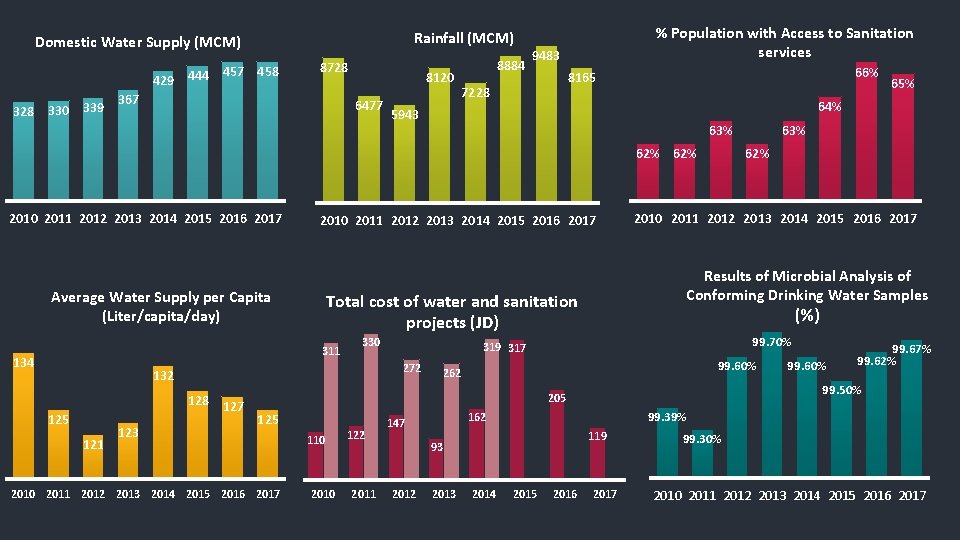
Rainfall (MCM) Domestic Water Supply (MCM) 457 458 429 444 328 330 339 8728 367 8120 6477 8884 % Population with Access to Sanitation services 9483 66% 8165 7228 64% 5943 63% 62% 2010 2011 2012 2013 2014 2015 2016 2017 Average Water Supply per Capita (Liter/capita/day) 134 330 128 127 125 121 123 62% 2010 2011 2012 2013 2014 2015 2016 2017 (%) 99. 70% 319 317 272 132 99. 60% 262 2010 2011 2012 2013 2014 2015 2016 2017 110 2010 122 2011 99. 39% 162 147 119 93 2012 2013 2014 99. 60% 99. 67% 99. 62% 99. 50% 205 125 63% Results of Microbial Analysis of Conforming Drinking Water Samples Total cost of water and sanitation projects (JD) 311 65% 2015 2016 2017 99. 30% 2010 2011 2012 2013 2014 2015 2016 2017
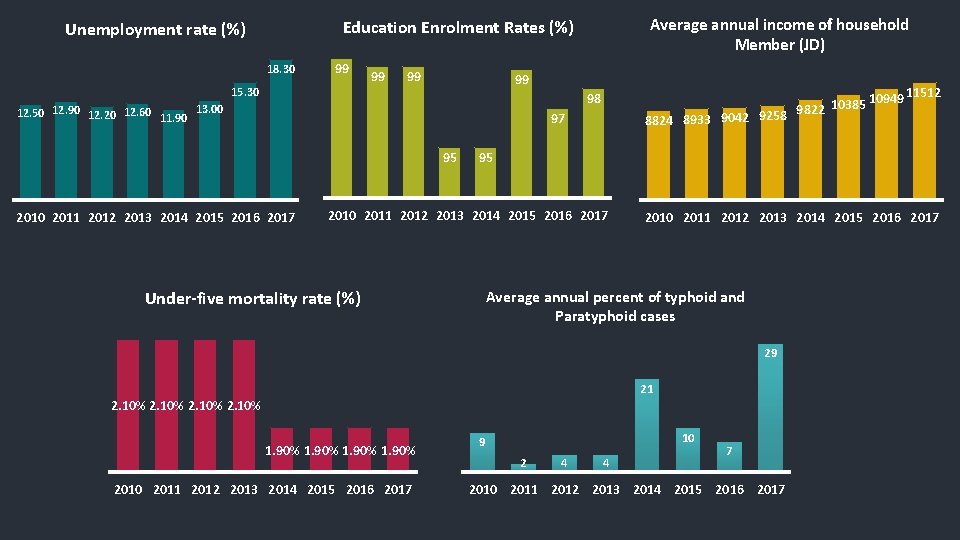
Average annual income of household Member (JD) Education Enrolment Rates (%) Unemployment rate (%) 18. 30 99 15. 30 99 99 99 10385 10949 9822 8824 8933 9042 9258 98 12. 50 12. 90 12. 20 12. 60 11. 90 13. 00 97 95 2010 2011 2012 2013 2014 2015 2016 2017 Under-five mortality rate (%) 2010 2011 2012 2013 2014 2015 2016 2017 Average annual percent of typhoid and Paratyphoid cases 29 21 2. 10% 1. 90% 2010 2011 2012 2013 2014 2015 2016 2017 11512 10 9 2 4 4 7 2010 2011 2012 2013 2014 2015 2016 2017
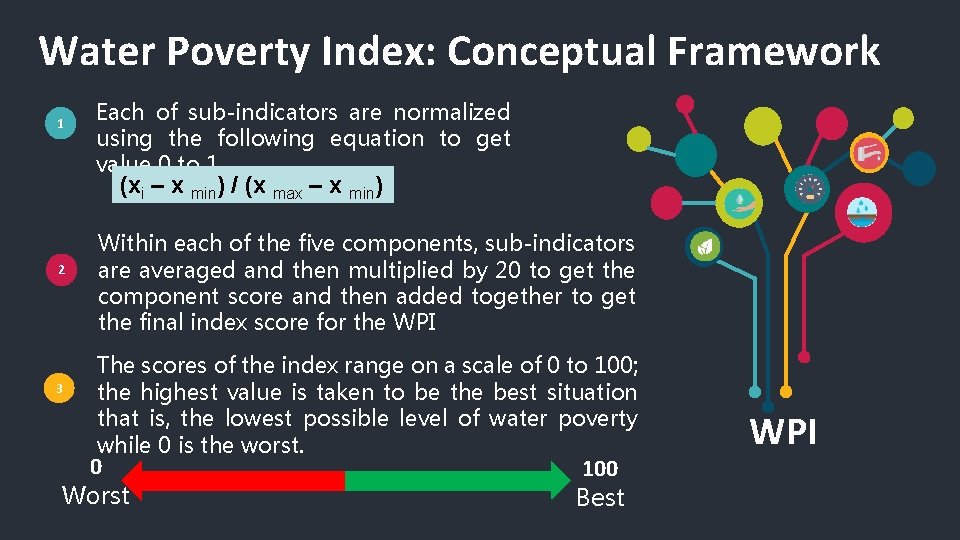
Water Poverty Index: Conceptual Framework 1 Each of sub-indicators are normalized using the following equation to get value 0 to 1 (xi – x min) / (x max – x min) 2 3 Within each of the five components, sub-indicators are averaged and then multiplied by 20 to get the component score and then added together to get the final index score for the WPI The scores of the index range on a scale of 0 to 100; the highest value is taken to be the best situation that is, the lowest possible level of water poverty while 0 is the worst. 0 Worst 100 Best WPI
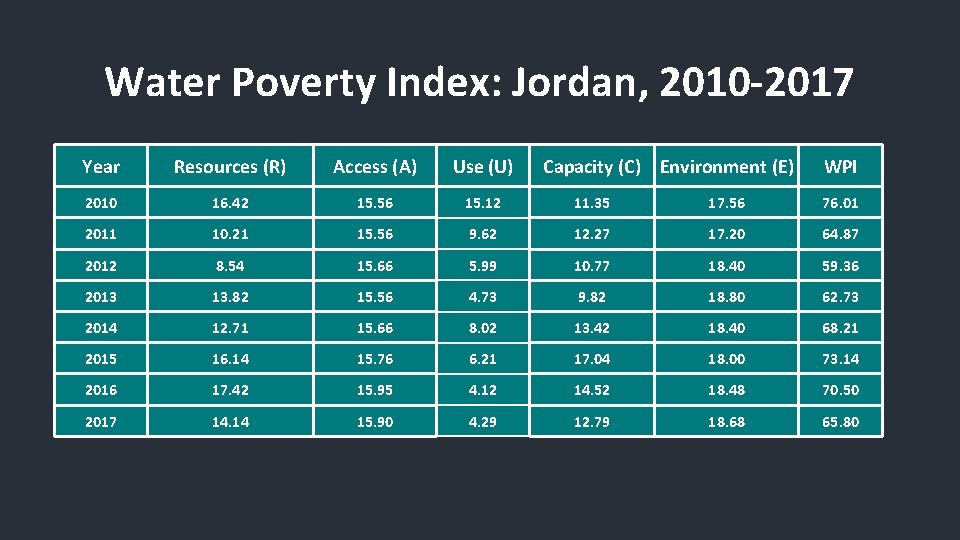
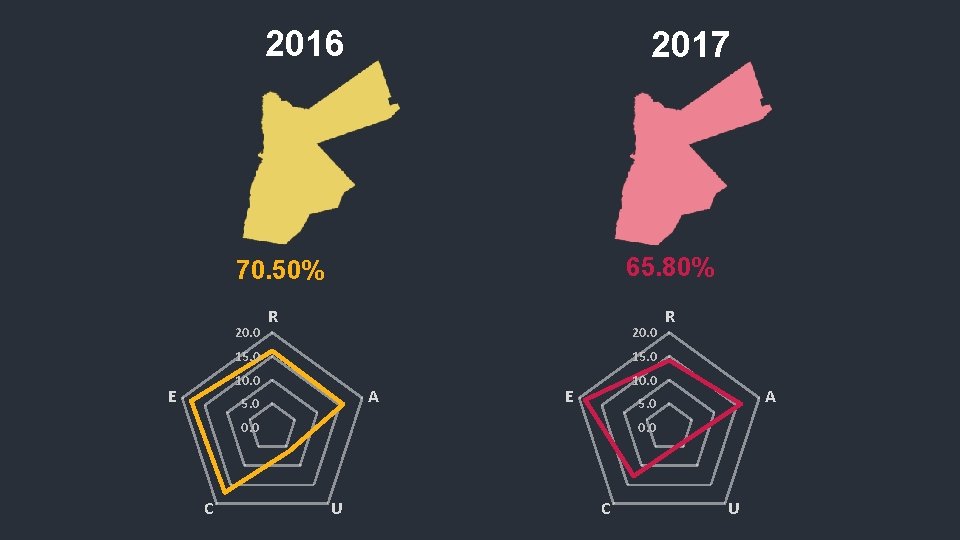
Water Poverty Index: Jordan, 2010 -2017 Year Resources (R) Access (A) Use (U) Capacity (C) Environment (E) WPI 2010 16. 42 15. 56 15. 12 11. 35 17. 56 76. 01 2011 10. 21 15. 56 9. 62 12. 27 17. 20 64. 87 2012 8. 54 15. 66 5. 99 10. 77 18. 40 59. 36 2013 13. 82 15. 56 4. 73 9. 82 18. 80 62. 73 2014 12. 71 15. 66 8. 02 13. 42 18. 40 68. 21 2015 16. 14 15. 76 6. 21 17. 04 18. 00 73. 14 2016 17. 42 15. 95 4. 12 14. 52 18. 48 70. 50 2017 14. 14 15. 90 4. 29 12. 79 18. 68 65. 80
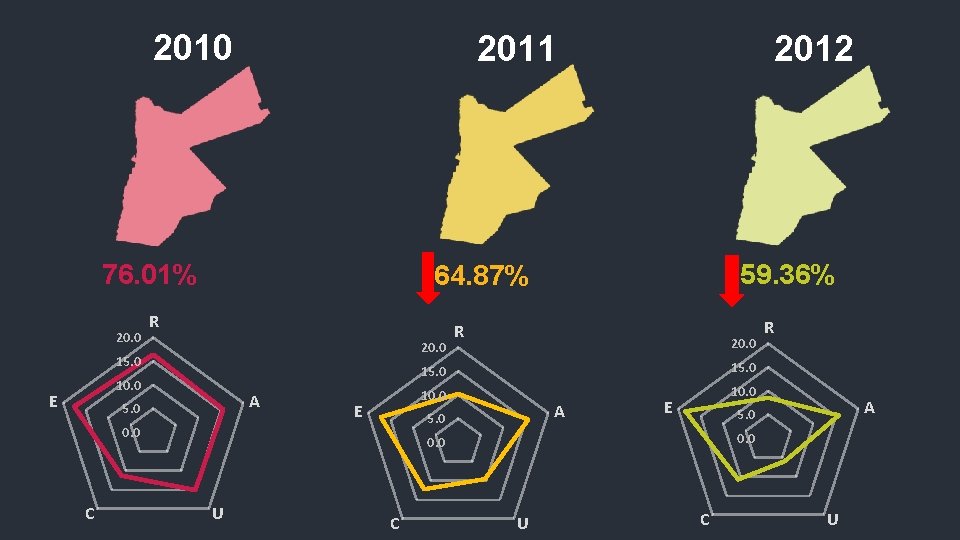
2010 2011 76. 01% 20. 0 R 20. 0 10. 0 A 5. 0 E R 20. 0 15. 0 10. 0 A 5. 0 0. 0 C 59. 36% 64. 87% 15. 0 E 2012 E C A 5. 0 0. 0 U R U C U
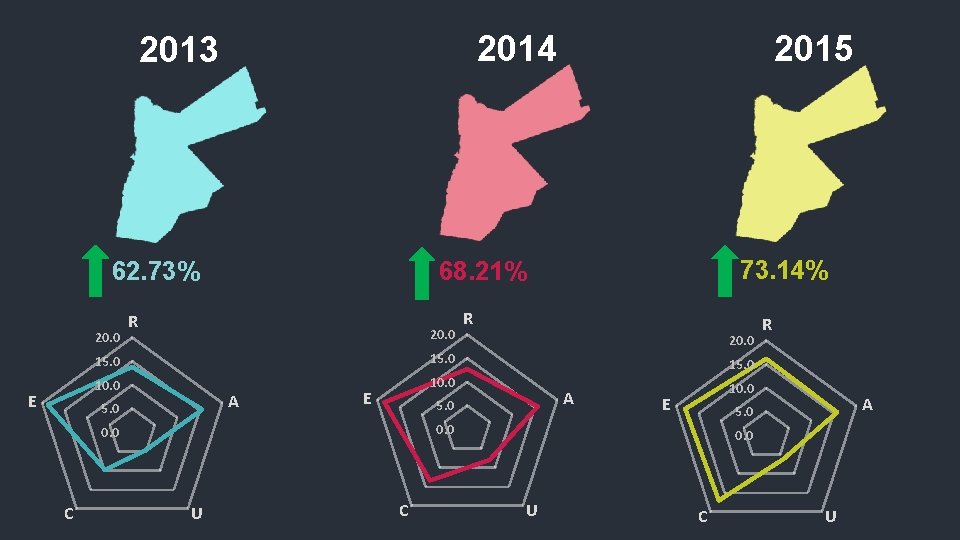
2014 2013 62. 73% 20. 0 E 20. 0 15. 0 10. 0 A E R 20. 0 A 10. 0 E C A 5. 0 0. 0 U R 15. 0 0. 0 C 73. 14% 68. 21% R 5. 0 2015 0. 0 U C U
2016 2017 65. 80% 70. 50% 20. 0 E R 20. 0 15. 0 10. 0 A 5. 0 E A 5. 0 0. 0 C R 0. 0 U C U
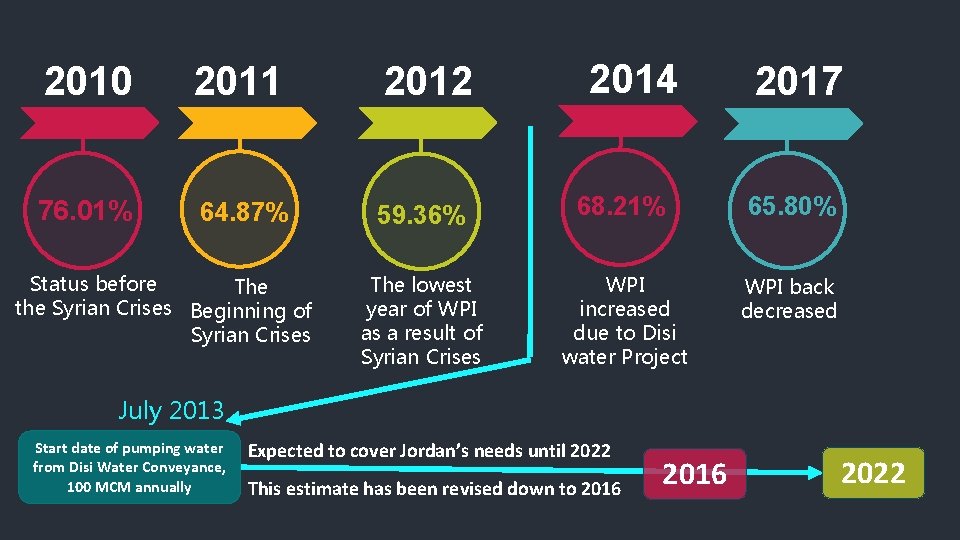
2014 2010 2011 2012 76. 01% 64. 87% 59. 36% 68. 21% 65. 80% The lowest year of WPI as a result of Syrian Crises WPI increased due to Disi water Project WPI back decreased Status before The the Syrian Crises Beginning of Syrian Crises 2017 July 2013 Start date of pumping water from Disi Water Conveyance, 100 MCM annually Expected to cover Jordan’s needs until 2022 This estimate has been revised down to 2016 2022
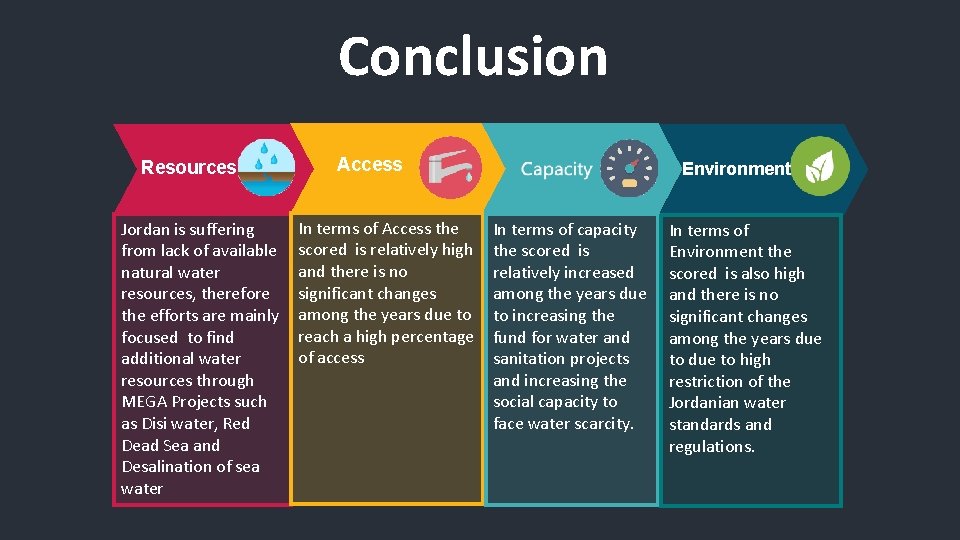
Conclusion Resources Jordan is suffering from lack of available natural water resources, therefore the efforts are mainly focused to find additional water resources through MEGA Projects such as Disi water, Red Dead Sea and Desalination of sea water Access In terms of Access the scored is relatively high and there is no significant changes among the years due to reach a high percentage of access Environment In terms of capacity the scored is relatively increased among the years due to increasing the fund for water and sanitation projects and increasing the social capacity to face water scarcity. In terms of Environment the scored is also high and there is no significant changes among the years due to high restriction of the Jordanian water standards and regulations.
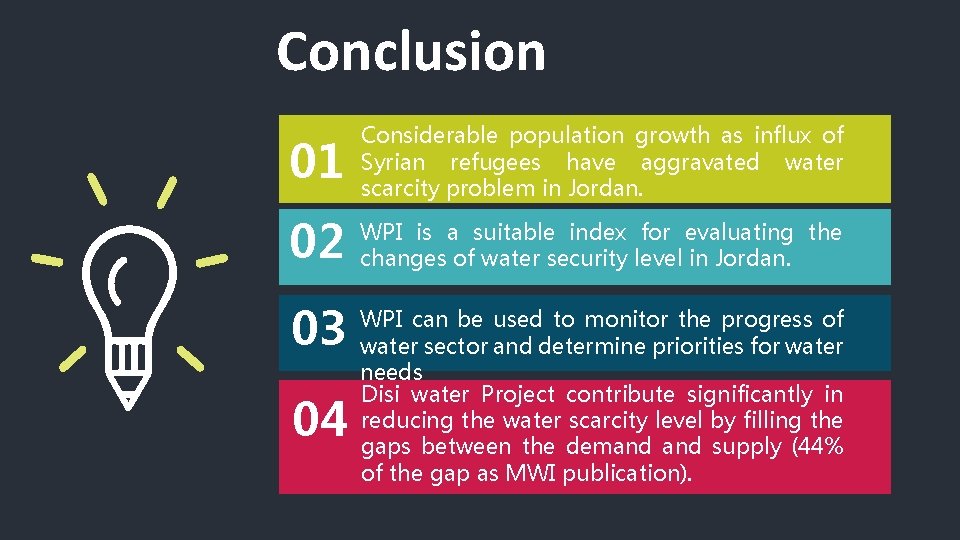
Conclusion 01 Considerable population growth as influx of Syrian refugees have aggravated water scarcity problem in Jordan. 02 WPI is a suitable index for evaluating the changes of water security level in Jordan. 03 WPI can be used to monitor the progress of water sector and determine priorities for water needs Disi water Project contribute significantly in reducing the water scarcity level by filling the gaps between the demand supply (44% of the gap as MWI publication). 04
THANK YOU FOR LISTENING D N TH E E