
Assessing and Dealing with the Impact of Imputation
- Slides: 18
Assessing and Dealing with the Impact of Imputation through Variance Estimation Eric Rancourt Statistics Canada UN/ECE Work Session on Statistical Data Editing Ottawa, 16 -18 May 2005
Outline n n n Context Impact of imputation GENESIS SEVANI Outlook Conclusion
Context n n Nonresponse / unusable data Imputation n Attractive (complete files, simple) Quality (auxiliary information) Impacts
Measuring the impact of Imputation n Model assessment n Simulations n Variance estimation
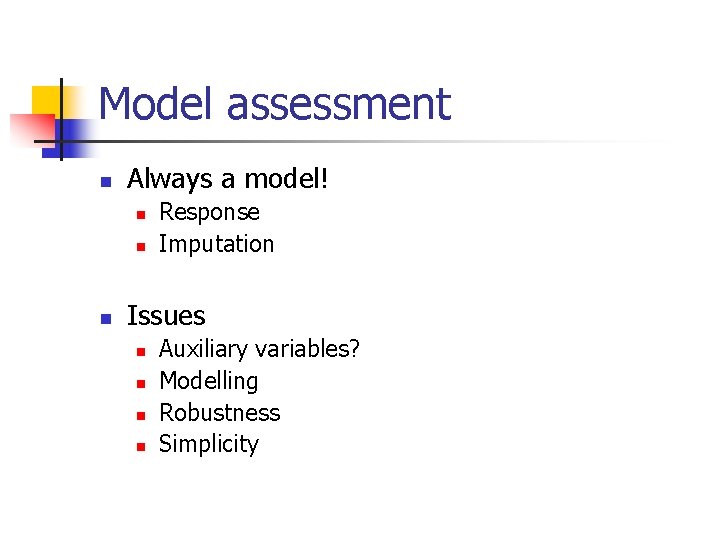
Model assessment n Always a model! n n n Response Imputation Issues n n Auxiliary variables? Modelling Robustness Simplicity
Simulations n Comparisons of methods n Quantitative information n Controlled experiment n Learning tool
Variance estimation Purpose n Knowledge of quality n Correct inference n Reporting to users n Evaluation of methods n Budget (re-)allocation
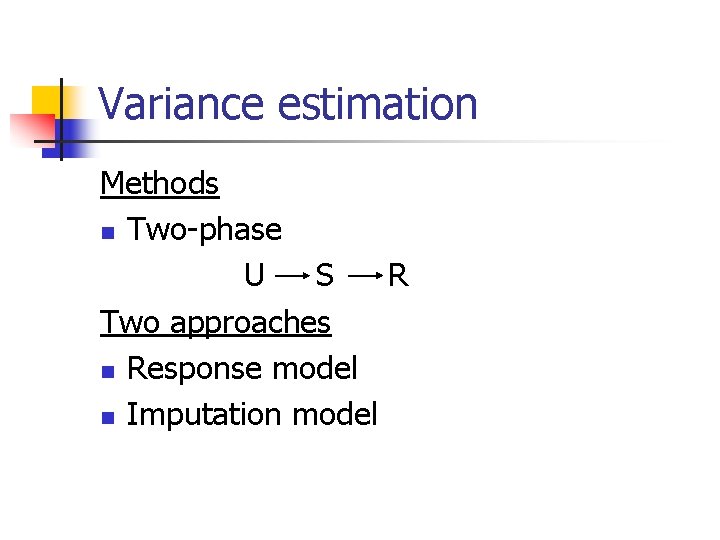
Variance estimation Methods n Two-phase U S R Two approaches n Response model n Imputation model
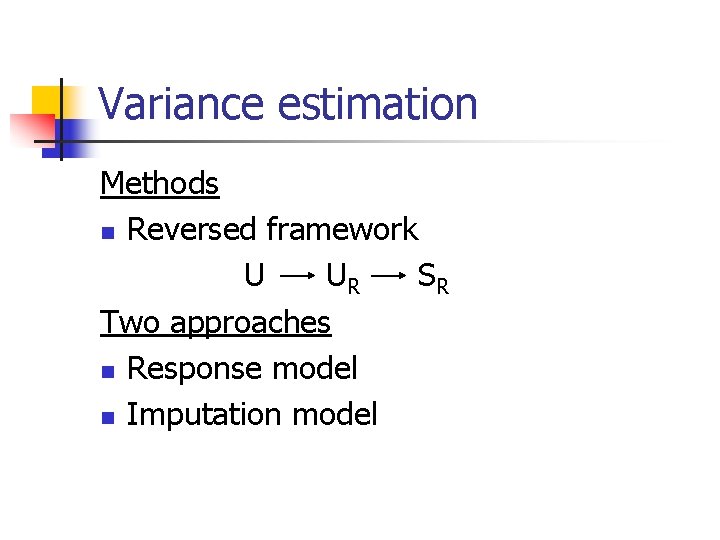
Variance estimation Methods n Reversed framework U UR SR Two approaches n Response model n Imputation model
Variance estimation Implementation Issues n Full response method n Need for separate components n Internal vs external users n Design & estimation n Simplicity
Measuring the impact of imputation at Statistics Canada Modelling: Training, Research Simulations: GENESIS Variance estimation: SEVANI
GENESIS n Evaluation n Tests n Simulations
GENESIS 3 modules: n Full response n Imputation/re-weighting classes
SEVANI n n n Production (variance estimation) Nonresponse and Imputation Provides n n Components Relative importance
SEVANI n Any design n Broad families of imputation n Quasi-multi-phase framework (Nonresponse and/or imputation model)
Outlook Applications of variance estimation n Manual imputation n Editing
Outlook Research avenues n Combining surveys and administrative data n Rolling surveys & Censuses n Multi-level imputation
Conclusion n Imputation n Evaluation methods n n n Impact Model assessment Simulations Variance estimation STC tools GENESIS, SEVANI A lot accomplished, need full implementation