
Assessing a Food Safety Behavior Questionnaire for Criterion
Assessing a Food Safety Behavior Questionnaire for Criterion Validity Patricia Kendall, Mary Schroeder, Kelly Sinclair & Anne Elsbernd Colorado State University Lydia Medeiros and Gang Chen The Ohio State University Virginia Hillers and Verna Bergman Washington State University
Introduction • Food safety education programs generally rely on self-reported behavioral questions administered pre and post education to measure program impact. • Observational studies indicate that errors in food handling are more common than reported on questionnaires (Jay et al. 1999; Anderson et al. , 2000)
Purpose • Develop a validated bank of food safety behavior questions that could be used with confidence when evaluating consumer education programs. • Determine if self-reported behaviors can be a valid way to assess behavioral outcomes of food safety education programs among lowincome groups. Medeiros, Hillers, Kendall 1999 -2001 UDSA grant #99 -35201 -8126
Development of Behavioral Questions • Sub-group (n=8) from Expert Panel developed behavioral questions for each of 29 behaviors identified by Expert Panel as being important in reducing risk of foodborne illness in the home. • First draft reviewed for content and face validity by tri-state team, faculty in three states, and 2 groups from target audience. • Questionnaire revised and shortened based on feedback received.
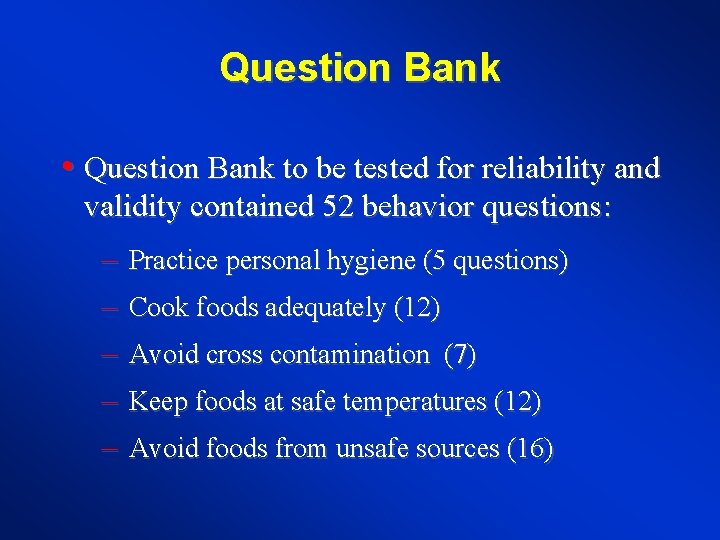
Question Bank • Question Bank to be tested for reliability and validity contained 52 behavior questions: – – – Practice personal hygiene (5 questions) Cook foods adequately (12) Avoid cross contamination (7) Keep foods at safe temperatures (12) Avoid foods from unsafe sources (16)
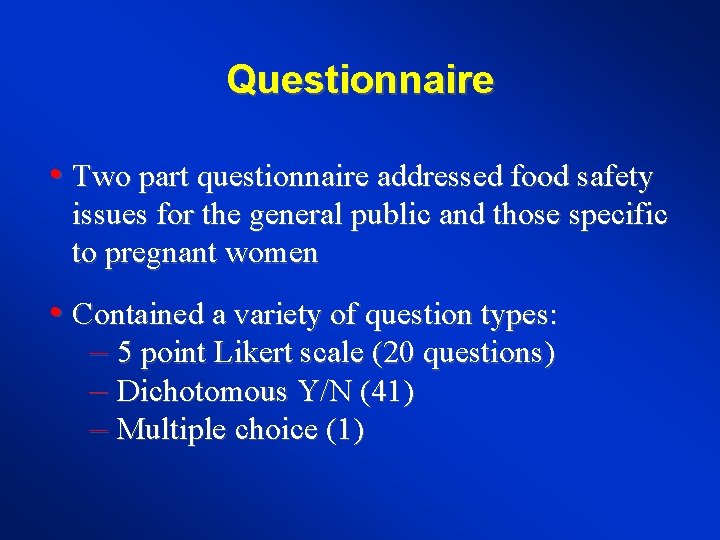
Questionnaire • Two part questionnaire addressed food safety issues for the general public and those specific to pregnant women • Contained a variety of question types: – 5 point Likert scale (20 questions) – Dichotomous Y/N (41) – Multiple choice (1)
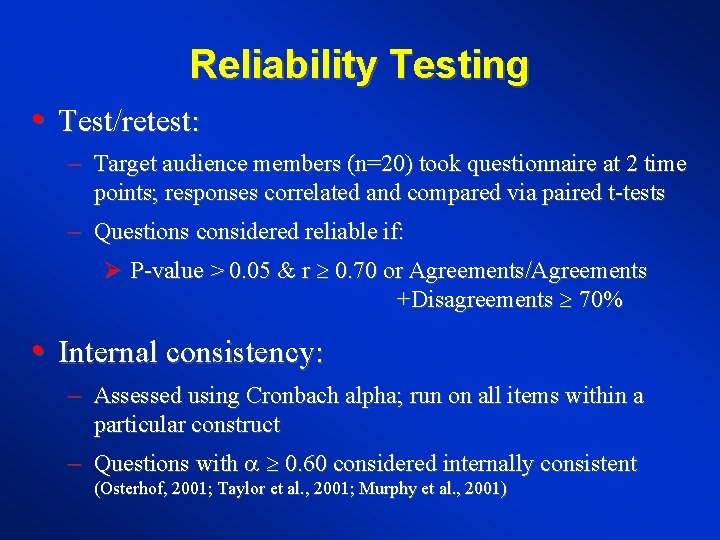
Reliability Testing • Test/retest: – Target audience members (n=20) took questionnaire at 2 time points; responses correlated and compared via paired t-tests – Questions considered reliable if: Ø P-value > 0. 05 & r 0. 70 or Agreements/Agreements +Disagreements 70% • Internal consistency: – Assessed using Cronbach alpha; run on all items within a particular construct – Questions with 0. 60 considered internally consistent (Osterhof, 2001; Taylor et al. , 2001; Murphy et al. , 2001)
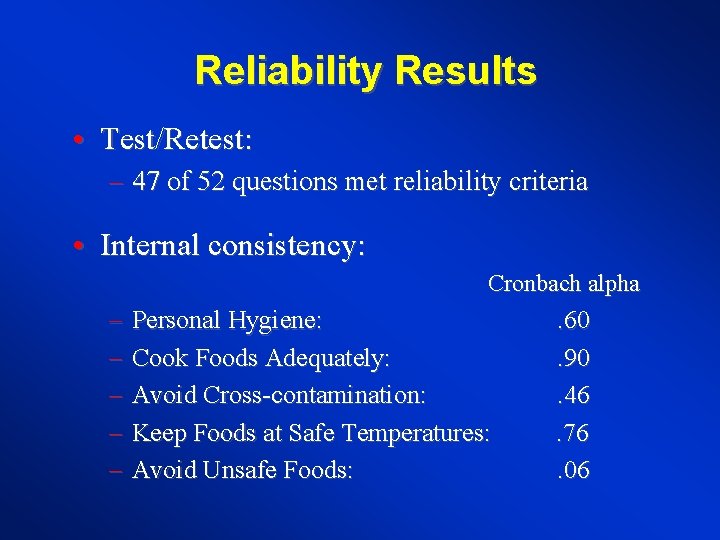
Reliability Results • Test/Retest: – 47 of 52 questions met reliability criteria • Internal consistency: Cronbach alpha – – – Personal Hygiene: Cook Foods Adequately: Avoid Cross-contamination: Keep Foods at Safe Temperatures: Avoid Unsafe Foods: . 60. 90. 46. 76. 06
Validity • Degree to which an instrument measures what it is intended to measure • Assessed several types of validity: – Content Validity: Reflects domain of content to be measured – Face Validity: Measures what intended to measure – Criterion Validity: Correlates with other more accurate instrument
Validity Testing • Criterion Validity – focus of this study. • Established by comparing questionnaire response to observed behavior and interview responses during a kitchen activity session held ~ one week later.
Validation Study Subjects • 70 FSNEP and EFNEP participants in CO, WA, and OH – 50 post education only – 20 pre and post education • Primary food preparers • Had completed an education program that included a 30 - to 60 -minute food safety component
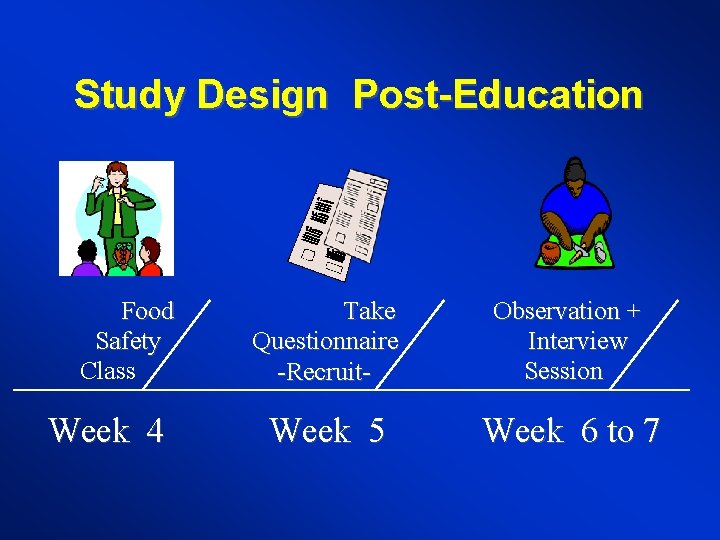
Study Design Post-Education Food Safety Class Week 4 Take Questionnaire -Recruit- Observation + Interview Session Week 5 Week 6 to 7
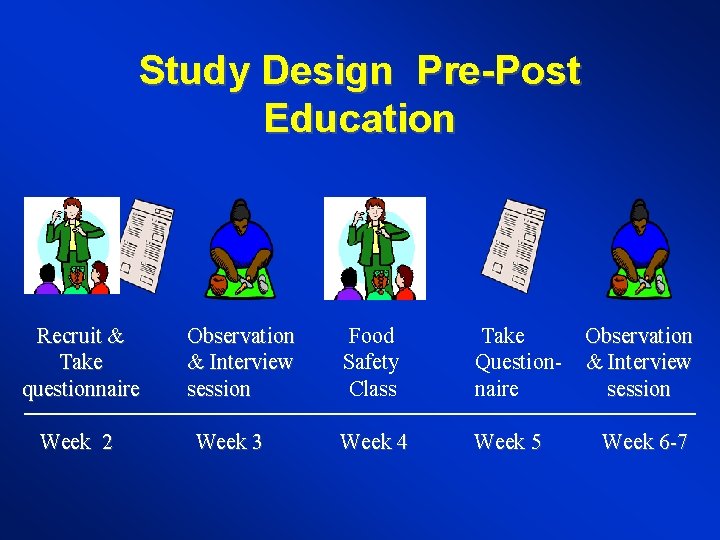
Study Design Pre-Post Education Recruit & Take questionnaire Week 2 Observation & Interview session Week 3 Food Safety Class Take Questionnaire Week 4 Week 5 Observation & Interview session Week 6 -7

Kitchen Activity Session • Cooking Observation in Community Kitchen: – – Cook a chicken breast to desired doneness Slice an apple to garnish the chicken Cook a hamburger to desired doneness Slice a tomato to go with the hamburger • In-depth interview – Asked the same questions on the questionnaire in a conversational, open-ended manner
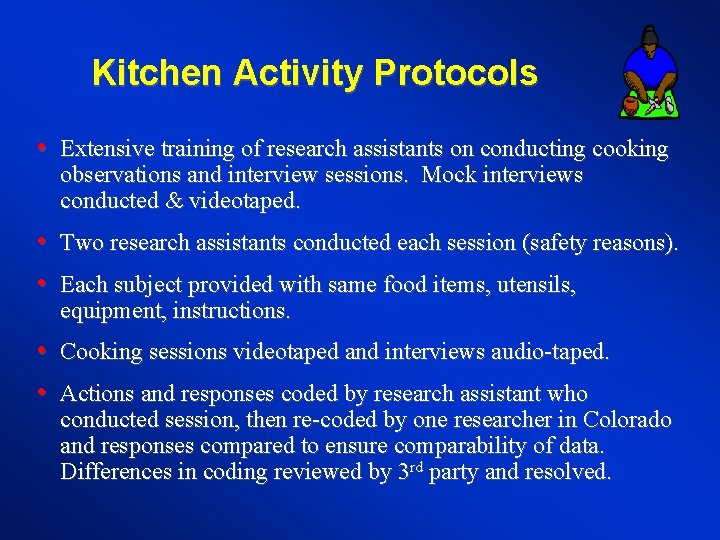
Kitchen Activity Protocols • Extensive training of research assistants on conducting cooking observations and interview sessions. Mock interviews conducted & videotaped. • Two research assistants conducted each session (safety reasons). • Each subject provided with same food items, utensils, equipment, instructions. • Cooking sessions videotaped and interviews audio-taped. • Actions and responses coded by research assistant who conducted session, then re-coded by one researcher in Colorado and responses compared to ensure comparability of data. Differences in coding reviewed by 3 rd party and resolved.
Limitations • Non-randomized design • Observations not performed in homes – No interruptions – Subjects could focus on food preparation/cooking • Intervention for pre/post design wasn’t controlled
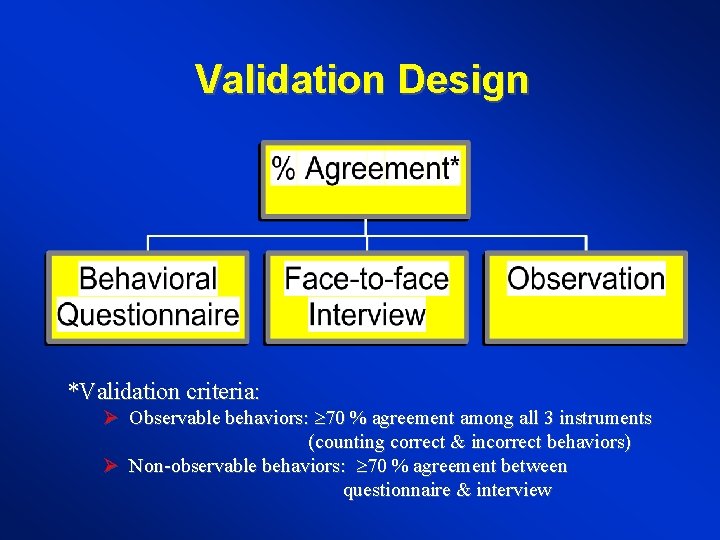
Validation Design *Validation criteria: Ø Observable behaviors: 70 % agreement among all 3 instruments (counting correct & incorrect behaviors) Ø Non-observable behaviors: 70 % agreement between questionnaire & interview
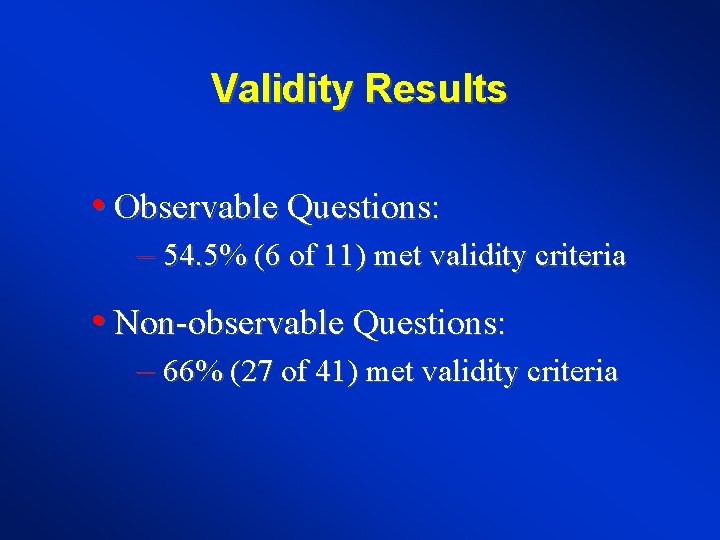
Validity Results • Observable Questions: – 54. 5% (6 of 11) met validity criteria • Non-observable Questions: – 66% (27 of 41) met validity criteria
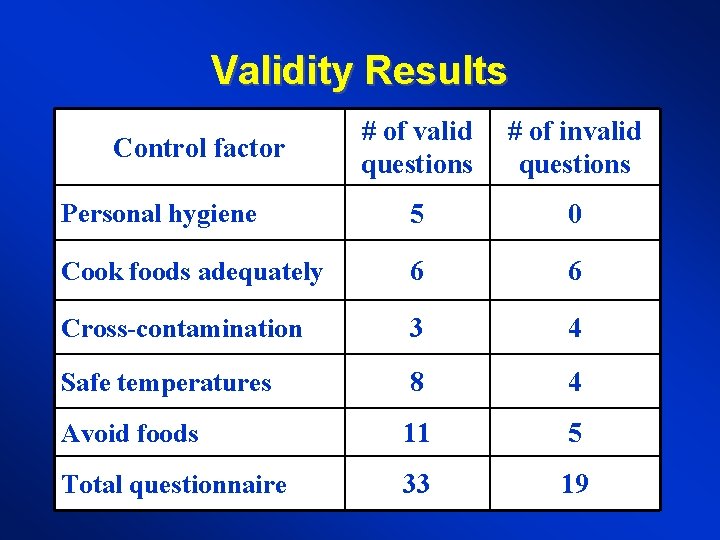
Validity Results # of valid questions # of invalid questions Personal hygiene 5 0 Cook foods adequately 6 6 Cross-contamination 3 4 Safe temperatures 8 4 Avoid foods 11 5 Total questionnaire 33 19 Control factor
Instrument Sensitivity • Potential ceiling effect: – Good questions are those that capture range of responses – Looked for questions that 20 -80% gave less desirable response at pre education • Change in mean scores from pre to post education (n=20) (Parmenter and Wardle, JNE 32: 269; 2000)
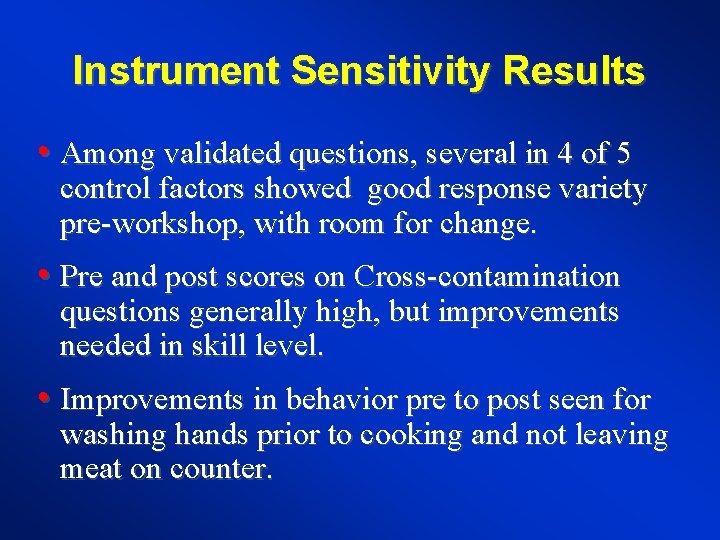
Instrument Sensitivity Results • Among validated questions, several in 4 of 5 control factors showed good response variety pre-workshop, with room for change. • Pre and post scores on Cross-contamination questions generally high, but improvements needed in skill level. • Improvements in behavior pre to post seen for washing hands prior to cooking and not leaving meat on counter.
Conclusions • 33 of 52 behavioral questions met reliability and validity criteria ( 70% agreement), including several questions from each pathogen control factor. • Agreement between observed and self-reported behaviors was better when incorrectly performed behaviors were included. • Further study is needed using these questions in educational settings with controlled interventions.

Thank You !
- Slides: 23