
Assessig the ears and hearing Prepared by Eman
Assessig the ears and hearing Prepared by/ Eman
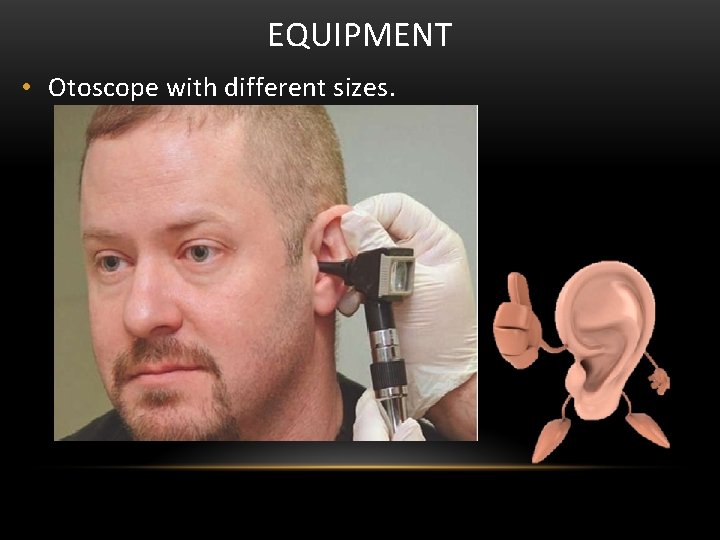
EQUIPMENT • Otoscope with different sizes.
PREPARATION • Assessment should be in a quiet area. • Position the patient at the same level as the nurse. • Ask about any history of the following: family history of hearing problem or hearing loss, medication history especially if there are complains of tinnitus.
PROCEDURE • Step 1: Introduce self and verify patient's identity. • Step 2: Explain procedure to patient. • Step 3: Gather appropriate equipment. • Step 4: Perform hand hygiene. • Step 5: Provide for patient privacy. • Step 6: Maintain body mechanics.
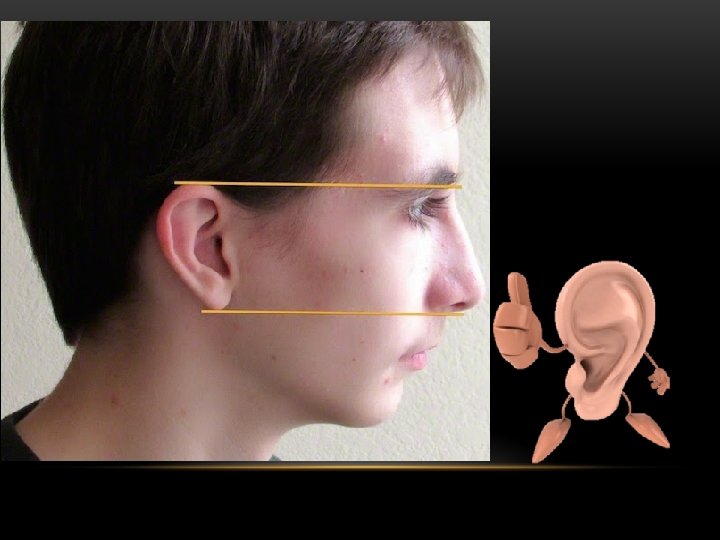
PROCEDURE • Step 7: Inspect and palpate the external ear, including alignment and pinna. Observe the shape, color and size of the ear. • Rational: a- Identifies signs and symptoms of illness or disease of the ear. b-Check for normal alignment that the top of the ear crosses an imaginary line from eye to occiput. c-Check for abnormal findings of excess wax, drainage, deformities, nodules, inflammation and pain.
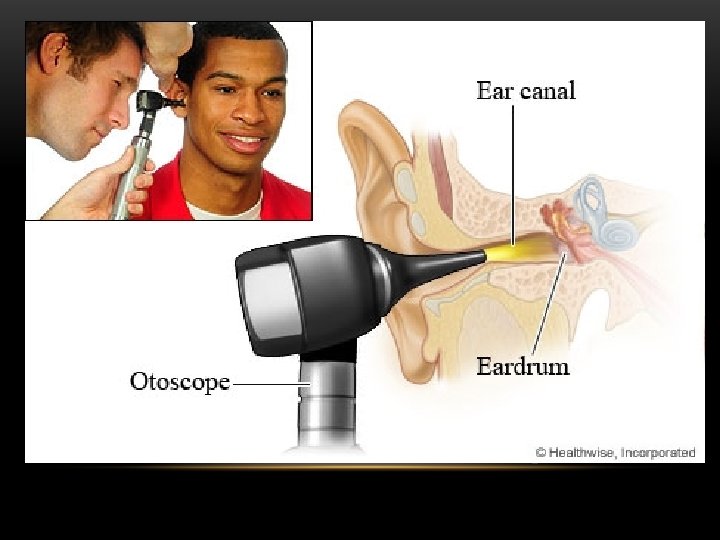
PROCEDURE • Proceed with an otoscope assessment: • Step 8: Identify the tympanic membrane and observe Rationale: Establish the quality of tympanic membrane movement; detect bulging and abnormal or discolored middle ear fluid.
PROCEDURE • Step 9: Check the patient's hearing acuity, note responses to normal sounds, conduct watch tick test and rinne test.
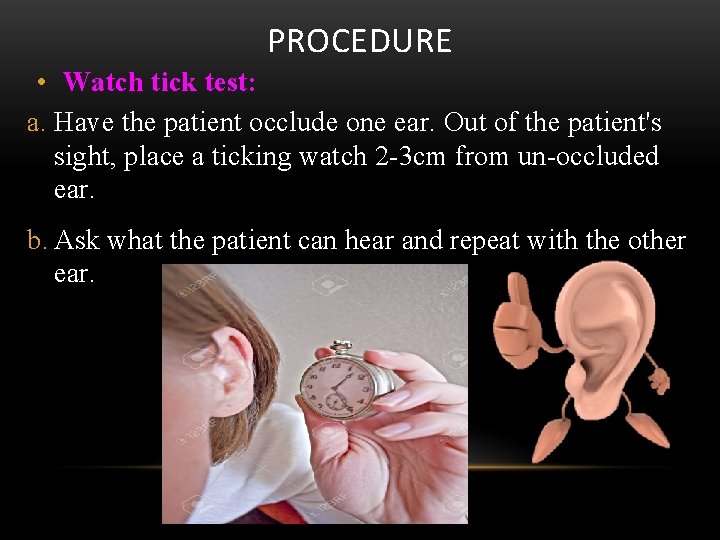
PROCEDURE • Watch tick test: a. Have the patient occlude one ear. Out of the patient's sight, place a ticking watch 2 -3 cm from un-occluded ear. b. Ask what the patient can hear and repeat with the other ear.
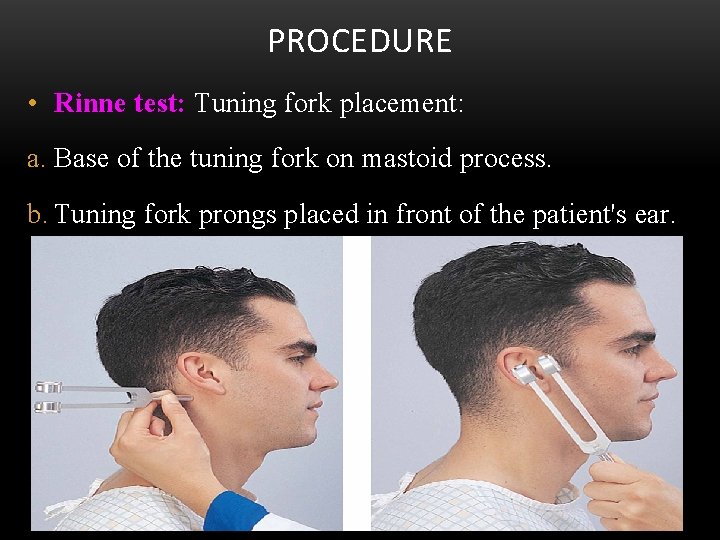
PROCEDURE • Rinne test: Tuning fork placement: a. Base of the tuning fork on mastoid process. b. Tuning fork prongs placed in front of the patient's ear.
PROCEDURE • Step 10: Wash hands. • Step 11: Rearrange the equipment. • Step 12: Maintain the comfortable position for the patient. • Step 13: Documentation:
- Slides: 13