
Assembly Language Part IV The FLAGS Register Department
Assembly Language Part IV The FLAGS Register Department of Computer Science, Faculty of Science, Chiang Mai University
Outline • The FLAGS Register • Overflow • How Instruction Affect the Flags 204231: Computer Organization and Architecture 2
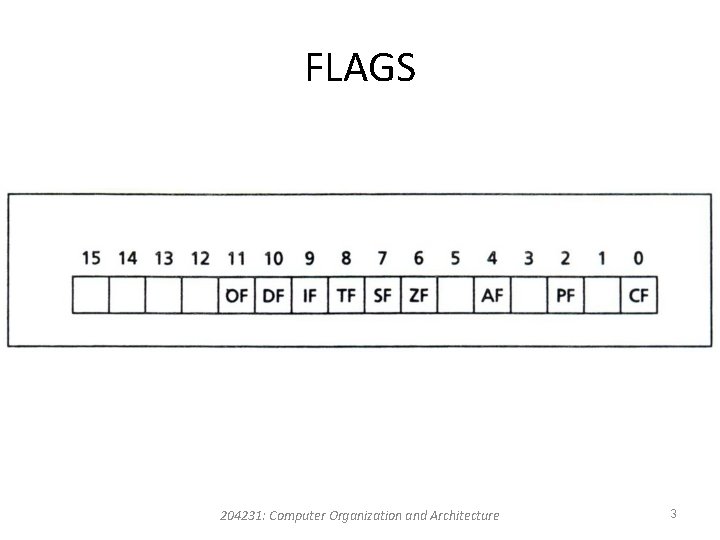
FLAGS 204231: Computer Organization and Architecture 3
The Status Flags • The processor uses the status flags to reflect the result of an operation. • The status flags are located in bits 0, 2, 4, 6, 7, and 11. 204231: Computer Organization and Architecture 4
Carry Flag (CF) • CF = 1 if there is a carry out of msb on addition, or there is a borrow into msb on subtraction; otherwise, CF = 0. 204231: Computer Organization and Architecture 5
Parity Flag (PF) • PF = 1 if the low byte of a result has an even number of one bits (even parity). • PF = 0 if the low byte has odd parity. 204231: Computer Organization and Architecture 6
Auxiliary Carry Flag (AF) • AF = 1 if there is a carry out from bit 3 on addition, or a borrow into bit 3 on subtraction. 204231: Computer Organization and Architecture 7
Zero Flag (ZF) • ZF = 1 for a zero result. • ZF = 0 for a nonzero result. 204231: Computer Organization and Architecture 8
Sign Flag (SF) • SF = 1 if the msb of a result is 1; it means the result is negative if you are giving a signed interpretation. • SF = 0 if the msb is 0. • SF = MSB 204231: Computer Organization and Architecture 9
Overflow Flag (OF) • OF = 1 if signed overflow occurred, otherwise OF = 0. 204231: Computer Organization and Architecture 10
![Decimal Range BYTE WORD UNSIGN [0, 255] [0, 65535] SIGN [-128, 127] [-32768, 32767]](http://slidetodoc.com/presentation_image_h/d531daddc0752252439a34d97a576214/image-11.jpg "Decimal Range BYTE WORD UNSIGN [0, 255] [0, 65535] SIGN [-128, 127] [-32768, 32767]")
Decimal Range BYTE WORD UNSIGN [0, 255] [0, 65535] SIGN [-128, 127] [-32768, 32767] 204231: Computer Organization and Architecture 11
Overflow • • No Overflow Signed Overflow Only Unsinged Overflow Only Both Overflows 204231: Computer Organization and Architecture 12
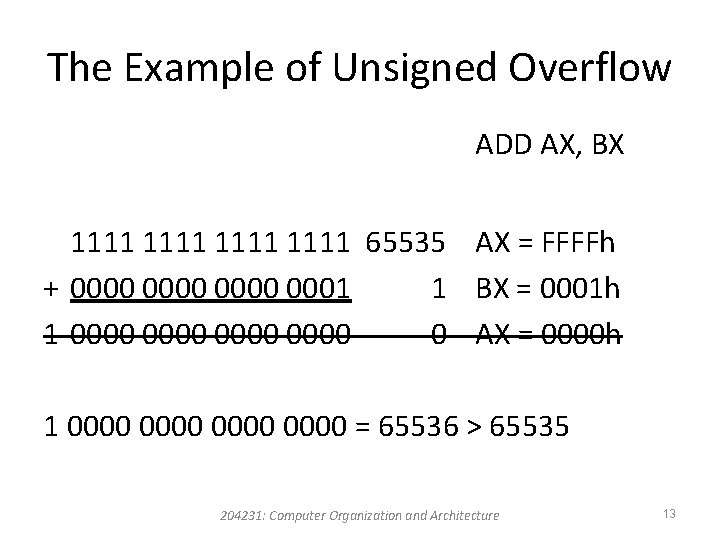
The Example of Unsigned Overflow ADD AX, BX 1111 65535 AX = FFFFh + 0000 0001 1 BX = 0001 h 1 0000 00000 AX = 0000 h 1 0000 = 65536 > 65535 204231: Computer Organization and Architecture 13
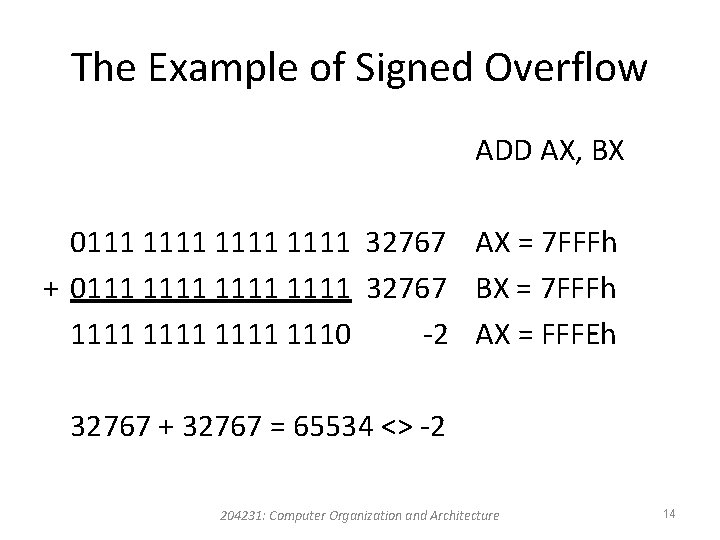
The Example of Signed Overflow ADD AX, BX 0111 1111 32767 AX = 7 FFFh + 0111 1111 32767 BX = 7 FFFh 1111 1110 -2 AX = FFFEh 32767 + 32767 = 65534 <> -2 204231: Computer Organization and Architecture 14
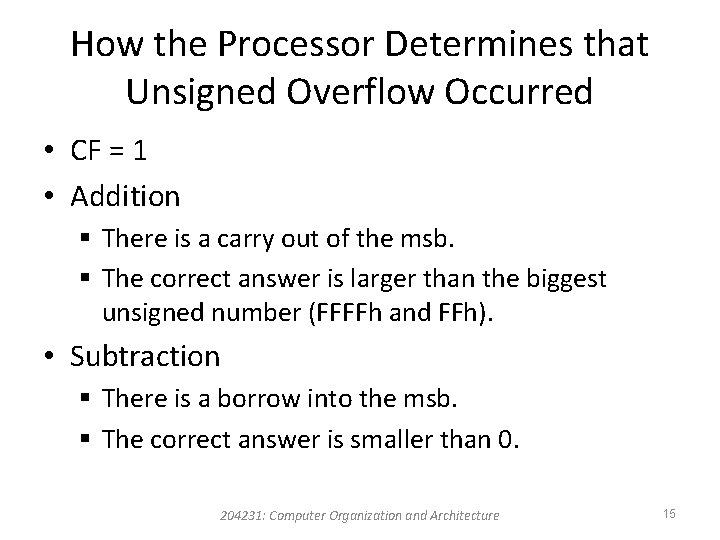
How the Processor Determines that Unsigned Overflow Occurred • CF = 1 • Addition § There is a carry out of the msb. § The correct answer is larger than the biggest unsigned number (FFFFh and FFh). • Subtraction § There is a borrow into the msb. § The correct answer is smaller than 0. 204231: Computer Organization and Architecture 15
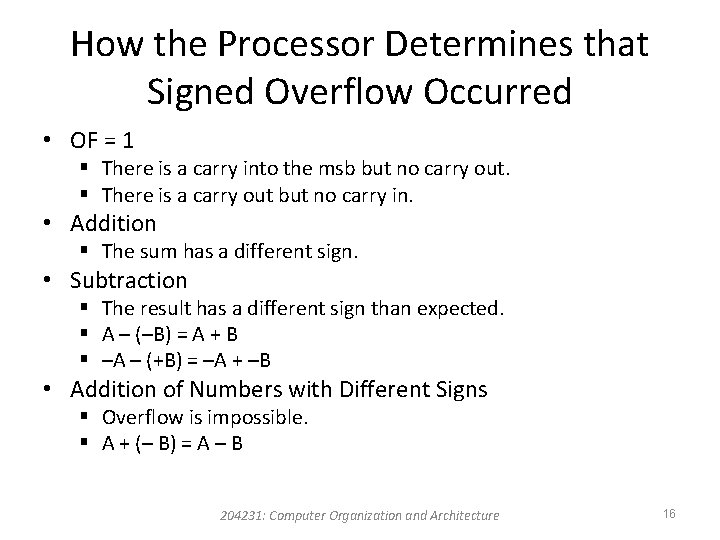
How the Processor Determines that Signed Overflow Occurred • OF = 1 § There is a carry into the msb but no carry out. § There is a carry out but no carry in. • Addition § The sum has a different sign. • Subtraction § The result has a different sign than expected. § A – (–B) = A + B § –A – (+B) = –A + –B • Addition of Numbers with Different Signs § Overflow is impossible. § A + (– B) = A – B 204231: Computer Organization and Architecture 16
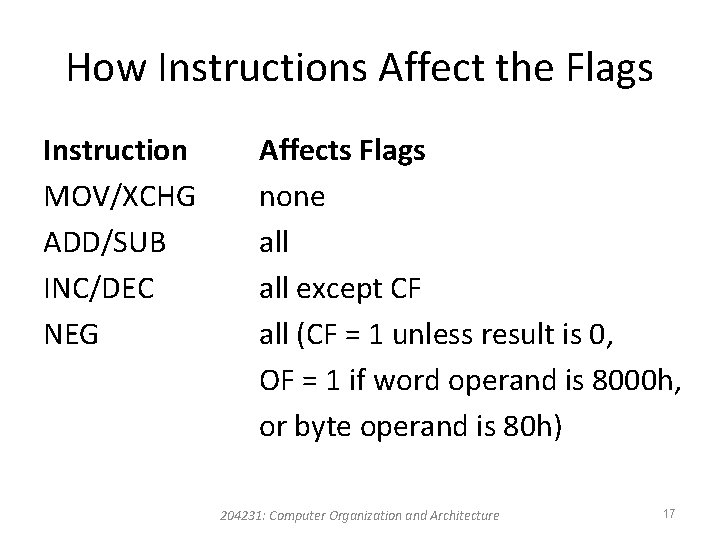
How Instructions Affect the Flags Instruction MOV/XCHG ADD/SUB INC/DEC NEG Affects Flags none all except CF all (CF = 1 unless result is 0, OF = 1 if word operand is 8000 h, or byte operand is 80 h) 204231: Computer Organization and Architecture 17
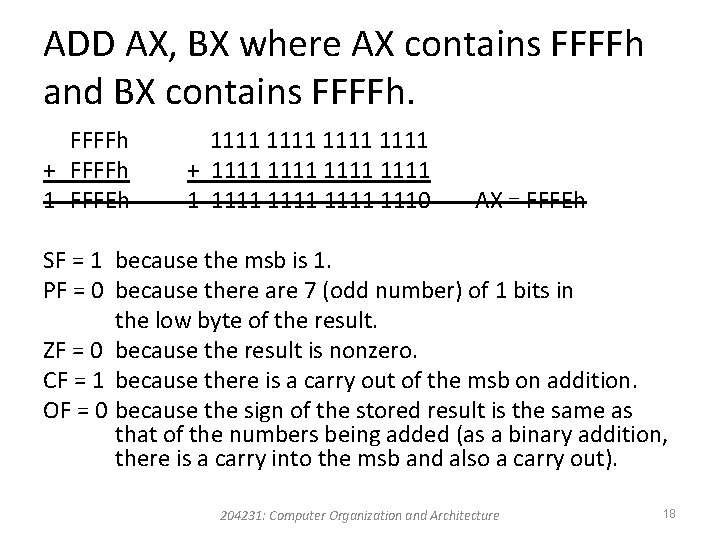
ADD AX, BX where AX contains FFFFh and BX contains FFFFh + FFFFh 1 FFFEh 1111 + 1111 1 1111 1110 AX = FFFEh SF = 1 because the msb is 1. PF = 0 because there are 7 (odd number) of 1 bits in the low byte of the result. ZF = 0 because the result is nonzero. CF = 1 because there is a carry out of the msb on addition. OF = 0 because the sign of the stored result is the same as that of the numbers being added (as a binary addition, there is a carry into the msb and also a carry out). 204231: Computer Organization and Architecture 18
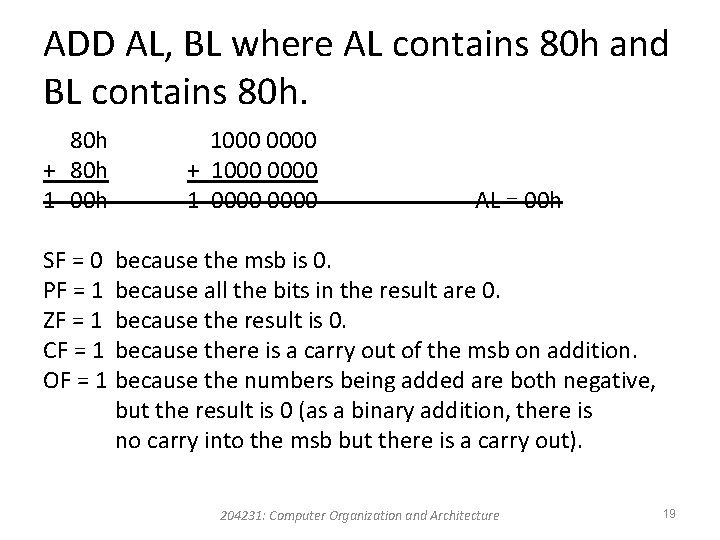
ADD AL, BL where AL contains 80 h and BL contains 80 h + 80 h 1 00 h SF = 0 PF = 1 ZF = 1 CF = 1 OF = 1 1000 0000 + 1000 0000 1 0000 AL = 00 h because the msb is 0. because all the bits in the result are 0. because the result is 0. because there is a carry out of the msb on addition. because the numbers being added are both negative, but the result is 0 (as a binary addition, there is no carry into the msb but there is a carry out). 204231: Computer Organization and Architecture 19
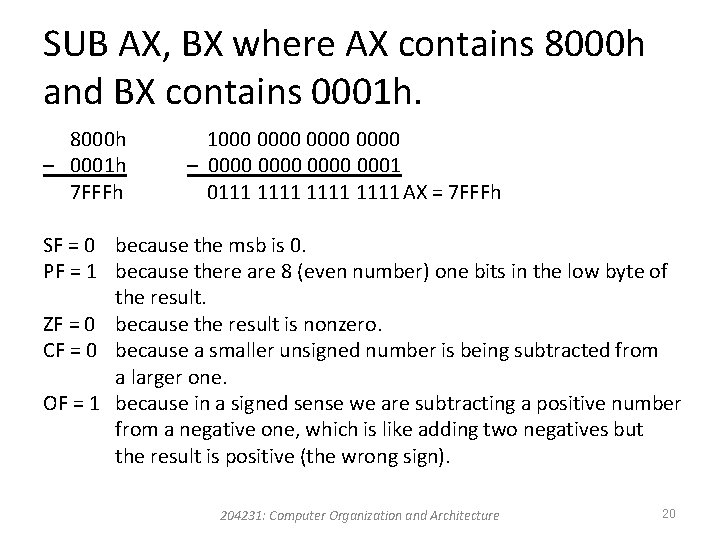
SUB AX, BX where AX contains 8000 h and BX contains 0001 h. 8000 h – 0001 h 7 FFFh 1000 0000 – 0000 0001 0111 1111 AX = 7 FFFh SF = 0 because the msb is 0. PF = 1 because there are 8 (even number) one bits in the low byte of the result. ZF = 0 because the result is nonzero. CF = 0 because a smaller unsigned number is being subtracted from a larger one. OF = 1 because in a signed sense we are subtracting a positive number from a negative one, which is like adding two negatives but the result is positive (the wrong sign). 204231: Computer Organization and Architecture 20
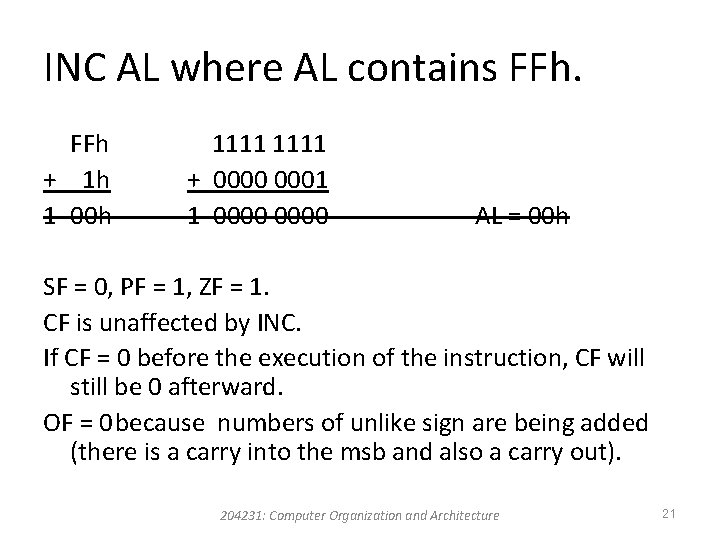
INC AL where AL contains FFh + 1 h 1 00 h 1111 + 0000 0001 1 0000 AL = 00 h SF = 0, PF = 1, ZF = 1. CF is unaffected by INC. If CF = 0 before the execution of the instruction, CF will still be 0 afterward. OF = 0 because numbers of unlike sign are being added (there is a carry into the msb and also a carry out). 204231: Computer Organization and Architecture 21
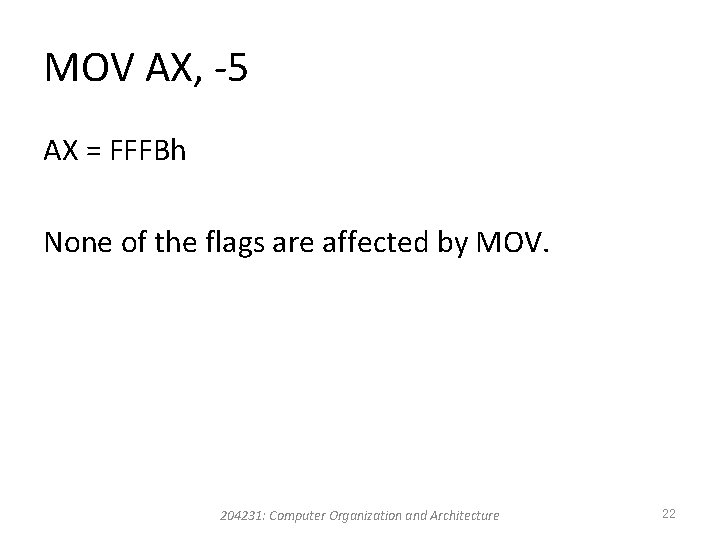
MOV AX, -5 AX = FFFBh None of the flags are affected by MOV. 204231: Computer Organization and Architecture 22
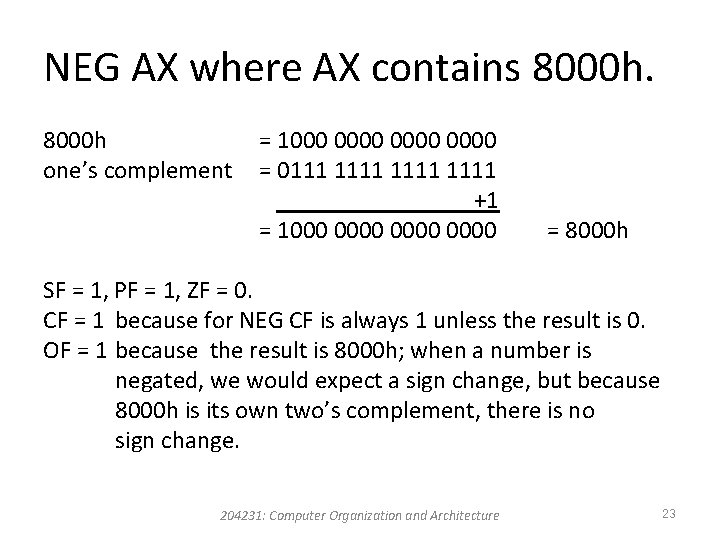
NEG AX where AX contains 8000 h one’s complement = 1000 0000 = 0111 1111 +1 = 1000 0000 = 8000 h SF = 1, PF = 1, ZF = 0. CF = 1 because for NEG CF is always 1 unless the result is 0. OF = 1 because the result is 8000 h; when a number is negated, we would expect a sign change, but because 8000 h is its own two’s complement, there is no sign change. 204231: Computer Organization and Architecture 23
Reference • Ytha Yu and Charles Marut, Assembly Language Programming and Organization of the IBM PC. New York: Mc. Graw-Hill, 1992. 204231: Computer Organization and Architecture 24
- Slides: 24