
Assembly Language for x 86 Processors 6 th
Assembly Language for x 86 Processors 6 th Edition Kip Irvine Chapter 2: x 86 Processor Architecture Slides prepared by the author Revision date: 2/15/2010 (c) Pearson Education, 2010. All rights reserved. You may modify and copy this slide show for your personal use, or for use in the classroom, as long as this copyright statement, the author's name, and the title are not changed.
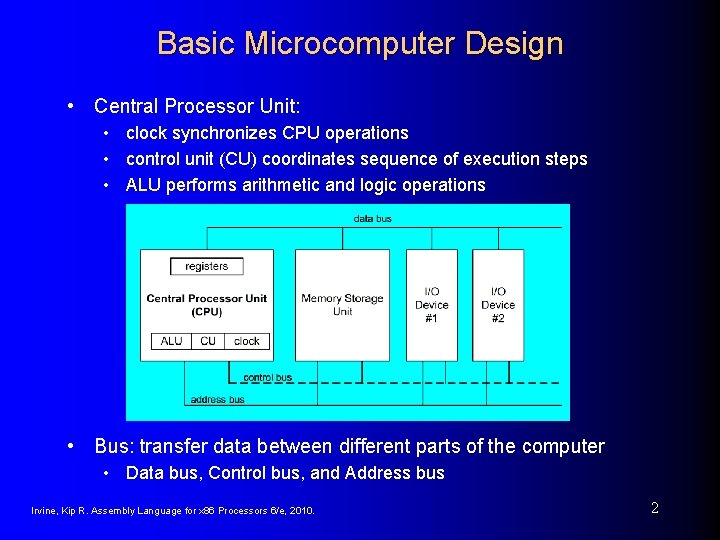
Basic Microcomputer Design • Central Processor Unit: • clock synchronizes CPU operations • control unit (CU) coordinates sequence of execution steps • ALU performs arithmetic and logic operations • Bus: transfer data between different parts of the computer • Data bus, Control bus, and Address bus Irvine, Kip R. Assembly Language for x 86 Processors 6/e, 2010. 2
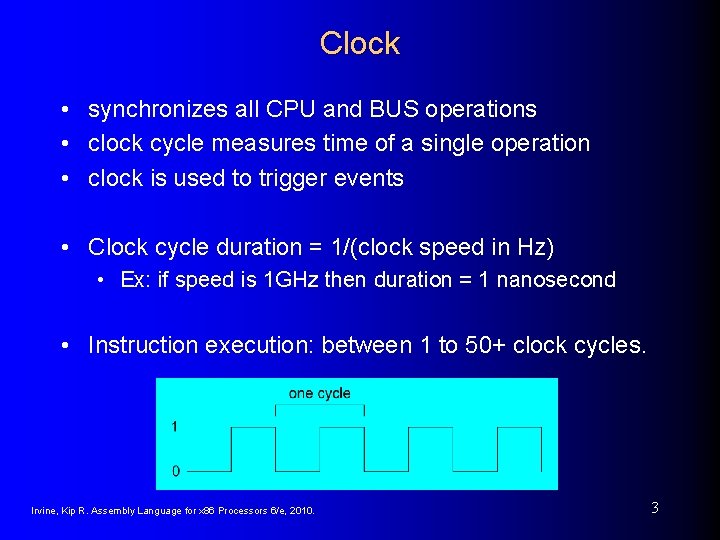
Clock • synchronizes all CPU and BUS operations • clock cycle measures time of a single operation • clock is used to trigger events • Clock cycle duration = 1/(clock speed in Hz) • Ex: if speed is 1 GHz then duration = 1 nanosecond • Instruction execution: between 1 to 50+ clock cycles. Irvine, Kip R. Assembly Language for x 86 Processors 6/e, 2010. 3
![Instruction Execution Cycle [Fetch-and-Execute Cycle] • Loop: • Fetch next instruction then increment IP](http://slidetodoc.com/presentation_image_h/002ed7b9e46973b368c4ece12ba2ea77/image-4.jpg "Instruction Execution Cycle [Fetch-and-Execute Cycle] • Loop: • Fetch next instruction then increment IP")
Instruction Execution Cycle [Fetch-and-Execute Cycle] • Loop: • Fetch next instruction then increment IP (the Instruction Pointer) • Decode the instruction • If memory operand needed then • Fetch operand’s value from memory • Execute the instruction • If result is memory operand then • Store output to memory • Continue loop Irvine, Kip R. Assembly Language for x 86 Processors 6/e, 2010. 4
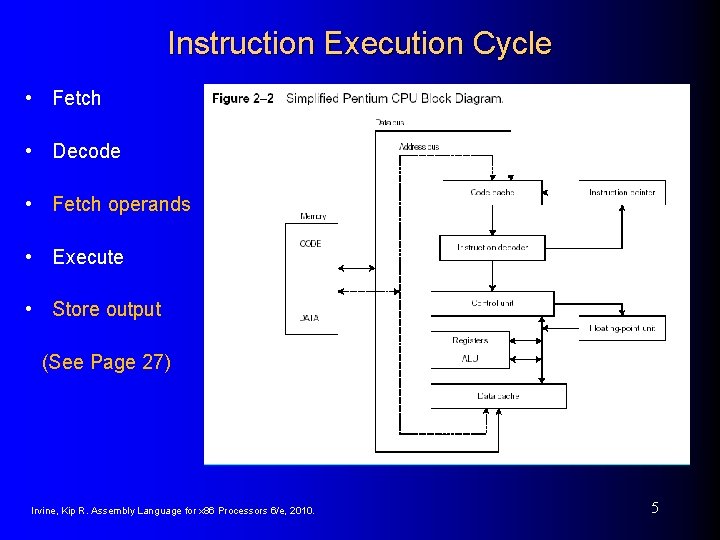
Instruction Execution Cycle • Fetch • Decode • Fetch operands • Execute • Store output (See Page 27) Irvine, Kip R. Assembly Language for x 86 Processors 6/e, 2010. 5
The Platform We Will Use § Assembly language and machine language are processor specific § We will write code for Intel’s 80 x 86 (x>=3) § IA-32 family: Intel 80386, 486, … Pentium, … § The assembler places its machine code into an object file which is OS specific § Our code will run (only) on Windows § And it will crash on DOS § Our programs will be Win 32 console applications 6 § These are programs for which all I/O operations are characterbased § They run into an MS-DOS box but they are not DOS programs (they do not use DOS calls)
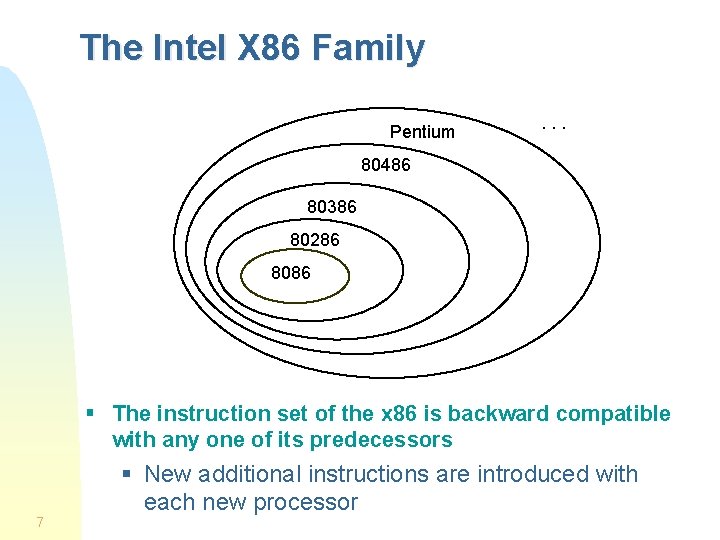
The Intel X 86 Family Pentium . . . 80486 80386 80286 8086 § The instruction set of the x 86 is backward compatible with any one of its predecessors 7 § New additional instructions are introduced with each new processor

Basic Program Execution Registers: high-speed memories located in the CPU • Registers for 8086 and 80286 are 16 bits wide • Registers for IA-32 family are 32 bits wide Irvine, Kip R. Assembly Language for x 86 Processors 6/e, 2010. 8
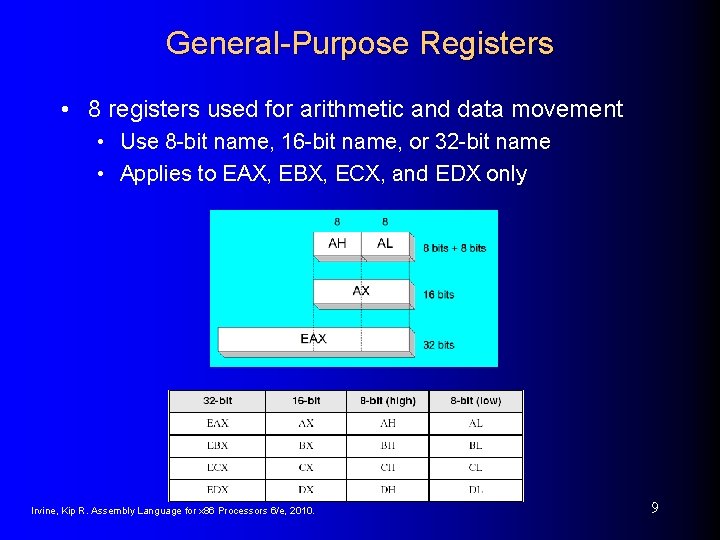
General-Purpose Registers • 8 registers used for arithmetic and data movement • Use 8 -bit name, 16 -bit name, or 32 -bit name • Applies to EAX, EBX, ECX, and EDX only Irvine, Kip R. Assembly Language for x 86 Processors 6/e, 2010. 9
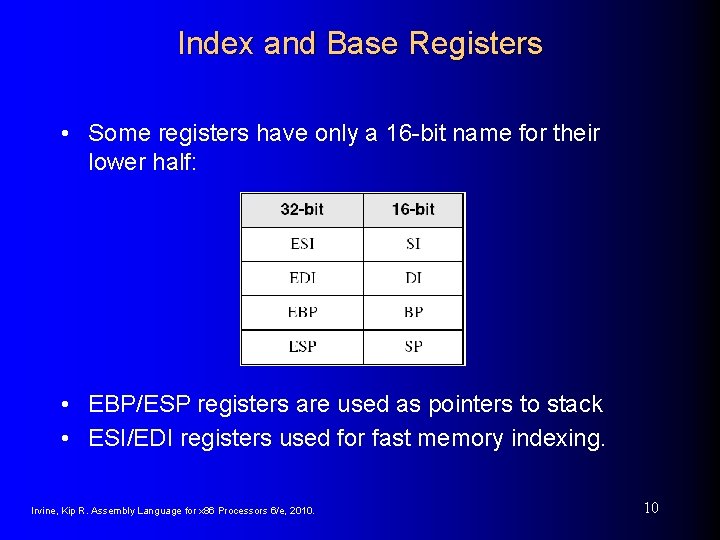
Index and Base Registers • Some registers have only a 16 -bit name for their lower half: • EBP/ESP registers are used as pointers to stack • ESI/EDI registers used for fast memory indexing. Irvine, Kip R. Assembly Language for x 86 Processors 6/e, 2010. 10
Some Specialized Register Uses (1 of 2) • General-Purpose • • • EAX – accumulator ECX – loop counter ESP – stack pointer ESI, EDI – index registers EBP – extended frame pointer (stack) • Segment: stores the address of a memory segment • • CS – code segment DS – data segment SS – stack segment ES, FS, GS - additional segments Irvine, Kip R. Assembly Language for x 86 Processors 6/e, 2010. 11
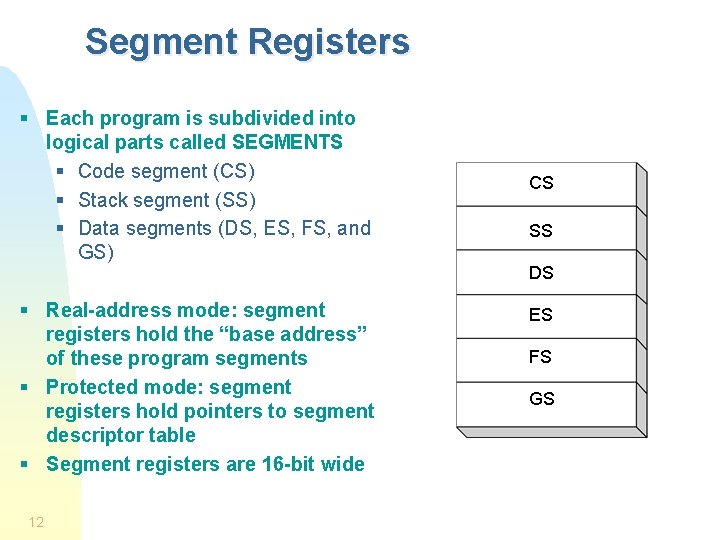
Segment Registers § Each program is subdivided into logical parts called SEGMENTS § Code segment (CS) § Stack segment (SS) § Data segments (DS, ES, FS, and GS) § Real-address mode: segment registers hold the “base address” of these program segments § Protected mode: segment registers hold pointers to segment descriptor table § Segment registers are 16 -bit wide 12 CS SS DS ES FS GS
Some Specialized Register Uses (2 of 2) • EIP – instruction pointer • Stores the address of the next instruction to be executed • IP for 8086 • EFLAGS • control flags: • Controling the operation of the CPU • status flags: • Reflecting outcome of CPU operations • each flag is a single binary bit • Set flag = 1 and Clear flag = 0 Irvine, Kip R. Assembly Language for x 86 Processors 6/e, 2010. 13
EFLAGS’s Status Flags • Carry • CF: unsigned arithmetic out of range • Overflow • OF: signed arithmetic out of range • Sign • SF: result is negative • Zero • ZF: result is zero • Auxiliary Carry • AF: carry from bit 3 to bit 4 • Parity • PF: sum of 1 bits is an even number • Direction DF: (CPU control flag) • Process arrays up or down ? Irvine, Kip R. Assembly Language for x 86 Processors 6/e, 2010. 14
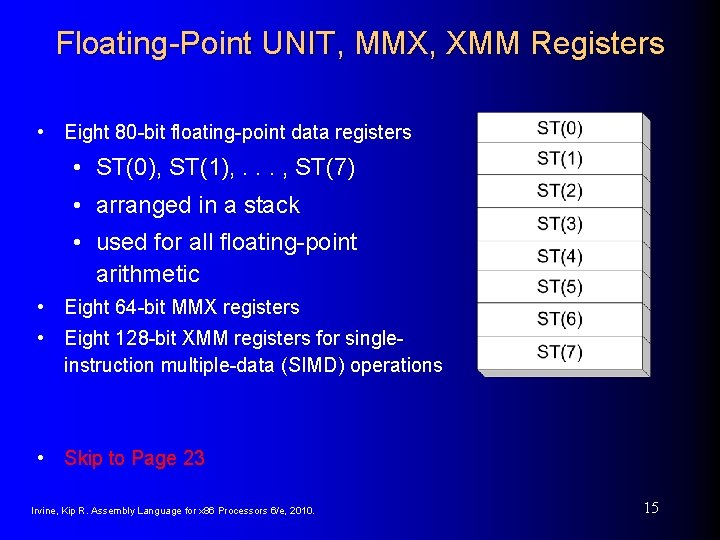
Floating-Point UNIT, MMX, XMM Registers • Eight 80 -bit floating-point data registers • ST(0), ST(1), . . . , ST(7) • arranged in a stack • used for all floating-point arithmetic • Eight 64 -bit MMX registers • Eight 128 -bit XMM registers for singleinstruction multiple-data (SIMD) operations • Skip to Page 23 Irvine, Kip R. Assembly Language for x 86 Processors 6/e, 2010. 15
Early Intel Microprocessors • Intel 8080 • 64 K addressable RAM • 8 -bit registers • CP/M operating system • S-100 BUS architecture • 8 -inch floppy disks! • Intel 8086/8088 • IBM-PC Used 8088 • 1 MB addressable RAM • 16 -bit registers • 16 -bit data bus (8 -bit for 8088) • separate floating-point unit (8087) Irvine, Kip R. Assembly Language for x 86 Processors 6/e, 2010. 16
The IBM-AT • Intel 80286 • 16 MB addressable RAM • Protected memory • several times faster than 8086 • introduced IDE bus architecture • 80287 floating point unit Irvine, Kip R. Assembly Language for x 86 Processors 6/e, 2010. 17
Intel IA-32 Family • Intel 386 • 4 GB addressable RAM, 32 -bit registers, paging (virtual memory) • Intel 486 • instruction pipelining • Pentium • superscalar, 32 -bit address bus, 64 -bit internal data path Irvine, Kip R. Assembly Language for x 86 Processors 6/e, 2010. 18
64 -bit Processors • Intel 64 • 64 -bit linear address space • Intel: Pentium Extreme, Xeon, Celeron D, Pendium D, Core 2, and Core i 7 • IA-32 e Mode • Compatibility mode for legacy 16 - and 32 -bit applications • 64 -bit Mode uses 64 -bit addresses and operands Irvine, Kip R. Assembly Language for x 86 Processors 6/e, 2010. 19
Intel Technologies • Hyper. Threading technology • two tasks execute on a single processor at the same time • Dual Core processing • multiple processor cores in the same IC package • each processor has its own resources and communication path with the bus Irvine, Kip R. Assembly Language for x 86 Processors 6/e, 2010. 20
Intel Processor Families Currently Used: • • Pentium & Celeron – dual core Core 2 Duo - 2 processor cores Core 2 Quad - 4 processor cores Core i 7 – 4 processor cores Irvine, Kip R. Assembly Language for x 86 Processors 6/e, 2010. 21
CISC and RISC • CISC – complex instruction set • large instruction set • high-level operations • requires microcode interpreter • examples: Intel 80 x 86 family • RISC – reduced instruction set • simple, atomic instructions • small instruction set • directly executed by hardware • examples: • ARM (Advanced RISC Machines) • DEC Alpha (now Compaq) Irvine, Kip R. Assembly Language for x 86 Processors 6/e, 2010. 22
Logical and Physical Addresses § Addresses specify the location of instructions and data § Addresses that specify an absolute location in main memory are physical addresses (called linear addresses) § They appear on the address bus § Addresses that specify a location relative to a point in the program are logical (or virtual) addresses § They are addresses used in the code and are independent of the structure of main memory § Each logical address for the x 86 consist of 2 parts: 23 § A segment number used to specify a (logical) part of the program [The physical address of the segment] § A offset number used to specify a location relative to the beginning of the segment
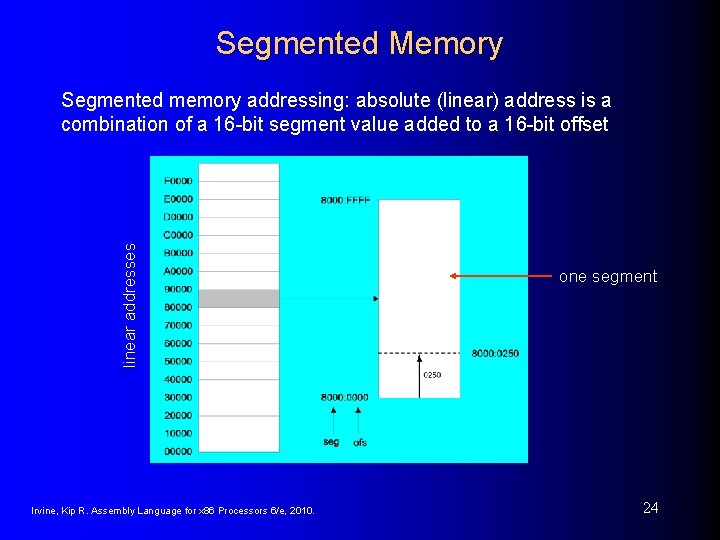
Segmented Memory linear addresses Segmented memory addressing: absolute (linear) address is a combination of a 16 -bit segment value added to a 16 -bit offset Irvine, Kip R. Assembly Language for x 86 Processors 6/e, 2010. one segment 24
IA-32 Processor Architecture (Modes of Operation) • Protected mode: programs in separate segments • native mode (Windows, Linux) • Supported by all x 86 except 8086 • Real-address mode: 8086 • native MS-DOS • Supported by all x 86 • System management mode: customized processor • power management, system security, diagnostics • Virtual-8086 mode • Protected, but can execute real-address mode software • each program has its own 8086 computer Irvine, Kip R. Assembly Language for x 86 Processors 6/e, 2010. 25
Addressable Memory • Protected mode • 4 GB • 32 -bit address • Real-address and Virtual-8086 modes • 1 MB space • 20 -bit address Irvine, Kip R. Assembly Language for x 86 Processors 6/e, 2010. 26
Address Translation and Running Modes § The translation from logical to physical addresses is done at run time § The way in which this address translation is done depends on the running mode of the x 86 § Two different running modes exist for the x 86: § Real mode (supported by every x 86) § Protected mode (all x 86 except the 8086) § You will use this mode 27
IA-32 Memory Management (Real-Address mode) • 1 MB RAM maximum addressable • Application programs can access any area of memory • Single tasking • Supported by MS-DOS operating system Irvine, Kip R. Assembly Language for x 86 Processors 6/e, 2010. 28
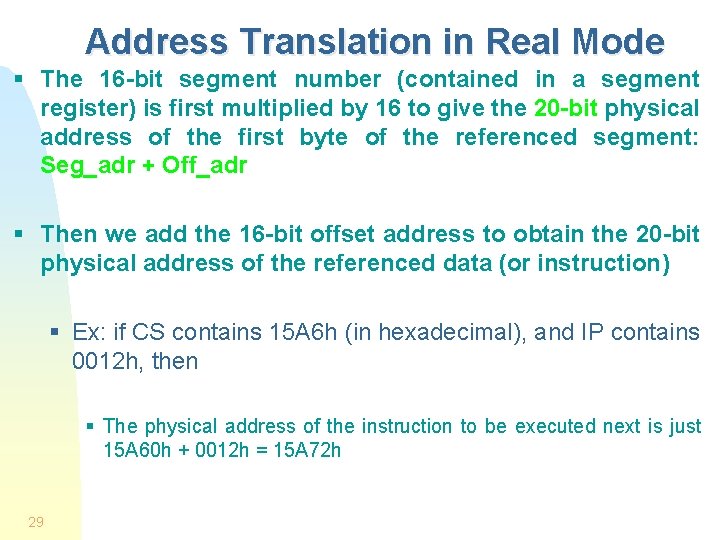
Address Translation in Real Mode § The 16 -bit segment number (contained in a segment register) is first multiplied by 16 to give the 20 -bit physical address of the first byte of the referenced segment: Seg_adr + Off_adr § Then we add the 16 -bit offset address to obtain the 20 -bit physical address of the referenced data (or instruction) § Ex: if CS contains 15 A 6 h (in hexadecimal), and IP contains 0012 h, then § The physical address of the instruction to be executed next is just 15 A 60 h + 0012 h = 15 A 72 h 29
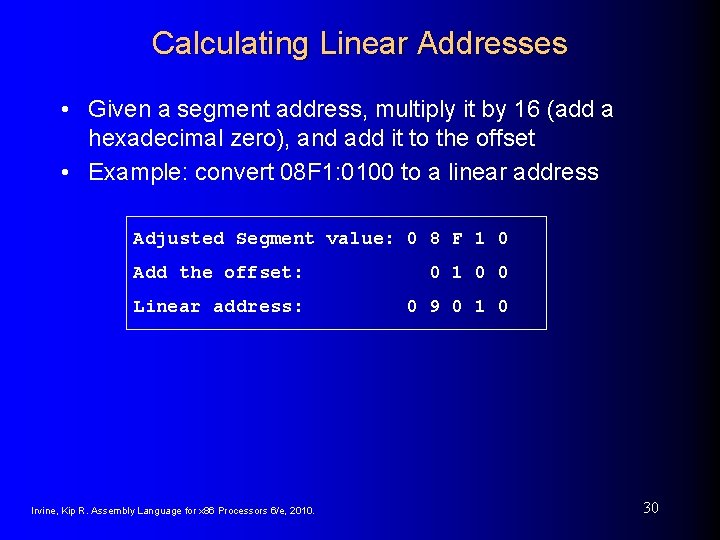
Calculating Linear Addresses • Given a segment address, multiply it by 16 (add a hexadecimal zero), and add it to the offset • Example: convert 08 F 1: 0100 to a linear address Adjusted Segment value: 0 8 F 1 0 Add the offset: 0 1 0 0 Linear address: 0 9 0 1 0 Irvine, Kip R. Assembly Language for x 86 Processors 6/e, 2010. 30
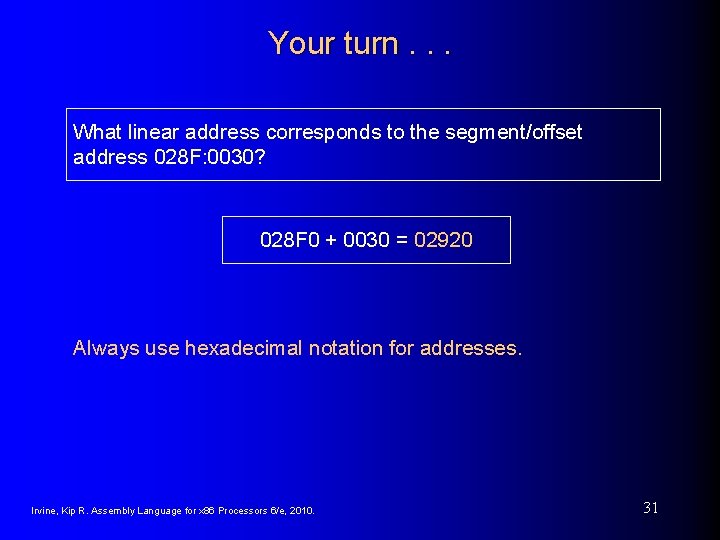
Your turn. . . What linear address corresponds to the segment/offset address 028 F: 0030? 028 F 0 + 0030 = 02920 Always use hexadecimal notation for addresses. Irvine, Kip R. Assembly Language for x 86 Processors 6/e, 2010. 31
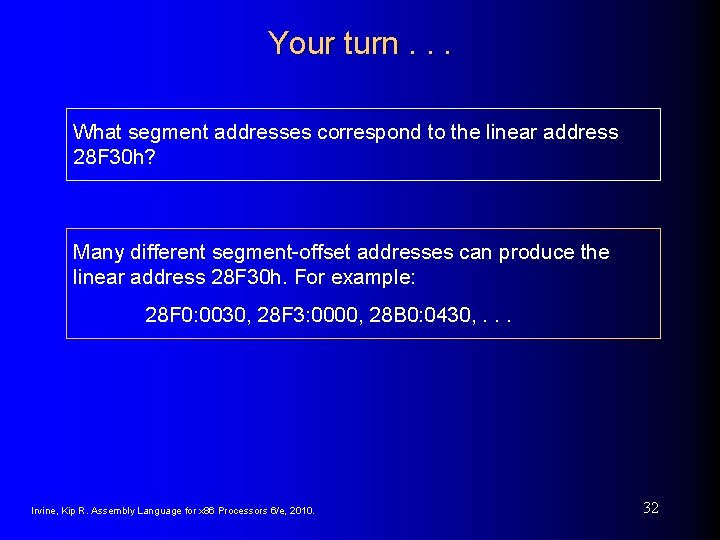
Your turn. . . What segment addresses correspond to the linear address 28 F 30 h? Many different segment-offset addresses can produce the linear address 28 F 30 h. For example: 28 F 0: 0030, 28 F 3: 0000, 28 B 0: 0430, . . . Irvine, Kip R. Assembly Language for x 86 Processors 6/e, 2010. 32
Characteristics of (Archaic) Real Mode § Can address only up to 1 MB of physical memory § Uses 20 -bit address for referenced segment § Does not support multitasking § Only 1 process at a time is active § No protection is provided: a program can write anywhere (and corrupt the operating system) § The 8086 runs only in this mode § DOS is a real-mode operating system § Our programs will not run in this archaic mode § They will run in protected mode which does not suffer from any of these limitations 33
IA-32 Memory Management (Protected Mode) • 4 GB addressable RAM • (0000 to FFFFh) • Each program assigned a memory partition which is protected from other programs • Designed for multitasking • Supported by Linux & MS-Windows Irvine, Kip R. Assembly Language for x 86 Processors 6/e, 2010. 34
Protected mode • Segment descriptor tables • Program structure • code, data, and stack areas • CS, DS, SS segment descriptors • global descriptor table (GDT) • MASM Programs use the Microsoft flat memory model Irvine, Kip R. Assembly Language for x 86 Processors 6/e, 2010. 35
§ Address Translation in Protected Mode The logical/virtual address of a referenced word is given by a pair of numbers (segment, offset) § The segment number is contained in a segment register and is used to select (or index) an entry in a segment table (called a descriptor table) § Hence, a segment register is also called a selector § The selected entry (the descriptor) contains the base address and length of the referenced segment § The 32 -bit base address is added to the 32 -bit offset to form a 32 -bit linear address (P 1, P 2, D) § P 1 indexes a directory page table (in memory) to obtain the base address of a second page table which is indexed by P 2 to give the physical address of the referenced word 36
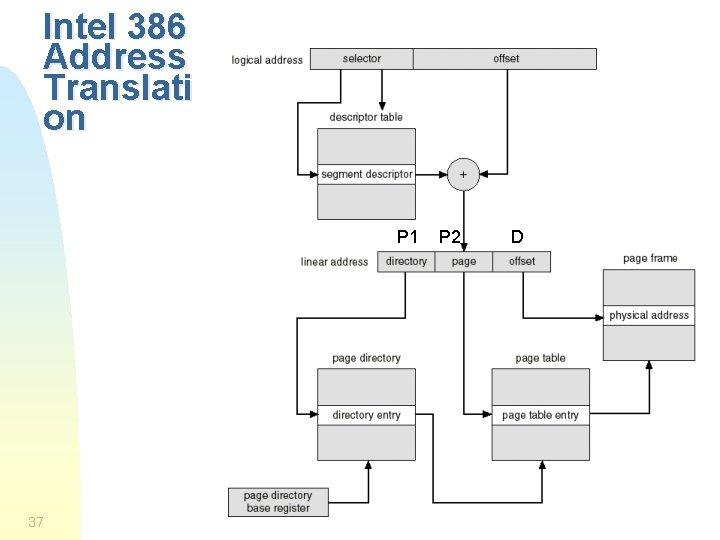
Intel 386 Address Translati on P 1 37 P 2 D
The FLAT Memory Model § The segmentation part is hidden to the programmer when the base address of each segment descriptor is the same § Each selector then points to the same segment so that code, data, and stack share the same segment § Protection bits (read-only, read-write) in each descriptor can still be used § Done by Windows, Linux, Free. BSD… § The offset part of the logical address is then equivalent to the linear address (P 1, P 2, D). § Only the offset part of the logical address is used to specify the location of a referenced word § The address space is then said to be FLAT § All our programs will use the FLAT memory model 38
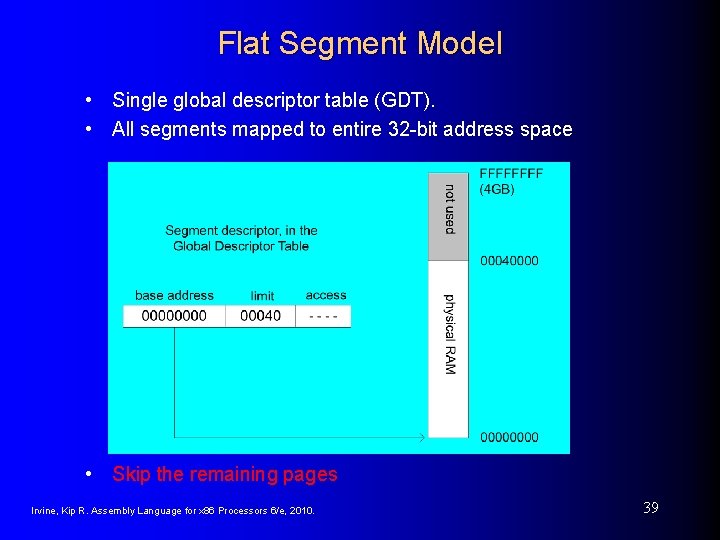
Flat Segment Model • Single global descriptor table (GDT). • All segments mapped to entire 32 -bit address space • Skip the remaining pages Irvine, Kip R. Assembly Language for x 86 Processors 6/e, 2010. 39
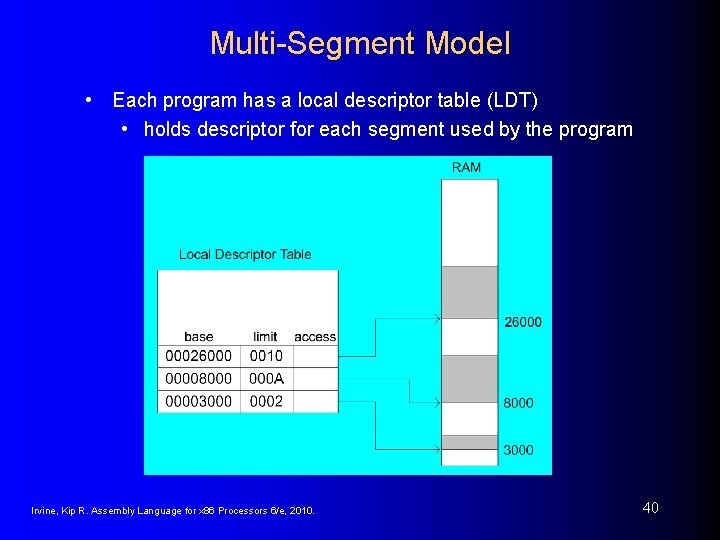
Multi-Segment Model • Each program has a local descriptor table (LDT) • holds descriptor for each segment used by the program Irvine, Kip R. Assembly Language for x 86 Processors 6/e, 2010. 40
Paging • Supported directly by the CPU • Divides each segment into 4096 -byte blocks called pages • Sum of all programs can be larger than physical memory • Part of running program is in memory, part is on disk • Virtual memory manager (VMM) – OS utility that manages the loading and unloading of pages • Page fault – issued by CPU when a page must be loaded from disk Irvine, Kip R. Assembly Language for x 86 Processors 6/e, 2010. 41
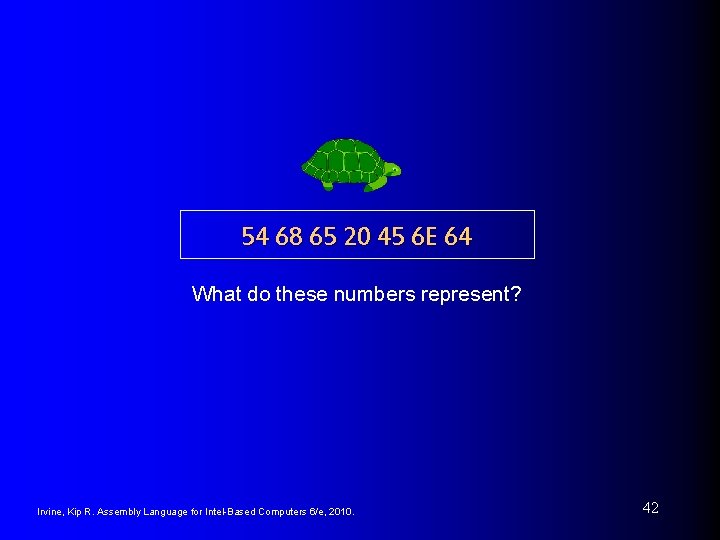
54 68 65 20 45 6 E 64 What do these numbers represent? Irvine, Kip R. Assembly Language for Intel-Based Computers 6/e, 2010. 42
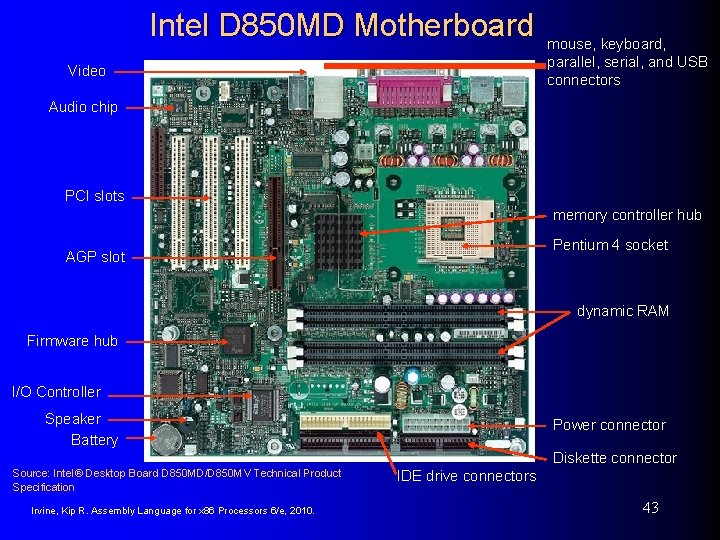
Intel D 850 MD Motherboard Video mouse, keyboard, parallel, serial, and USB connectors Audio chip PCI slots memory controller hub Pentium 4 socket AGP slot dynamic RAM Firmware hub I/O Controller Speaker Battery Power connector Diskette connector Source: Intel® Desktop Board D 850 MD/D 850 MV Technical Product Specification Irvine, Kip R. Assembly Language for x 86 Processors 6/e, 2010. IDE drive connectors 43
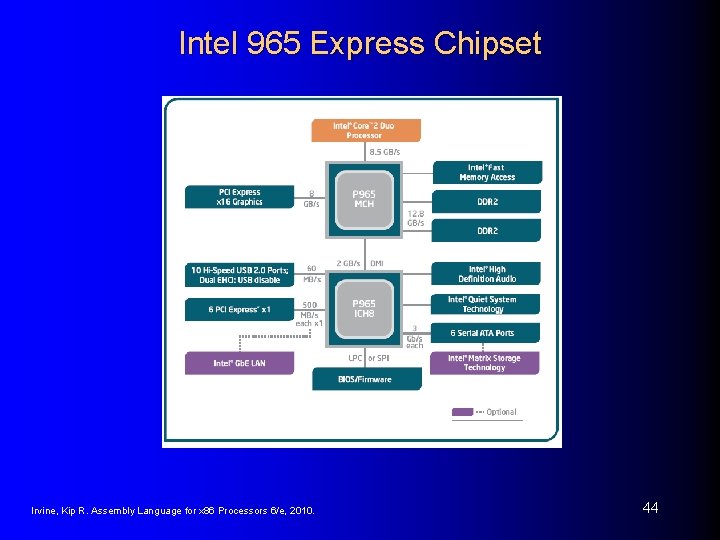
Intel 965 Express Chipset Irvine, Kip R. Assembly Language for x 86 Processors 6/e, 2010. 44
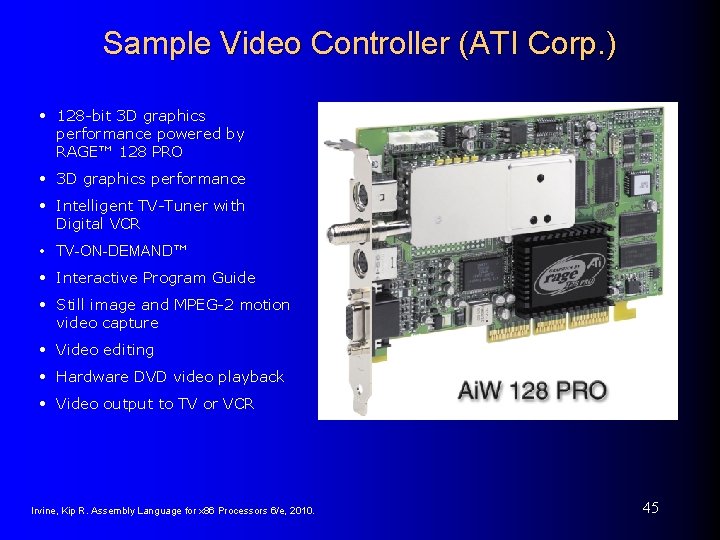
Sample Video Controller (ATI Corp. ) • 128 -bit 3 D graphics performance powered by RAGE™ 128 PRO • 3 D graphics performance • Intelligent TV-Tuner with Digital VCR • TV-ON-DEMAND™ • Interactive Program Guide • Still image and MPEG-2 motion video capture • Video editing • Hardware DVD video playback • Video output to TV or VCR Irvine, Kip R. Assembly Language for x 86 Processors 6/e, 2010. 45
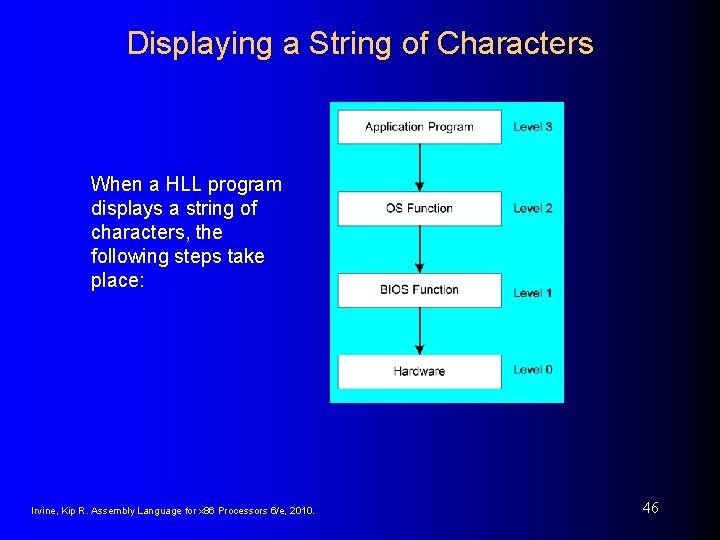
Displaying a String of Characters When a HLL program displays a string of characters, the following steps take place: Irvine, Kip R. Assembly Language for x 86 Processors 6/e, 2010. 46
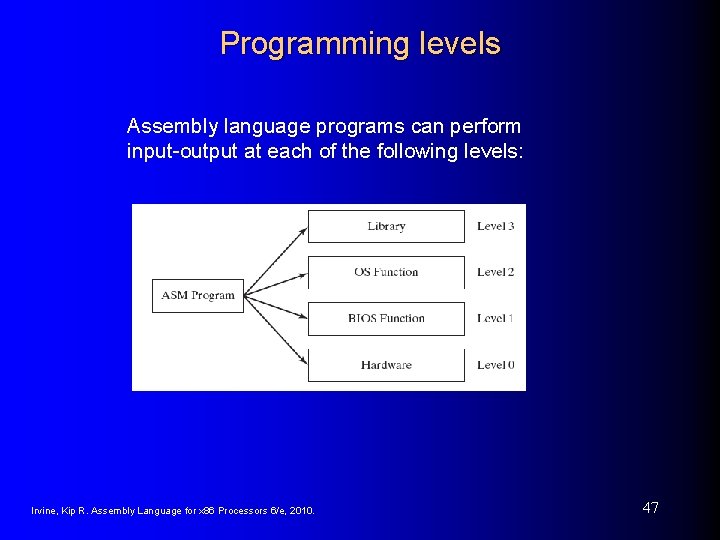
Programming levels Assembly language programs can perform input-output at each of the following levels: Irvine, Kip R. Assembly Language for x 86 Processors 6/e, 2010. 47
42 69 6 E 61 72 79 What does this say? Irvine, Kip R. Assembly Language for x 86 Processors 6/e, 2010. 48
- Slides: 48