
Assembly Language for IntelBased Computers Kip R Irvine
Assembly Language for Intel-Based Computers Kip R. Irvine Chapter 8: Advanced Procedures
Chapter Overview • Stack Frames • Recursion Irvine, Kip R. Assembly Language for Intel-Based Computers 5/e, 2007. Web site Examples 2
Stack Parameters • More convenient than register parameters Irvine, Kip R. Assembly Language for Intel-Based Computers 5/e, 2007. Web site Examples 3
Stack Frame • Also known as an activation record • Area of the stack set aside for a procedure's return address, passed parameters, saved registers, and local variables • Created by the following steps: • Calling program pushes arguments on the stack and calls the procedure. • The called procedure pushes EBP on the stack, and sets EBP to ESP. • If local variables are needed, a constant is subtracted from ESP to make room on the stack. Irvine, Kip R. Assembly Language for Intel-Based Computers 5/e, 2007. Web site Examples 4
Explicit Access to Stack Parameters • A procedure can explicitly access stack parameters using constant offsets from EBP 1. • Example: [ebp + 8] • EBP is often called the base pointer or frame pointer because it holds the base address of the stack frame. • EBP does not change value during the procedure. • EBP must be restored to its original value when a procedure returns. 1 BP in Real-address mode Irvine, Kip R. Assembly Language for Intel-Based Computers 5/e, 2007. Web site Examples 5
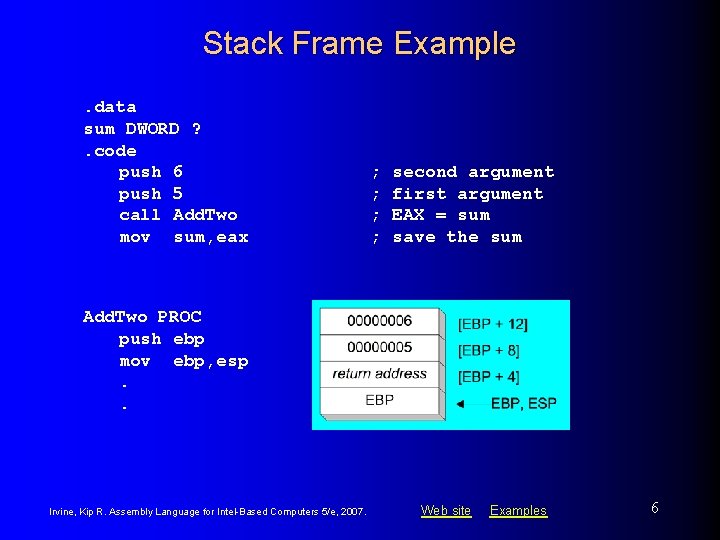
Stack Frame Example. data sum DWORD ? . code push 6 push 5 call Add. Two mov sum, eax ; ; second argument first argument EAX = sum save the sum Add. Two PROC push ebp mov ebp, esp. . Irvine, Kip R. Assembly Language for Intel-Based Computers 5/e, 2007. Web site Examples 6
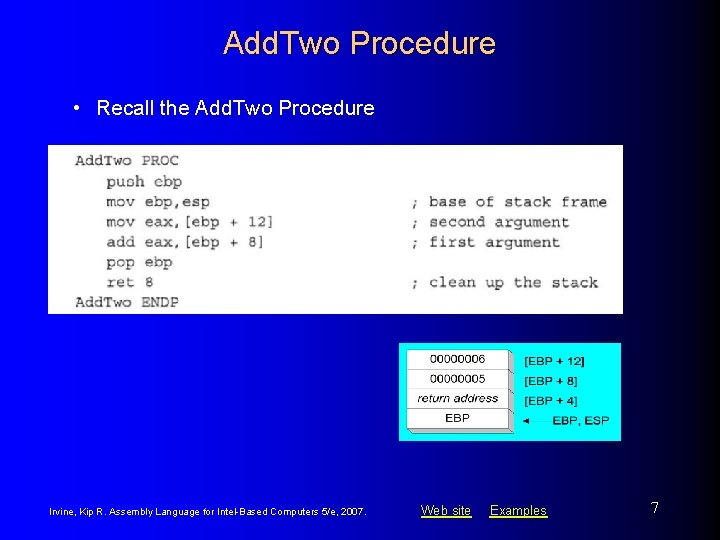
Add. Two Procedure • Recall the Add. Two Procedure Irvine, Kip R. Assembly Language for Intel-Based Computers 5/e, 2007. Web site Examples 7
RET Instruction • Return from subroutine • Pops stack into the instruction pointer (EIP or IP). Control transfers to the target address. • Syntax: • RET n • Optional operand n causes n bytes to be added to the stack pointer after EIP (or IP) is assigned a value. Irvine, Kip R. Assembly Language for Intel-Based Computers 5/e, 2007. Web site Examples 8
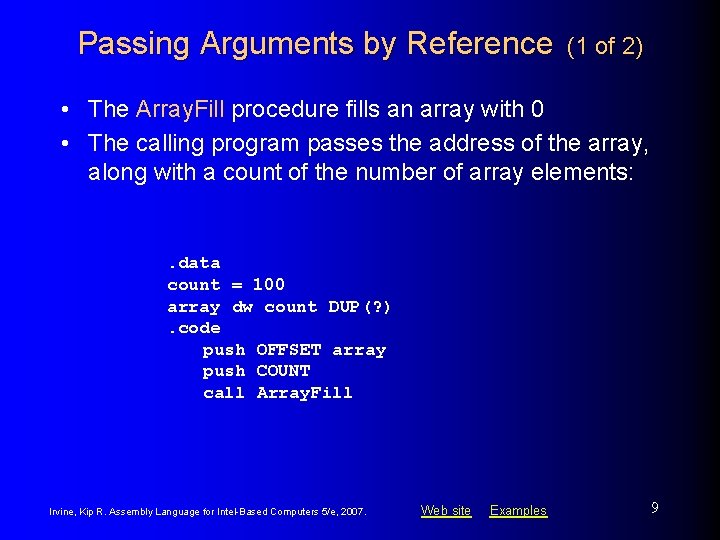
Passing Arguments by Reference (1 of 2) • The Array. Fill procedure fills an array with 0 • The calling program passes the address of the array, along with a count of the number of array elements: . data count = 100 array dw count DUP(? ). code push OFFSET array push COUNT call Array. Fill Irvine, Kip R. Assembly Language for Intel-Based Computers 5/e, 2007. Web site Examples 9
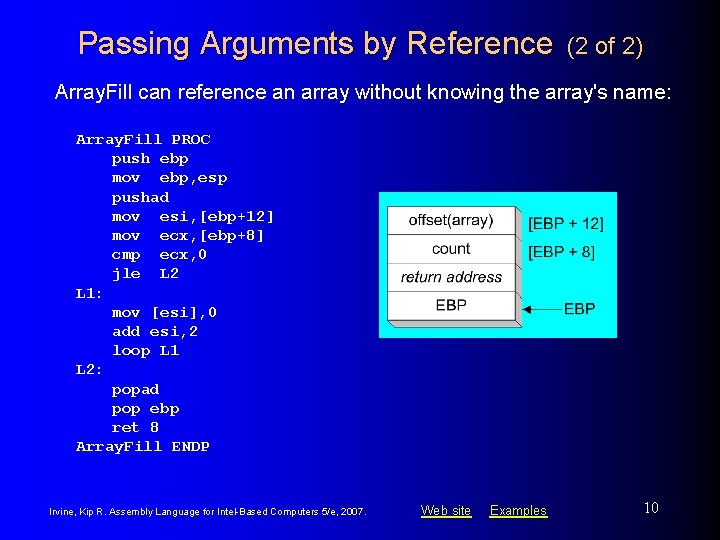
Passing Arguments by Reference (2 of 2) Array. Fill can reference an array without knowing the array's name: Array. Fill PROC push ebp mov ebp, esp pushad mov esi, [ebp+12] mov ecx, [ebp+8] cmp ecx, 0 jle L 2 L 1: mov [esi], 0 add esi, 2 loop L 1 L 2: popad pop ebp ret 8 Array. Fill ENDP Irvine, Kip R. Assembly Language for Intel-Based Computers 5/e, 2007. Web site Examples 10
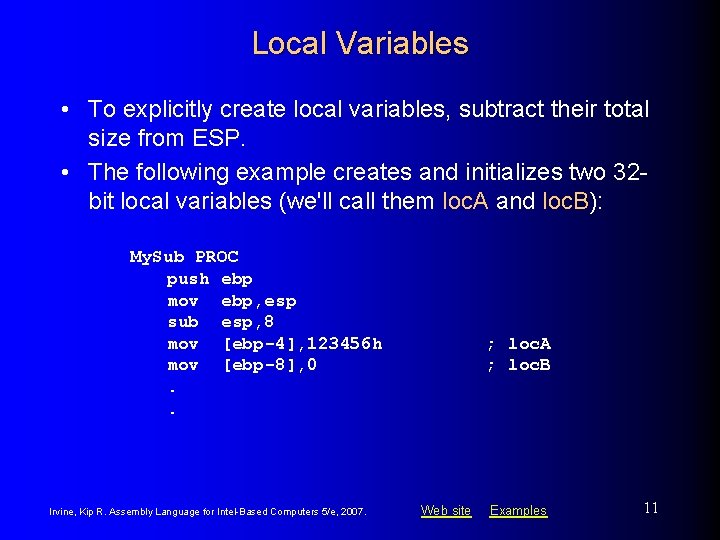
Local Variables • To explicitly create local variables, subtract their total size from ESP. • The following example creates and initializes two 32 bit local variables (we'll call them loc. A and loc. B): My. Sub PROC push ebp mov ebp, esp sub esp, 8 mov [ebp-4], 123456 h mov [ebp-8], 0. . Irvine, Kip R. Assembly Language for Intel-Based Computers 5/e, 2007. ; loc. A ; loc. B Web site Examples 11
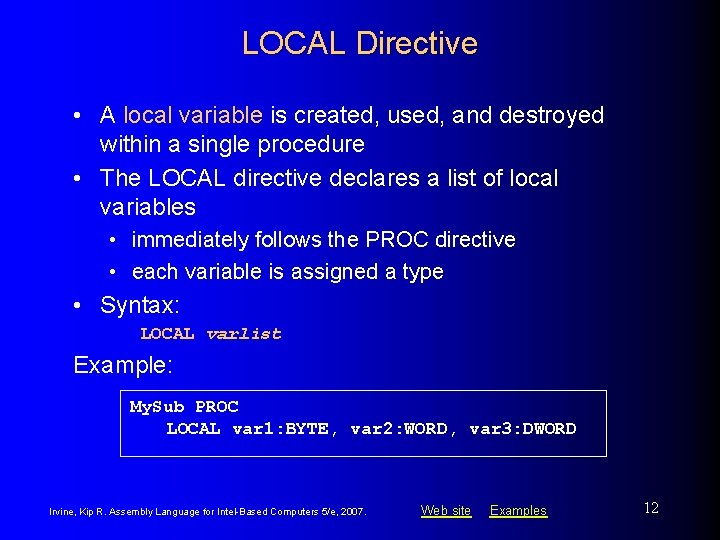
LOCAL Directive • A local variable is created, used, and destroyed within a single procedure • The LOCAL directive declares a list of local variables • immediately follows the PROC directive • each variable is assigned a type • Syntax: LOCAL varlist Example: My. Sub PROC LOCAL var 1: BYTE, var 2: WORD, var 3: DWORD Irvine, Kip R. Assembly Language for Intel-Based Computers 5/e, 2007. Web site Examples 12
![Using LOCAL Examples: LOCAL flag. Vals[20]: BYTE ; array of bytes my. Proc PROC](http://slidetodoc.com/presentation_image_h2/fe5a15189c560c347730fc27a63b3906/image-13.jpg "Using LOCAL Examples: LOCAL flag. Vals[20]: BYTE ; array of bytes my. Proc PROC")
Using LOCAL Examples: LOCAL flag. Vals[20]: BYTE ; array of bytes my. Proc PROC LOCAL t 1: BYTE, ; procedure ; local variables Irvine, Kip R. Assembly Language for Intel-Based Computers 5/e, 2007. Web site Examples 13
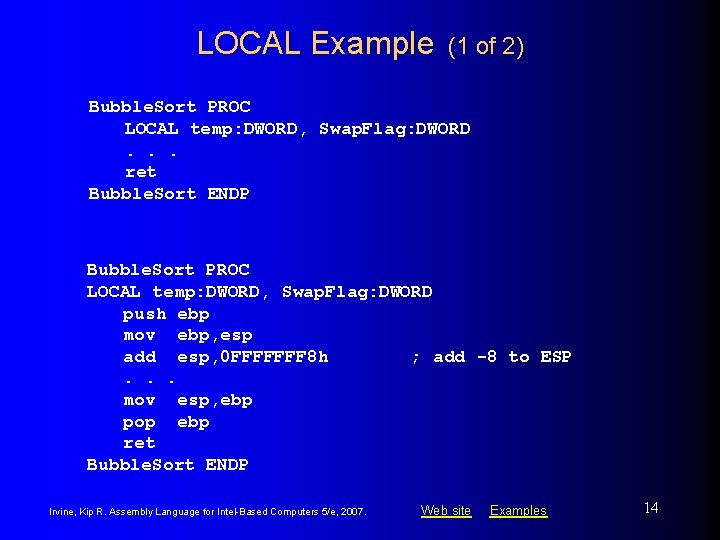
LOCAL Example (1 of 2) Bubble. Sort PROC LOCAL temp: DWORD, Swap. Flag: DWORD. . . ret Bubble. Sort ENDP Bubble. Sort PROC LOCAL temp: DWORD, Swap. Flag: DWORD push ebp mov ebp, esp add esp, 0 FFFFFFF 8 h ; add -8 to ESP. . . mov esp, ebp pop ebp ret Bubble. Sort ENDP Irvine, Kip R. Assembly Language for Intel-Based Computers 5/e, 2007. Web site Examples 14
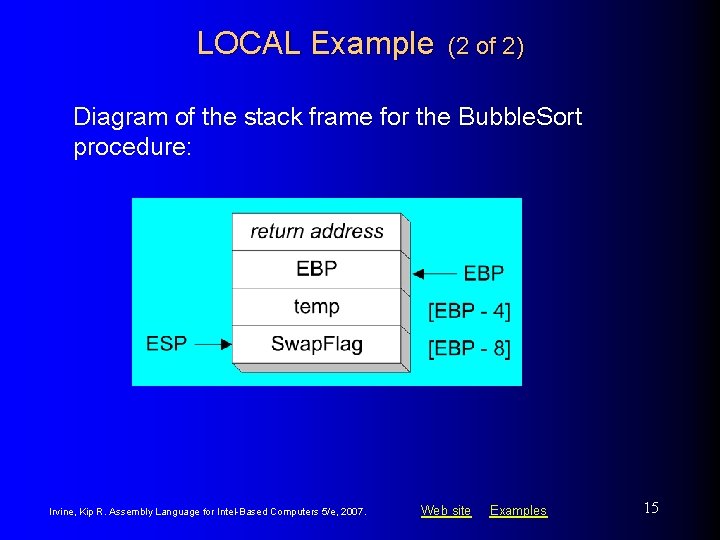
LOCAL Example (2 of 2) Diagram of the stack frame for the Bubble. Sort procedure: Irvine, Kip R. Assembly Language for Intel-Based Computers 5/e, 2007. Web site Examples 15
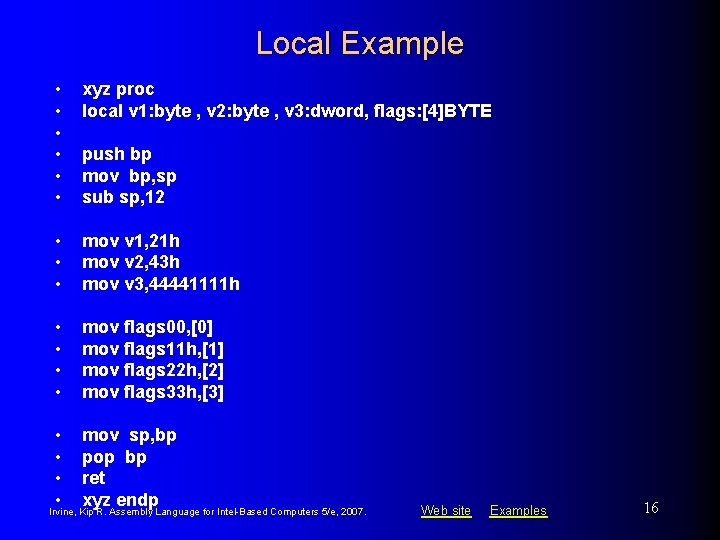
Local Example • • • xyz proc local v 1: byte , v 2: byte , v 3: dword, flags: [4]BYTE • • • mov v 1, 21 h mov v 2, 43 h mov v 3, 44441111 h • • mov flags 00, [0] mov flags 11 h, [1] mov flags 22 h, [2] mov flags 33 h, [3] push bp mov bp, sp sub sp, 12 • mov sp, bp • pop bp • ret • xyz endp Irvine, Kip R. Assembly Language for Intel-Based Computers 5/e, 2007. Web site Examples 16
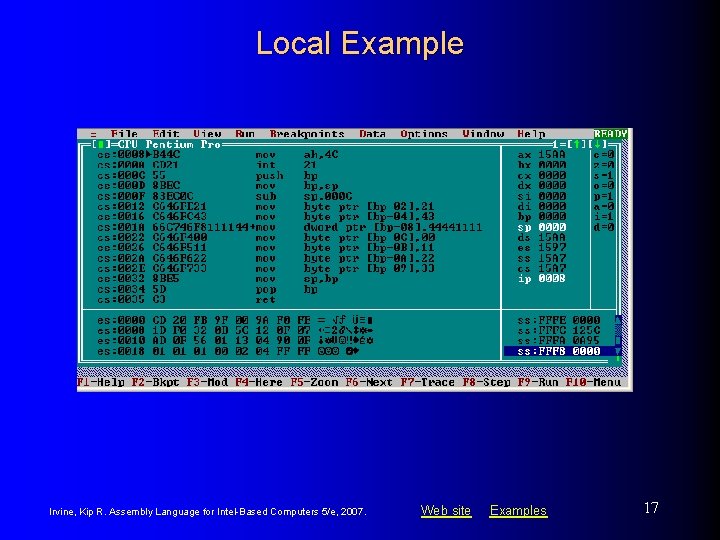
Local Example Irvine, Kip R. Assembly Language for Intel-Based Computers 5/e, 2007. Web site Examples 17
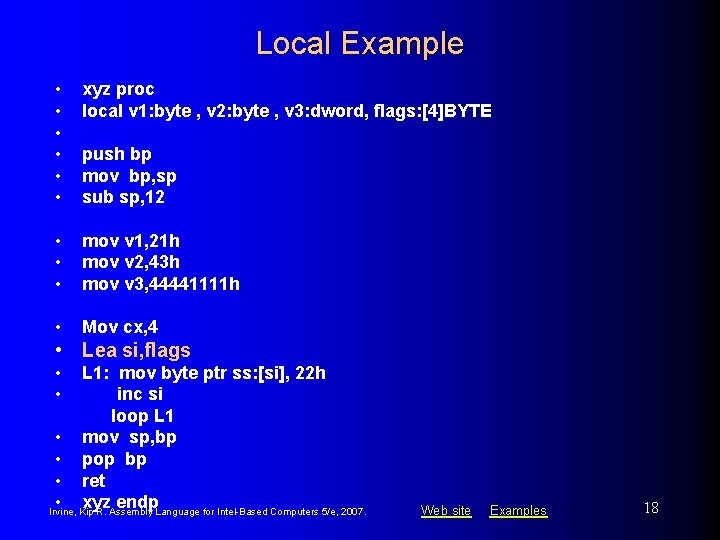
Local Example • • • xyz proc local v 1: byte , v 2: byte , v 3: dword, flags: [4]BYTE • • • mov v 1, 21 h mov v 2, 43 h mov v 3, 44441111 h • Mov cx, 4 push bp mov bp, sp sub sp, 12 • Lea si, flags • • L 1: mov byte ptr ss: [si], 22 h inc si loop L 1 • mov sp, bp • pop bp • ret • xyz endp Irvine, Kip R. Assembly Language for Intel-Based Computers 5/e, 2007. Web site Examples 18
Recursion • What is recursion? • Recursively Calculating a Sum • Calculating a Factorial Irvine, Kip R. Assembly Language for Intel-Based Computers 5/e, 2007. Web site Examples 19
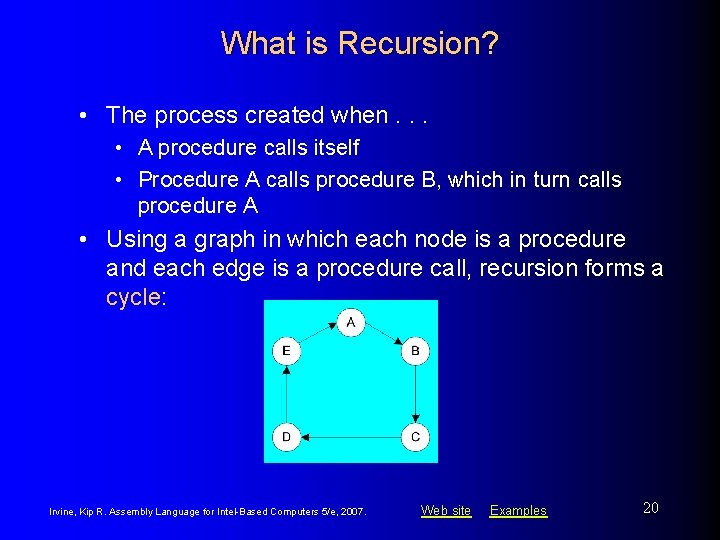
What is Recursion? • The process created when. . . • A procedure calls itself • Procedure A calls procedure B, which in turn calls procedure A • Using a graph in which each node is a procedure and each edge is a procedure call, recursion forms a cycle: Irvine, Kip R. Assembly Language for Intel-Based Computers 5/e, 2007. Web site Examples 20
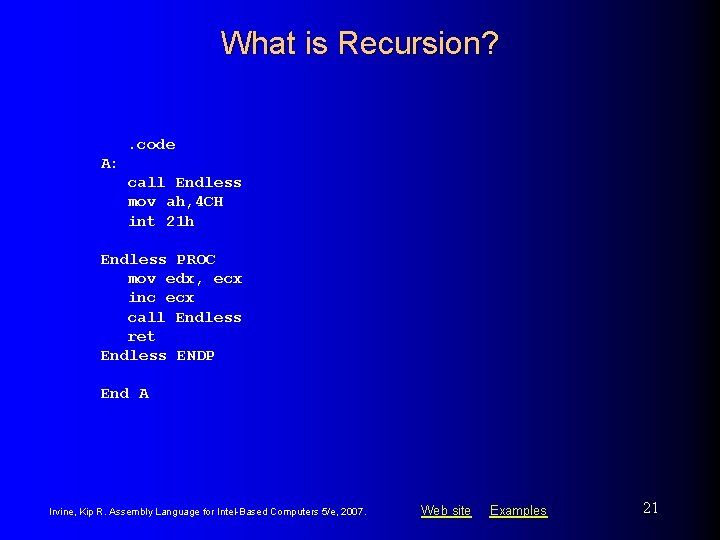
What is Recursion? . code A: call Endless mov ah, 4 CH int 21 h Endless PROC mov edx, ecx inc ecx call Endless ret Endless ENDP End A Irvine, Kip R. Assembly Language for Intel-Based Computers 5/e, 2007. Web site Examples 21
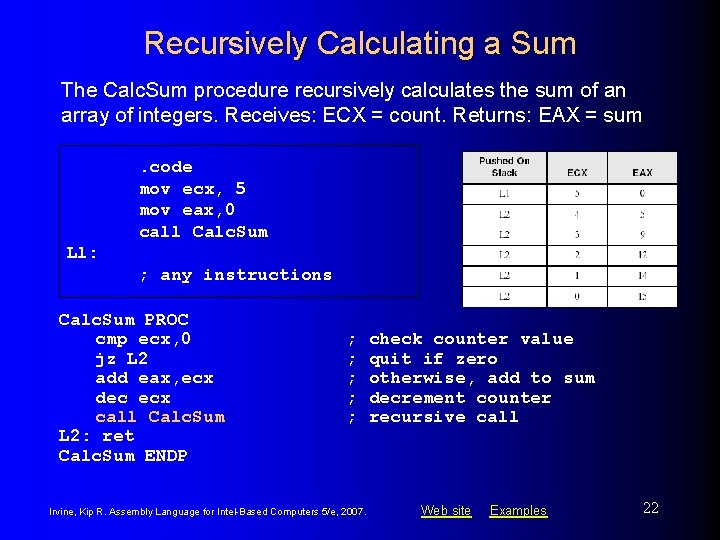
Recursively Calculating a Sum The Calc. Sum procedure recursively calculates the sum of an array of integers. Receives: ECX = count. Returns: EAX = sum. code mov ecx, 5 mov eax, 0 call Calc. Sum Ll: ; any instructions Calc. Sum PROC cmp ecx, 0 jz L 2 add eax, ecx dec ecx call Calc. Sum L 2: ret Calc. Sum ENDP ; ; ; Irvine, Kip R. Assembly Language for Intel-Based Computers 5/e, 2007. check counter value quit if zero otherwise, add to sum decrement counter recursive call Web site Examples 22
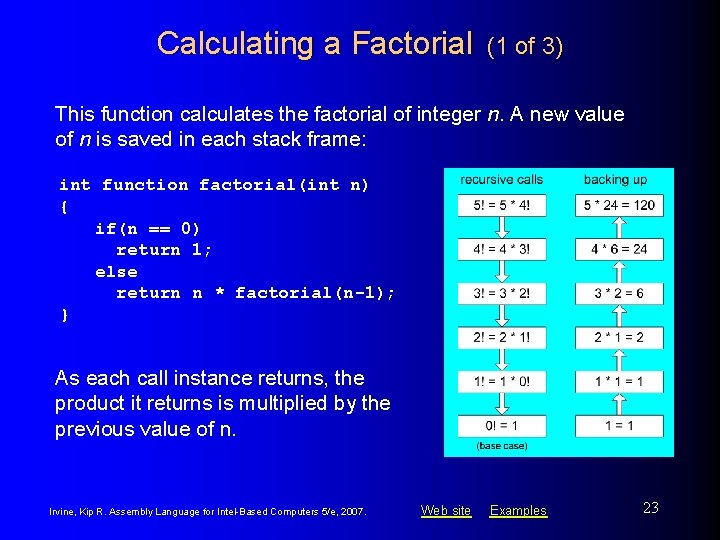
Calculating a Factorial (1 of 3) This function calculates the factorial of integer n. A new value of n is saved in each stack frame: int function factorial(int n) { if(n == 0) return 1; else return n * factorial(n-1); } As each call instance returns, the product it returns is multiplied by the previous value of n. Irvine, Kip R. Assembly Language for Intel-Based Computers 5/e, 2007. Web site Examples 23
![Calculating a Factorial PROC push ebp mov ebp, esp mov eax, [ebp+8] cmp eax,](http://slidetodoc.com/presentation_image_h2/fe5a15189c560c347730fc27a63b3906/image-24.jpg "Calculating a Factorial PROC push ebp mov ebp, esp mov eax, [ebp+8] cmp eax,")
Calculating a Factorial PROC push ebp mov ebp, esp mov eax, [ebp+8] cmp eax, 0 ja L 1 mov eax, 1 jmp L 2 L 1: dec eax push eax call Factorial ; ; (2 of 3) get n n < 0? yes: continue no: return 1 ; Factorial(n-1) ; Instructions from this point on execute when each ; recursive call returns. Return. Fact: mov ebx, [ebp+8] mul ebx ; get n ; eax = eax * ebx L 2: pop ebp ret 4 Factorial ENDP ; return EAX ; clean up stack Irvine, Kip R. Assembly Language for Intel-Based Computers 5/e, 2007. Web site Examples 24
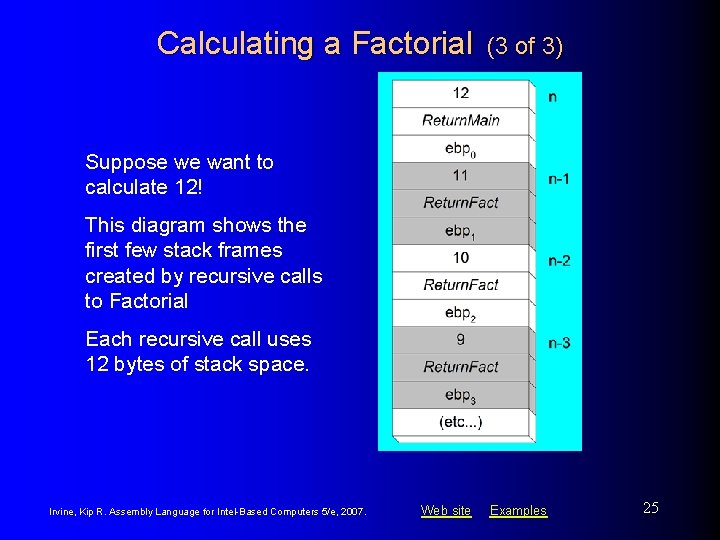
Calculating a Factorial (3 of 3) Suppose we want to calculate 12! This diagram shows the first few stack frames created by recursive calls to Factorial Each recursive call uses 12 bytes of stack space. Irvine, Kip R. Assembly Language for Intel-Based Computers 5/e, 2007. Web site Examples 25
- Slides: 25