
Assembler Building a Modern Computer From First Principles
Assembler Building a Modern Computer From First Principles www. nand 2 tetris. org ms, Nisan & Schocken, MIT Press, www. nand 2 tetris. org , Chapter 6: Assembler 1 slide
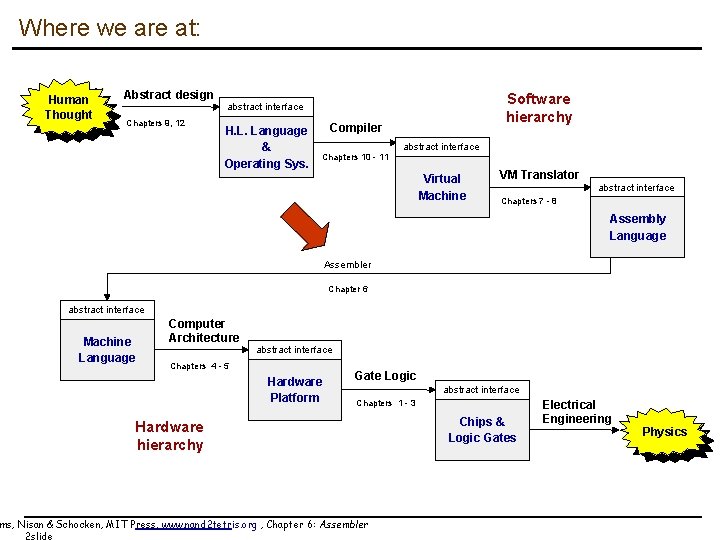
Where we are at: Human Thought Abstract design Chapters 9, 12 Software hierarchy abstract interface H. L. Language & Operating Sys. Compiler Chapters 10 - 11 abstract interface Virtual Machine VM Translator abstract interface Chapters 7 - 8 Assembly Language Assembler Chapter 6 abstract interface Machine Language Computer Architecture abstract interface Chapters 4 - 5 Hardware Platform Gate Logic abstract interface Chapters 1 - 3 Hardware hierarchy ms, Nisan & Schocken, MIT Press, www. nand 2 tetris. org , Chapter 6: Assembler 2 slide Chips & Logic Gates Electrical Engineering Physics
Why care about assemblers? Because … n Assemblers employ nifty programming tricks n Assemblers are the first rung up the software hierarchy ladder n An assembler is a translator of a simple language n Writing an assembler = low-impact practice for writing compilers. ms, Nisan & Schocken, MIT Press, www. nand 2 tetris. org , Chapter 6: Assembler 3 slide
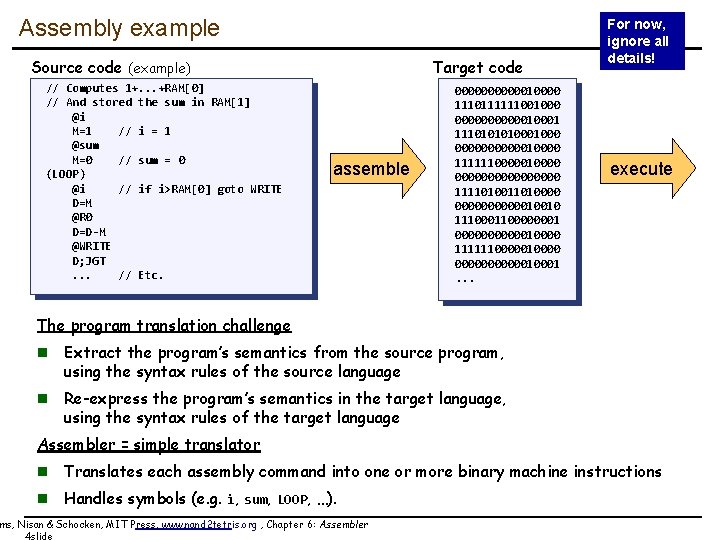
Assembly example Source code (example) // Computes 1+. . . +RAM[0] // And stored the sum in RAM[1] @i M=1 // i = 1 @sum M=0 // sum = 0 (LOOP) @i // if i>RAM[0] goto WRITE D=M @R 0 D=D-M @WRITE D; JGT. . . // Etc. Target code assemble 00000010000 1110111111001000 00000010001 111010001000 00000010000 11111100000100000000 11110100000010010 111000000010000 11111100000100000010001. . . For now, ignore all details! execute The program translation challenge n Extract the program’s semantics from the source program, using the syntax rules of the source language n Re-express the program’s semantics in the target language, using the syntax rules of the target language Assembler = simple translator n Translates each assembly command into one or more binary machine instructions n Handles symbols (e. g. i, sum, LOOP, …). ms, Nisan & Schocken, MIT Press, www. nand 2 tetris. org , Chapter 6: Assembler 4 slide
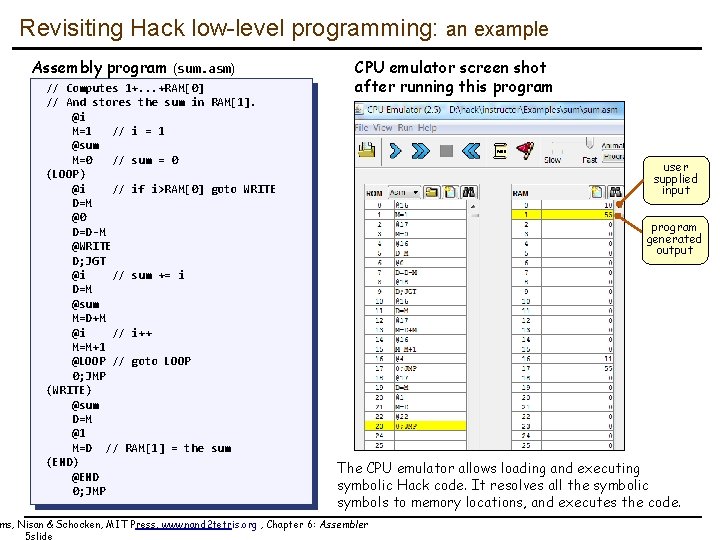
Revisiting Hack low-level programming: an example Assembly program (sum. asm) // Computes 1+. . . +RAM[0] // And stores the sum in RAM[1]. @i M=1 // i = 1 @sum M=0 // sum = 0 (LOOP) @i // if i>RAM[0] goto WRITE D=M @0 D=D-M @WRITE D; JGT @i // sum += i D=M @sum M=D+M @i // i++ M=M+1 @LOOP // goto LOOP 0; JMP (WRITE) @sum D=M @1 M=D // RAM[1] = the sum (END) @END 0; JMP CPU emulator screen shot after running this program user supplied input program generated output The CPU emulator allows loading and executing symbolic Hack code. It resolves all the symbolic symbols to memory locations, and executes the code. ms, Nisan & Schocken, MIT Press, www. nand 2 tetris. org , Chapter 6: Assembler 5 slide
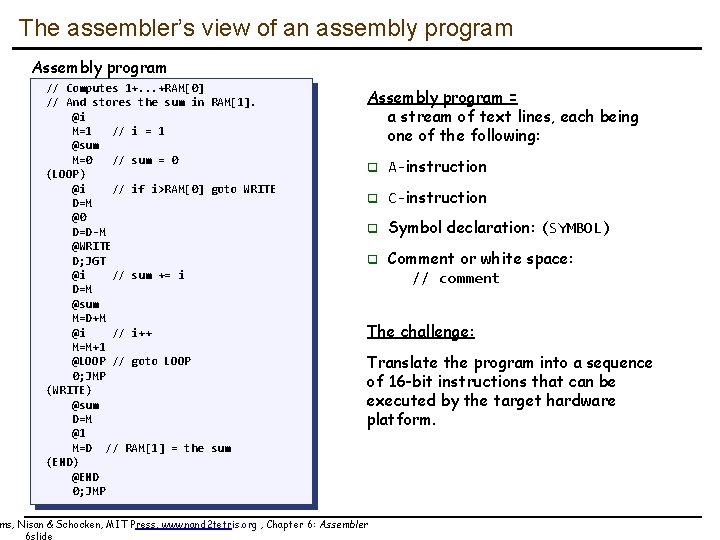
The assembler’s view of an assembly program Assembly program // Computes 1+. . . +RAM[0] // And stores the sum in RAM[1]. @i M=1 // i = 1 @sum M=0 // sum = 0 (LOOP) @i // if i>RAM[0] goto WRITE D=M @0 D=D-M @WRITE D; JGT @i // sum += i D=M @sum M=D+M @i // i++ M=M+1 @LOOP // goto LOOP 0; JMP (WRITE) @sum D=M @1 M=D // RAM[1] = the sum (END) @END 0; JMP Assembly program = a stream of text lines, each being one of the following: q A-instruction q C-instruction q Symbol declaration: (SYMBOL) q Comment or white space: // comment The challenge: Translate the program into a sequence of 16 -bit instructions that can be executed by the target hardware platform. ms, Nisan & Schocken, MIT Press, www. nand 2 tetris. org , Chapter 6: Assembler 6 slide
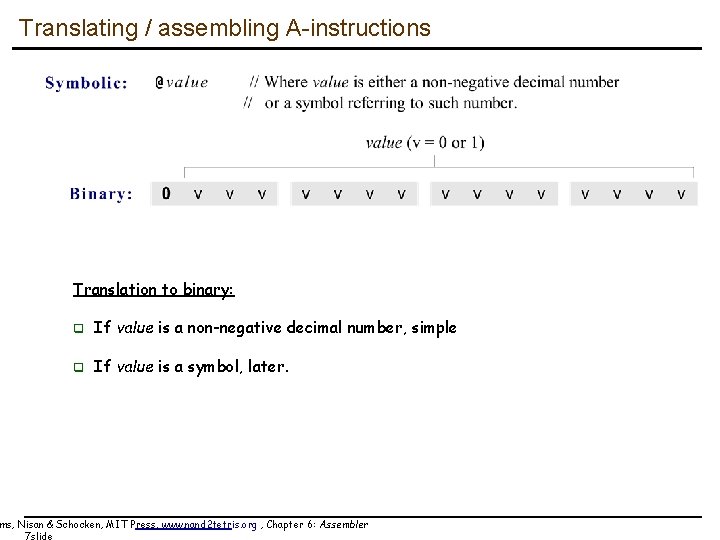
Translating / assembling A-instructions Translation to binary: q If value is a non-negative decimal number, simple q If value is a symbol, later. ms, Nisan & Schocken, MIT Press, www. nand 2 tetris. org , Chapter 6: Assembler 7 slide
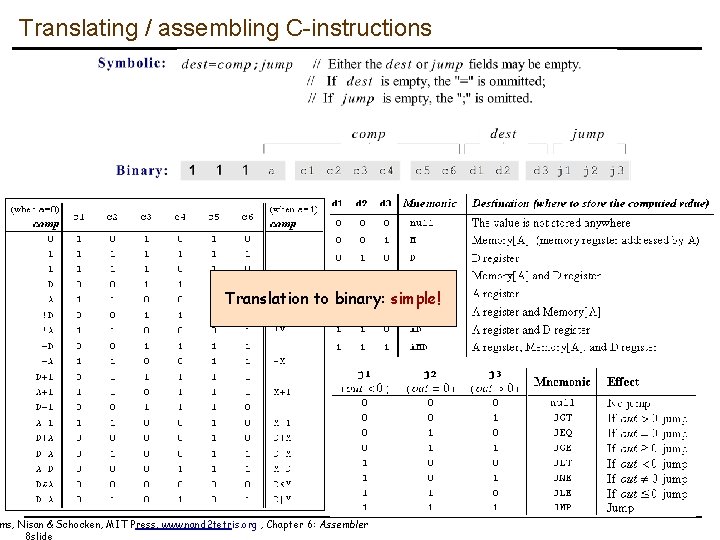
Translating / assembling C-instructions Translation to binary: simple! ms, Nisan & Schocken, MIT Press, www. nand 2 tetris. org , Chapter 6: Assembler 8 slide
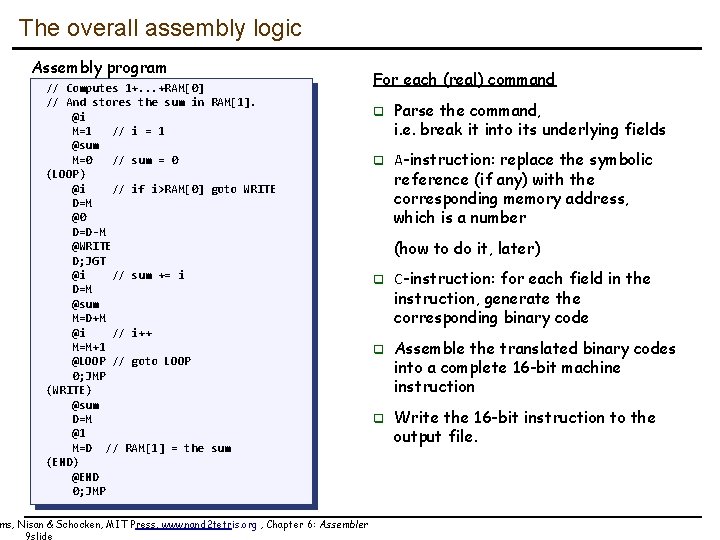
The overall assembly logic Assembly program // Computes 1+. . . +RAM[0] // And stores the sum in RAM[1]. @i M=1 // i = 1 @sum M=0 // sum = 0 (LOOP) @i // if i>RAM[0] goto WRITE D=M @0 D=D-M @WRITE D; JGT @i // sum += i D=M @sum M=D+M @i // i++ M=M+1 @LOOP // goto LOOP 0; JMP (WRITE) @sum D=M @1 M=D // RAM[1] = the sum (END) @END 0; JMP ms, Nisan & Schocken, MIT Press, www. nand 2 tetris. org , Chapter 6: Assembler 9 slide For each (real) command q Parse the command, i. e. break it into its underlying fields q A-instruction: replace the symbolic reference (if any) with the corresponding memory address, which is a number q (how to do it, later) q C-instruction: for each field in the instruction, generate the corresponding binary code q Assemble the translated binary codes into a complete 16 -bit machine instruction q Write the 16 -bit instruction to the output file.
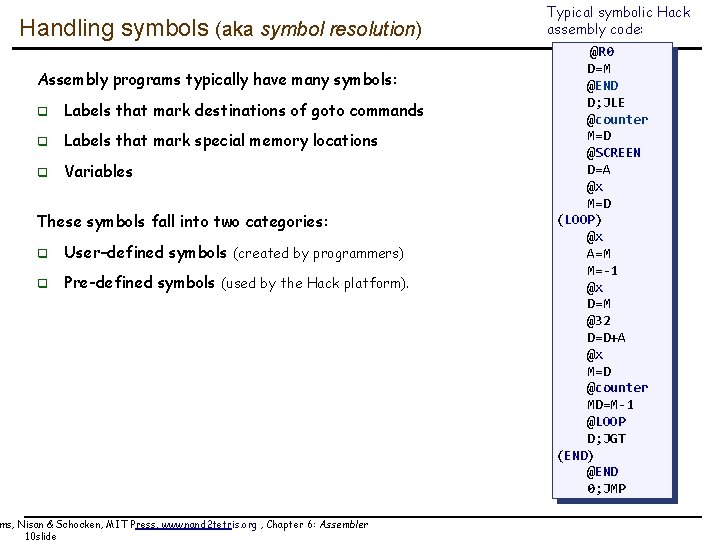
Handling symbols (aka symbol resolution) Assembly programs typically have many symbols: q Labels that mark destinations of goto commands q Labels that mark special memory locations q Variables These symbols fall into two categories: q User–defined symbols (created by programmers) q Pre-defined symbols (used by the Hack platform). ms, Nisan & Schocken, MIT Press, www. nand 2 tetris. org , Chapter 6: Assembler 10 slide Typical symbolic Hack assembly code: @R 0 D=M @END D; JLE @counter M=D @SCREEN D=A @x M=D (LOOP) @x A=M M=-1 @x D=M @32 D=D+A @x M=D @counter MD=M-1 @LOOP D; JGT (END) @END 0; JMP
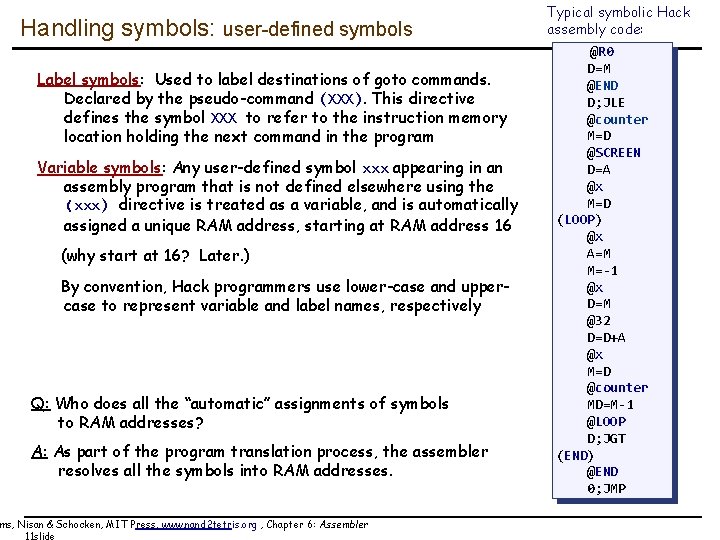
Handling symbols: user-defined symbols Label symbols: Used to label destinations of goto commands. Declared by the pseudo-command (XXX). This directive defines the symbol XXX to refer to the instruction memory location holding the next command in the program Variable symbols: Any user-defined symbol xxx appearing in an assembly program that is not defined elsewhere using the (xxx) directive is treated as a variable, and is automatically assigned a unique RAM address, starting at RAM address 16 (why start at 16? Later. ) By convention, Hack programmers use lower-case and uppercase to represent variable and label names, respectively Q: Who does all the “automatic” assignments of symbols to RAM addresses? A: As part of the program translation process, the assembler resolves all the symbols into RAM addresses. ms, Nisan & Schocken, MIT Press, www. nand 2 tetris. org , Chapter 6: Assembler 11 slide Typical symbolic Hack assembly code: @R 0 D=M @END D; JLE @counter M=D @SCREEN D=A @x M=D (LOOP) @x A=M M=-1 @x D=M @32 D=D+A @x M=D @counter MD=M-1 @LOOP D; JGT (END) @END 0; JMP
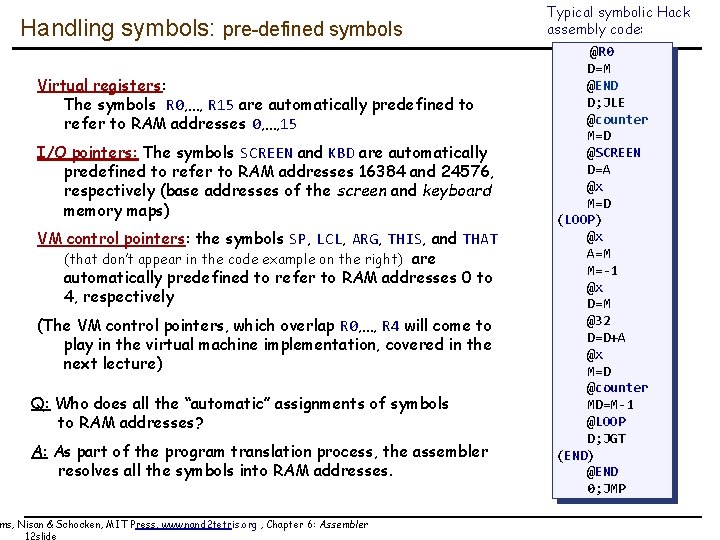
Handling symbols: pre-defined symbols Virtual registers: The symbols R 0, …, R 15 are automatically predefined to refer to RAM addresses 0, …, 15 I/O pointers: The symbols SCREEN and KBD are automatically predefined to refer to RAM addresses 16384 and 24576, respectively (base addresses of the screen and keyboard memory maps) VM control pointers: the symbols SP, LCL, ARG, THIS, and THAT (that don’t appear in the code example on the right) are automatically predefined to refer to RAM addresses 0 to 4, respectively (The VM control pointers, which overlap R 0, …, R 4 will come to play in the virtual machine implementation, covered in the next lecture) Q: Who does all the “automatic” assignments of symbols to RAM addresses? A: As part of the program translation process, the assembler resolves all the symbols into RAM addresses. ms, Nisan & Schocken, MIT Press, www. nand 2 tetris. org , Chapter 6: Assembler 12 slide Typical symbolic Hack assembly code: @R 0 D=M @END D; JLE @counter M=D @SCREEN D=A @x M=D (LOOP) @x A=M M=-1 @x D=M @32 D=D+A @x M=D @counter MD=M-1 @LOOP D; JGT (END) @END 0; JMP
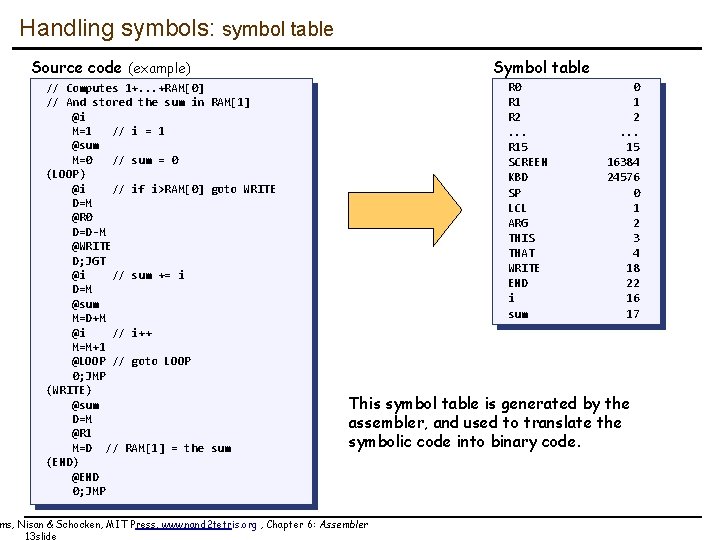
Handling symbols: symbol table Source code (example) // Computes 1+. . . +RAM[0] // And stored the sum in RAM[1] @i M=1 // i = 1 @sum M=0 // sum = 0 (LOOP) @i // if i>RAM[0] goto WRITE D=M @R 0 D=D-M @WRITE D; JGT @i // sum += i D=M @sum M=D+M @i // i++ M=M+1 @LOOP // goto LOOP 0; JMP (WRITE) @sum D=M @R 1 M=D // RAM[1] = the sum (END) @END 0; JMP Symbol table R 0 R 1 R 2. . . R 15 SCREEN KBD SP LCL ARG THIS THAT WRITE END i sum 0 1 2. . . 15 16384 24576 0 1 2 3 4 18 22 16 17 This symbol table is generated by the assembler, and used to translate the symbolic code into binary code. ms, Nisan & Schocken, MIT Press, www. nand 2 tetris. org , Chapter 6: Assembler 13 slide
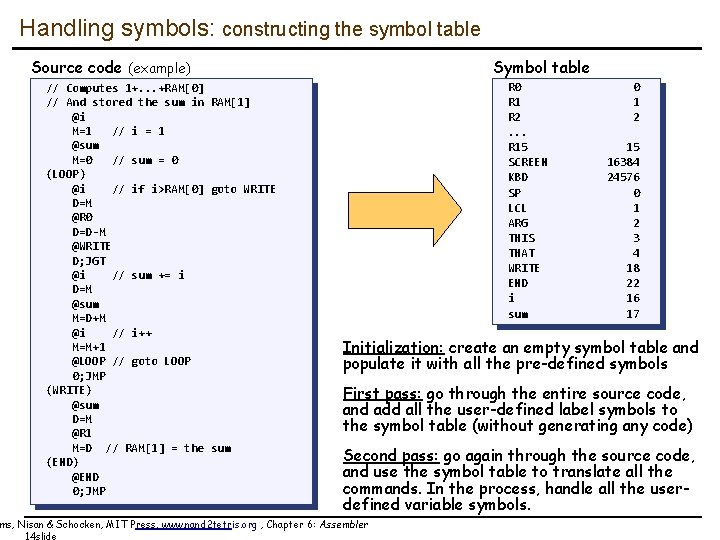
Handling symbols: constructing the symbol table Source code (example) // Computes 1+. . . +RAM[0] // And stored the sum in RAM[1] @i M=1 // i = 1 @sum M=0 // sum = 0 (LOOP) @i // if i>RAM[0] goto WRITE D=M @R 0 D=D-M @WRITE D; JGT @i // sum += i D=M @sum M=D+M @i // i++ M=M+1 @LOOP // goto LOOP 0; JMP (WRITE) @sum D=M @R 1 M=D // RAM[1] = the sum (END) @END 0; JMP Symbol table R 0 R 1 R 2. . . R 15 SCREEN KBD SP LCL ARG THIS THAT WRITE END i sum 0 1 2 15 16384 24576 0 1 2 3 4 18 22 16 17 Initialization: create an empty symbol table and populate it with all the pre-defined symbols First pass: go through the entire source code, and add all the user-defined label symbols to the symbol table (without generating any code) Second pass: go again through the source code, and use the symbol table to translate all the commands. In the process, handle all the userdefined variable symbols. ms, Nisan & Schocken, MIT Press, www. nand 2 tetris. org , Chapter 6: Assembler 14 slide
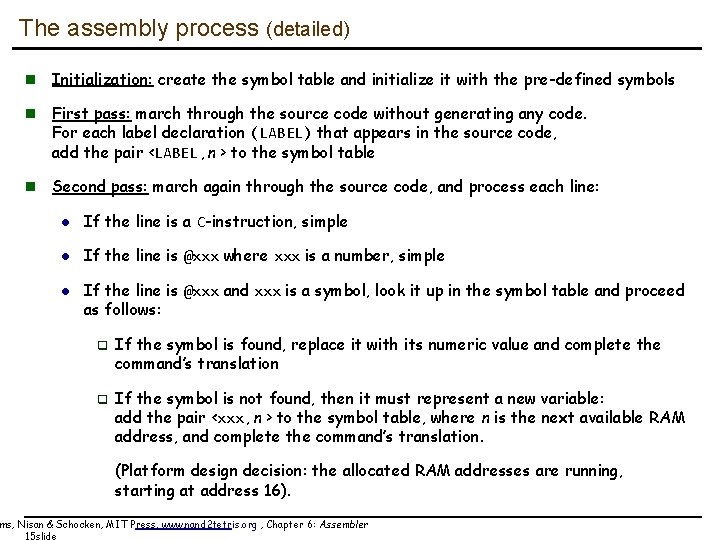
The assembly process (detailed) n Initialization: create the symbol table and initialize it with the pre-defined symbols n First pass: march through the source code without generating any code. For each label declaration (LABEL) that appears in the source code, add the pair <LABEL , n > to the symbol table n Second pass: march again through the source code, and process each line: l If the line is a C-instruction, simple l If the line is @xxx where xxx is a number, simple l If the line is @xxx and xxx is a symbol, look it up in the symbol table and proceed as follows: q q q If the symbol is found, replace it with its numeric value and complete the command’s translation If the symbol is not found, then it must represent a new variable: add the pair <xxx , n > to the symbol table, where n is the next available RAM address, and complete the command’s translation. (Platform design decision: the allocated RAM addresses are running, starting at address 16). ms, Nisan & Schocken, MIT Press, www. nand 2 tetris. org , Chapter 6: Assembler 15 slide
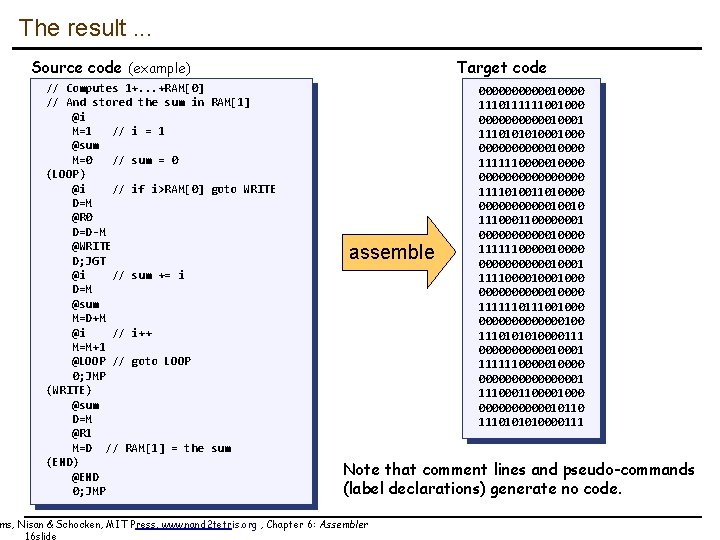
The result. . . Source code (example) // Computes 1+. . . +RAM[0] // And stored the sum in RAM[1] @i M=1 // i = 1 @sum M=0 // sum = 0 (LOOP) @i // if i>RAM[0] goto WRITE D=M @R 0 D=D-M @WRITE D; JGT @i // sum += i D=M @sum M=D+M @i // i++ M=M+1 @LOOP // goto LOOP 0; JMP (WRITE) @sum D=M @R 1 M=D // RAM[1] = the sum (END) @END 0; JMP Target code assemble 00000010000 1110111111001000 00000010001 111010001000 00000010000 11111100000100000000 11110100000010010 111000000010000 11111100000100000010001 111100001000 00000010000 111111001000 0000000100 111010000111 00000010001 111111000001000000001 11100001000 00000010110 111010000111 Note that comment lines and pseudo-commands (label declarations) generate no code. ms, Nisan & Schocken, MIT Press, www. nand 2 tetris. org , Chapter 6: Assembler 16 slide
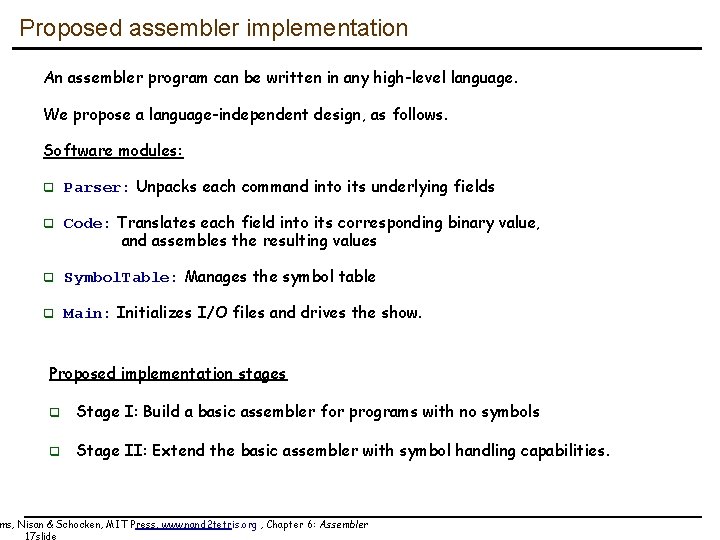
Proposed assembler implementation An assembler program can be written in any high-level language. We propose a language-independent design, as follows. Software modules: q Parser: Unpacks each command into its underlying fields q Code: Translates each field into its corresponding binary value, and assembles the resulting values q Symbol. Table: Manages the symbol table q Main: Initializes I/O files and drives the show. Proposed implementation stages q Stage I: Build a basic assembler for programs with no symbols q Stage II: Extend the basic assembler with symbol handling capabilities. ms, Nisan & Schocken, MIT Press, www. nand 2 tetris. org , Chapter 6: Assembler 17 slide
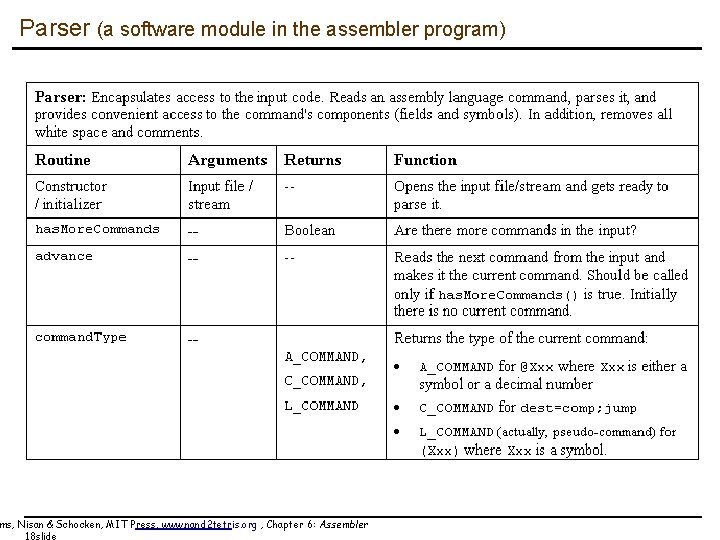
Parser (a software module in the assembler program) ms, Nisan & Schocken, MIT Press, www. nand 2 tetris. org , Chapter 6: Assembler 18 slide
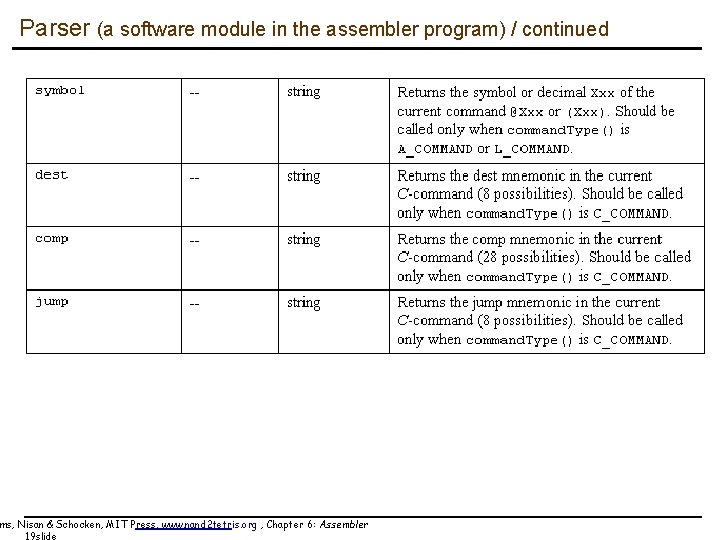
Parser (a software module in the assembler program) / continued ms, Nisan & Schocken, MIT Press, www. nand 2 tetris. org , Chapter 6: Assembler 19 slide
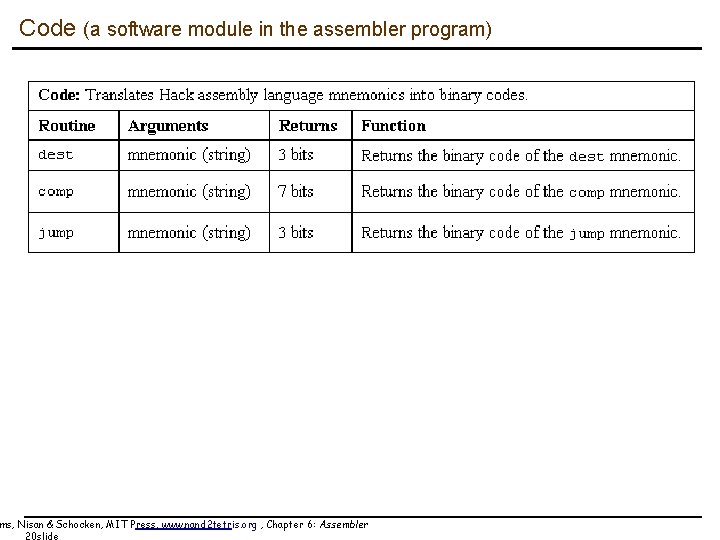
Code (a software module in the assembler program) ms, Nisan & Schocken, MIT Press, www. nand 2 tetris. org , Chapter 6: Assembler 20 slide
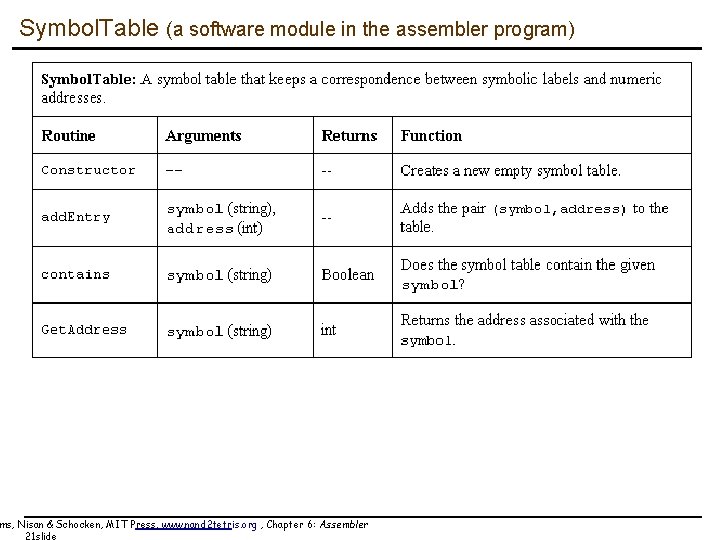
Symbol. Table (a software module in the assembler program) ms, Nisan & Schocken, MIT Press, www. nand 2 tetris. org , Chapter 6: Assembler 21 slide
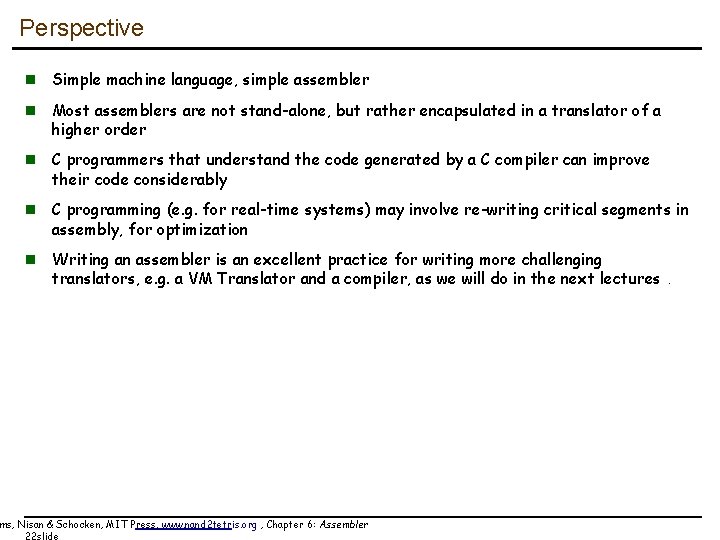
Perspective n Simple machine language, simple assembler n Most assemblers are not stand-alone, but rather encapsulated in a translator of a higher order n C programmers that understand the code generated by a C compiler can improve their code considerably n C programming (e. g. for real-time systems) may involve re-writing critical segments in assembly, for optimization n Writing an assembler is an excellent practice for writing more challenging translators, e. g. a VM Translator and a compiler, as we will do in the next lectures. ms, Nisan & Schocken, MIT Press, www. nand 2 tetris. org , Chapter 6: Assembler 22 slide
- Slides: 22