
Aspire ASPIRE Evaluate To raise the attainment of


- Slides: 88
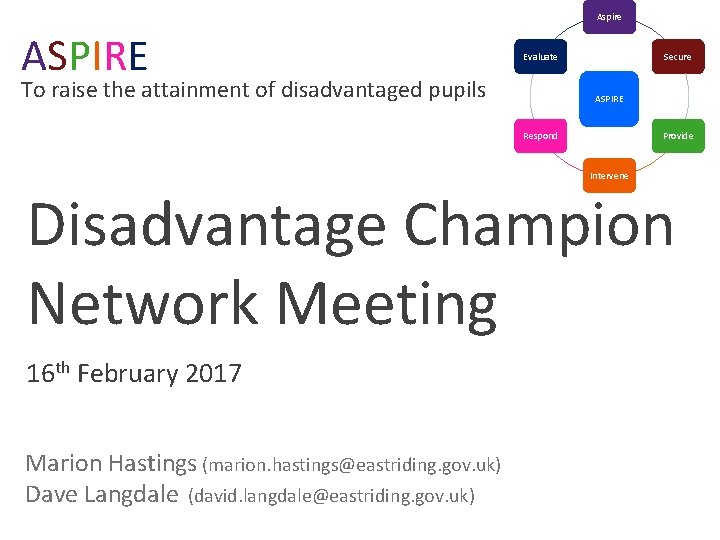
Aspire ASPIRE Evaluate To raise the attainment of disadvantaged pupils Secure ASPIRE Respond Provide Intervene Disadvantage Champion Network Meeting 16 th February 2017 Marion Hastings (marion. hastings@eastriding. gov. uk) Dave Langdale (david. langdale@eastriding. gov. uk)
ASPIRE Disadvantage Champion Network Meeting Welcome WELCOME!
ASPIRE Disadvantage Champion Network Meeting Aims • To provide useful and important updates relating to the Pupil Premium Grant and provision for disadvantaged students • To discuss and share successful pedagogy and effective practice in order to refine and further develop provision for disadvantaged pupils within each school context or setting • To offer support and guidance in relation to: o what Ofsted are looking for in terms of use of the PPG o approaches to improving progress of the most able disadvantaged pupils o ensuring successful transitions for disadvantaged pupils • Agree next steps in school and for the network
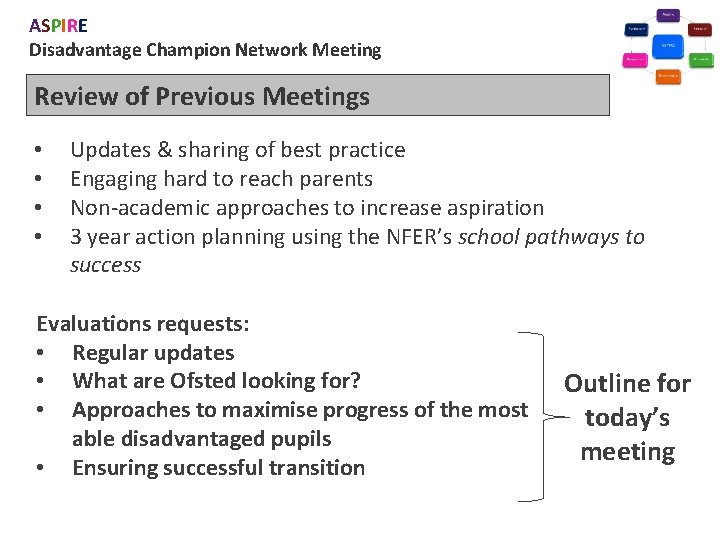
ASPIRE Disadvantage Champion Network Meeting Review of Previous Meetings • • Updates & sharing of best practice Engaging hard to reach parents Non-academic approaches to increase aspiration 3 year action planning using the NFER’s school pathways to success Evaluations requests: • Regular updates • What are Ofsted looking for? • Approaches to maximise progress of the most able disadvantaged pupils • Ensuring successful transition Outline for today’s meeting
ASPIRE Disadvantage Champion Network Meeting Activity 1: Swap! Let’s swap ideas • Locate your ‘question sheet’ • Circulate around the room and ask colleagues your question • Record their answers on your sheet • Also record the school name • Speak to as many different people as you can in the time Be prepared to feedback your findings in 10 mins.
ASPIRE Disadvantage Champion Network Meeting Activity 2: Your updates On your tables consider your PP work, progress made and measurable impact since the last meeting. • Have you introduced any new strategies or interventions to improve disadvantage outcomes? • How have you attempted to further develop the schools approach to those aspects discussed at the last DCNM – 3 year plan, non-academic approaches, parental engagement? • What are you proud of?
ASPIRE Disadvantage Champion Network Meeting Our updates Updates LA V National Progress Data Consistent Messages: • Governors • SLs • ERSIP/ERPLG • EYFS National Conferences DD 4 D support package 1: 1 meetings Social Media
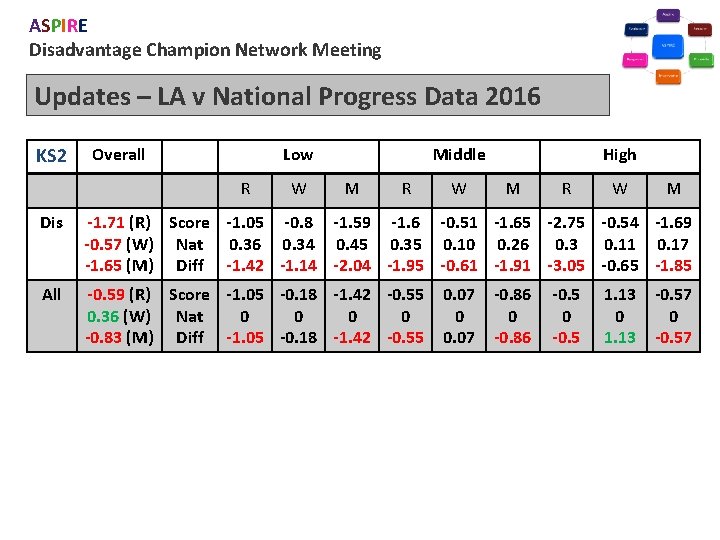
ASPIRE Disadvantage Champion Network Meeting Updates – LA v National Progress Data 2016 KS 2 Overall Low R W Middle M R W High M R W M Dis -1. 71 (R) Score -1. 05 -0. 8 -1. 59 -1. 6 -0. 51 -1. 65 -2. 75 -0. 54 -1. 69 -0. 57 (W) Nat 0. 36 0. 34 0. 45 0. 35 0. 10 0. 26 0. 3 0. 11 0. 17 -1. 65 (M) Diff -1. 42 -1. 14 -2. 04 -1. 95 -0. 61 -1. 91 -3. 05 -0. 65 -1. 85 All -0. 59 (R) Score -1. 05 -0. 18 -1. 42 -0. 55 0. 36 (W) Nat 0 0 -0. 83 (M) Diff -1. 05 -0. 18 -1. 42 -0. 55 0. 07 0 0. 07 -0. 86 0 -0. 86 -0. 5 0 -0. 5 1. 13 0 1. 13 -0. 57 0 -0. 57
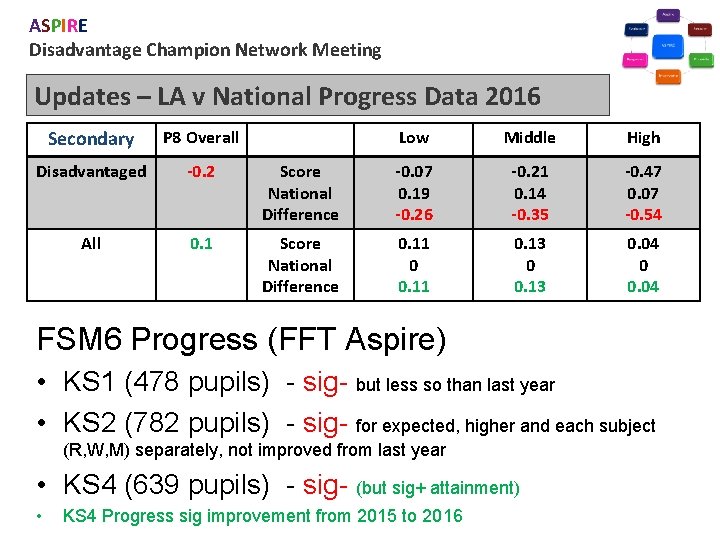
ASPIRE Disadvantage Champion Network Meeting Updates – LA v National Progress Data 2016 Secondary P 8 Overall Disadvantaged -0. 2 All 0. 1 Low Middle High Score National Difference -0. 07 0. 19 -0. 26 -0. 21 0. 14 -0. 35 -0. 47 0. 07 -0. 54 Score National Difference 0. 11 0. 13 0. 04 0 0. 04 FSM 6 Progress (FFT Aspire) • KS 1 (478 pupils) - sig- but less so than last year • KS 2 (782 pupils) - sig- for expected, higher and each subject (R, W, M) separately, not improved from last year • KS 4 (639 pupils) - sig- (but sig+ attainment) • KS 4 Progress sig improvement from 2015 to 2016
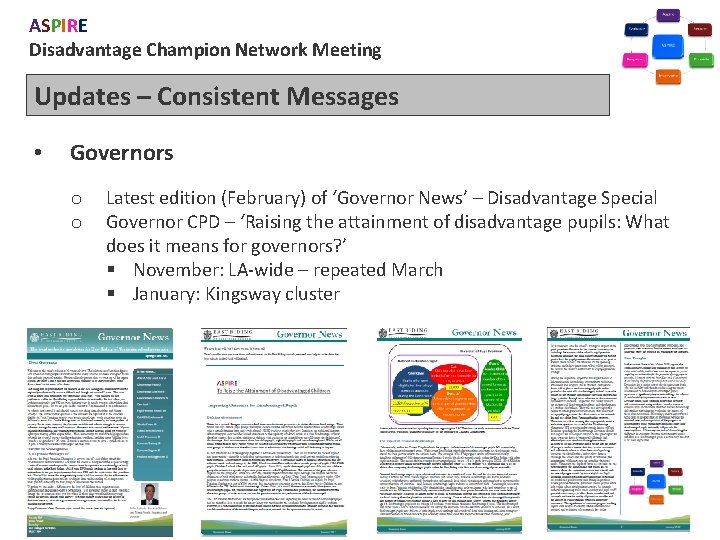
ASPIRE Disadvantage Champion Network Meeting Updates – Consistent Messages • Governors o o Latest edition (February) of ‘Governor News’ – Disadvantage Special Governor CPD – ‘Raising the attainment of disadvantage pupils: What does it means for governors? ’ § November: LA-wide – repeated March § January: Kingsway cluster
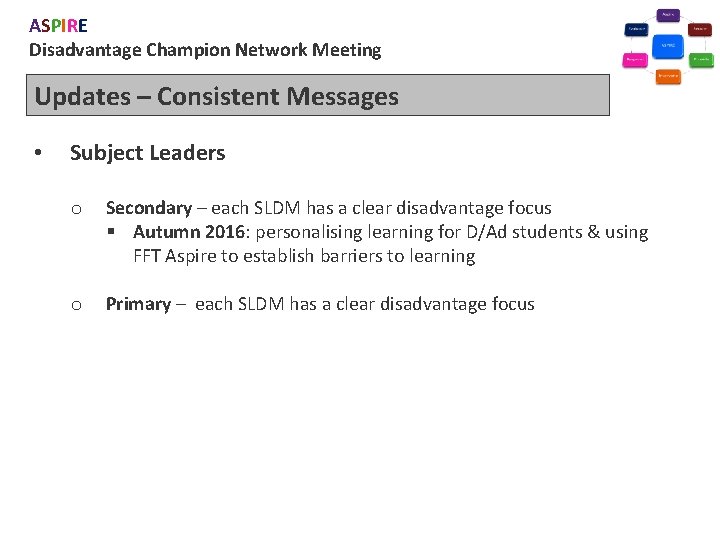
ASPIRE Disadvantage Champion Network Meeting Updates – Consistent Messages • Subject Leaders o Secondary – each SLDM has a clear disadvantage focus § Autumn 2016: personalising learning for D/Ad students & using FFT Aspire to establish barriers to learning o Primary – each SLDM has a clear disadvantage focus
ASPIRE Disadvantage Champion Network Meeting Updates – Consistent Messages • ERPLG & ERPLG o ERPLG § January: Disadvantage Conference § Re-launch of ASPIRE: HT Bulletin § Commitment to improving outcomes o ERSIP § Spreading message far and wide § 122 Disadvantage Champions across the LA
ASPIRE Disadvantage Champion Network Meeting Updates – Disadvantage in the Early Years • ASPIRE o Booklet & charter o Revamped for private & voluntary settings o Launch during Spring term 2017 • Early Years Conference • EY Disadvantage CPD
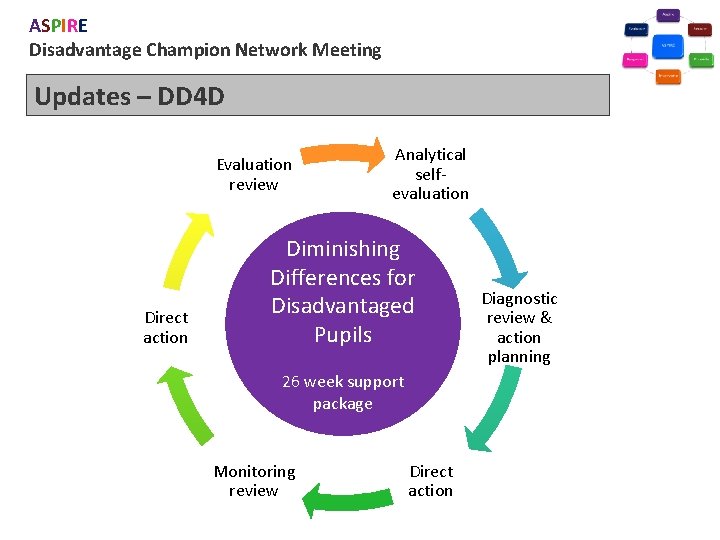
ASPIRE Disadvantage Champion Network Meeting Updates – DD 4 D Evaluation review Direct action Analytical selfevaluation Diminishing Differences for Disadvantaged Pupils 26 week support package Monitoring review Direct action Diagnostic review & action planning
ASPIRE Disadvantage Champion Network Meeting Updates – 1: 1 meetings • Meetings held this academic year have focused on: o PP strategy o Website compliance o Barriers to learning o Evaluating PP spend o Approaches to measuring impact
ASPIRE Disadvantage Champion Network Meeting Updates – New Publications/National Research • Pupil Premium: Assessing the impact of the pupil premium – NGA (2016) • Thinking, Doing, Talking Science • Cross-phase toolkit – Teach. First https: //www. familylinks. org. uk/. . . /teachfirstcross-phasehandbook 2015 final. pdf • The most able students – Ofsted, March 2015 https: //www. gov. uk/government/publications/the-most-able-students-anupdate-on-progress-since-june-2013 • The Sutton Trust Mobility Manifesto – The Sutton Trust, September 2014 http: //www. suttontrust. com/researchive/mobility-manifesto-2015/ • Research Brief: Missing Talent – The Sutton Trust, June 2015 http: //www. suttontrust. com/researchive/missing-talent/
ASPIRE Disadvantage Champion Network Meeting Updates – Social Media • ERYC ILS team Facebook & Twitter accounts in development
ASPIRE Disadvantage Champion Network Meeting November Evaluations – Requested Foci (1) What are Ofsted looking for in terms of use of the PP?
How do Ofsted evaluate the use of the pupil premium? • Brian Stillings • LA Improvement Advisor East Riding of Yorkshire Council County Hall Beverley East Riding of Yorkshire HU 17 9 BA Telephone 01482 887700 • www. eastriding. gov. uk 19
Objectives • To understand how Ofsted evaluate the use of the pupil premium in relation to the Common Inspection Framework (CIF) • To reflect on good and outstanding grade descriptors • To review own practice in relation to the CIF • To reflect on questions and next steps East Riding of Yorkshire Council County Hall Beverley East Riding of Yorkshire HU 17 9 BA Telephone 01482 887700 • www. eastriding. gov. uk 20
Definition – Section 5 Handbook • In a footnote on page 20 of Ofsted’s School Inspection Handbook, it says that the term ‘disadvantaged pupils’ refers to: • … those pupils who attract government pupil premium funding: pupils claiming FSM at any point in the last six years and pupils in care or who left care through adoption or another formal route. East Riding of Yorkshire Council County Hall Beverley East Riding of Yorkshire HU 17 9 BA Telephone 01482 887700 • www. eastriding. gov. uk 21
Vulnerable pupils • Df. E: no set definition for 'vulnerable' pupils • Performance data from the Df. E refers to 'disadvantaged pupils', but does not specifically refer to 'vulnerable' pupils. • Schools set their own vulnerable populations. East Riding of Yorkshire Council County Hall Beverley East Riding of Yorkshire HU 17 9 BA Telephone 01482 887700 • www. eastriding. gov. uk 22
The effectiveness of Leadership and Management – paragraph 141 • “how effectively leaders use additional funding, including the pupil premium, and measure its impact on outcomes for pupils, and how effectively governors hold them to account for this. ” • The pupil premium is also mentioned in the grade descriptors for leadership and management, found on pages 41 to 43 of the handbook. East Riding of Yorkshire Council County Hall Beverley East Riding of Yorkshire HU 17 9 BA Telephone 01482 887700 • www. eastriding. gov. uk 23
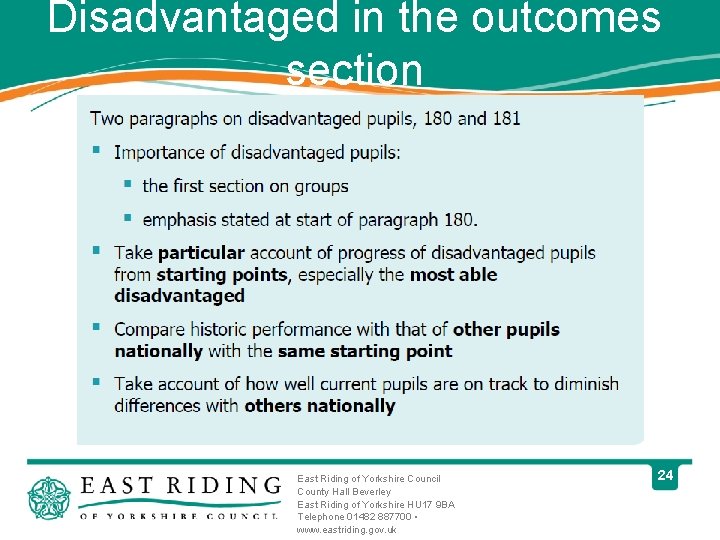
Disadvantaged in the outcomes section East Riding of Yorkshire Council County Hall Beverley East Riding of Yorkshire HU 17 9 BA Telephone 01482 887700 • www. eastriding. gov. uk 24
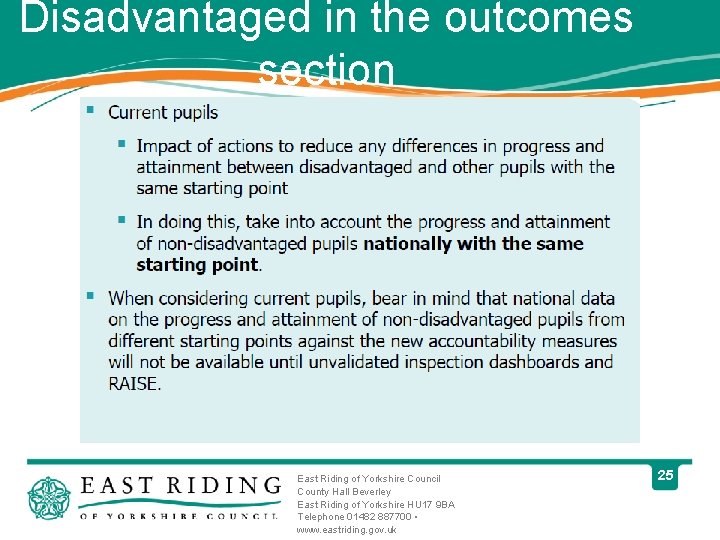
Disadvantaged in the outcomes section East Riding of Yorkshire Council County Hall Beverley East Riding of Yorkshire HU 17 9 BA Telephone 01482 887700 • www. eastriding. gov. uk 25
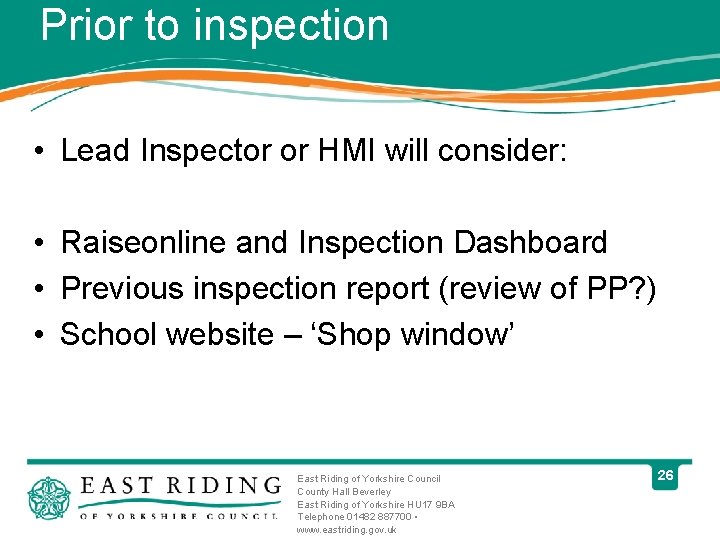
Prior to inspection • Lead Inspector or HMI will consider: • Raiseonline and Inspection Dashboard • Previous inspection report (review of PP? ) • School website – ‘Shop window’ East Riding of Yorkshire Council County Hall Beverley East Riding of Yorkshire HU 17 9 BA Telephone 01482 887700 • www. eastriding. gov. uk 26
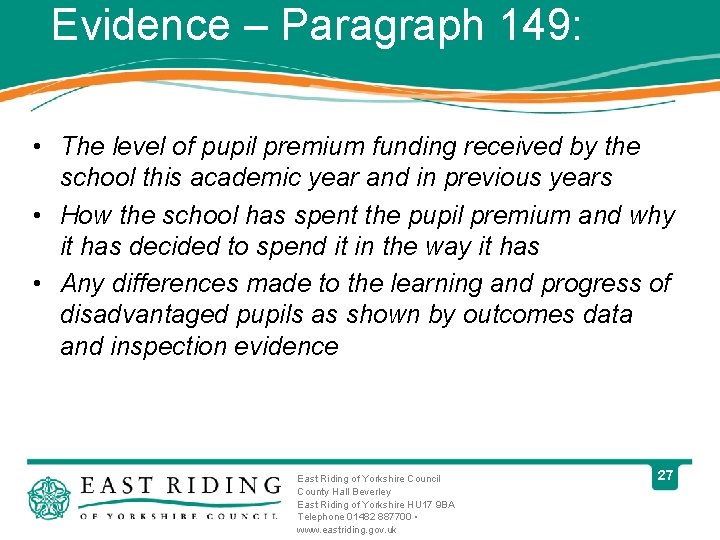
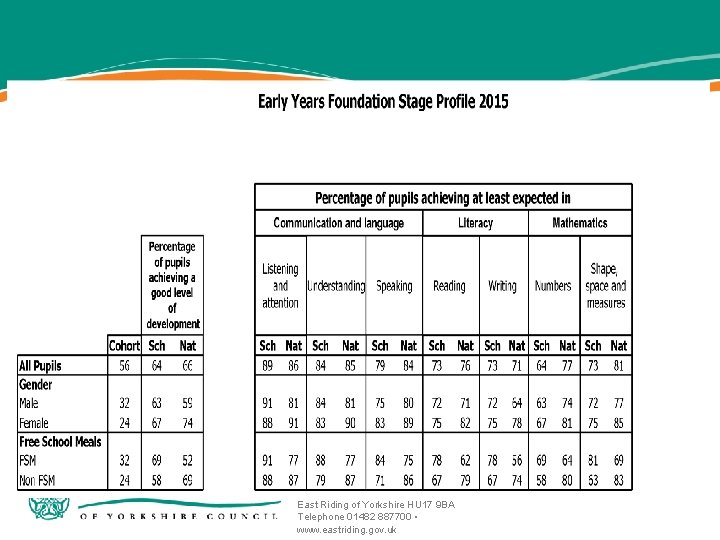
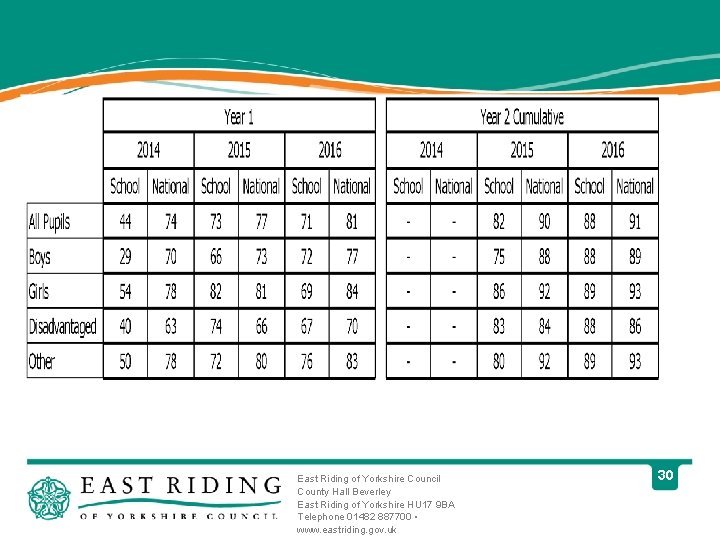
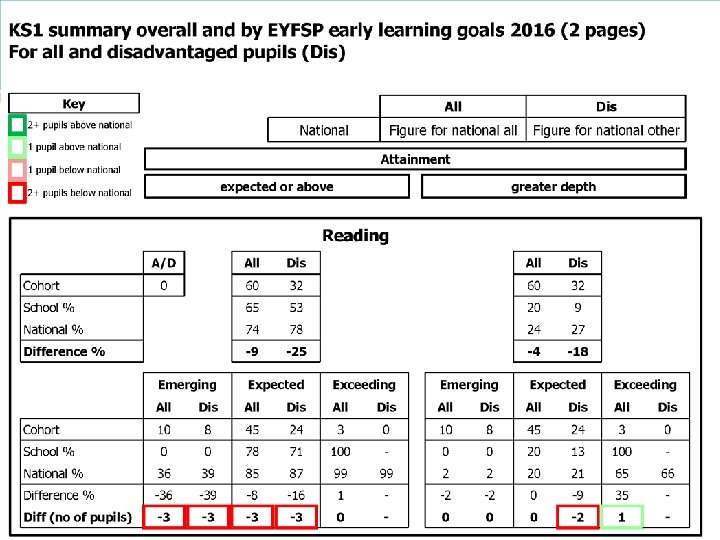
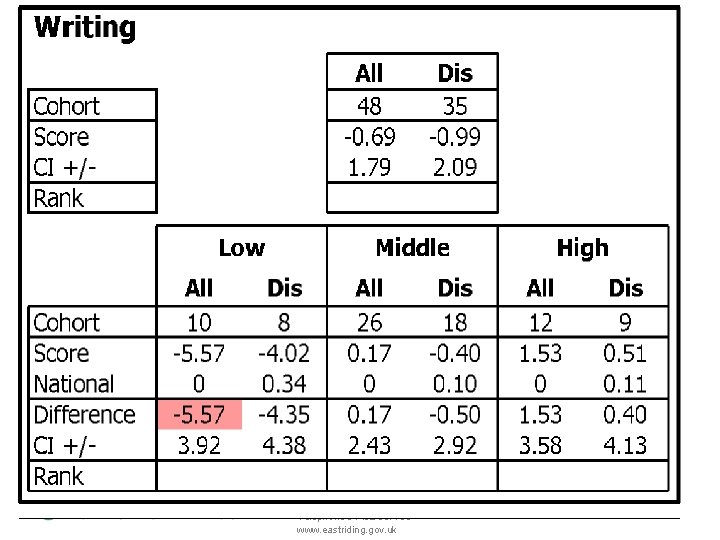
Evidence – Paragraph 149: • The level of pupil premium funding received by the school this academic year and in previous years • How the school has spent the pupil premium and why it has decided to spend it in the way it has • Any differences made to the learning and progress of disadvantaged pupils as shown by outcomes data and inspection evidence East Riding of Yorkshire Council County Hall Beverley East Riding of Yorkshire HU 17 9 BA Telephone 01482 887700 • www. eastriding. gov. uk 27
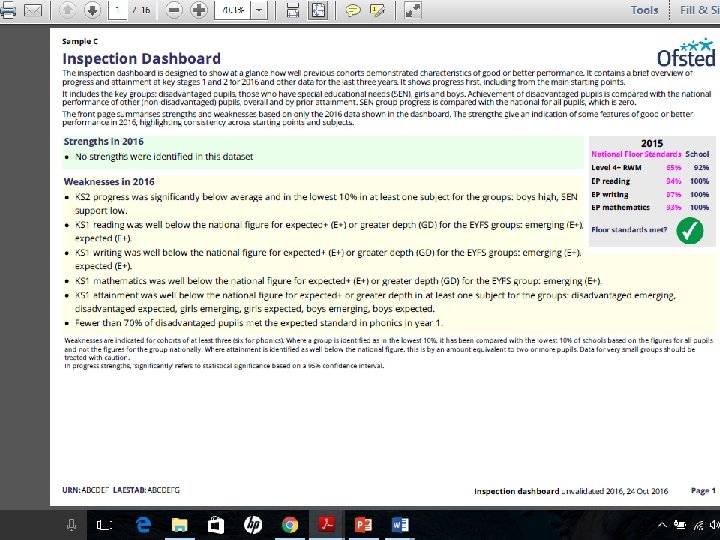
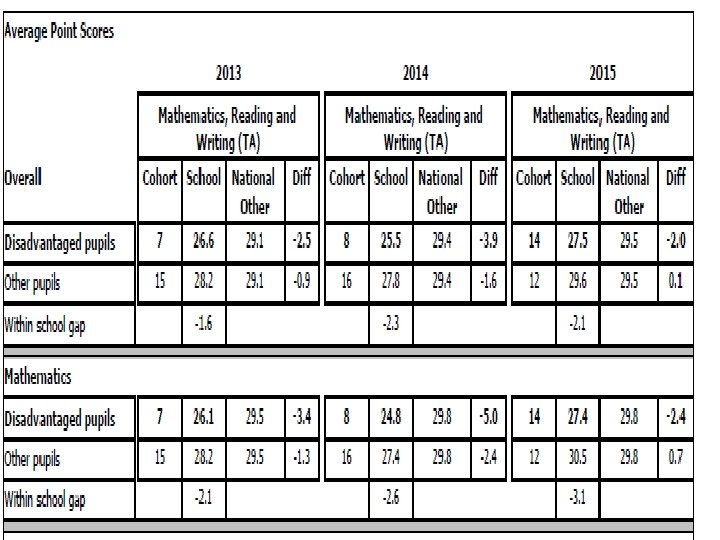
Inspection Dashboard East Riding of Yorkshire Council County Hall Beverley East Riding of Yorkshire HU 17 9 BA Telephone 01482 887700 • www. eastriding. gov. uk 28
East Riding of Yorkshire Council County Hall Beverley East Riding of Yorkshire HU 17 9 BA Telephone 01482 887700 • www. eastriding. gov. uk 29
East Riding of Yorkshire Council County Hall Beverley East Riding of Yorkshire HU 17 9 BA Telephone 01482 887700 • www. eastriding. gov. uk 30
East Riding of Yorkshire Council County Hall Beverley East Riding of Yorkshire HU 17 9 BA Telephone 01482 887700 • www. eastriding. gov. uk 31
East Riding of Yorkshire Council County Hall Beverley East Riding of Yorkshire HU 17 9 BA Telephone 01482 887700 • www. eastriding. gov. uk 32
East Riding of Yorkshire Council County Hall Beverley East Riding of Yorkshire HU 17 9 BA Telephone 01482 887700 • www. eastriding. gov. uk 33
Key Lines of Enquiry • How effectively are leaders using the additional Pupil Premium funding to ensure that disadvantaged pupils including the most able achieve the higher standards? East Riding of Yorkshire Council County Hall Beverley East Riding of Yorkshire HU 17 9 BA Telephone 01482 887700 • www. eastriding. gov. uk 34
Disadvantaged Pupils and the Most Able ØImproved progress and attainment of disadvantaged pupils is a national priority, starting from the early years. ØThe disadvantaged pupils in a school often start with prior attainment lower than the non-disadvantaged (other) pupils in the school. 35 East Riding of Yorkshire Council County Hall Beverley East Riding of Yorkshire HU 17 9 BA Telephone 01482 887700 • www. eastriding. gov. uk
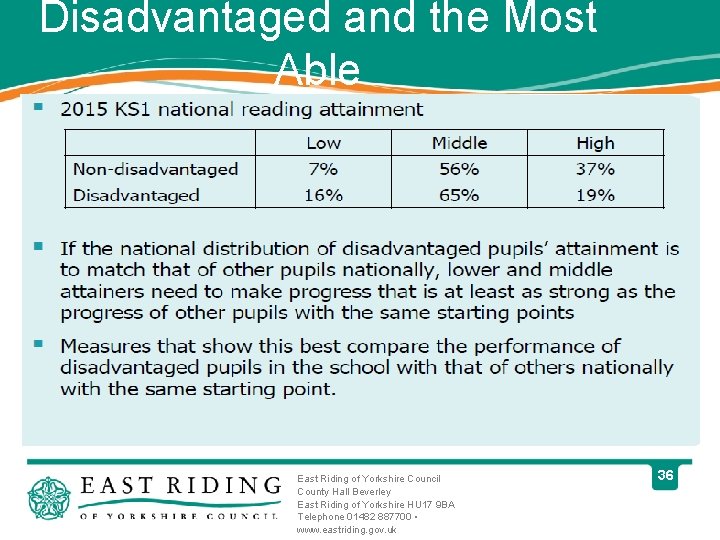
Disadvantaged and the Most Able East Riding of Yorkshire Council County Hall Beverley East Riding of Yorkshire HU 17 9 BA Telephone 01482 887700 • www. eastriding. gov. uk 36
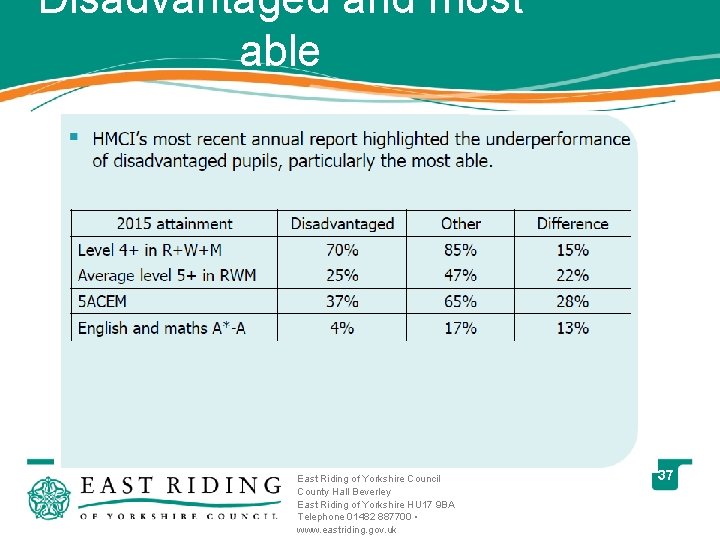
Disadvantaged and most able East Riding of Yorkshire Council County Hall Beverley East Riding of Yorkshire HU 17 9 BA Telephone 01482 887700 • www. eastriding. gov. uk 37
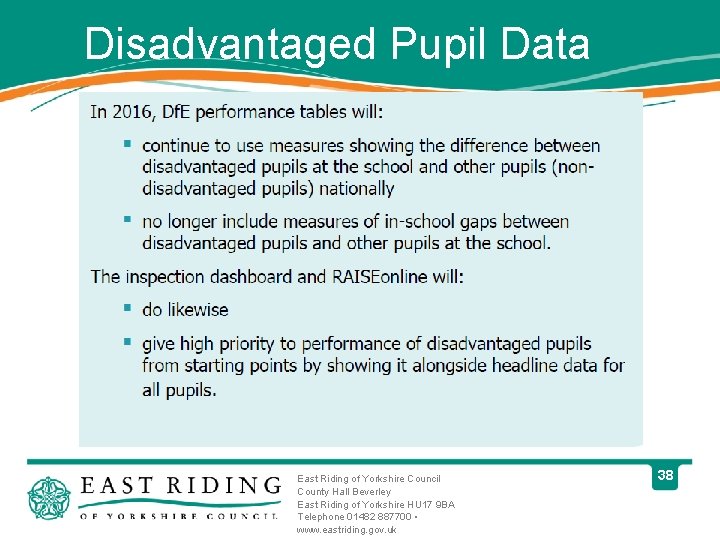
Disadvantaged Pupil Data East Riding of Yorkshire Council County Hall Beverley East Riding of Yorkshire HU 17 9 BA Telephone 01482 887700 • www. eastriding. gov. uk 38
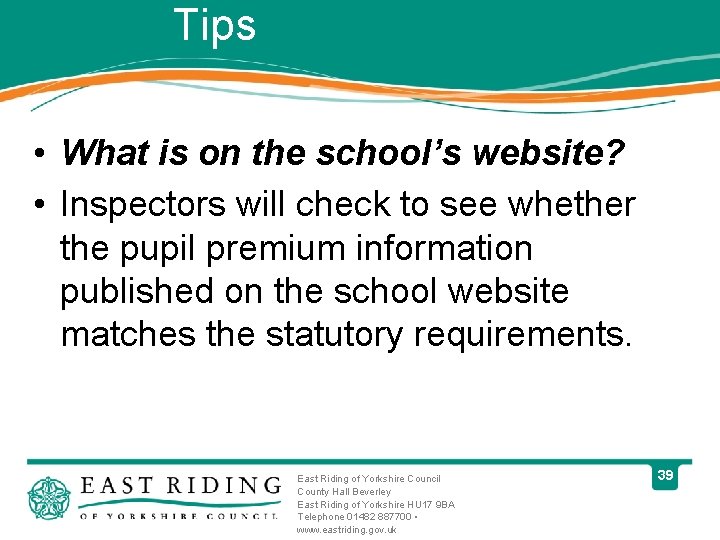
Tips • What is on the school’s website? • Inspectors will check to see whether the pupil premium information published on the school website matches the statutory requirements. East Riding of Yorkshire Council County Hall Beverley East Riding of Yorkshire HU 17 9 BA Telephone 01482 887700 • www. eastriding. gov. uk 39
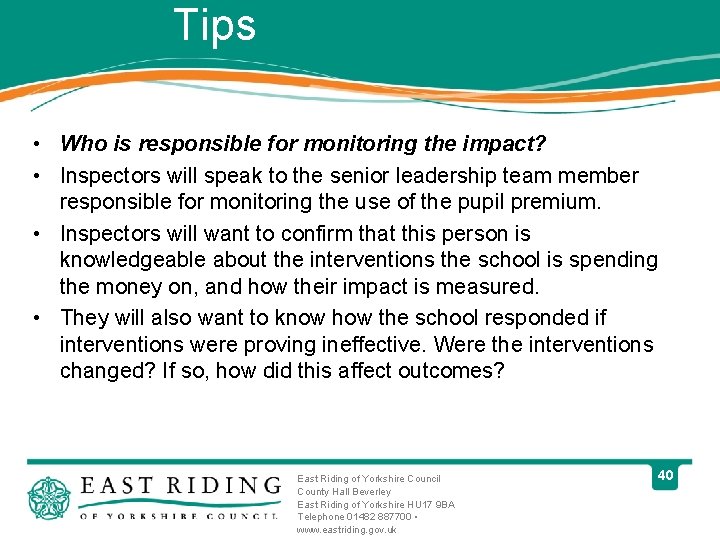
Tips • Who is responsible for monitoring the impact? • Inspectors will speak to the senior leadership team member responsible for monitoring the use of the pupil premium. • Inspectors will want to confirm that this person is knowledgeable about the interventions the school is spending the money on, and how their impact is measured. • They will also want to know how the school responded if interventions were proving ineffective. Were the interventions changed? If so, how did this affect outcomes? East Riding of Yorkshire Council County Hall Beverley East Riding of Yorkshire HU 17 9 BA Telephone 01482 887700 • www. eastriding. gov. uk 40
Tips • Be consistent in evidencing impact on outcomes • Ofsted has no expectation about the format in which schools present their progress data. The data should be consistent across the school. • The school's method for monitoring and demonstrating the impact of the pupil premium on pupils’ achievement should be moderated across year groups/classes, to ensure it is in line with the school's assessment and tracking policy. East Riding of Yorkshire Council County Hall Beverley East Riding of Yorkshire HU 17 9 BA Telephone 01482 887700 • www. eastriding. gov. uk 41
Tips • • Governors School Development Plan Pupil Voice Work scrutiny Marking Seating plans Impact of spending East Riding of Yorkshire Council County Hall Beverley East Riding of Yorkshire HU 17 9 BA Telephone 01482 887700 • www. eastriding. gov. uk 42
Grade Descriptors • The ‘outstanding’ grade descriptors include the following: • Governors systematically challenge senior leaders so that the effective deployment of staff and resources, including the pupil premium and special educational needs (SEN) funding, secures excellent outcomes for pupils. • Governors do not shy away from challenging leaders about variations in outcomes for pupil groups, especially between disadvantaged and other pupils. East Riding of Yorkshire Council County Hall Beverley East Riding of Yorkshire HU 17 9 BA Telephone 01482 887700 • www. eastriding. gov. uk 43
Grade Descriptors • One of the ‘good’ grade descriptors says: • Governors hold senior leaders stringently to account for all aspects of the school’s performance, including the use of pupil premium. . . , ensuring that the skilful deployment of staff and resources delivers good or improving outcomes for pupils. East Riding of Yorkshire Council County Hall Beverley East Riding of Yorkshire HU 17 9 BA Telephone 01482 887700 • www. eastriding. gov. uk 44
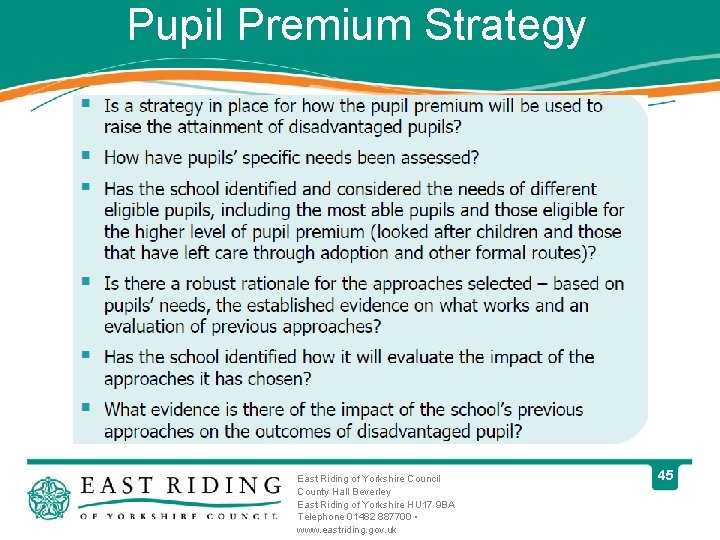
Pupil Premium Strategy East Riding of Yorkshire Council County Hall Beverley East Riding of Yorkshire HU 17 9 BA Telephone 01482 887700 • www. eastriding. gov. uk 45
External Review of Pupil Premium • Paragraph 153 of the handbook says: • Inspectors will recommend an external review of the school’s use of the pupil premium if they identify specific issues regarding the provision and outcomes for disadvantaged pupils. East Riding of Yorkshire Council County Hall Beverley East Riding of Yorkshire HU 17 9 BA Telephone 01482 887700 • www. eastriding. gov. uk 46
Published and school data Task – • Look at your own school’s outcomes • How well are disadvantaged pupils doing? • How does this compare with current tracking East Riding of Yorkshire Council County Hall Beverley East Riding of Yorkshire HU 17 9 BA Telephone 01482 887700 • www. eastriding. gov. uk 47
Resources • https: //www. gov. uk/government/uploads/sy stem/uploads/attachment_data/file/553942/ School_inspection_handbook-section_5. pdf East Riding of Yorkshire Council County Hall Beverley East Riding of Yorkshire HU 17 9 BA Telephone 01482 887700 • www. eastriding. gov. uk 48
ASPIRE To raise the attainment of disadvantaged pupils Activity 3: Ofsted Scenario: An Ofsted inspection during which a major focus has been placed upon the outcomes of disadvantaged pupils within the school. As Disadvantage Champion you have been asked to attend an interview to investigate the performance of disadvantage pupils within your school. Activity: Produce a range of questions which you feel it is likely you could be asked. Feedback
ASPIRE To raise the attainment of disadvantaged pupils Ofsted Scenario – Potential Questions 1. What do you understand is the difference between disadvantage, vulnerability and Pupil Premium eligibility? 2. How many disadvantaged pupils currently are there within each year group and what is the ability profile of these disadvantaged pupils? 3. Do all staff know who these disadvantaged pupils are and how, as a school, do you ensure that each member of staff is aware of and caters for the individual needs of each disadvantaged pupil? 4. How do you track the progress of disadvantaged pupils within the school? 5. What happens when disadvantaged pupils fall behind? 6. What are the rates of progress for disadvantaged pupils/most able disadvantaged pupils vs. peers and other pupils nationally? 7. What patterns of attainment/progress of disadvantaged pupils/the most able disadvantaged pupils have you identified from Raise?
ASPIRE To raise the attainment of disadvantaged pupils Ofsted Scenario – Potential Questions 8. What does Raise tell you about the 3 year trend of attainment/progress for disadvantaged pupils/the most able disadvantaged pupils in your school? 9. How do disadvantaged pupils engage in wider school life? What are participation levels outside of the classroom like? 10. How does the school ensure that the aspirations of the disadvantaged cohort are raised? 11. How has the ER ASPIRE document been used within the school? 12. How are the specific needs of disadvantaged pupils assessed and catered for? 13. How do you identify and address the specific barriers to learning of disadvantaged pupils? 14. How does the school personalise the learning for disadvantaged pupils to ensure maximum progress? Can you give me an example?
ASPIRE To raise the attainment of disadvantaged pupils Ofsted Scenario – Potential Questions 15. How do you evaluate the impact of provision for the disadvantaged? How regularly does evaluation take place? What evidence do you have of the impact of the strategies employed? 16. What happens if an employed intervention is not working or having a positive impact? How do you know whether an intervention is having impact? 17. How much support/challenge do you receive from governors regarding PP spending and what impact does this have on your work? 18. How effective is the use of PP? Can you give me an example of positive impact? Discuss on your tables how you would go about answering these questions and what information you would require to do so. RAG rate your current level of confidence in being to answer them successfully.
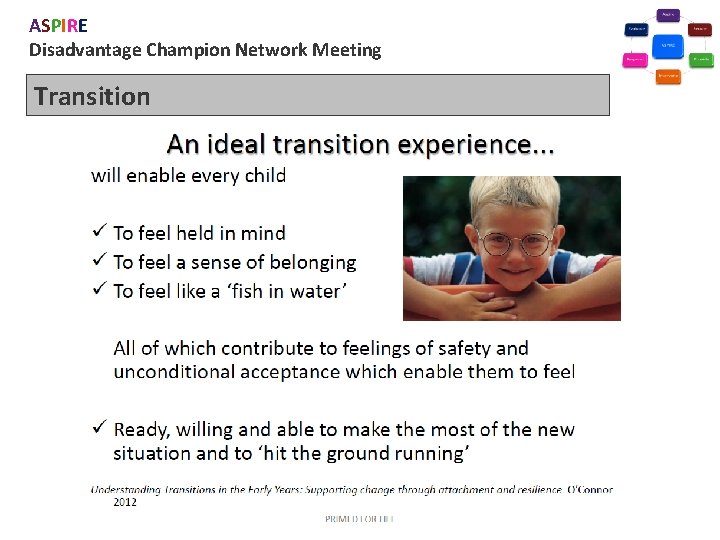
ASPIRE Disadvantage Champion Network Meeting November Evaluations – Requested Foci (2) Transition
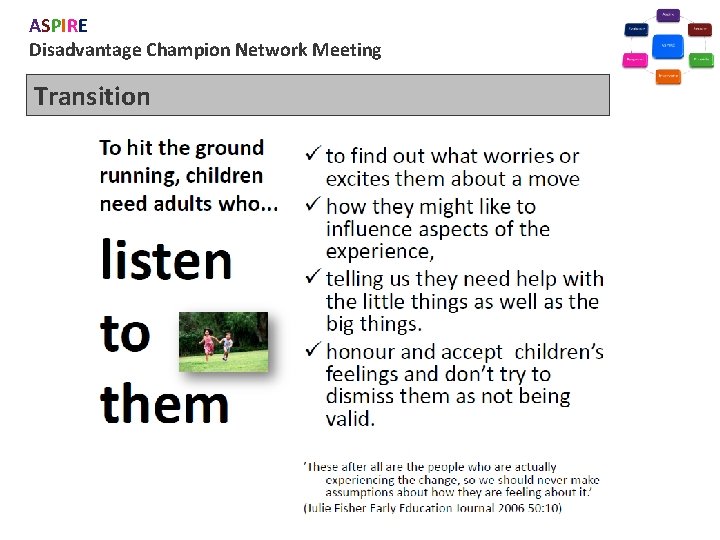
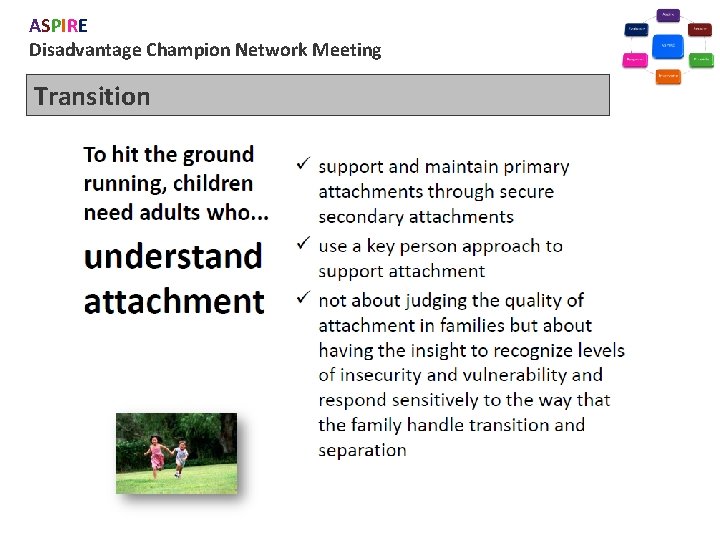
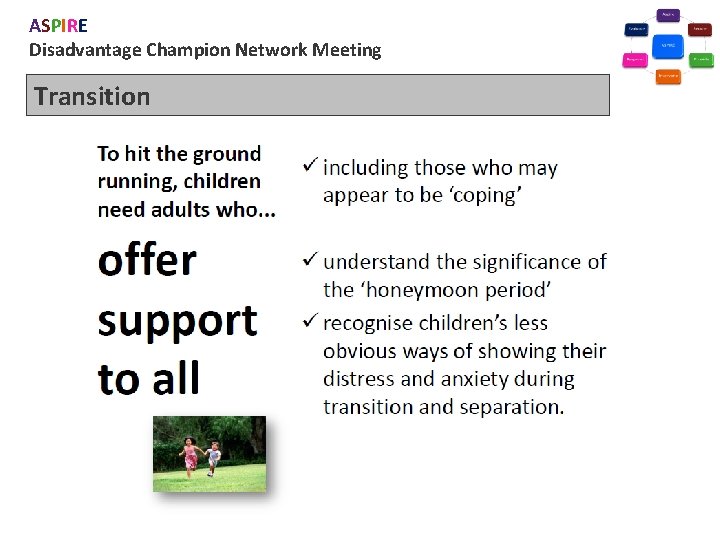
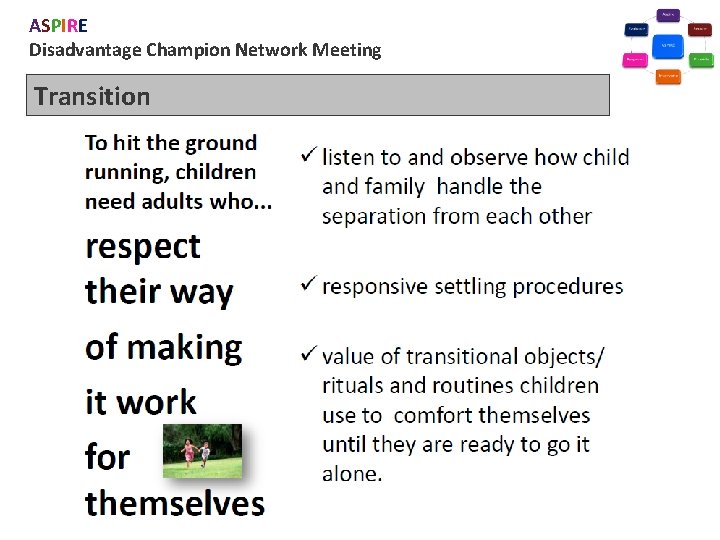
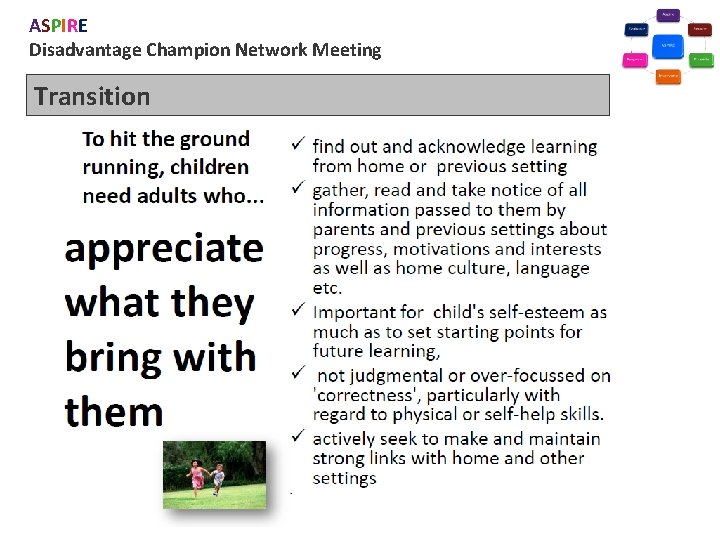
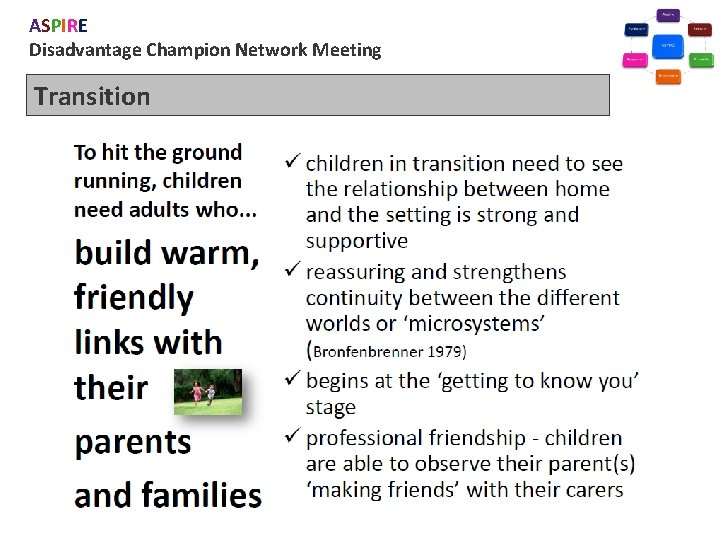
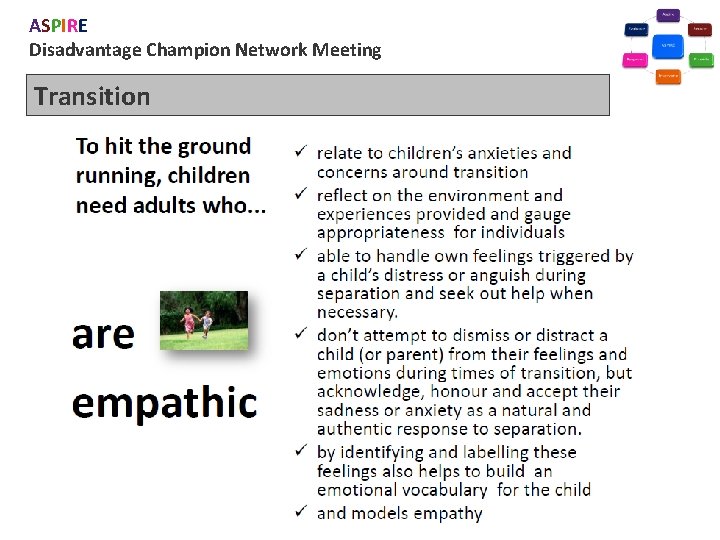
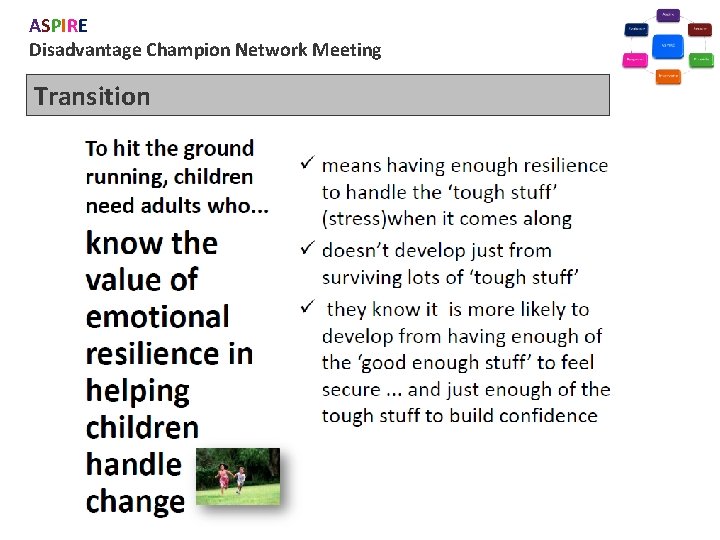
ASPIRE Disadvantage Champion Network Meeting Transition – the effects Most pupils can cope with [transition]. Any negative impact the changes may have on pupils’ progress in learning is usually short term. Some research suggests that the effects of transition dissipate during the first term. Other research suggests that this can take up to a year (Anderson et al. , 2000; WAG, 2011). A few pupils, however, are less able to cope with transition from primary to post-primary school. Research shows that pupils from disadvantaged backgrounds and those from some ethnic minority groups are particularly vulnerable at the transition stage. Pupils in vulnerable groups may have greater difficulty coping with transitional changes in their schooling than their peers. This can have a negative and long lasting impact on their progress in learning and achievement (Sutherland et al. , 2010, WAG, 2011). They may be at risk of underachieving and find coping with the changes associated with transition difficult. (CCEA, 2015)
ASPIRE Disadvantage Champion Network Meeting Transition – the effects The educational ‘dip’ Between primary and secondary school: • Almost 40% of children fail to make expected progress during the year immediately following the change of schools (Galton, 1999) • Average progress drops between KS 2 and KS 3 for reading, writing and maths. The probability of dropping backwards to a lower sub-level is greatest between summer of Year 6 and autumn of Year 7 (Df. E, 2011) There are some factors which make a can make a problematic transition more likely. There is evidence to show that pupils’ anxiety in the run-up to transition can lead to more negative experiences, and ultimately dips in educational outcomes. Some groups are more prone to experience such anxiety and a resulting poor transition. These groups [amongst others] include those that: • receive free school meals • are of lower socio-economic status • have low self-image and self-esteem • have single parents (Teach First: Cross-phase toolkit)
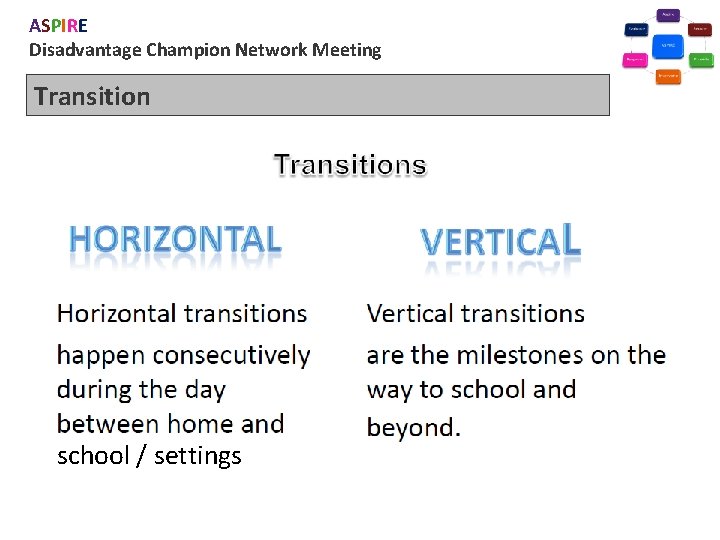
ASPIRE Disadvantage Champion Network Meeting Transition school / settings
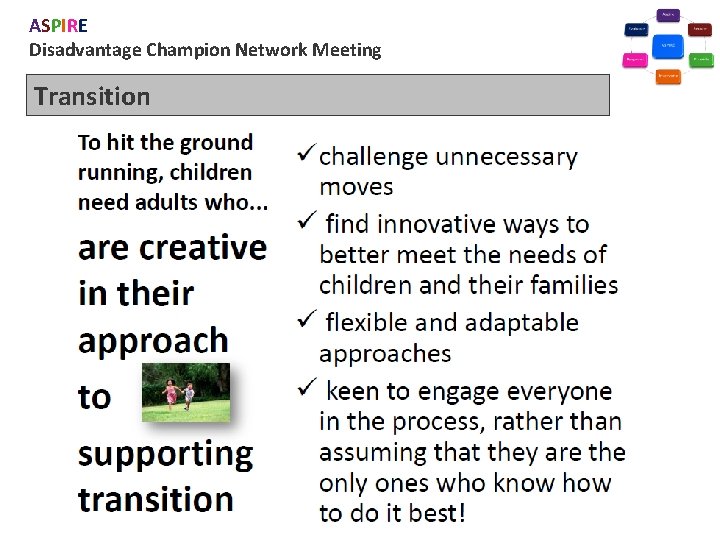
ASPIRE Disadvantage Champion Network Meeting Transition
ASPIRE Disadvantage Champion Network Meeting Transition
ASPIRE Disadvantage Champion Network Meeting Transition
ASPIRE Disadvantage Champion Network Meeting Transition
ASPIRE Disadvantage Champion Network Meeting Transition
ASPIRE Disadvantage Champion Network Meeting Transition
ASPIRE Disadvantage Champion Network Meeting Transition
ASPIRE Disadvantage Champion Network Meeting Transition
ASPIRE Disadvantage Champion Network Meeting Transition
ASPIRE Disadvantage Champion Network Meeting Transition
ASPIRE Disadvantage Champion Network Meeting Transition
ASPIRE Disadvantage Champion Network Meeting Transition
ASPIRE Disadvantage Champion Network Meeting Transition
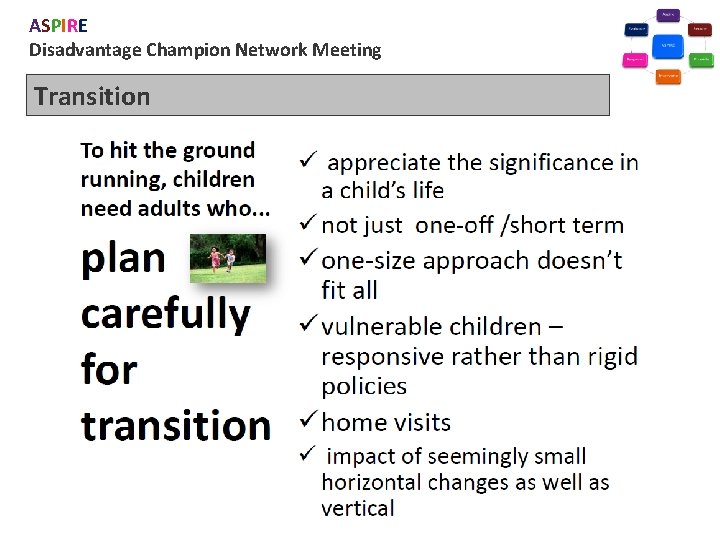
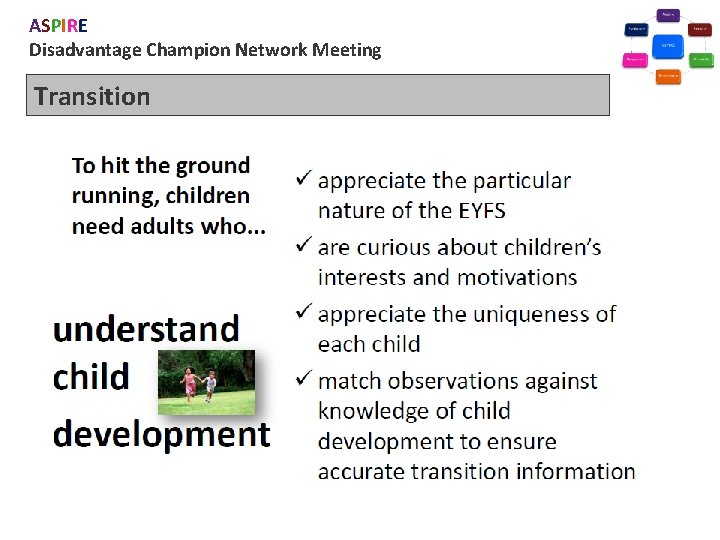
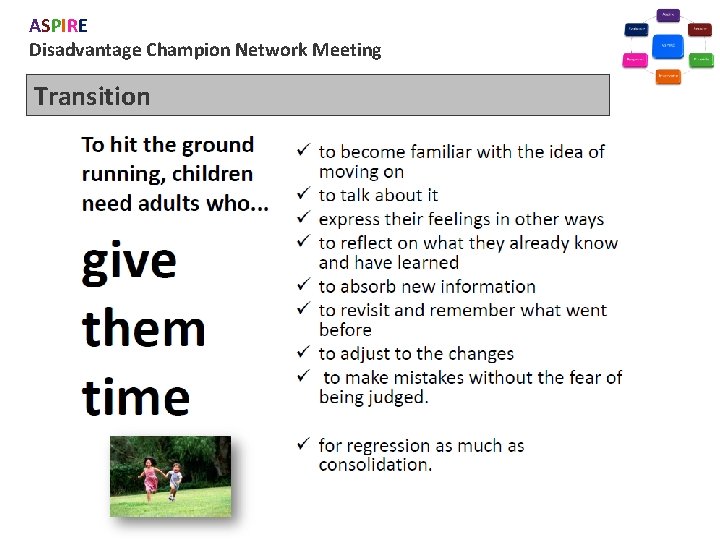
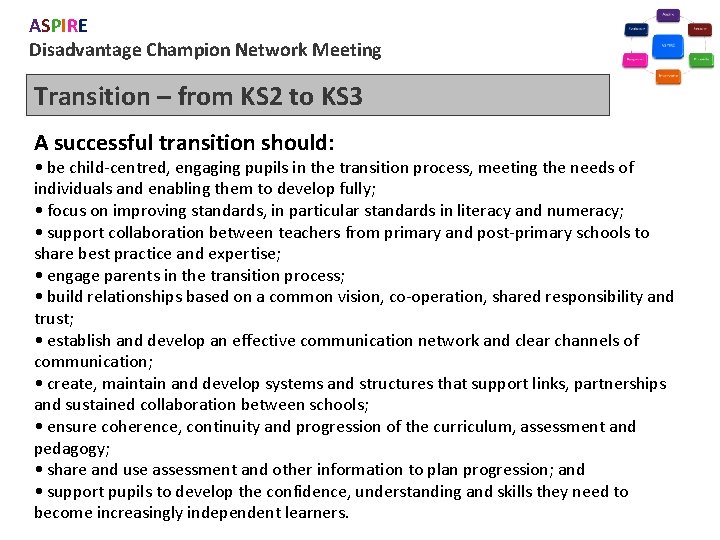
ASPIRE Disadvantage Champion Network Meeting Transition – from KS 2 to KS 3 A successful transition should: • be child-centred, engaging pupils in the transition process, meeting the needs of individuals and enabling them to develop fully; • focus on improving standards, in particular standards in literacy and numeracy; • support collaboration between teachers from primary and post-primary schools to share best practice and expertise; • engage parents in the transition process; • build relationships based on a common vision, co-operation, shared responsibility and trust; • establish and develop an effective communication network and clear channels of communication; • create, maintain and develop systems and structures that support links, partnerships and sustained collaboration between schools; • ensure coherence, continuity and progression of the curriculum, assessment and pedagogy; • share and use assessment and other information to plan progression; and • support pupils to develop the confidence, understanding and skills they need to become increasingly independent learners.
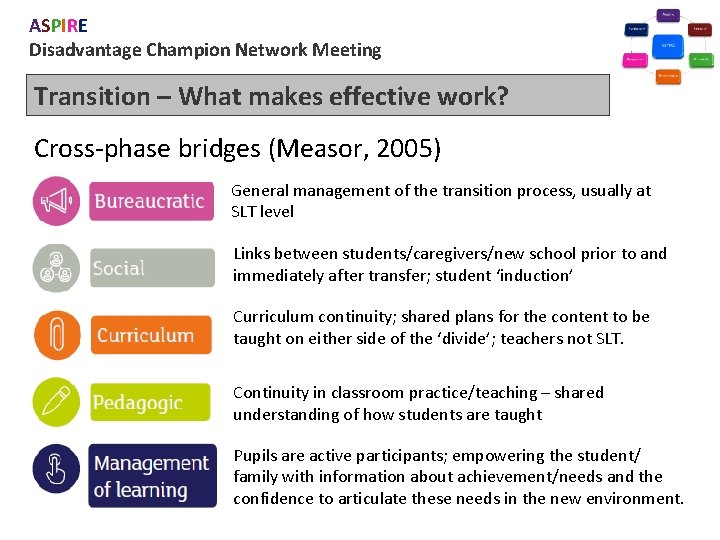
ASPIRE Disadvantage Champion Network Meeting Transition – What makes effective work? Cross-phase bridges (Measor, 2005) General management of the transition process, usually at SLT level Links between students/caregivers/new school prior to and immediately after transfer; student ‘induction’ Curriculum continuity; shared plans for the content to be taught on either side of the ‘divide’; teachers not SLT. Continuity in classroom practice/teaching – shared understanding of how students are taught Pupils are active participants; empowering the student/ family with information about achievement/needs and the confidence to articulate these needs in the new environment.
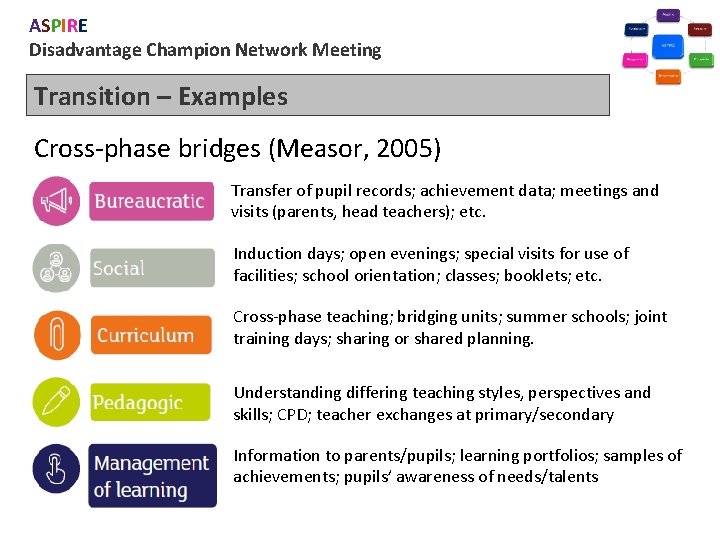
ASPIRE Disadvantage Champion Network Meeting Transition – Examples Cross-phase bridges (Measor, 2005) Transfer of pupil records; achievement data; meetings and visits (parents, head teachers); etc. Induction days; open evenings; special visits for use of facilities; school orientation; classes; booklets; etc. Cross-phase teaching; bridging units; summer schools; joint training days; sharing or shared planning. Understanding differing teaching styles, perspectives and skills; CPD; teacher exchanges at primary/secondary Information to parents/pupils; learning portfolios; samples of achievements; pupils’ awareness of needs/talents
ASPIRE Disadvantage Champion Network Meeting Transition – Activity 1. Group discussion: (a)How is transition currently approached at your school (b)What is done to support disadvantaged children during transition? (c) What information do you request / provide? (d)How could cross-phase work be developed? 2. Devise an activity/approach to specifically support the transition of disadvantaged pupils.
ASPIRE Disadvantage Champion Network Meeting Activity 4: Taboo Let’s play TABOO!!
ASPIRE Disadvantage Champion Network Meeting November Evaluations – Requested Foci (3) Challenging the Most Able Disadvantaged Student
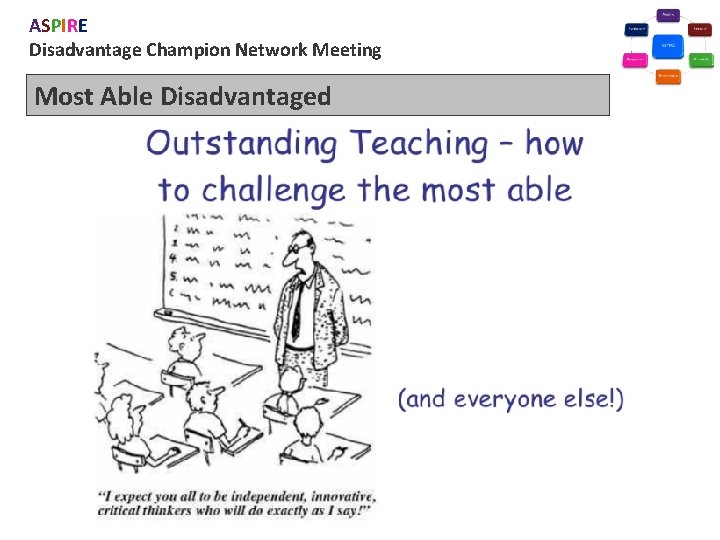
ASPIRE Disadvantage Champion Network Meeting Most Able Disadvantaged
ASPIRE Disadvantage Champion Network Meeting Most Able Disadvantaged The most able students – Ofsted, 2015 Inspectors found that the secondary schools visited were not using transition information from primary school effectively to get the most able off to s flying start in KS 3
ASPIRE Disadvantage Champion Network Meeting Most Able Disadvantaged - Ofsted The most able students – Ofsted, 2015 School leaders should: • develop a culture of high expectations for students and teachers in KS 3 and rapidly improve the quality of curriculum delivery, teaching and assessment, especially in foundation subjects • ensure that teachers and leaders in KS 3 use information held by primary schools about students’ learning and achievements in KS 2 effectively, so that work for the most able students provides the right level of challenge • identify designated staff and governors to champion the needs of disadvantaged most able students • give KS 3 equal priority with other key stages when allocating teaching staff to classes • provide training for teachers of all key stages so that their teaching routinely challenges the most able students • ensure evaluations of curriculum delivery, teaching and learning in KS 3 are robust and lead to rapid improvements • involve universities, other providers and employers in training school staff to provide expert advice and guidance to the most able students, especially those who are disadvantaged, about the opportunities open to them in higher education, apprenticeships and other work opportunities
ASPIRE Disadvantage Champion Network Meeting Most Able Disadvantaged Research Brief: June 2015 Missing Talent
ASPIRE Disadvantage Champion Network Meeting Most Able Disadvantaged The voice of the pupil ‘Most of the stuff I know already and you have to complete the simple stuff first to get to the more advanced things. ’
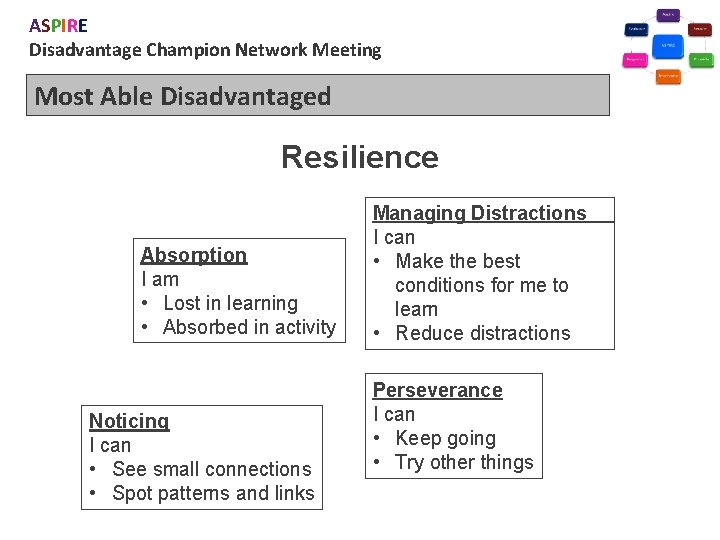
ASPIRE Disadvantage Champion Network Meeting Most Able Disadvantaged Resilience Absorption I am • Lost in learning • Absorbed in activity Noticing I can • See small connections • Spot patterns and links Managing Distractions I can • Make the best conditions for me to learn • Reduce distractions Perseverance I can • Keep going • Try other things
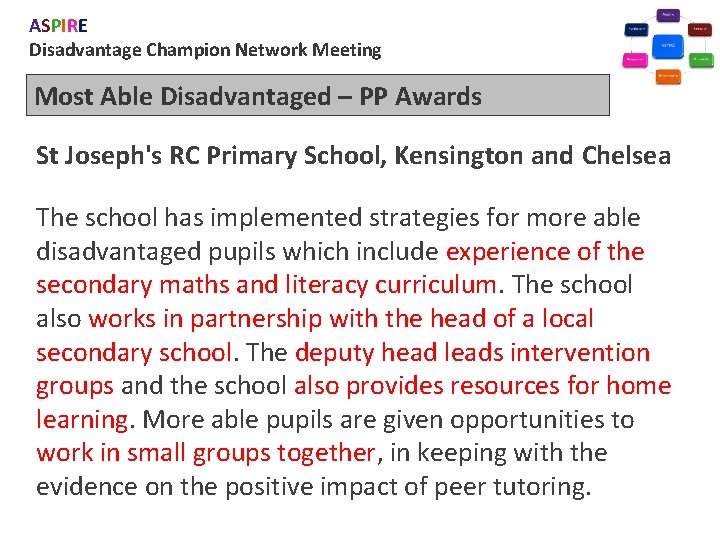
ASPIRE Disadvantage Champion Network Meeting Most Able Disadvantaged – PP Awards St Joseph's RC Primary School, Kensington and Chelsea The school has implemented strategies for more able disadvantaged pupils which include experience of the secondary maths and literacy curriculum. The school also works in partnership with the head of a local secondary school. The deputy head leads intervention groups and the school also provides resources for home learning. More able pupils are given opportunities to work in small groups together, in keeping with the evidence on the positive impact of peer tutoring.
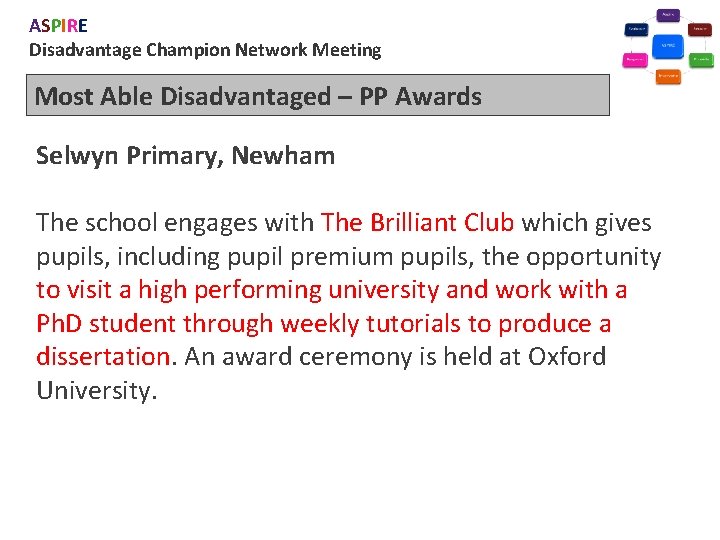
ASPIRE Disadvantage Champion Network Meeting Most Able Disadvantaged – PP Awards Selwyn Primary, Newham The school engages with The Brilliant Club which gives pupils, including pupil premium pupils, the opportunity to visit a high performing university and work with a Ph. D student through weekly tutorials to produce a dissertation. An award ceremony is held at Oxford University.
ASPIRE Disadvantage Champion Network Meeting Most Able Disadvantaged – PP Awards Vauxhall Primary, Lambeth More able pupils, the majority of which are eligible for the pupil premium, are identified in the early years of primary. The school works in partnership with the Polka Theatre, the Royal Institution and Shell STEM to encourage pupils who aspire in literature, mathematics and sciences. More able pupils also attend Early School where they get breakfast and work with senior teachers on high level maths and English. They also receive weekly coding tuition after school. There is a whole school strategy to improve independence and the school uses the Growth Mindset Programme.
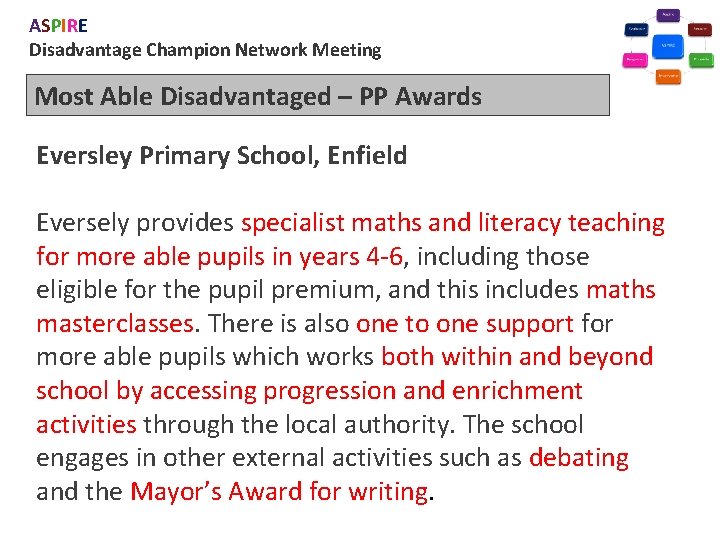
ASPIRE Disadvantage Champion Network Meeting Most Able Disadvantaged – PP Awards Eversley Primary School, Enfield Eversely provides specialist maths and literacy teaching for more able pupils in years 4 -6, including those eligible for the pupil premium, and this includes maths masterclasses. There is also one to one support for more able pupils which works both within and beyond school by accessing progression and enrichment activities through the local authority. The school engages in other external activities such as debating and the Mayor’s Award for writing.
ASPIRE Disadvantage Champion Network Meeting Most Able Disadvantaged http: //www. nace. co. uk/
ASPIRE Disadvantage Champion Network Meeting Future Meetings Summer Term DCNM – Thursday 29 th June 2017 Raising the Attainment of Disadvantaged Students: What Does it Mean for Governors? – Tuesday 28 th March 2017 What support you may find useful going forward? • What would you like the next networking session to focus on? • Would you be prepared to share your successes? • Please help!!! Areas of specific help that schools require – email to us and we will ensure we cover.
ASPIRE Disadvantage Champion Network Meeting Evaluations Please complete the evaluation forms: • Course facilitators: Marion Hastings, Dave Langdale Meeting Aims • To provide useful and important updates relating to the Pupil Premium Grant and provision for disadvantaged students • To discuss and share successful pedagogy and effective practice in order to refine and further develop provision for disadvantaged pupils within each school context or setting • To offer support and guidance in relation to: o what Ofsted are looking for in terms of use of the PPG o approaches to improving progress of the most able disadvantaged pupils o ensuring successful transitions for disadvantaged pupils • Agree next steps in school and for the network