
Asphalt Compaction Evaluation using Rolling Density Meter TH

- Slides: 26
Asphalt Compaction Evaluation using Rolling Density Meter (TH 52 and TH 14 Field Trials) Dr. Shongtao Dai, Mn. DOT Dr. Kyle Hoegh, Mn. DOT Dr. Lev Khazanovich, U. of Pittsburgh NRRA Pavement Conference (May 24, 2017) Mn/DOT Office of Materials and Road Research
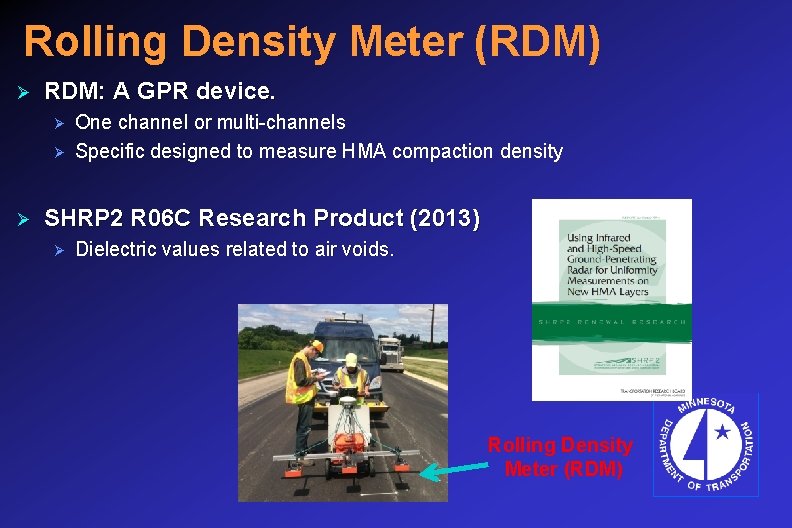
Rolling Density Meter (RDM) Ø RDM: A GPR device. Ø Ø Ø One channel or multi-channels Specific designed to measure HMA compaction density SHRP 2 R 06 C Research Product (2013) Ø Dielectric values related to air voids. Rolling Density Meter (RDM)
SHRP 2 R 06 C Implementation (2015) Ø Ø Ø Objective: Ø Evaluate RDM equipment. Ø Provide support to states to assist to implement RDM. Partnership Ø FHWA, AASHTO, CH 2 M Hill Ø University of Minnesota Ø Mn. DOT Ø Maine DOT Ø Nebraska DOT Field Trails Ø Maine: HWY 9 near Clifton Ø Nebraska: HWY 2, Lincoln Ø Minnesota: TH. 14 and TH. 52
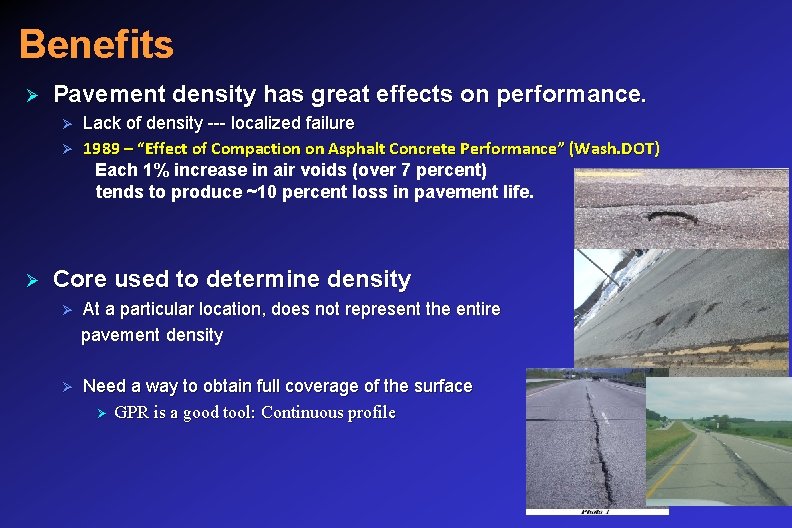
Benefits Ø Pavement density has great effects on performance. Ø Ø Ø Lack of density --- localized failure 1989 – “Effect of Compaction on Asphalt Concrete Performance” (Wash. DOT) Each 1% increase in air voids (over 7 percent) tends to produce ~10 percent loss in pavement life. Core used to determine density Ø At a particular location, does not represent the entire pavement density Ø Need a way to obtain full coverage of the surface Ø GPR is a good tool: Continuous profile
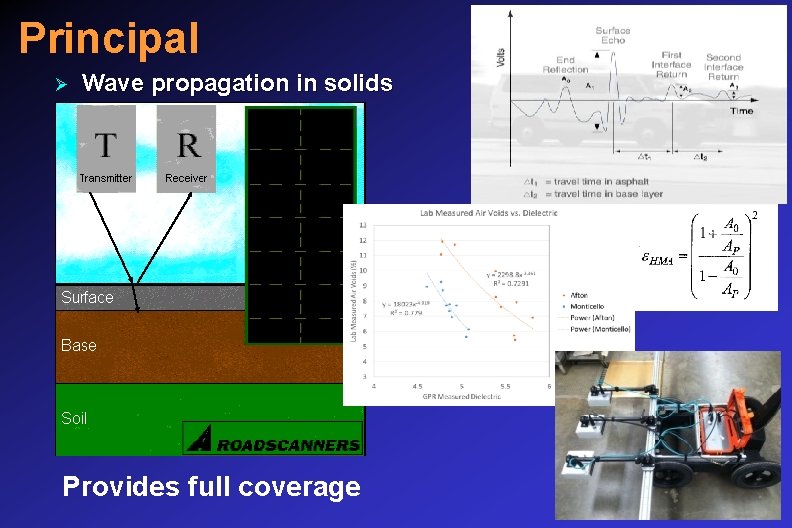
Principal Ø Wave propagation in solids Provides full coverage
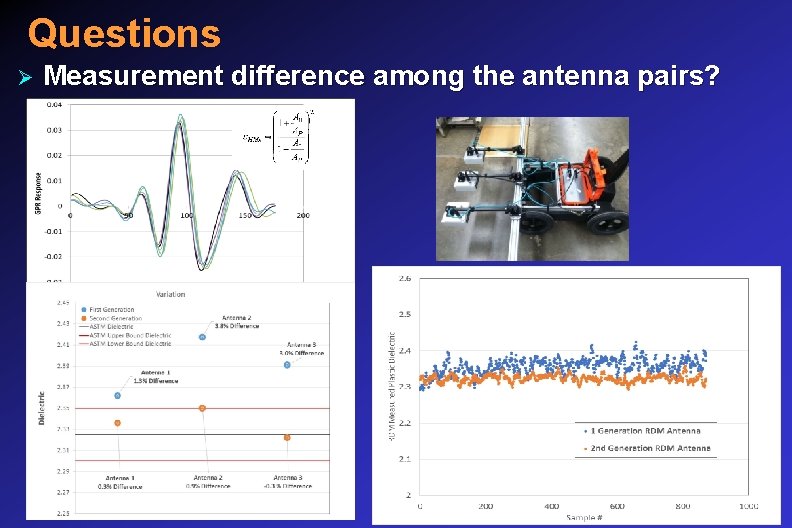
Questions Ø Measurement difference among the antenna pairs?
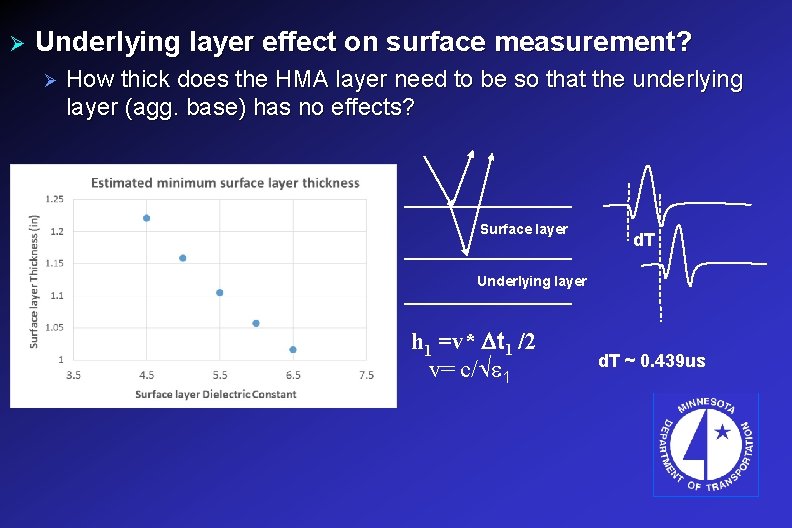
Ø Underlying layer effect on surface measurement? Ø How thick does the HMA layer need to be so that the underlying layer (agg. base) has no effects? Surface layer d. T Underlying layer h 1 =v* t 1 /2 v= c/ 1 d. T ~ 0. 439 us
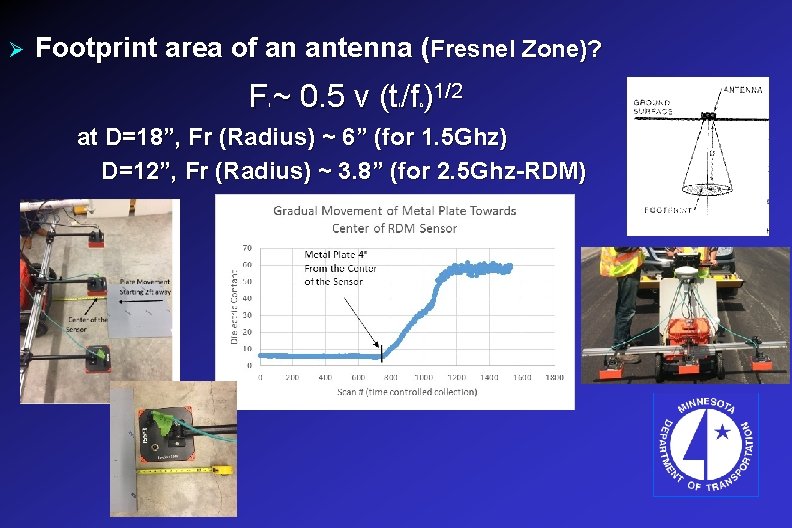
Ø Footprint area of an antenna (Fresnel Zone)? F ~ 0. 5 v (t /f )1/2 r r c at D=18”, Fr (Radius) ~ 6” (for 1. 5 Ghz) D=12”, Fr (Radius) ~ 3. 8” (for 2. 5 Ghz-RDM)
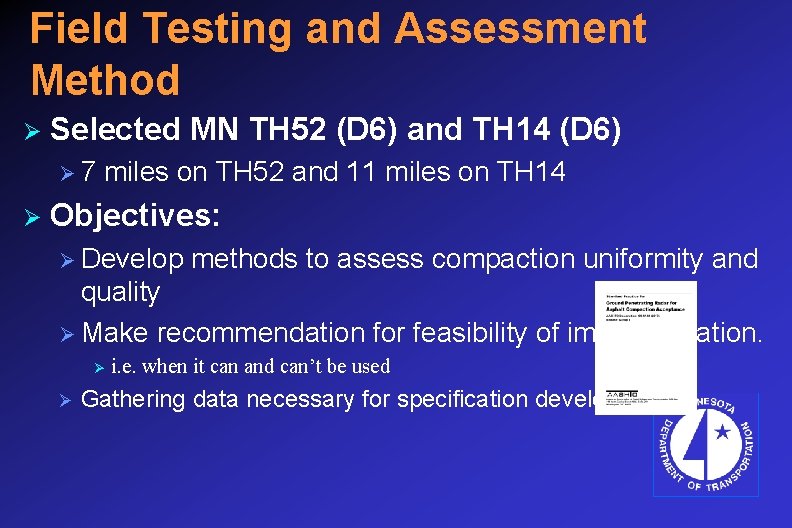
Field Testing and Assessment Method Ø Selected Ø 7 MN TH 52 (D 6) and TH 14 (D 6) miles on TH 52 and 11 miles on TH 14 Ø Objectives: Ø Develop methods to assess compaction uniformity and quality Ø Make recommendation for feasibility of implementation. Ø Ø i. e. when it can and can’t be used Gathering data necessary for specification development.
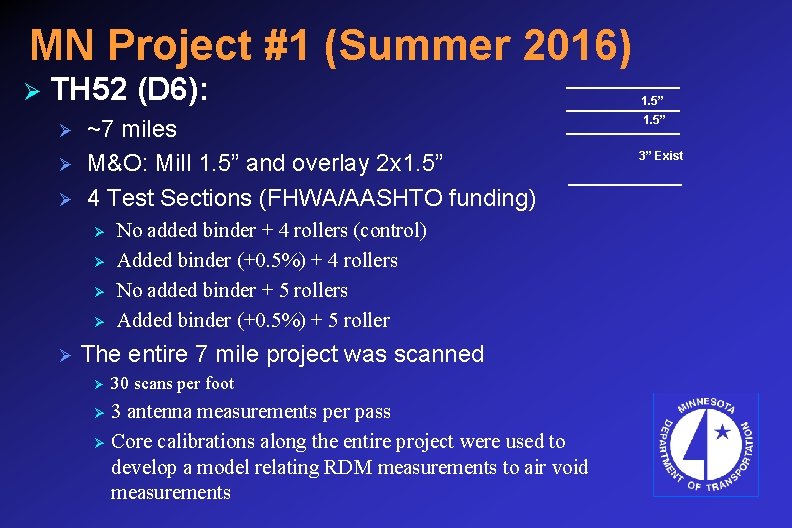
MN Project #1 (Summer 2016) Ø TH 52 (D 6): Ø ~7 miles Ø M&O: Mill 1. 5” and overlay 2 x 1. 5” Ø 4 Test Sections (FHWA/AASHTO funding) Ø Ø Ø No added binder + 4 rollers (control) Added binder (+0. 5%) + 4 rollers No added binder + 5 rollers Added binder (+0. 5%) + 5 roller The entire 7 mile project was scanned Ø 30 scans per foot Ø 3 antenna measurements per pass Core calibrations along the entire project were used to develop a model relating RDM measurements to air void measurements Ø 1. 5” 3” Exist
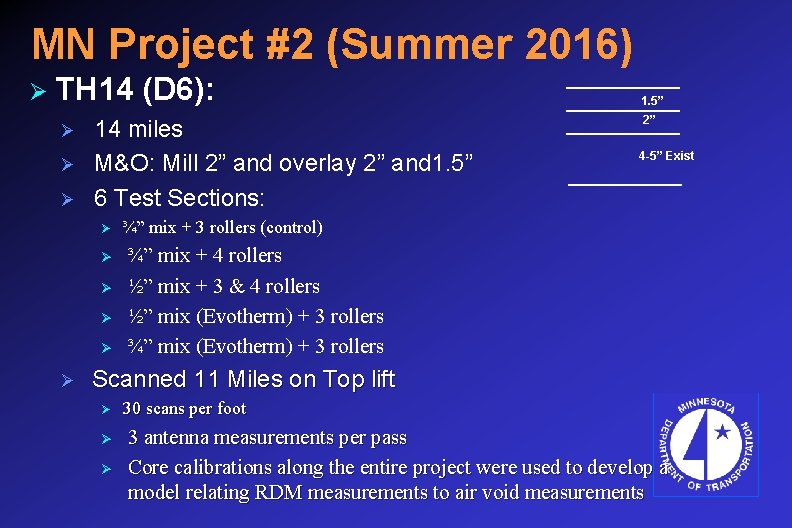
MN Project #2 (Summer 2016) Ø TH 14 (D 6): Ø 14 miles Ø M&O: Mill 2” and overlay 2” and 1. 5” Ø 6 Test Sections: Ø Ø Ø 1. 5” 2” 4 -5” Exist ¾” mix + 3 rollers (control) ¾” mix + 4 rollers ½” mix + 3 & 4 rollers ½” mix (Evotherm) + 3 rollers ¾” mix (Evotherm) + 3 rollers Scanned 11 Miles on Top lift Ø Ø Ø 30 scans per foot 3 antenna measurements per pass Core calibrations along the entire project were used to develop a model relating RDM measurements to air void measurements
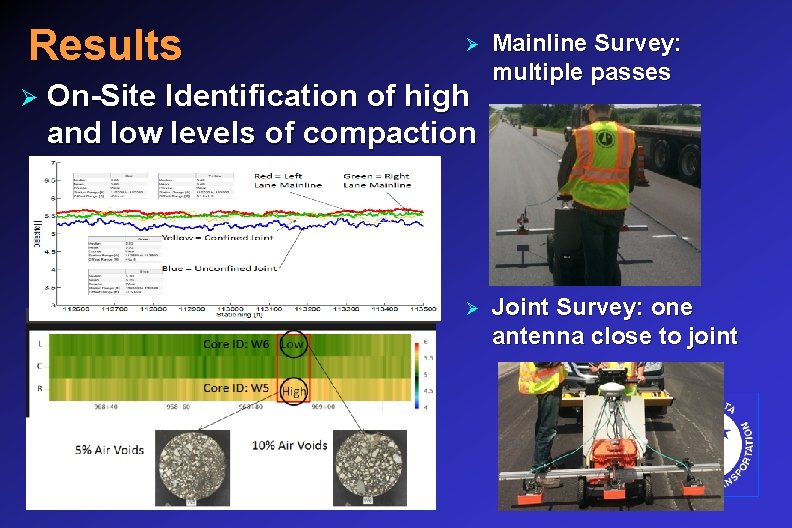
Results Ø Ø On-Site Identification of high and low levels of compaction Ø Mainline Survey: multiple passes Joint Survey: one antenna close to joint
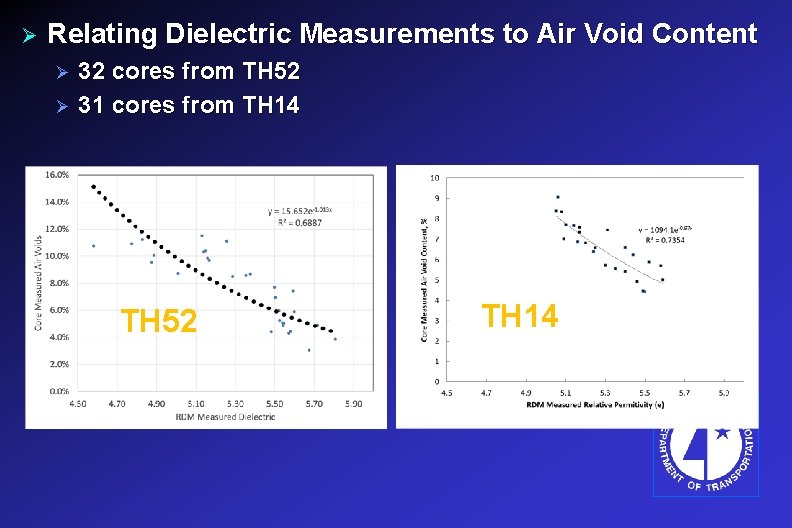
Ø Relating Dielectric Measurements to Air Void Content 32 cores from TH 52 Ø 31 cores from TH 14 Ø TH 52 TH 14
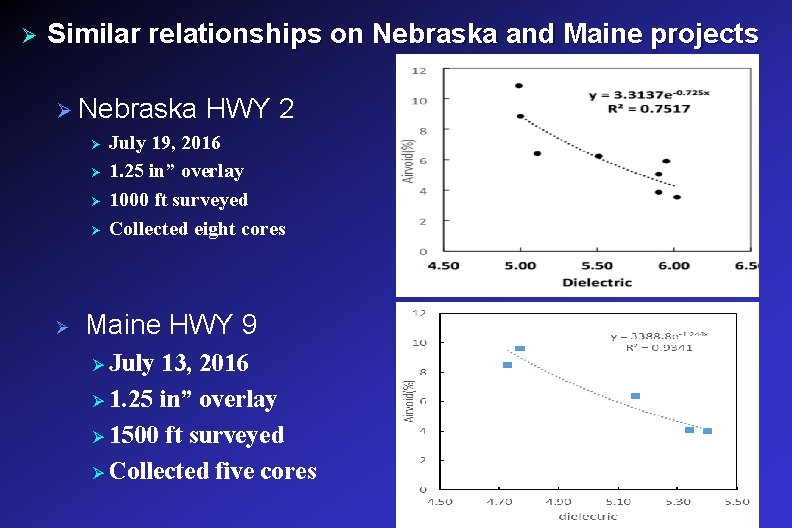
Ø Similar relationships on Nebraska and Maine projects Ø Nebraska Ø Ø Ø HWY 2 July 19, 2016 1. 25 in” overlay 1000 ft surveyed Collected eight cores Maine HWY 9 Ø July 13, 2016 Ø 1. 25 in” overlay Ø 1500 ft surveyed Ø Collected five cores
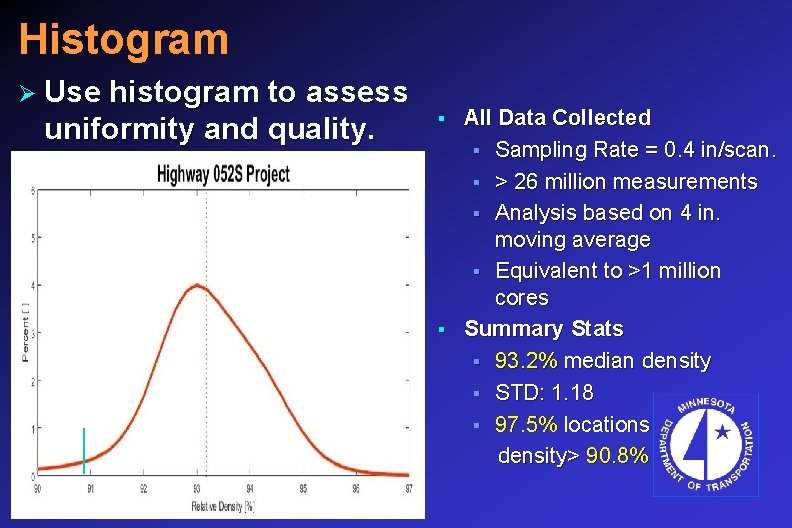
Histogram Ø Use histogram to assess uniformity and quality. § § All Data Collected § Sampling Rate = 0. 4 in/scan. § > 26 million measurements § Analysis based on 4 in. moving average § Equivalent to >1 million cores Summary Stats § 93. 2% median density § STD: 1. 18 § 97. 5% locations density> 90. 8%
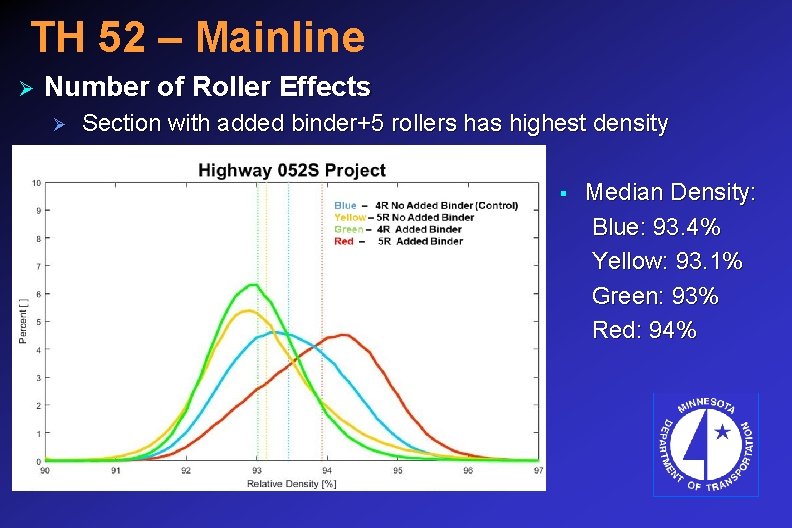
TH 52 – Mainline Ø Number of Roller Effects Ø Section with added binder+5 rollers has highest density § Median Density: Blue: 93. 4% Yellow: 93. 1% Green: 93% Red: 94%
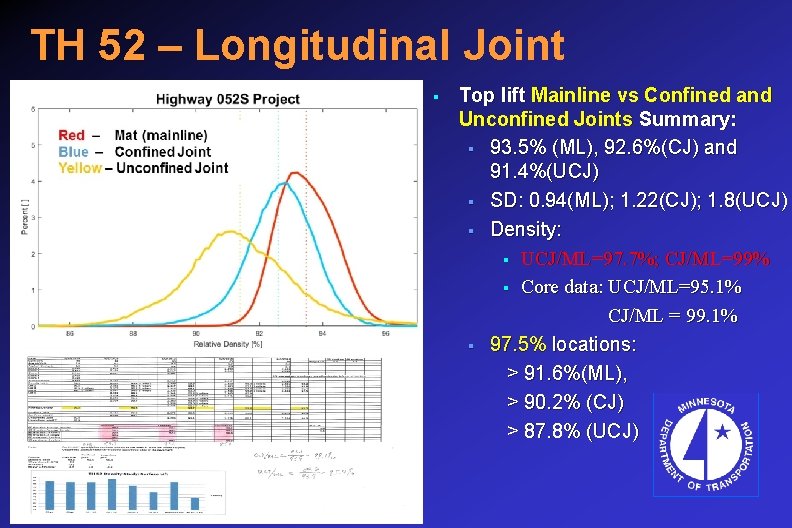
TH 52 – Longitudinal Joint § Top lift Mainline vs Confined and Unconfined Joints Summary: § 93. 5% (ML), 92. 6%(CJ) and 91. 4%(UCJ) § SD: 0. 94(ML); 1. 22(CJ); 1. 8(UCJ) § Density: § UCJ/ML=97. 7%; CJ/ML=99% § Core data: UCJ/ML=95. 1% CJ/ML = 99. 1% § 97. 5% locations: > 91. 6%(ML), > 90. 2% (CJ) > 87. 8% (UCJ)
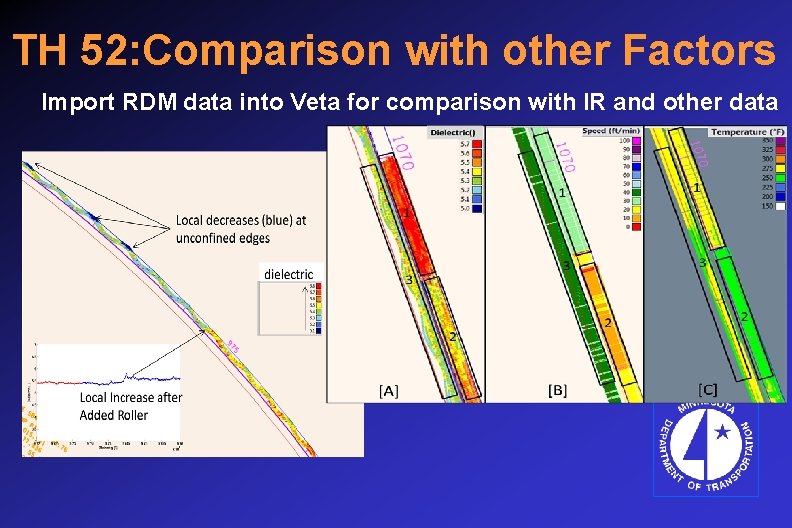
TH 52: Comparison with other Factors Import RDM data into Veta for comparison with IR and other data
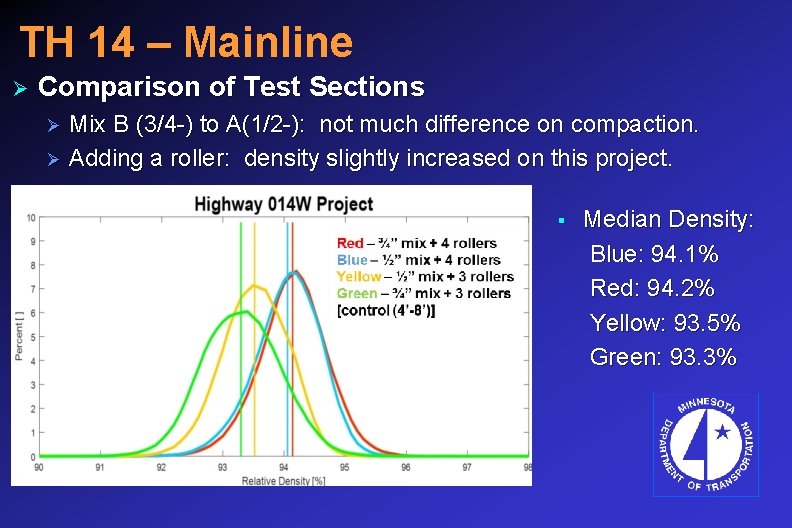
TH 14 – Mainline Ø Comparison of Test Sections Mix B (3/4 -) to A(1/2 -): not much difference on compaction. Ø Adding a roller: density slightly increased on this project. Ø. § Median Density: Blue: 94. 1% Red: 94. 2% Yellow: 93. 5% Green: 93. 3% Ø
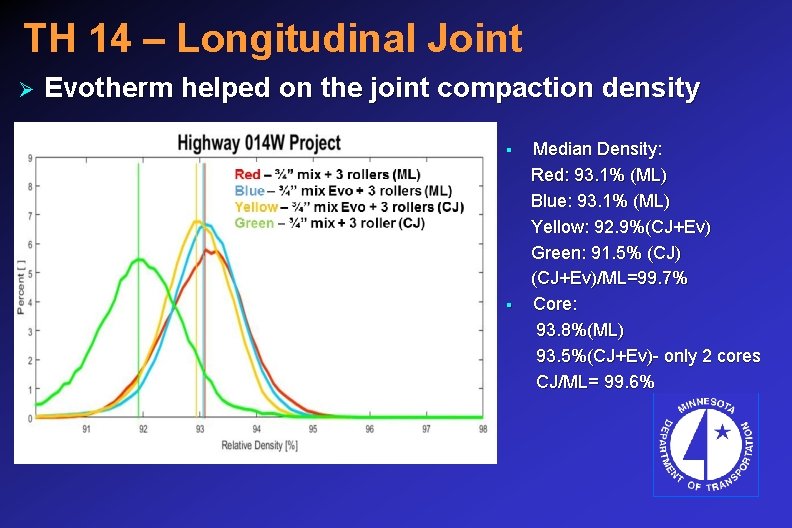
TH 14 – Longitudinal Joint Ø Evotherm helped on the joint compaction density § § Median Density: Red: 93. 1% (ML) Blue: 93. 1% (ML) Yellow: 92. 9%(CJ+Ev) Green: 91. 5% (CJ) (CJ+Ev)/ML=99. 7% Core: 93. 8%(ML) 93. 5%(CJ+Ev)- only 2 cores CJ/ML= 99. 6%
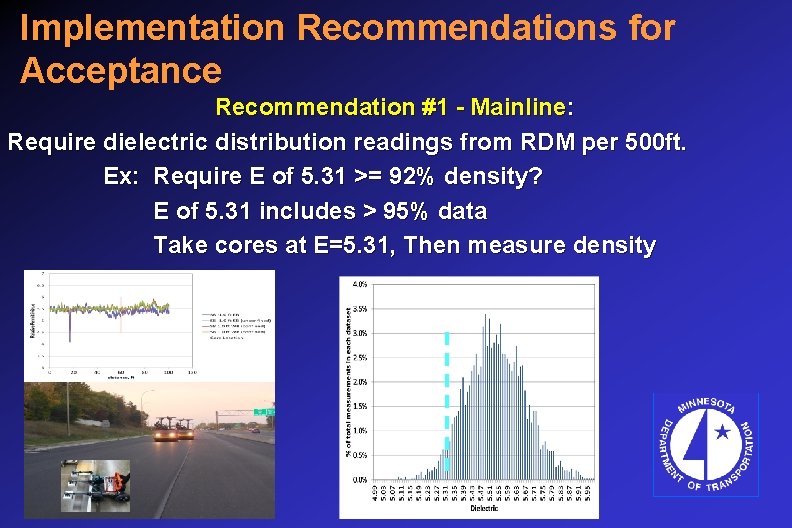
Implementation Recommendations for Acceptance Recommendation #1 - Mainline: Require dielectric distribution readings from RDM per 500 ft. Ex: Require E of 5. 31 >= 92% density? E of 5. 31 includes > 95% data Take cores at E=5. 31, Then measure density
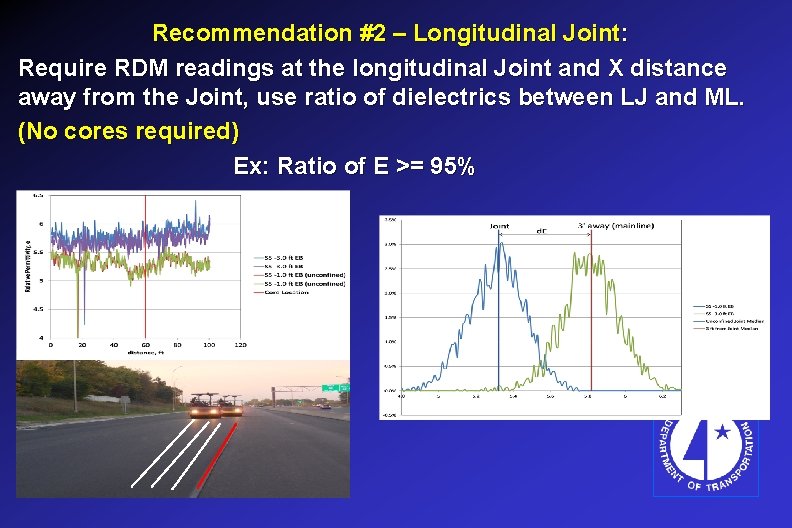
Recommendation #2 – Longitudinal Joint: Require RDM readings at the longitudinal Joint and X distance away from the Joint, use ratio of dielectrics between LJ and ML. (No cores required) Ex: Ratio of E >= 95%
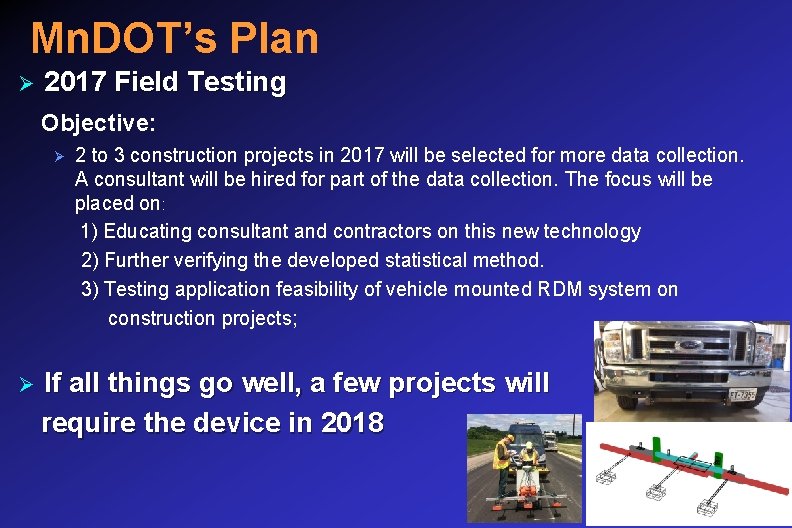
Mn. DOT’s Plan Ø 2017 Field Testing Objective: Ø Ø 2 to 3 construction projects in 2017 will be selected for more data collection. A consultant will be hired for part of the data collection. The focus will be placed on: 1) Educating consultant and contractors on this new technology 2) Further verifying the developed statistical method. 3) Testing application feasibility of vehicle mounted RDM system on construction projects; If all things go well, a few projects will require the device in 2018
Summary Ø RDM is a good tool for mapping a continuous coverage of the relative compaction levels (higher dielectric = higher compaction) Ø Histograms and general statistics can be used to give a complete assessments of the in-place compaction Ø Potential Uses: Ø Ø Ø Assess compaction density and uniformity for QC/QA. Provide on-site feedback to contractor of high and low compaction locations that they can cross-check with differences in mix or paving strategies in those locations to determine optimal construction procedures Identification of trends in the air void content maps that can be crosschecked with IC and other data to determine the most critical factors in achieving higher density
Acknowledgements Ø FHWA/AASHTO for providing RDM Ø Mn. DOT district materials and constructions Ø UMN students Ø Nebraska and Maine DOTs
Thank you!