
Asphalt Chemistry First Stage Lecture 3 Lecture Rana
- Slides: 11
Asphalt Chemistry First Stage Lecture 3 Lecture. Rana Amir Yousif Lecture. Sady Abd Tayh Highway and Transportation Engineering Mustansiriyah University 2017 -2018
References: � Edwin J. Barth. ”Asphalt Science and Technology”, 1 st Ed. , 1962. � James Speight” Asphalt Materials Science and Technology”, 1 st Edition 2015.
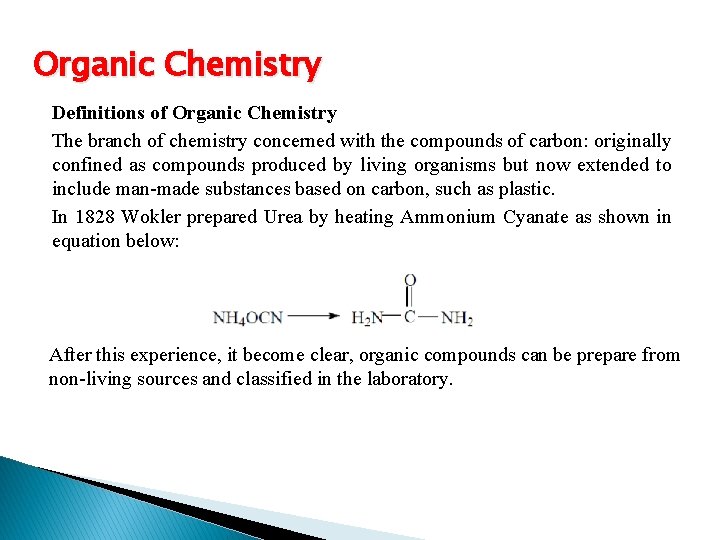
Organic Chemistry Definitions of Organic Chemistry The branch of chemistry concerned with the compounds of carbon: originally confined as compounds produced by living organisms but now extended to include man-made substances based on carbon, such as plastic. In 1828 Wokler prepared Urea by heating Ammonium Cyanate as shown in equation below: After this experience, it become clear, organic compounds can be prepare from non-living sources and classified in the laboratory.
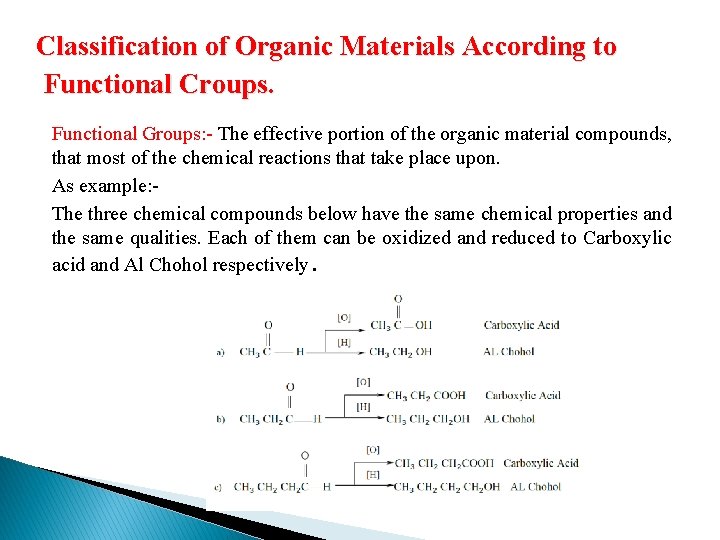
Classification of Organic Materials According to Functional Croups. Functional Groups: - The effective portion of the organic material compounds, that most of the chemical reactions that take place upon. As example: The three chemical compounds below have the same chemical properties and the same qualities. Each of them can be oxidized and reduced to Carboxylic acid and Al Chohol respectively.
Despite the differences in architecture synthetic compounds between the three chemical compounds above but they all give similar results due to the existence of Aldehyde collection (-CHO) involved in their structures. Therefore the active group is the active part in the organic compound.
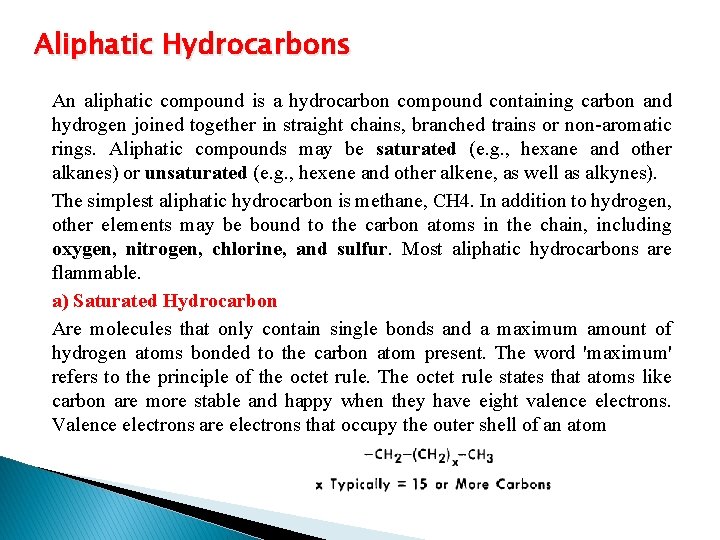
Aliphatic Hydrocarbons An aliphatic compound is a hydrocarbon compound containing carbon and hydrogen joined together in straight chains, branched trains or non-aromatic rings. Aliphatic compounds may be saturated (e. g. , hexane and other alkanes) or unsaturated (e. g. , hexene and other alkene, as well as alkynes). The simplest aliphatic hydrocarbon is methane, CH 4. In addition to hydrogen, other elements may be bound to the carbon atoms in the chain, including oxygen, nitrogen, chlorine, and sulfur. Most aliphatic hydrocarbons are flammable. a) Saturated Hydrocarbon Are molecules that only contain single bonds and a maximum amount of hydrogen atoms bonded to the carbon atom present. The word 'maximum' refers to the principle of the octet rule. The octet rule states that atoms like carbon are more stable and happy when they have eight valence electrons. Valence electrons are electrons that occupy the outer shell of an atom
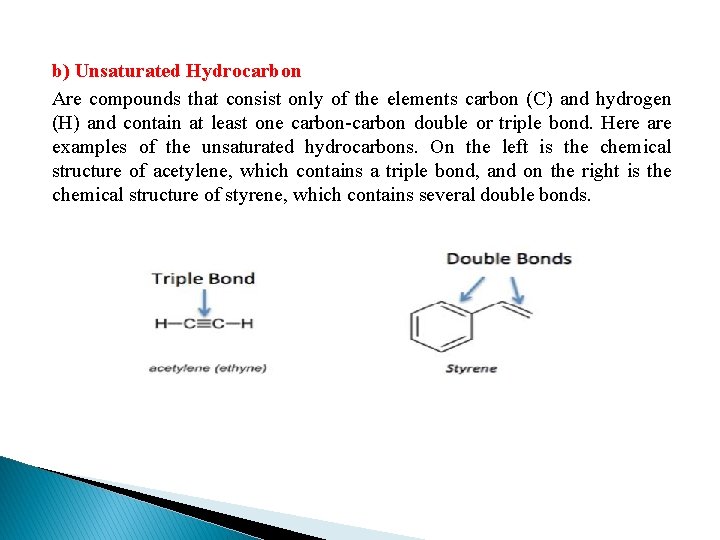
b) Unsaturated Hydrocarbon Are compounds that consist only of the elements carbon (C) and hydrogen (H) and contain at least one carbon-carbon double or triple bond. Here are examples of the unsaturated hydrocarbons. On the left is the chemical structure of acetylene, which contains a triple bond, and on the right is the chemical structure of styrene, which contains several double bonds.
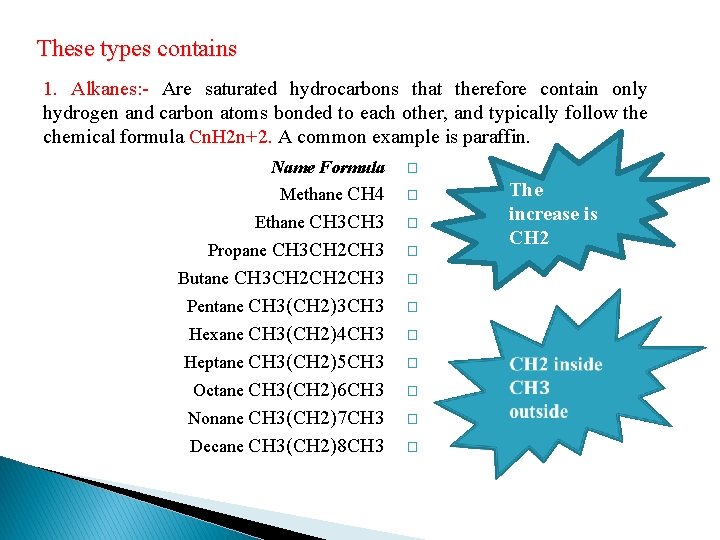
These types contains 1. Alkanes: - Are saturated hydrocarbons that therefore contain only hydrogen and carbon atoms bonded to each other, and typically follow the chemical formula Cn. H 2 n+2. A common example is paraffin. Name Formula � Methane CH 4 � Ethane CH 3 � Propane CH 3 CH 2 CH 3 � Butane CH 3 CH 2 CH 3 � Pentane CH 3(CH 2)3 CH 3 � Hexane CH 3(CH 2)4 CH 3 � Heptane CH 3(CH 2)5 CH 3 � Octane CH 3(CH 2)6 CH 3 � Nonane CH 3(CH 2)7 CH 3 � Decane CH 3(CH 2)8 CH 3 � The increase is CH 2
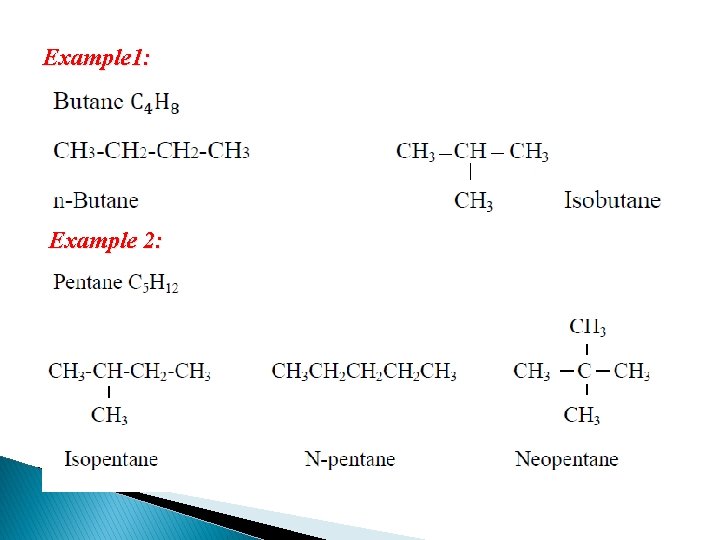
Example 1: Example 2:
2. Alkenes - These unsaturated hydrocarbons are molecules that contain at least one carbon-to-carbon double bond. With the chemical formula consisting of molecules of Cn. H 2 n, alkenes are very common in the petrochemical industry; the simplest alkene is ethylene, or ethane. 3. Alkynes - This category of hydrocarbons are unsaturated, and contain at least one carbon-to-carbon triple bond. The hydrophobic acetylenes are common examples of alkynes. 4. Cycloalkanes - The saturated hydrocarbons not only form only carbon-tohydrogen bonds, rather than the carbon-to-carbon bonds that have to then have added hydrogen atoms. These alkanes have to prefix "cyclo" due to the configuration of rings of carbon atoms in their structure. 5. Aromatic hydrocarbons - These unsaturated hydrocarbons have alternating carbon-to-carbon single or double bonds in their molecules. The term aromatic was applied to this category of hydrocarbons before the chemical nature of aromaticity was discovered, and they were therefore called aromatic simply because these compounds had a pleasant smell.