
ASPEN Separation Unit Operations CHBE 446 Team 2
ASPEN Separation Unit Operations CHBE 446 - Team 2 Victoria Null Funke Okunrinboye Jonah Spielman Camillo Trejos Loan Truong Mohammadou Njoya University of Maryland College Park | Professor Nam Sun Wang | 02/03/2020
Presentation Overview - Introduction - Aspen Unit Operation Separators ■ Separators (Flash, Decanter, Sep and Sep 2) ■ Columns (DSTWU, Distl, Rad. Frac, Extract, Con. Sep) ■ Solid Separators ( Cyclone, VScrub, CFuge, Hy. Cyc, CFuge, ESP, Cf. Filter etc. ) - Questions - References
Introduction ❖ Separation, involving the removal of impurities (purification), is used in pharmaceutical, medical, petroleum, agriculture, food, energy, manufacturing industries etc, and even locally in homes. ❖ Separation improves the quality of life. ❖ Separation techniques are largely dependent on Mixture properties ❖ ASPEN separation Unit Operations are generally classified into: ➢ Separators (Flash, Decanter, Sep and Sep 2) ➢ Columns (DSTWU, Distl, Rad. Frac, Extract, Con. Sep) ➢ Solid Separators ( Cyclone, VScrub, CFuge, Hy. Cyc, CFuge, ESP, Cf. Filter etc. ) ❖ Separators, Columns, and Solid separators can be accessed on ASPEN’s model palette on the main flowsheet via the simulation tab. https: //www. gettyimages. com/detail/photo/pet rochemical-plant-illuminated-at-dusk-royaltyfree-image/514620986? adppopup=true
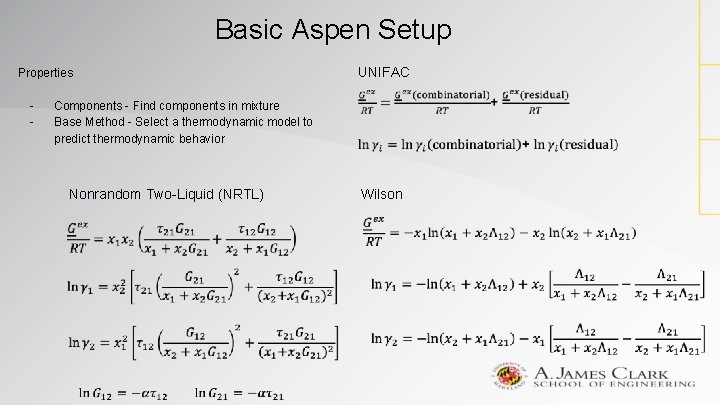
Basic Aspen Setup UNIFAC Properties - Components - Find components in mixture Base Method - Select a thermodynamic model to predict thermodynamic behavior Nonrandom Two-Liquid (NRTL) Wilson
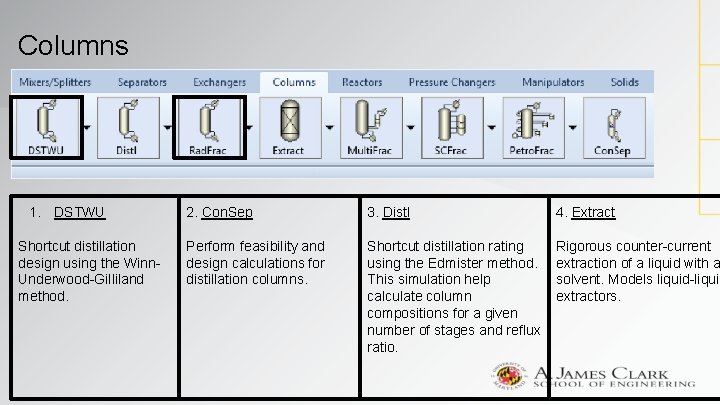
Columns 1. DSTWU Shortcut distillation design using the Winn. Underwood-Gilliland method. 2. Con. Sep 3. Distl 4. Extract Perform feasibility and design calculations for distillation columns. Shortcut distillation rating using the Edmister method. This simulation help calculate column compositions for a given number of stages and reflux ratio. Rigorous counter-current extraction of a liquid with a solvent. Models liquid-liquid extractors.
Columns- DSTWU General informations: ● ● The DSTWU unit operation is designed for single feed, two product distillation processes. This column is used for calculations of number of stages and reflux ratios. ● These calculations are completed based on two assumptions: constant molar overflow and constant relative volatilities. Work Process: ● The DSTWU column first estimates the minimum number of stages and the minimum reflux ratio, and then it calculates either the required reflux ratio or the required number of theoretical stages based on the user input.
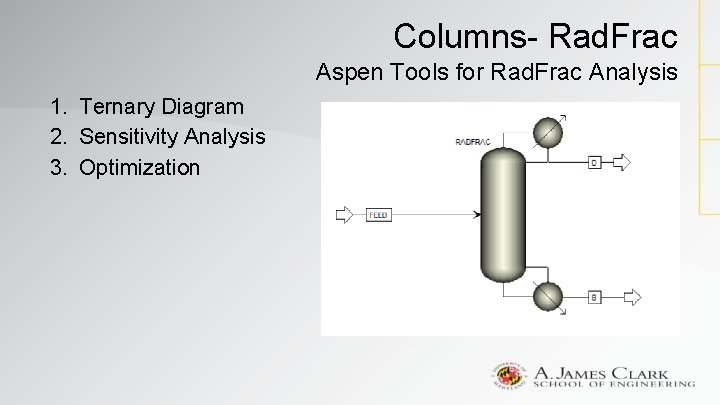
Columns- Rad. Frac Aspen Tools for Rad. Frac Analysis 1. Ternary Diagram 2. Sensitivity Analysis 3. Optimization
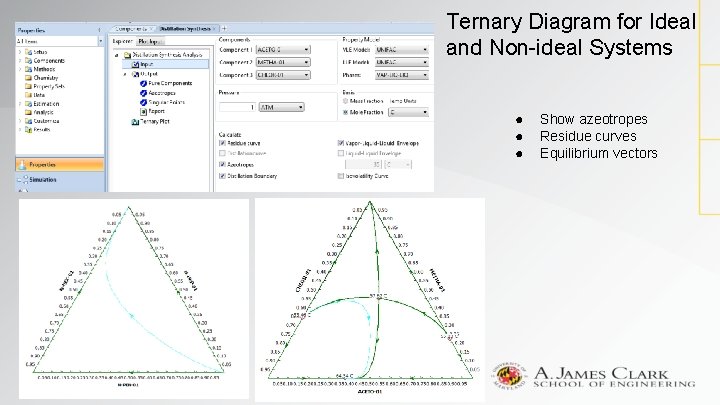
Ternary Diagram for Ideal and Non-ideal Systems ● ● ● Show azeotropes Residue curves Equilibrium vectors
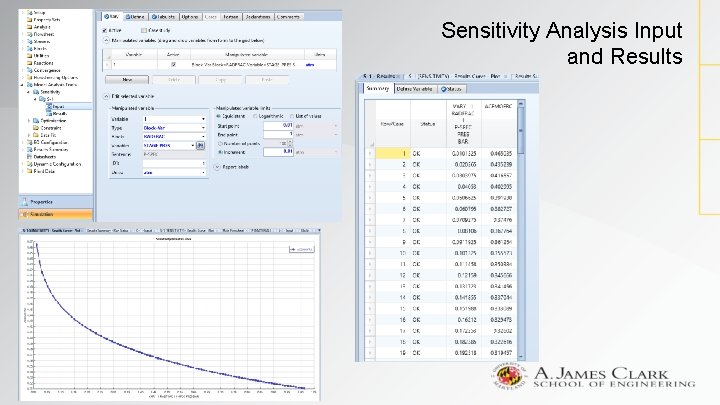
Sensitivity Analysis Input and Results
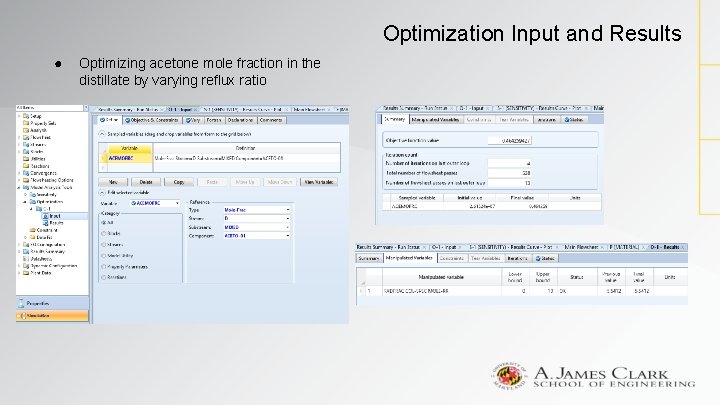
Optimization Input and Results ● Optimizing acetone mole fraction in the distillate by varying reflux ratio
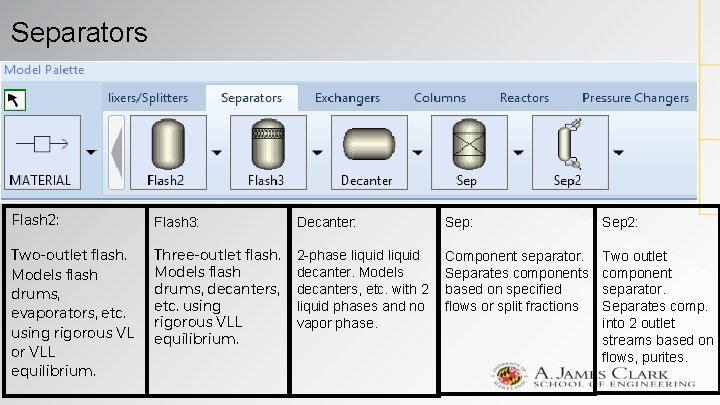
Separators Flash 2: Flash 3: Decanter: Sep 2: Two-outlet flash. Models flash drums, evaporators, etc. using rigorous VL or VLL equilibrium. Three-outlet flash. Models flash drums, decanters, etc. using rigorous VLL equilibrium. 2 -phase liquid decanter. Models decanters, etc. with 2 liquid phases and no vapor phase. Component separator. Separates components based on specified flows or split fractions Two outlet component separator. Separates comp. into 2 outlet streams based on flows, purites.
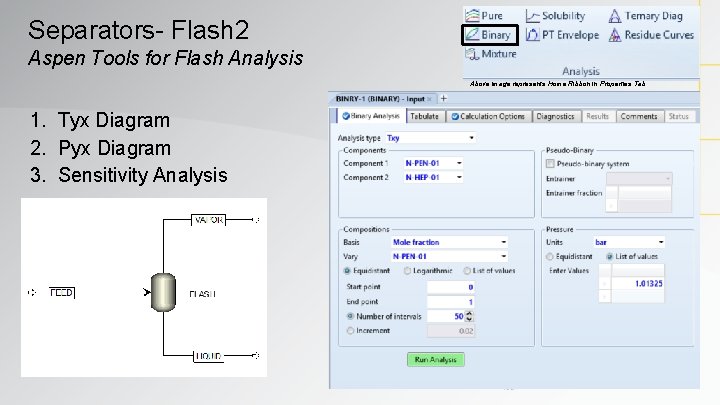
Separators- Flash 2 Aspen Tools for Flash Analysis Above image represents Home Ribbon in Properties Tab 1. Tyx Diagram 2. Pyx Diagram 3. Sensitivity Analysis
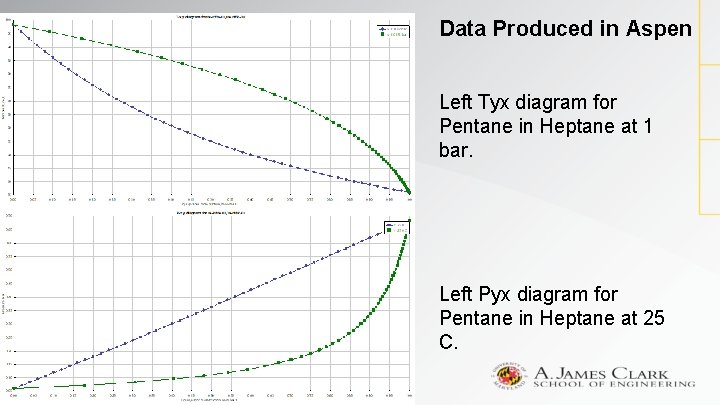
Data Produced in Aspen Left Tyx diagram for Pentane in Heptane at 1 bar. Left Pyx diagram for Pentane in Heptane at 25 C.
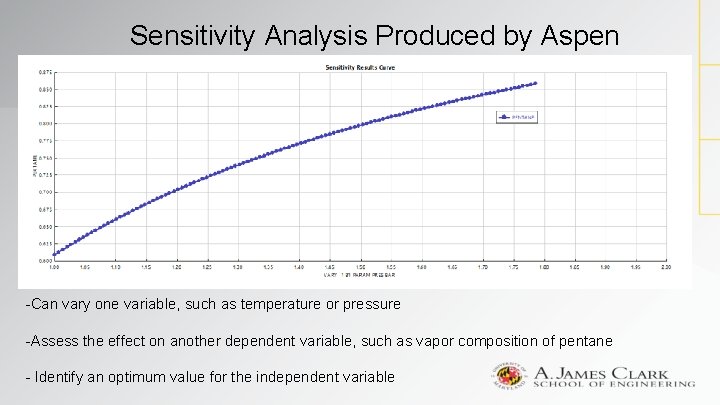
Sensitivity Analysis Produced by Aspen -Can vary one variable, such as temperature or pressure -Assess the effect on another dependent variable, such as vapor composition of pentane - Identify an optimum value for the independent variable
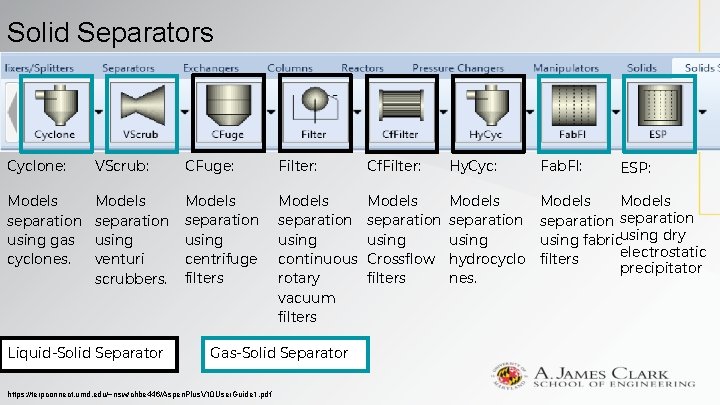
Solid Separators Cyclone: VScrub: CFuge: Filter: Cf. Filter: Hy. Cyc: Fab. Fl: Models separation using gas cyclones. Models separation using venturi scrubbers. Models separation using centrifuge filters Models separation using continuous rotary vacuum filters Models separation using Crossflow filters Models separation using hydrocyclo nes. Models separation using fabricusing dry electrostatic filters precipitator Liquid-Solid Separator Gas-Solid Separator https: //terpconnect. umd. edu/~nsw/chbe 446/Aspen. Plus. V 10 User. Guide 1. pdf ESP:

Questions
References 1) 2) 3) https: //terpconnect. umd. edu/~nsw/chbe 446/Aspen. Plus. V 10 User. Guide 1. pdf https: //courses. washington. edu/overney/Aspen_Tutorial_Unit_6. pdf https: //lms. nchu. edu. tw/sysdata/doc/9/9 c 7268967 f 6 ebabb/pdf. pdf
- Slides: 17