
Aspects of reliability of a power system Adequacy
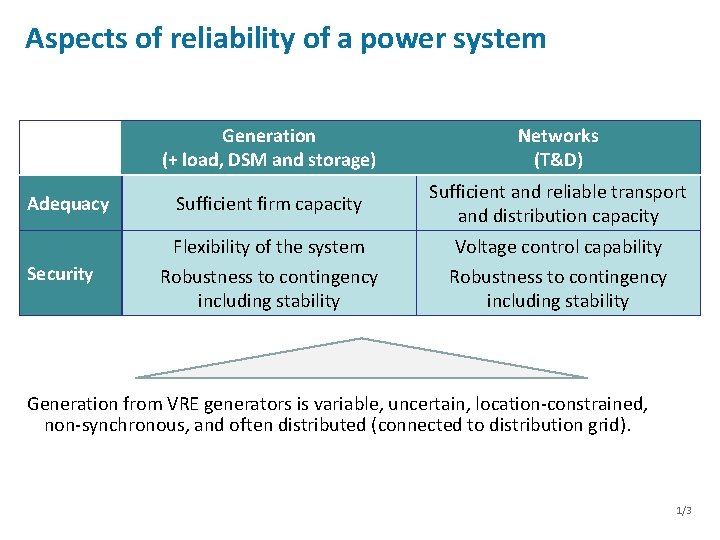
Aspects of reliability of a power system Adequacy Security Generation (+ load, DSM and storage) Networks (T&D) Sufficient firm capacity Sufficient and reliable transport and distribution capacity Flexibility of the system Voltage control capability Robustness to contingency including stability Generation from VRE generators is variable, uncertain, location-constrained, non-synchronous, and often distributed (connected to distribution grid). 1/3

Technical properties of VRE and their impacts to the aspects of reliability Adequacy Security Generation (+ load, DSM and storage) Networks (T&D) Variability reduces contribution to firm capacity Location-constraints may require grid extension and reinforcement Variability and limited predictability requires system to follow residual load Lack of inertia and governor response may pose the technical limit to VRE penetration Location-constraints may change voltage control requirements Distribution level connection may affect voltages and protection system coordination RE’s behavior during fault may affect system stability 2/3
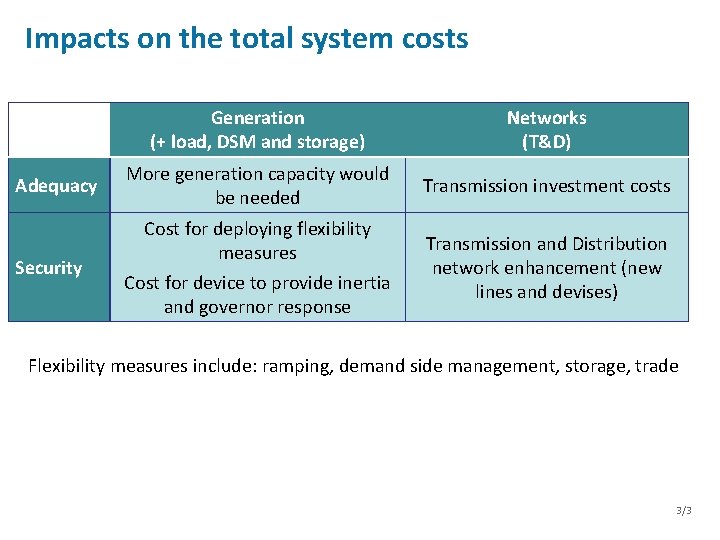
Impacts on the total system costs Generation (+ load, DSM and storage) Networks (T&D) Adequacy More generation capacity would be needed Transmission investment costs Security Cost for deploying flexibility measures Cost for device to provide inertia and governor response Transmission and Distribution network enhancement (new lines and devises) Flexibility measures include: ramping, demand side management, storage, trade 3/3
- Slides: 3