
ASPECTOS Y DEFINICIONES GENERALES MEDIDAS DIRECTAS E INDIRECTAS
- Slides: 6
ASPECTOS Y DEFINICIONES GENERALES MEDIDAS DIRECTAS E INDIRECTAS MEDIDAS DIRECTAS: EL RESULTADO INMEDIANTAMENTE DE DATOS PRIMARIOS. ES OBTENIDO MEDIDAS INDIRECTAS: EL RESULTADO BUSCADO ES OBTENIDO POR CALCULOS A PARTIR DE LOS DATOS PRIMARIOS. MÉTODOS DE MEDIDAS MÉTODOS DE DEFLEXIÓN: LA DEFLEXIÓN DEL INSTRUMENTO DA LA BASE PARA DETERMINAR LA CANTIDAD. MÉTODOS DE CERO: LA INDICACIÓN NULA O CERO DE UN INSTRUMENTO LLEVA A DETERMINAR LA CANTIDAD A PARTIR DE OTRAS CONDICIONES CONOCIDAS.
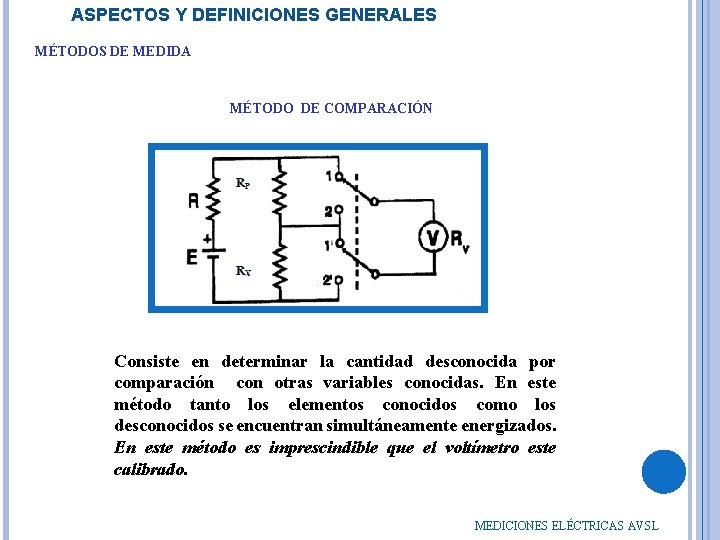
ASPECTOS Y DEFINICIONES GENERALES MÉTODOS DE MEDIDA MÉTODO DE COMPARACIÓN Consiste en determinar la cantidad desconocida por comparación con otras variables conocidas. En este método tanto los elementos conocidos como los desconocidos se encuentran simultáneamente energizados. En este método es imprescindible que el voltímetro este calibrado. MEDICIONES ELÉCTRICAS AVSL
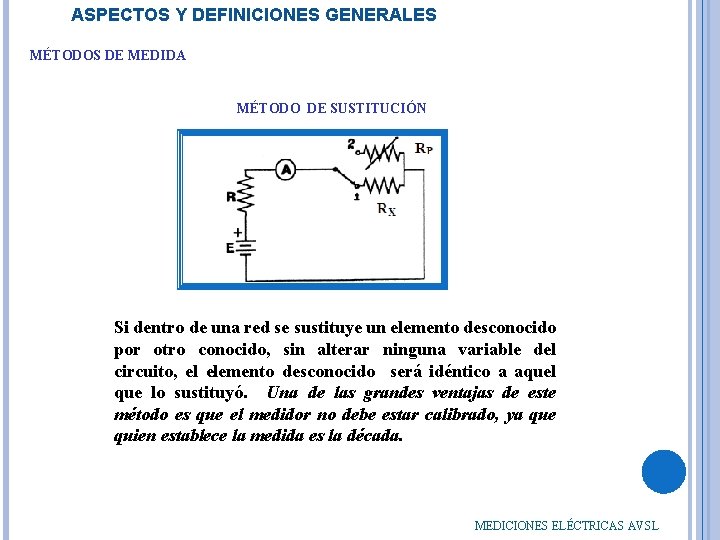
ASPECTOS Y DEFINICIONES GENERALES MÉTODOS DE MEDIDA MÉTODO DE SUSTITUCIÓN Si dentro de una red se sustituye un elemento desconocido por otro conocido, sin alterar ninguna variable del circuito, el elemento desconocido será idéntico a aquel que lo sustituyó. Una de las grandes ventajas de este método es que el medidor no debe estar calibrado, ya que quien establece la medida es la década. MEDICIONES ELÉCTRICAS AVSL
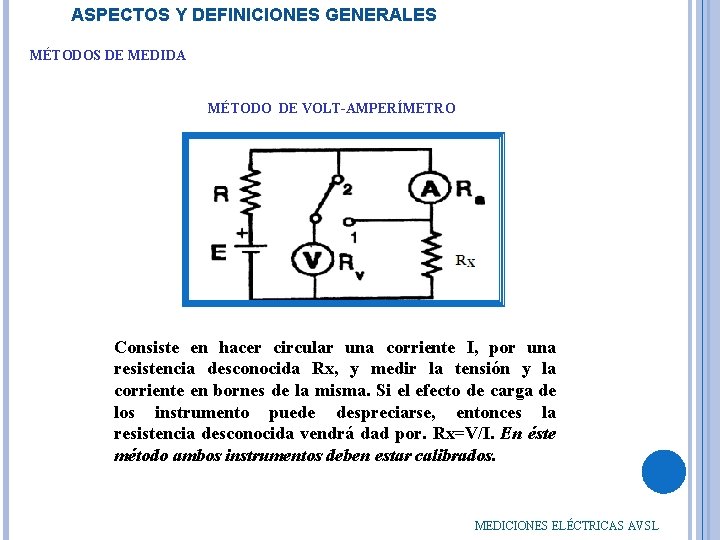
ASPECTOS Y DEFINICIONES GENERALES MÉTODOS DE MEDIDA MÉTODO DE VOLT-AMPERÍMETRO Consiste en hacer circular una corriente I, por una resistencia desconocida Rx, y medir la tensión y la corriente en bornes de la misma. Si el efecto de carga de los instrumento puede despreciarse, entonces la resistencia desconocida vendrá dad por. Rx=V/I. En éste método ambos instrumentos deben estar calibrados. MEDICIONES ELÉCTRICAS AVSL
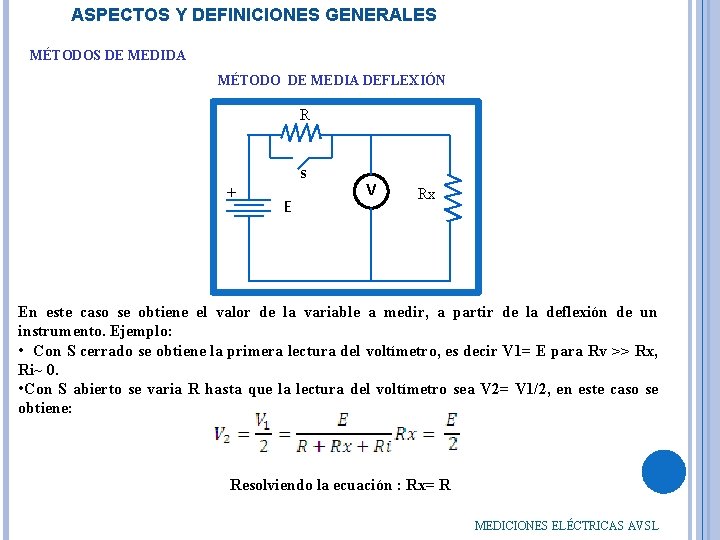
ASPECTOS Y DEFINICIONES GENERALES MÉTODOS DE MEDIDA MÉTODO DE MEDIA DEFLEXIÓN R s + E V Rx En este caso se obtiene el valor de la variable a medir, a partir de la deflexión de un instrumento. Ejemplo: • Con S cerrado se obtiene la primera lectura del voltímetro, es decir V 1= E para Rv >> Rx, Ri~ 0. • Con S abierto se varia R hasta que la lectura del voltímetro sea V 2= V 1/2, en este caso se obtiene: Resolviendo la ecuación : Rx= R MEDICIONES ELÉCTRICAS AVSL
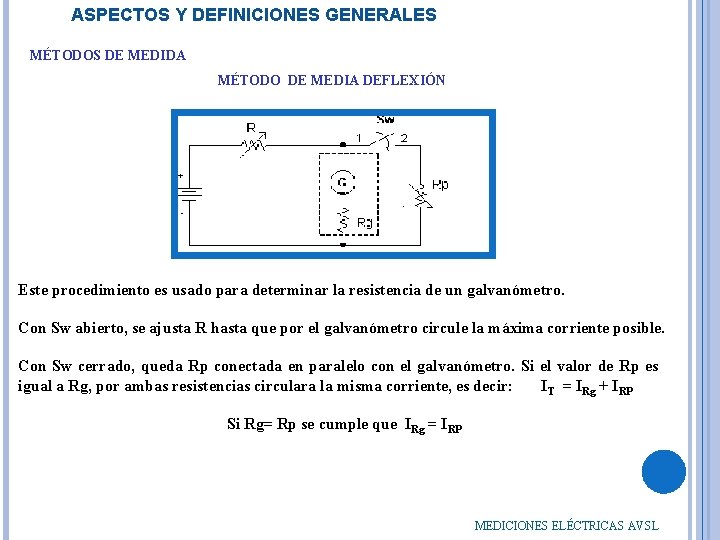
ASPECTOS Y DEFINICIONES GENERALES MÉTODOS DE MEDIDA MÉTODO DE MEDIA DEFLEXIÓN Este procedimiento es usado para determinar la resistencia de un galvanómetro. Con Sw abierto, se ajusta R hasta que por el galvanómetro circule la máxima corriente posible. Con Sw cerrado, queda Rp conectada en paralelo con el galvanómetro. Si el valor de Rp es igual a Rg, por ambas resistencias circulara la misma corriente, es decir: IT = IRg + IRP Si Rg= Rp se cumple que IRg = IRP MEDICIONES ELÉCTRICAS AVSL