
Aspect Oriented Software Development James Friedenberger Department of
Aspect Oriented Software Development James Friedenberger Department of Software Engineering University of Wisconsin – Platteville friedenbergj@uwplatt. edu
Contents � Introduction � Terms � Design – Modeling � Requirements � Languages � Maintenance � Comparison to Object Oriented � Applications 2
Introduction � Software Development History › Started out with emphasis on the machine code (basic machines) › Problems discovered in 70 s and 80 s led to emphasis on quality, productivity › 1980 s and 1990 s saw the rise of UML 3
Introduction � Object Oriented Development › Benchmark of most projects today › Started in 1960 s, rose to prominence in late 80 s and 90 s › Supported by many languages, most common C++ and Java › Easy to be modeled by UML language › Has several problems 4
Introduction “AOP can be understood as the desire to make quantified statements about the behavior of programs, and to have these quantifications hold over programs written by oblivious programmers. ” – Filman and Friedman 5
Introduction � Aspect Oriented Software Development › Developed due to problems with OO › First theory proposed in 1995 › Implementation in early 2000 s, Netherlands, Texas › Entire new vocabulary › Key structural differences › Still relatively new, gaining acceptance in a few areas 6
Terms � Concerns › Key new concept › Similar but more refined than objects � Aspects › Implementation of concern › Usually contains only code for a specific feature 7
Terms � Crosscutting Concerns › Code called in several places throughout a program › Feature that is hard to modularize in OO �Areas of Crosscutting Concerns: �Synchronization �Real-time constraints �Error detection and correction �Product features �Memory management �Information security �Caching �Logging �Monitoring �Code mobility �Internationalization and localization �Domain-specific optimizations 8
Terms � Join Points › Where aspects are called in the execution of a program › Placement dependent on language � Advice › Tells system what to do at a an aspect › Oblivious of base code › after() : set() { Display. update(); } 9
Terms � Pointcut designator › Collection of join points › Can be used for features called often at specific places (security) � Weaving › Inserting the aspects into the base code › Can happen at three stages of software 10
Design – Modeling � Unified Modeling Language (UML) › Due to acceptance, often used › Implementations capture aspect methods, join points › Separates base code from features 11
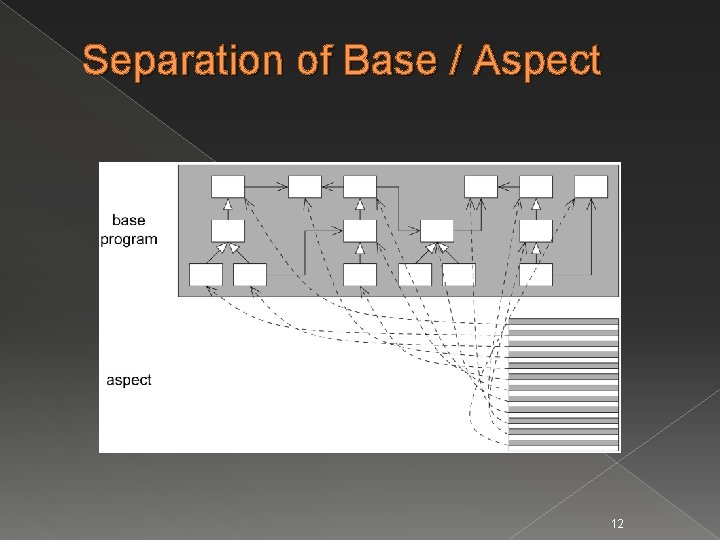
Separation of Base / Aspect 12
Design - Modeling � UML (Cont’d) � Aspects can also be grouped by function › › Synchronization Distribution Coordination Replication 13
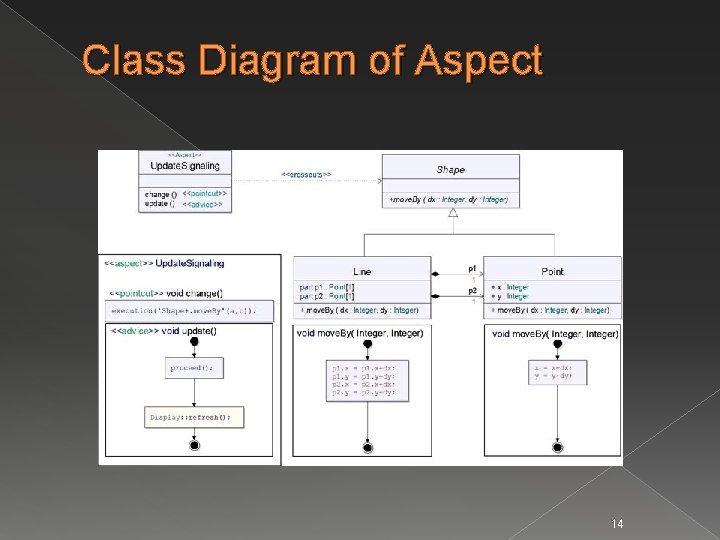
Class Diagram of Aspect 14
Design - Modeling � Architectural Description Language › Still in development › Able to show connections between base code and aspects › Also shows separation of base code and functional code › Good for upper level requirements 15
Other Diagrams � Sequence diagrams › Can demonstrate when aspects are called › Can help developers determine where to put join points 16
Requirements Gathering and Analysis � Best in beginning of software development � Good at separating features and base code � Good for determining join points � Helps with concern determination 17
Languages � � � . NET Framework languages (C# / VB. NET) C / C++ Cobol Cocoa Cold. Fusion Common Lisp Delphi Prism e (IEEE 1647) Haskell Java › Aspect. J � � � � Java. Script Emacs Lisp Lua make ML Perl PHP Prolog Python Ruby Squeak Smalltalk UML 2. 0 XML 18
Language � Languages › › › have to be adapted Some languages are supplementary Some have built in aspect support Determine join points Determine weaving time Some languages are Object Oriented language compatible, some not 19
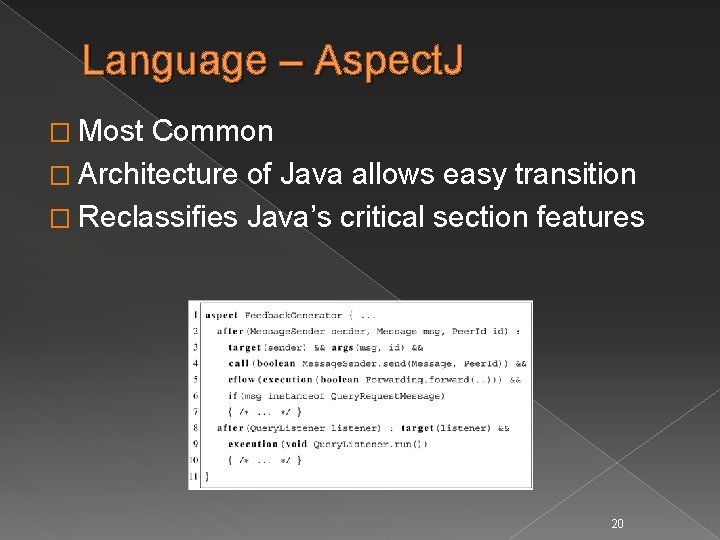
Language – Aspect. J � Most Common � Architecture of Java allows easy transition � Reclassifies Java’s critical section features 20
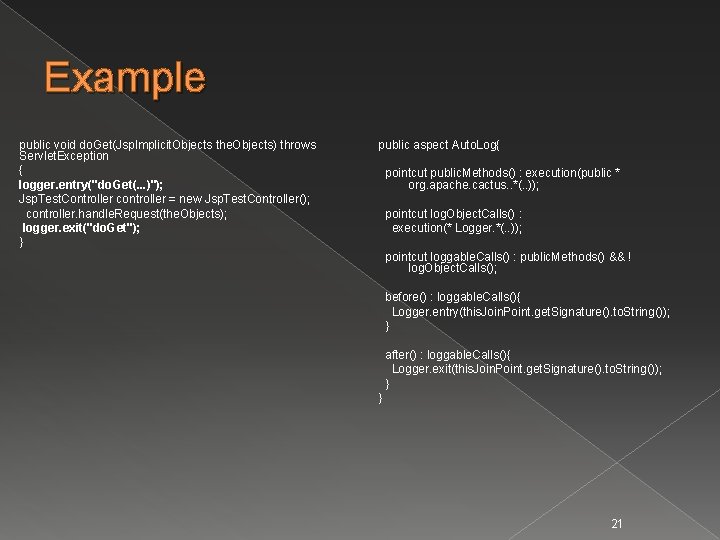
Example public void do. Get(Jsp. Implicit. Objects the. Objects) throws Servlet. Exception { logger. entry("do. Get(. . . )"); Jsp. Test. Controller controller = new Jsp. Test. Controller(); controller. handle. Request(the. Objects); logger. exit("do. Get"); } public aspect Auto. Log{ pointcut public. Methods() : execution(public * org. apache. cactus. . *(. . )); pointcut log. Object. Calls() : execution(* Logger. *(. . )); pointcut loggable. Calls() : public. Methods() && ! log. Object. Calls(); before() : loggable. Calls(){ Logger. entry(this. Join. Point. get. Signature(). to. String()); } after() : loggable. Calls(){ Logger. exit(this. Join. Point. get. Signature(). to. String()); } } 21
Maintenance � New features can be added without disturbing original code � Java programs can easily use aspects � Separation of concerns make maintenance easier � Helps prevent tangling of code � Easier to debug, all code in one place 22
Maintenance � Still has some problems › Could cause problems in large projects, join points getting changed › Small changes, function call placement can cause problems › Different structure can cause problems for programmers 23
Comparison to OO � Aspect Oriented Development is a derivative of Object Oriented Development � Object Orientation focuses on Modularity � Aspect Orientation focuses on Concerns � Object Orientation tangles code, Aspect Orientation separates � Singletons not supported in AOP 24
Comparison to Object Oriented – Study � Findings › › › : Easier to find where to put new code Easier to implement new code Similar compile times Harder to make changes Lack of understanding hurts Processes not clear to fix problems 25
Applications � Open Source Uses › Can allow mixing of proprietary and open source programming › Easy to add new features to base code › Can determine what features are actually needed 26
Applications � Can implement several different features � Allows many different products from one set of base code � Can roll out product sooner, worry about features later 27
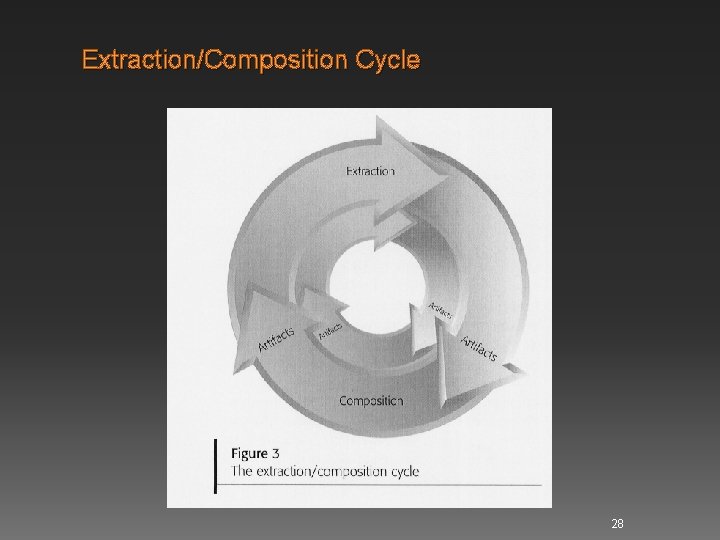
Extraction/Composition Cycle 28
Applications � Can turn existing software into AOP � Easier to test, especially features � Several different areas of features can be separated from main program � Makes software more portable 29
Current Uses � SAP � Siemens Health � Sun Microsystems � IBM � Motorola � Glassbox (Diagnostic Tool) 30
Conclusion � New emerging technology � Not complete solution to Object Oriented Software Development, but improves in a few areas � Has some exciting features � Currently in use, more widespread as it is refined 31
![Resources � � � [1] Filman, R. & Friedman, D. (2005). Aspect-Oriented Programming Is](http://slidetodoc.com/presentation_image_h2/eb2e43e20f028eb9e3b5ed4f61fa6c48/image-32.jpg "Resources � � � [1] Filman, R. & Friedman, D. (2005). Aspect-Oriented Programming Is")
Resources � � � [1] Filman, R. & Friedman, D. (2005). Aspect-Oriented Programming Is Quantification and Obliviousness. In Fillman, Elrad, Clark, Aksit (Eds. ), Aspect-Oriented Software Development (pp. 1 -7). Boston: Addison-Wesley. [2] Clemente, P. , Hernandez, J. , Herrero, J. , Murillo, J. , Sanchez, F. (2005). Aspect-Orientation in the Software Lifecycle: Fact and Fiction. In Fillman, Elrad, Clark, Aksit (Eds. ), Aspect-Oriented Software Development (pp. 409 -420). Boston: Addison-Wesley. [3] Pinto, M. , Fuentes, L. , Troya, J. (2003) A Dynamic Component and Aspect-Oriented Platform. The Computer Journal, 48, pp. 401 -420. [4] Spring Maintenance. (n. d. ). Retrieved November 1, 2009 from Maintenance website. https: //src. springframework. org/svn/springmaintenance/ [5] Blair, G. , Blair, L. , Rashid, A. , Moreira, A. , Araujo, J. , Chitchyan, R. (2005). Engineering Aspect-Oriented Systems. In Fillman, Elrad, Clark, Aksit (Eds. ), Aspect-Oriented Software Development (pp. 380398). Boston: Addison-Wesley. 32
![Resources 2 � � � [6] Aspect. J. (n. d. ). Retrieved October 31,](http://slidetodoc.com/presentation_image_h2/eb2e43e20f028eb9e3b5ed4f61fa6c48/image-33.jpg "Resources 2 � � � [6] Aspect. J. (n. d. ). Retrieved October 31,")
Resources 2 � � � [6] Aspect. J. (n. d. ). Retrieved October 31, 2009 from Eclipse website, www. eclipse. org/aspect. J. [7] Colyer, A. (2005). Aspect. J. In Fillman, Elrad, Clark, Aksit (Eds. ), Aspect-Oriented Software Development (pp. 123 -143). Boston: Addison-Wesley. [8] Apel, S. , Leich, T. , Saake, G. (2008). Aspectual Feature Models. IEEE Transactions of Software Engineering, 34, p. 173. [9] Walker, R. , Baniassad, E. , Murphy, G. (2005). An Initial Assessment of Aspect-Oriented Programming. In Fillman, Elrad, Clark, Aksit (Eds. ), Aspect-Oriented Software Development (pp. 335345). Boston: Addison-Wesley. [10] Harrison, W. , Ossher, H. , Sutton, S. , Tarr, P. (2005). Supporting aspect-oriented software development with the Concern Manipulation Environment. IBM Systems Journal, 44, (pp. 309 -313). [11] Aspect-Oriented Software Development(n. d. ). Retrieved November 4, 2009 from Wikipedia website, http: //en. wikipedia. org/wiki/Aspect-oriented_software_development. 33
Thank You � Questions 34
- Slides: 34