
ASM Performance for Cargo Bay Fire Suppression William
ASM Performance for Cargo Bay Fire Suppression William Cavage AAR-440 Fire Safety Branch Wm. J. Hughes Technical Center Federal Aviation Administration International Systems Fire Protection Working Group CAA London, England UK April 19 -20, 2006

Cargo Bay Fire Suppression ASM Data ___________________ Outline • Background • Test Article and Methods • Preliminary Results • Continued Work AAR-440 Fire Safety R&D

Cargo Bay Fire Suppression ASM Data ___________________ Background • FAA developed a proof of concept inerting system to inert the CWT of classic style Boeing model 747 – FAA intends to make a rule requiring flammability control of some or all CWTS with an emphasis on inerting system technologies • Potential for using these systems to expand fire protection needs to be explored – E&E bays, wheel wells, dry bays, and hidden overhead areas for example • Need to develop good ASM performance data to perform trade studies, analyze requirements, etc. – Do experiments to validate existing assumptions about ASM performance and obtain additional performance data relevant to cargo bay fire suppression AAR-440 Fire Safety R&D
Cargo Bay Fire Suppression ASM Data ___________________ Test Article & Methods • Use existing fire safety environmental chamber – Installed 1 of 2 available test articles (MEDAL D 640 HFM ASM) – Use cleaned shop air and process heater to supply air to ASM • Measuring temperature, pressure, flow, and O 2 concentration – Using thermocouples and pressure transducers when appropriate – Measure oxygen concentration of both product and permeate – Measure NEA flow with rotometer except altitude flow with flight test meter (not sized right) with a course measure of ASM feed flow • Examine performance changes with several key parameters – Examined the effects of ASM feed pressure, ASM temperature, and altitude as well as the effect of deposit pressure on performance – Examined the difference in performance between new and used ASM • Developed and test a matrix of specific relevant performance points AAR-440 Fire Safety R&D

Cargo Bay Fire Suppression ASM Data ___________________ Block Diagram of ASM Performance Experiment Purity Control AAR-440 Fire Safety R&D
Cargo Bay Fire Suppression ASM Data ___________________ Results – ASM Performance Effects • ASM productivity very sensitive to feed pressure at the low pressures associated with commercial airplane OBIGGS – Get nearly triple the flow of 9% NEA when increasing the pressure 25% from 40 psia • Higher feed temperatures give better performance, but ASM operates same across 150 -180 degree F range (and lower) – 13% decrease in 9% NEA flow with 40 psia feed pressure at sea level • Significant performance benefit from operating ASM at increase altitude (decrease permeate pressure) – Get more than double the mass flow of 5% NEA at 15 K feet compared to sea level with same feed pressure and temperature • New ASM data very similar to one with 200 hours flight test – Previous reported performance drop probably due to packaging AAR-440 Fire Safety R&D
Cargo Bay Fire Suppression ASM Data ___________________ Block Diagram of ASM Performance Experiment AAR-440 Fire Safety R&D

Cargo Bay Fire Suppression ASM Data ___________________ Block Diagram of ASM Performance Experiment AAR-440 Fire Safety R&D
Cargo Bay Fire Suppression ASM Data ___________________ Block Diagram of ASM Performance Experiment AAR-440 Fire Safety R&D
Cargo Bay Fire Suppression ASM Data ___________________ Block Diagram of ASM Performance Experiment AAR-440 Fire Safety R&D
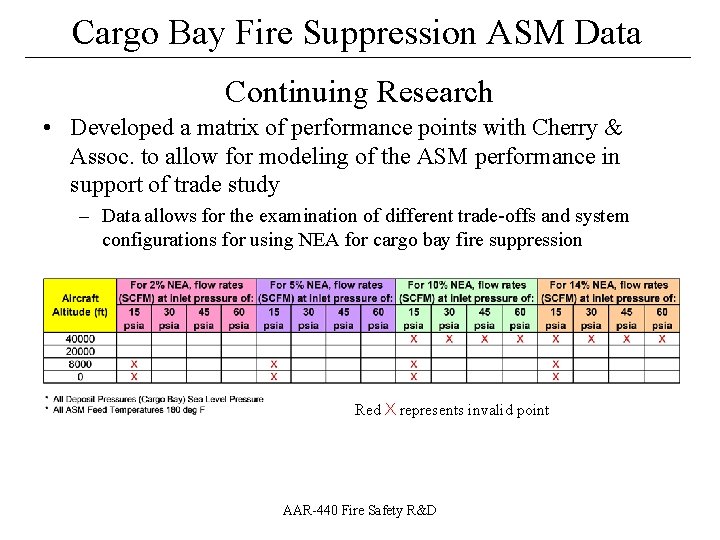
Cargo Bay Fire Suppression ASM Data ___________________ Continuing Research • Developed a matrix of performance points with Cherry & Assoc. to allow for modeling of the ASM performance in support of trade study – Data allows for the examination of different trade-offs and system configurations for using NEA for cargo bay fire suppression Red X represents invalid point AAR-440 Fire Safety R&D
- Slides: 11