
ASM Elements and Principles of Design Colour Schemes
- Slides: 27
ASM Elements and Principles of Design, Colour Schemes and Principles of Media Arts
Elements The building blocks
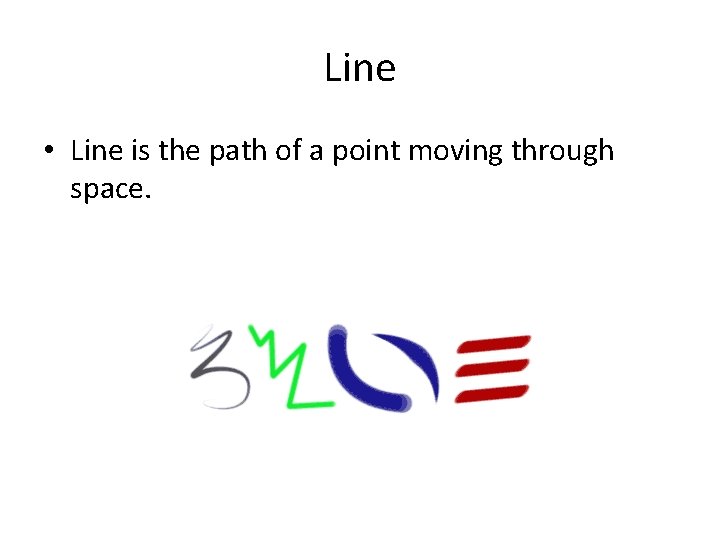
Line • Line is the path of a point moving through space.
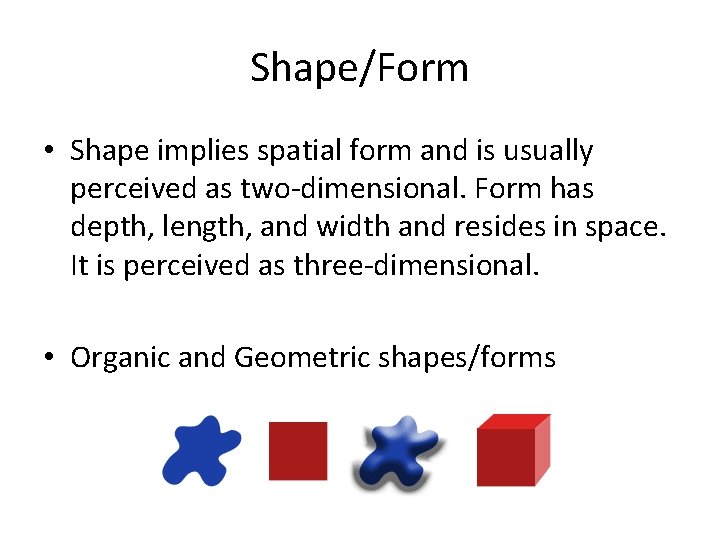
Shape/Form • Shape implies spatial form and is usually perceived as two-dimensional. Form has depth, length, and width and resides in space. It is perceived as three-dimensional. • Organic and Geometric shapes/forms
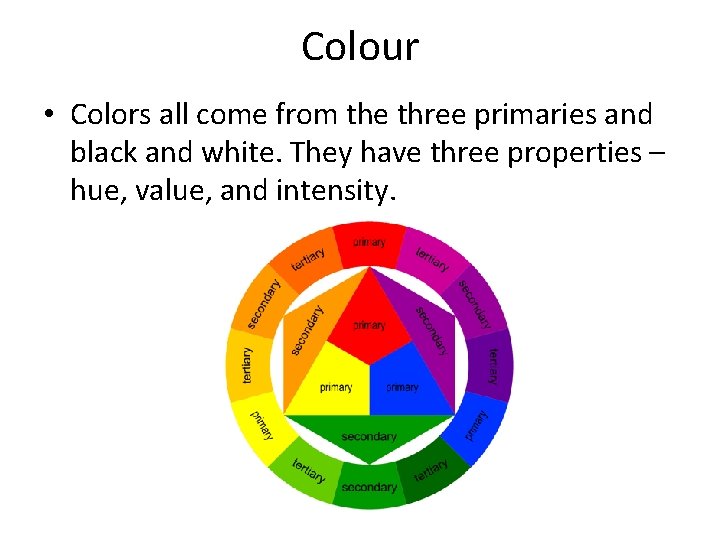
Colour • Colors all come from the three primaries and black and white. They have three properties – hue, value, and intensity.
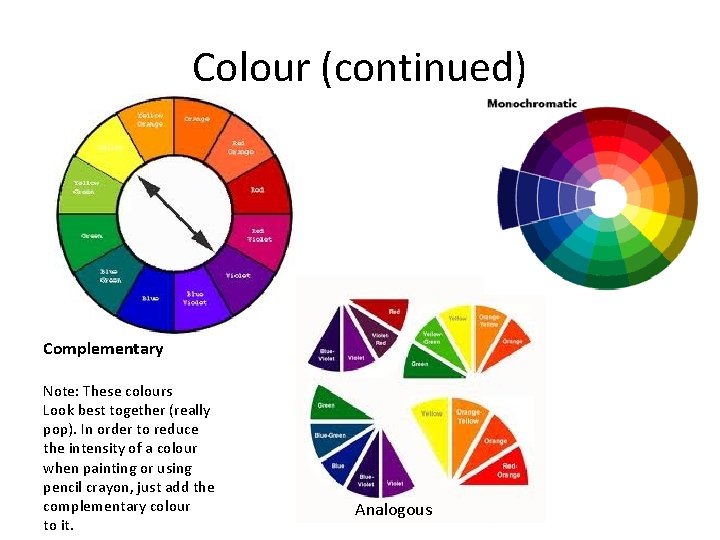
Colour (continued) Complementary Note: These colours Look best together (really pop). In order to reduce the intensity of a colour when painting or using pencil crayon, just add the complementary colour to it. Analogous
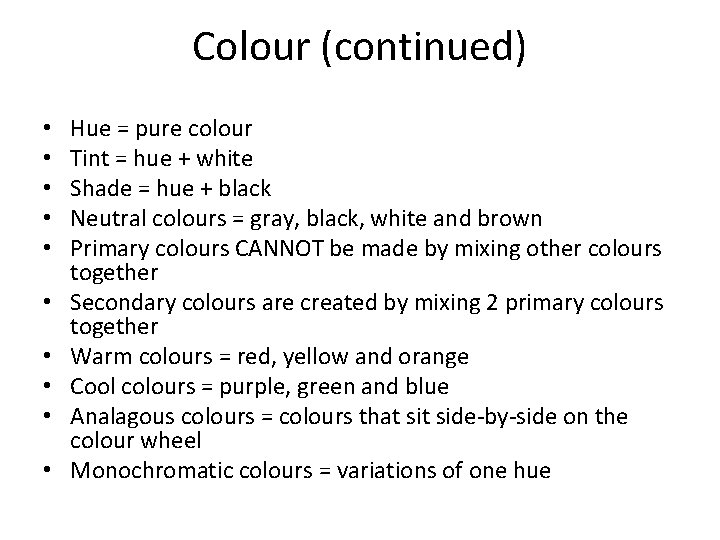
Colour (continued) • • • Hue = pure colour Tint = hue + white Shade = hue + black Neutral colours = gray, black, white and brown Primary colours CANNOT be made by mixing other colours together Secondary colours are created by mixing 2 primary colours together Warm colours = red, yellow and orange Cool colours = purple, green and blue Analagous colours = colours that side-by-side on the colour wheel Monochromatic colours = variations of one hue
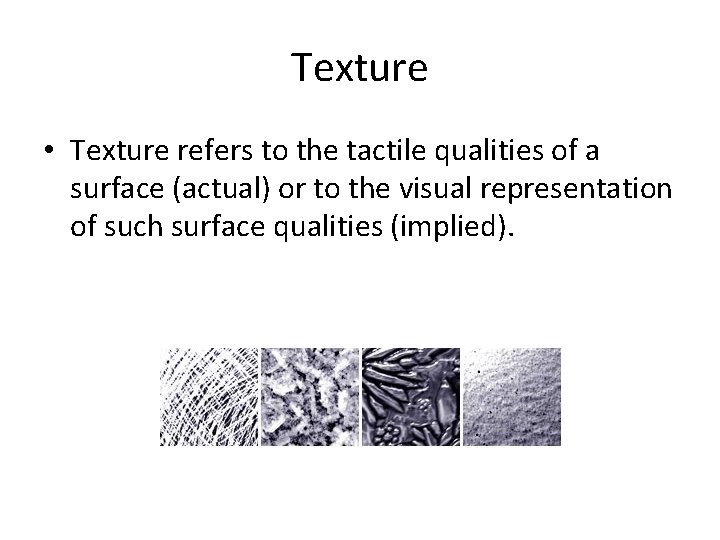
Texture • Texture refers to the tactile qualities of a surface (actual) or to the visual representation of such surface qualities (implied).
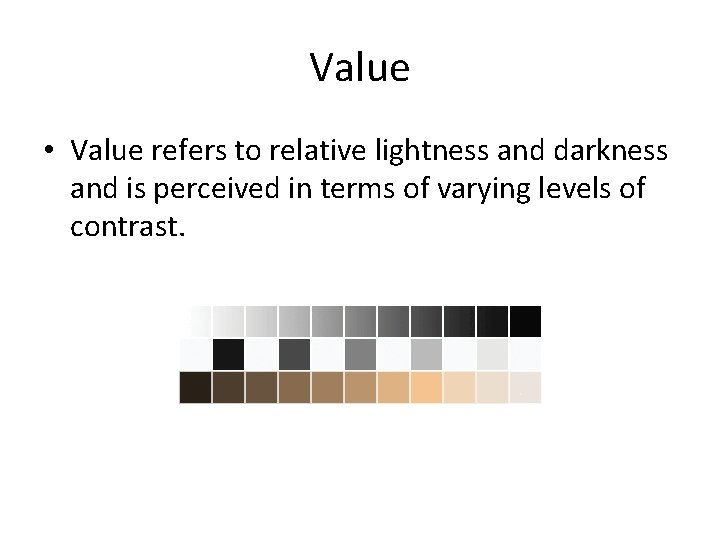
Value • Value refers to relative lightness and darkness and is perceived in terms of varying levels of contrast.
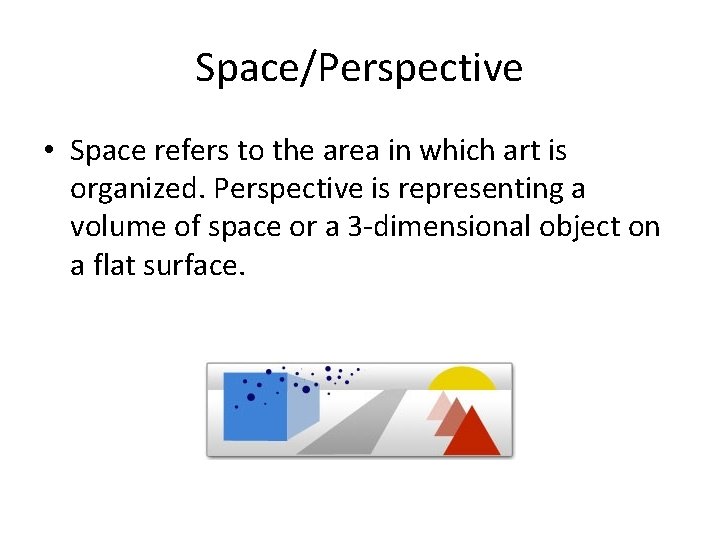
Space/Perspective • Space refers to the area in which art is organized. Perspective is representing a volume of space or a 3 -dimensional object on a flat surface.
Principles The way in which elements are arranged
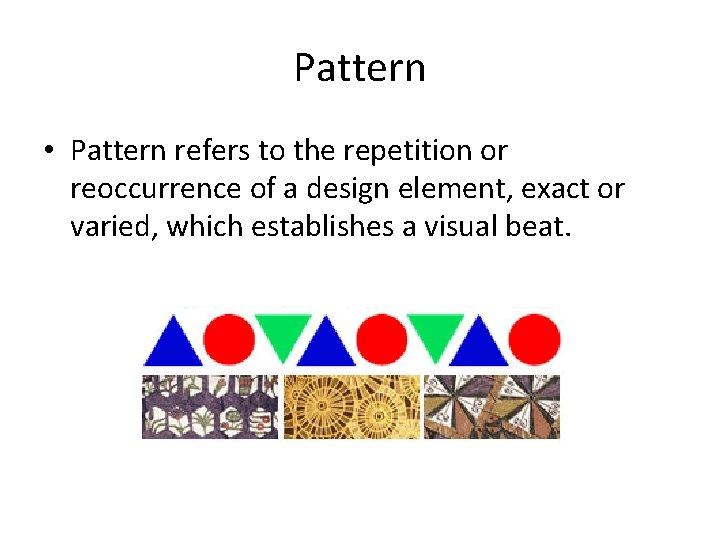
Pattern • Pattern refers to the repetition or reoccurrence of a design element, exact or varied, which establishes a visual beat.
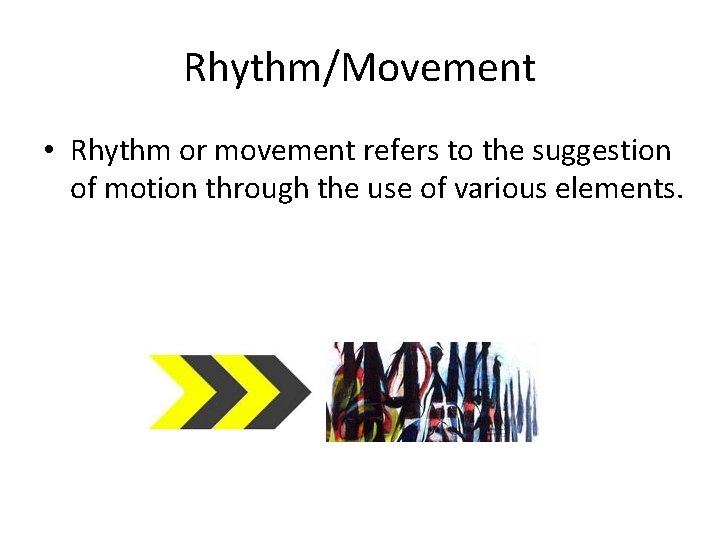
Rhythm/Movement • Rhythm or movement refers to the suggestion of motion through the use of various elements.
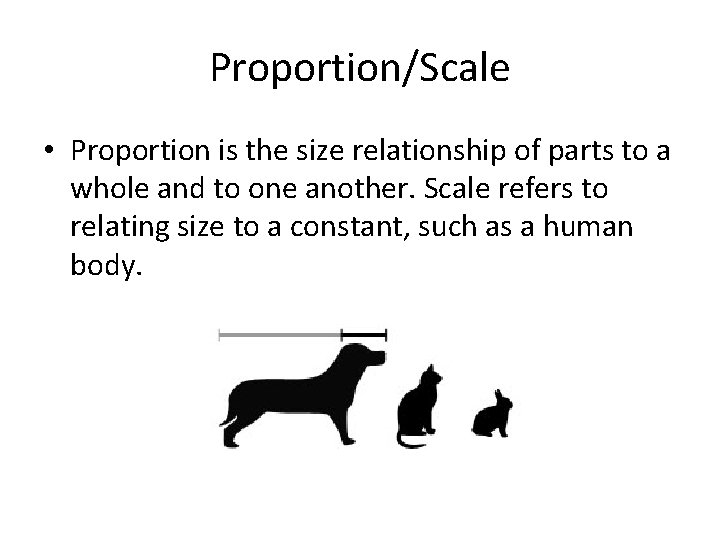
Proportion/Scale • Proportion is the size relationship of parts to a whole and to one another. Scale refers to relating size to a constant, such as a human body.
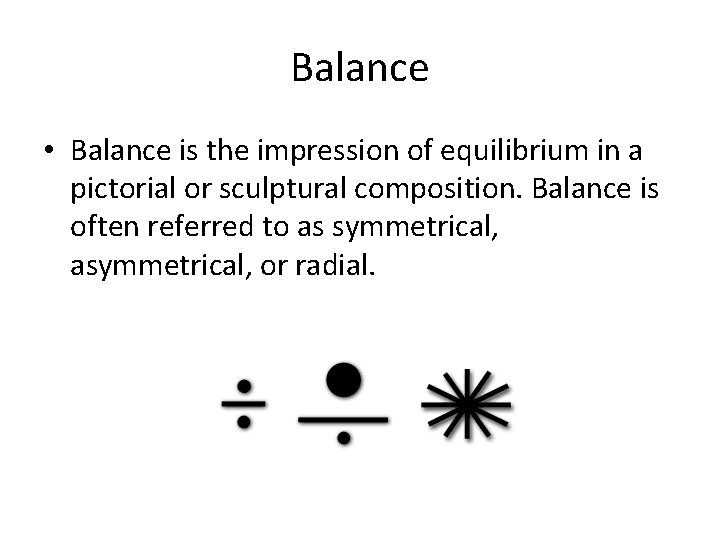
Balance • Balance is the impression of equilibrium in a pictorial or sculptural composition. Balance is often referred to as symmetrical, asymmetrical, or radial.
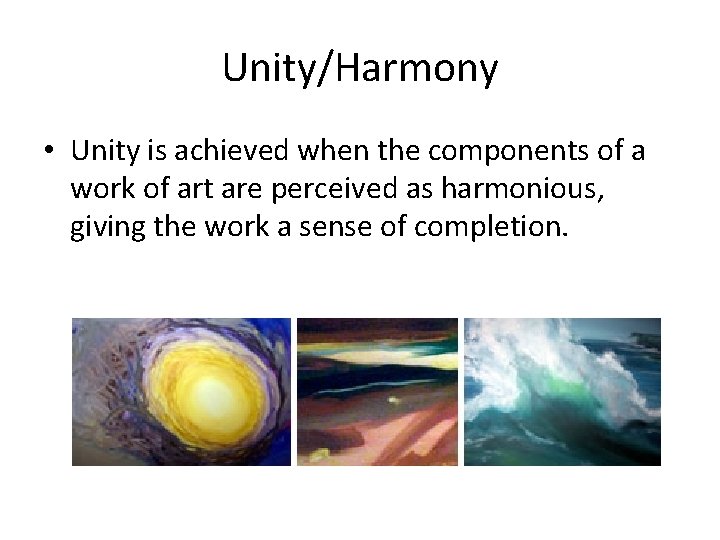
Unity/Harmony • Unity is achieved when the components of a work of art are perceived as harmonious, giving the work a sense of completion.
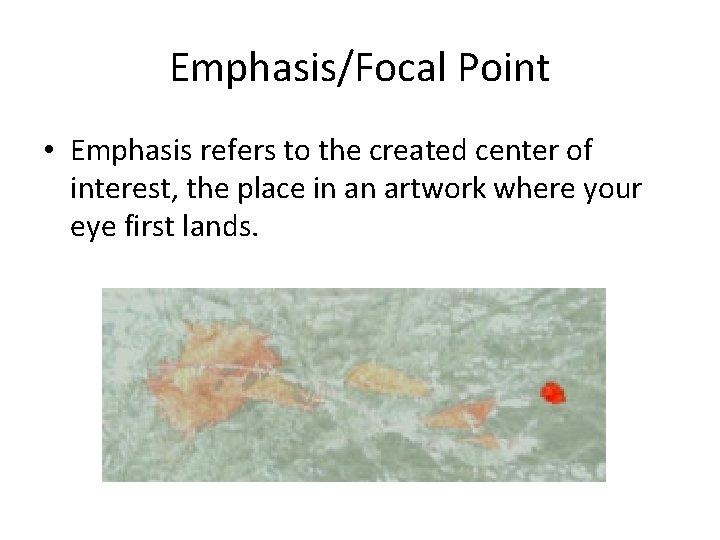
Emphasis/Focal Point • Emphasis refers to the created center of interest, the place in an artwork where your eye first lands.
Colour Schemes
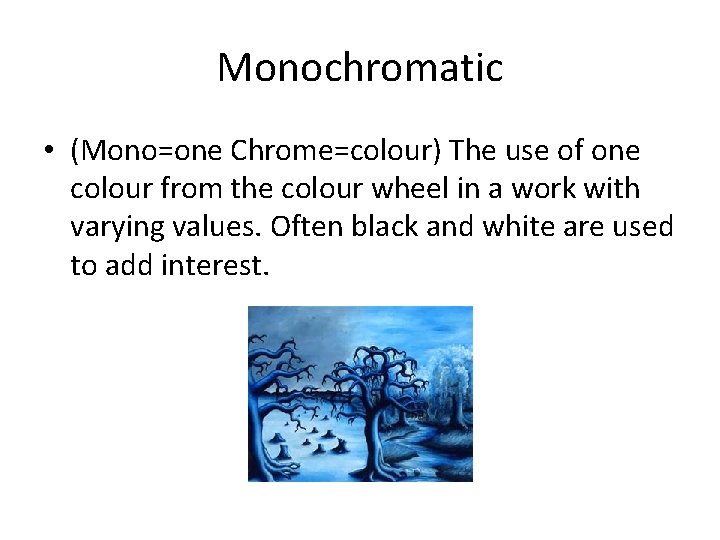
Monochromatic • (Mono=one Chrome=colour) The use of one colour from the colour wheel in a work with varying values. Often black and white are used to add interest.
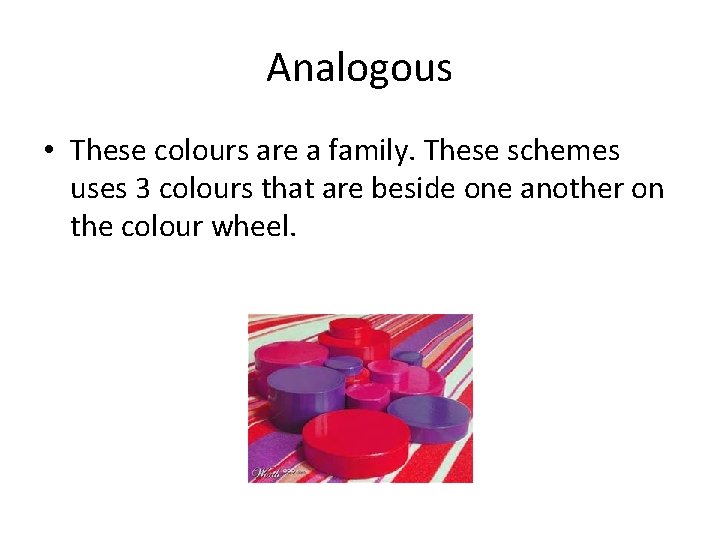
Analogous • These colours are a family. These schemes uses 3 colours that are beside one another on the colour wheel.
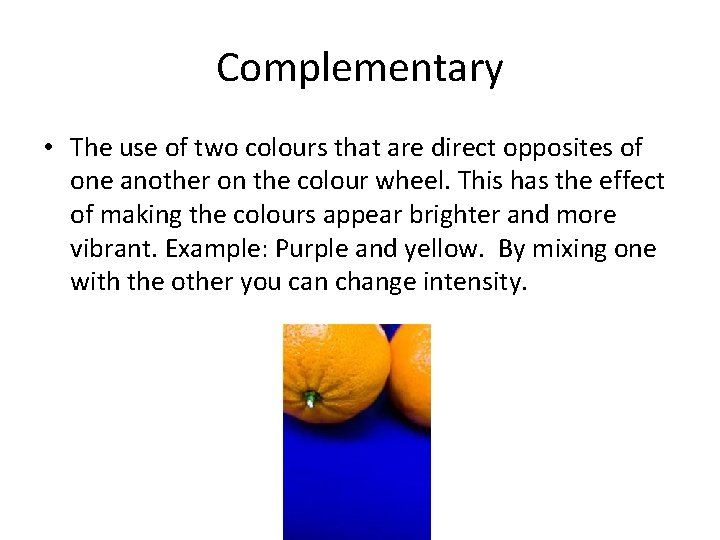
Complementary • The use of two colours that are direct opposites of one another on the colour wheel. This has the effect of making the colours appear brighter and more vibrant. Example: Purple and yellow. By mixing one with the other you can change intensity.
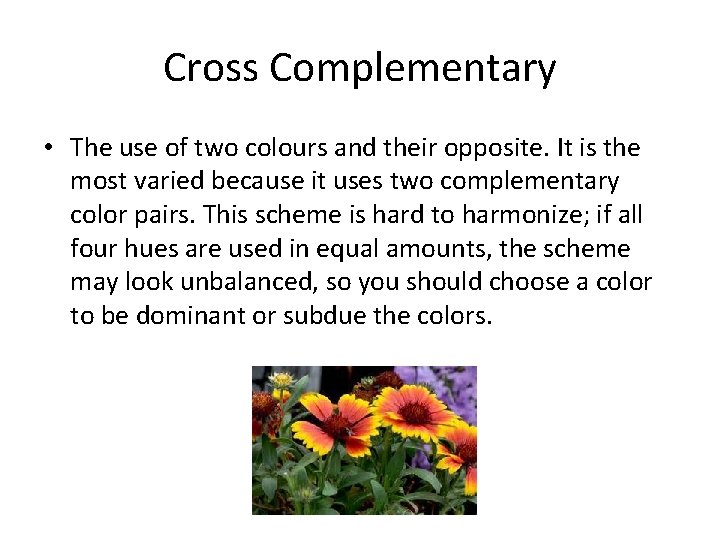
Cross Complementary • The use of two colours and their opposite. It is the most varied because it uses two complementary color pairs. This scheme is hard to harmonize; if all four hues are used in equal amounts, the scheme may look unbalanced, so you should choose a color to be dominant or subdue the colors.
When creating media arts, there tend to be four principles that are followed:
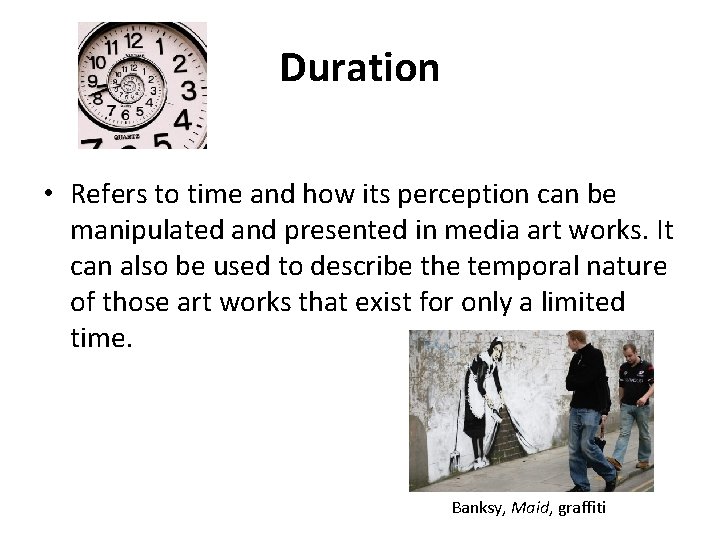
Duration • Refers to time and how its perception can be manipulated and presented in media art works. It can also be used to describe the temporal nature of those art works that exist for only a limited time. Banksy, Maid, graffiti
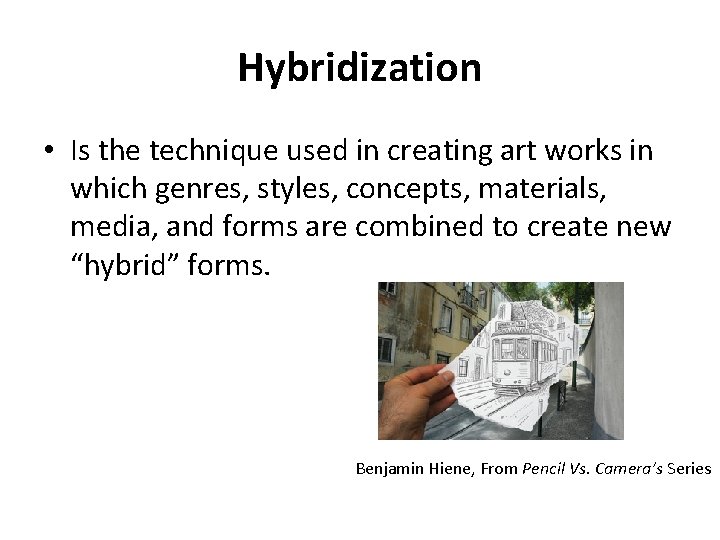
Hybridization • Is the technique used in creating art works in which genres, styles, concepts, materials, media, and forms are combined to create new “hybrid” forms. Benjamin Hiene, From Pencil Vs. Camera’s Series
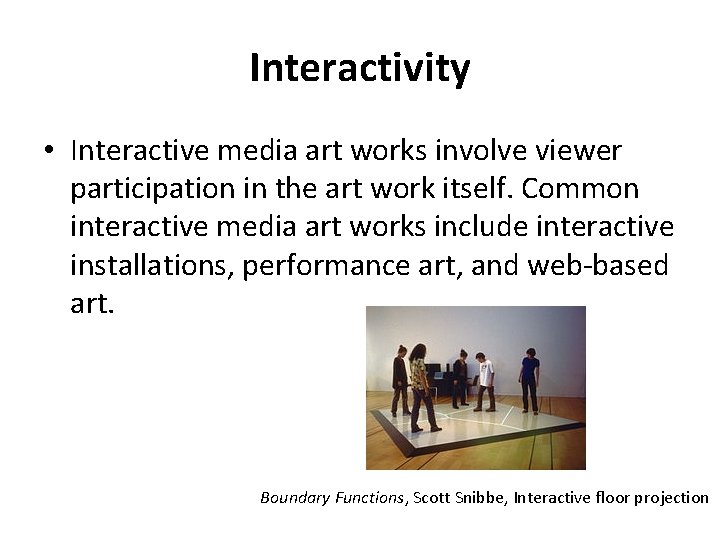
Interactivity • Interactive media art works involve viewer participation in the art work itself. Common interactive media art works include interactive installations, performance art, and web-based art. Boundary Functions, Scott Snibbe, Interactive floor projection
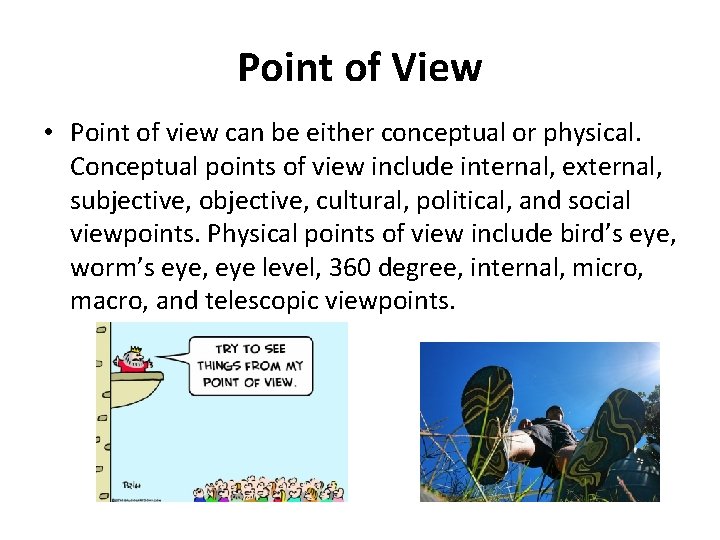
Point of View • Point of view can be either conceptual or physical. Conceptual points of view include internal, external, subjective, objective, cultural, political, and social viewpoints. Physical points of view include bird’s eye, worm’s eye, eye level, 360 degree, internal, micro, macro, and telescopic viewpoints.