
ASLevel Maths Mechanics 1 Kinematics This icon indicates
- Slides: 13
AS-Level Maths: Mechanics 1 Kinematics This icon indicates the slide contains activities created in Flash. These activities are not editable. For more detailed instructions, see the Getting Started presentation. 1 of 37 © Boardworks Ltd 2005
Contents Motion graphs 2 of 37 © Boardworks Ltd 2005
Kinematics involves the study of how things move. It is only concerned with the motion itself, not the forces that cause motion. The kinematics of an object is described in terms of its distance, displacement, speed, velocity, acceleration. 3 of 37 © Boardworks Ltd 2005
Distance and displacement Distance is a scalar quantity. The distance a body has travelled is the amount of ‘ground’ it has covered during its motion. Displacement is a vector quantity. Displacement describes how far a body is from its starting point and in what direction. Distance and displacement are measured in metres, m. 4 of 37 © Boardworks Ltd 2005
Speed, velocity and acceleration Speed is a scalar quantity. The speed of a body relates to how fast the body is travelling. Velocity is a vector quantity. The velocity of a body relates to how fast the body is travelling and in what direction. It is the rate at which a body changes its position. Speed and velocity are measured in metres per second, ms– 1. Acceleration can be a scalar or a vector quantity. Acceleration is the rate of change of speed or velocity. It is measured in metres per second, ms– 2. Negative acceleration is often called deceleration or retardation. 5 of 37 © Boardworks Ltd 2005
Motion graphs The kinematics of a body can be represented graphically. The most common graphs are position-time, speed-time, velocity-time and acceleration-time graphs. The gradient of a distance-time graph gives speed. The gradient of a displacement-time graph gives velocity. The gradient of a velocity-time graph gives acceleration. The area under a speed-time graph gives the distance travelled. The area under a velocity-time graph gives the change in displacement. The area under an acceleration-time graph gives the change in velocity. 6 of 37 © Boardworks Ltd 2005
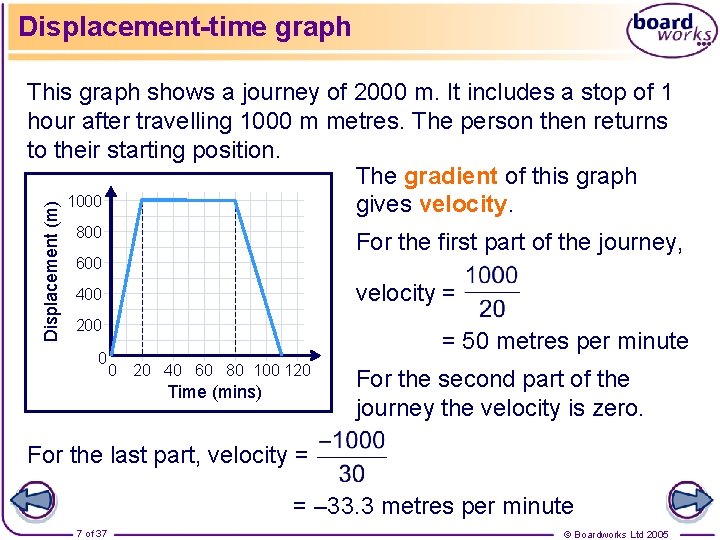
Displacement-time graph Displacement (m) This graph shows a journey of 2000 m. It includes a stop of 1 hour after travelling 1000 m metres. The person then returns to their starting position. The gradient of this graph 1000 gives velocity. 800 For the first part of the journey, 600 velocity = 400 200 0 = 50 metres per minute 0 20 40 60 80 100 120 Time (mins) For the second part of the journey the velocity is zero. For the last part, velocity = = – 33. 3 metres per minute 7 of 37 © Boardworks Ltd 2005
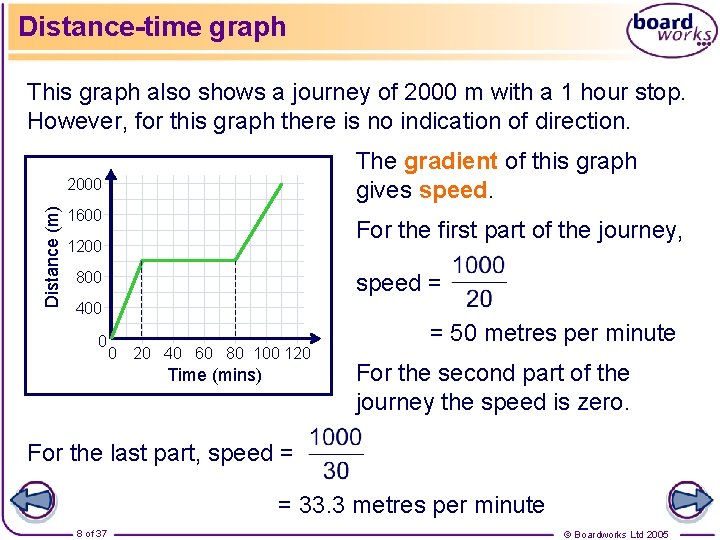
Distance-time graph This graph also shows a journey of 2000 m with a 1 hour stop. However, for this graph there is no indication of direction. The gradient of this graph gives speed. Distance (m) 2000 1600 For the first part of the journey, 1200 800 speed = 400 0 0 20 40 60 80 100 120 Time (mins) = 50 metres per minute For the second part of the journey the speed is zero. For the last part, speed = = 33. 3 metres per minute 8 of 37 © Boardworks Ltd 2005
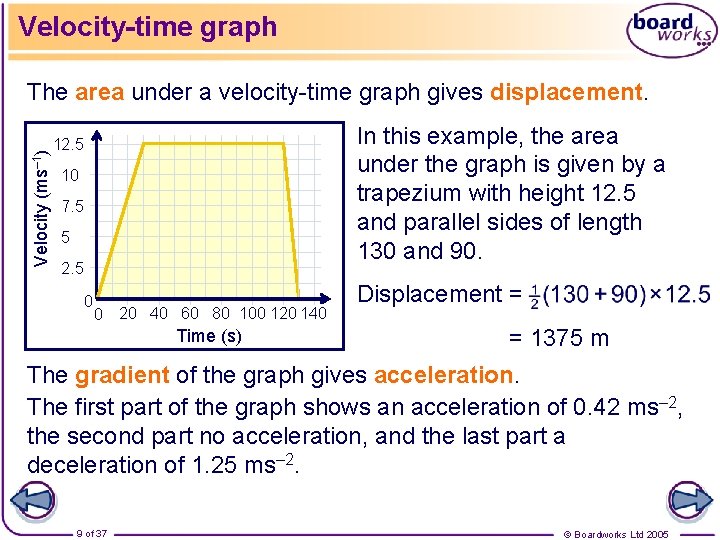
Velocity-time graph Velocity (ms– 1) The area under a velocity-time graph gives displacement. In this example, the area under the graph is given by a trapezium with height 12. 5 and parallel sides of length 130 and 90. 12. 5 10 7. 5 5 2. 5 0 0 20 40 60 80 100 120 140 Time (s) Displacement = = 1375 m The gradient of the graph gives acceleration. The first part of the graph shows an acceleration of 0. 42 ms– 2, the second part no acceleration, and the last part a deceleration of 1. 25 ms– 2. 9 of 37 © Boardworks Ltd 2005
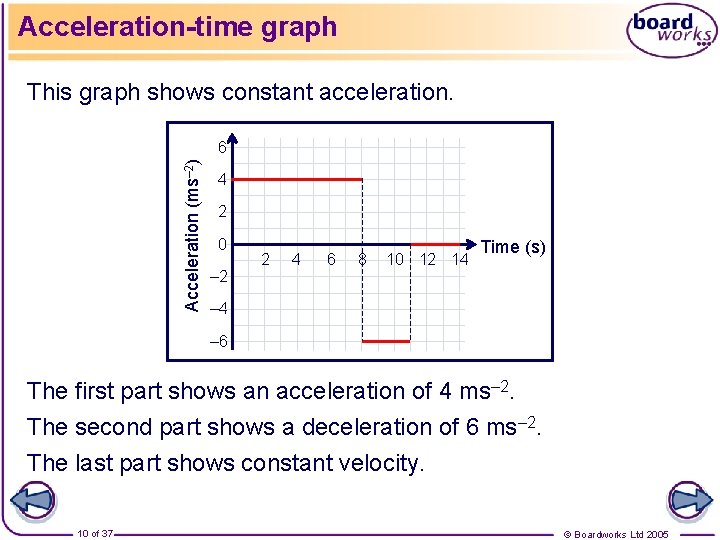
Acceleration-time graph This graph shows constant acceleration. Acceleration (ms– 2) 6 4 2 0 – 2 2 4 6 8 10 12 14 Time (s) – 4 – 6 The first part shows an acceleration of 4 ms– 2. The second part shows a deceleration of 6 ms– 2. The last part shows constant velocity. 10 of 37 © Boardworks Ltd 2005
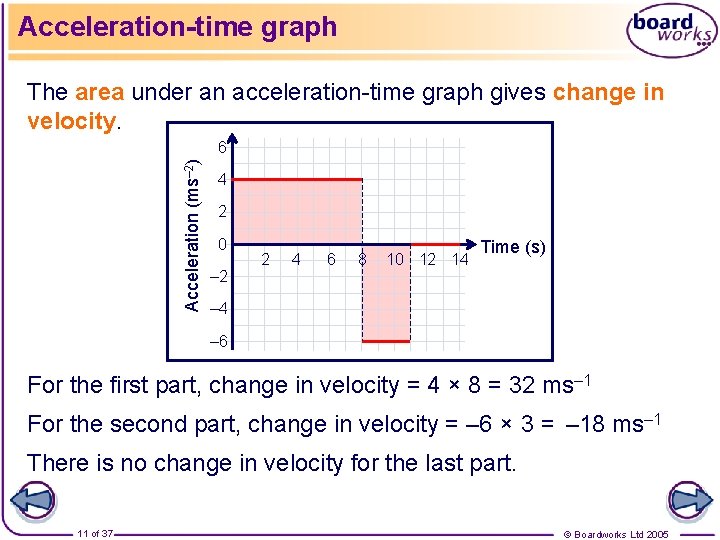
Acceleration-time graph The area under an acceleration-time graph gives change in velocity. Acceleration (ms– 2) 6 4 2 0 – 2 2 4 6 8 10 12 14 Time (s) – 4 – 6 For the first part, change in velocity = 4 × 8 = 32 ms– 1 For the second part, change in velocity = – 6 × 3 = – 18 ms– 1 There is no change in velocity for the last part. 11 of 37 © Boardworks Ltd 2005
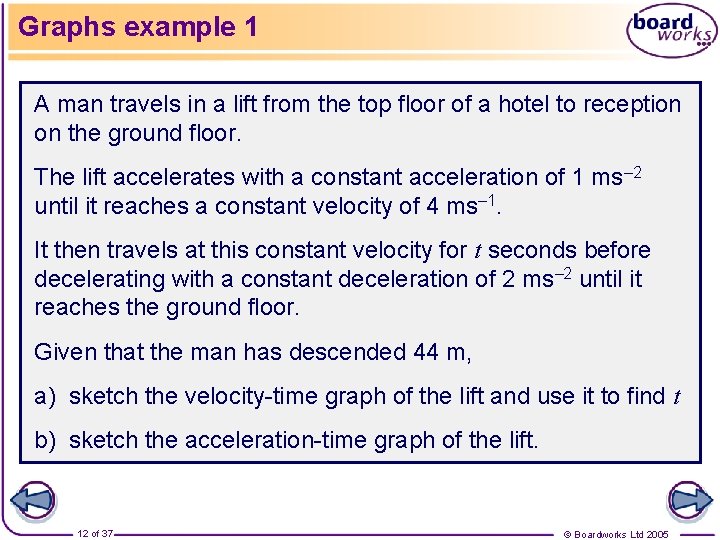
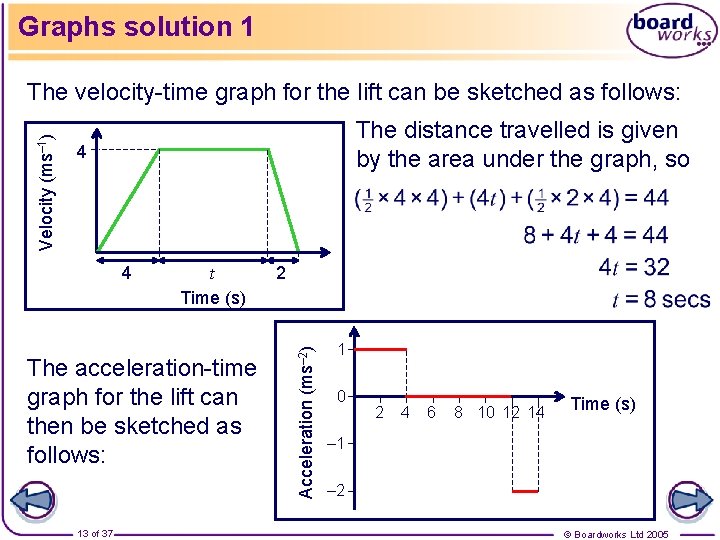
Graphs example 1 A man travels in a lift from the top floor of a hotel to reception on the ground floor. The lift accelerates with a constant acceleration of 1 ms– 2 until it reaches a constant velocity of 4 ms– 1. It then travels at this constant velocity for t seconds before decelerating with a constant deceleration of 2 ms– 2 until it reaches the ground floor. Given that the man has descended 44 m, a) sketch the velocity-time graph of the lift and use it to find t b) sketch the acceleration-time graph of the lift. 12 of 37 © Boardworks Ltd 2005
Graphs solution 1 The distance travelled is given by the area under the graph, so 4 4 t Time (s) The acceleration-time graph for the lift can then be sketched as follows: 13 of 37 2 Acceleration (ms– 2) Velocity (ms– 1) The velocity-time graph for the lift can be sketched as follows: 1 0 2 4 6 8 10 12 14 Time (s) – 1 – 2 © Boardworks Ltd 2005