
ASL I Review Glossing AMERICAN SIGN LANGUAGE Glossing
- Slides: 5
ASL I Review: Glossing AMERICAN SIGN LANGUAGE
Glossing? ? ? At certain times during the semester, your instructor may ask you to “gloss” something in ASL. Since ASL has no written form, glossing was developed to write down how a phrase is signed so someone reading the gloss could sign it. We will cover a few common standards for glossing.
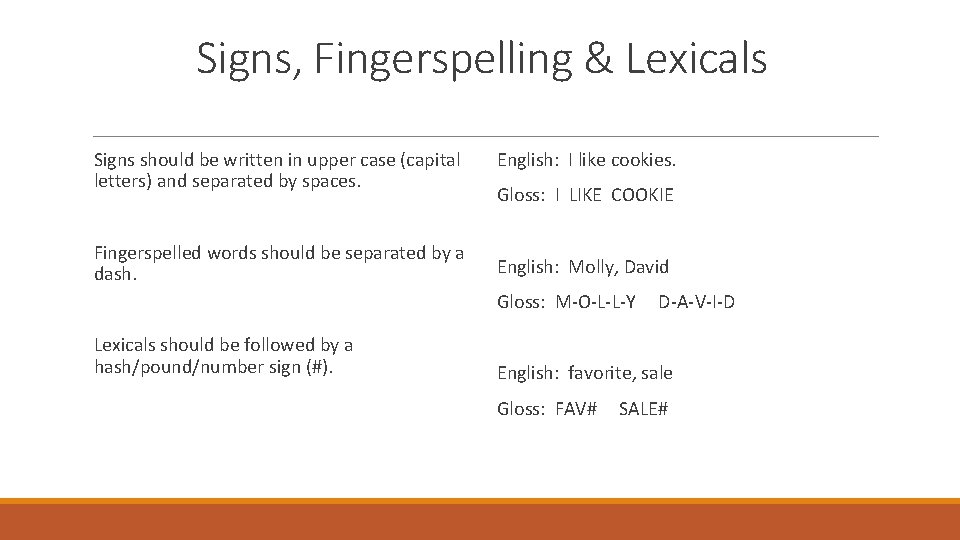
Signs, Fingerspelling & Lexicals Signs should be written in upper case (capital letters) and separated by spaces. Fingerspelled words should be separated by a dash. English: I like cookies. Gloss: I LIKE COOKIE English: Molly, David Gloss: M-O-L-L-Y Lexicals should be followed by a hash/pound/number sign (#). D-A-V-I-D English: favorite, sale Gloss: FAV# SALE#
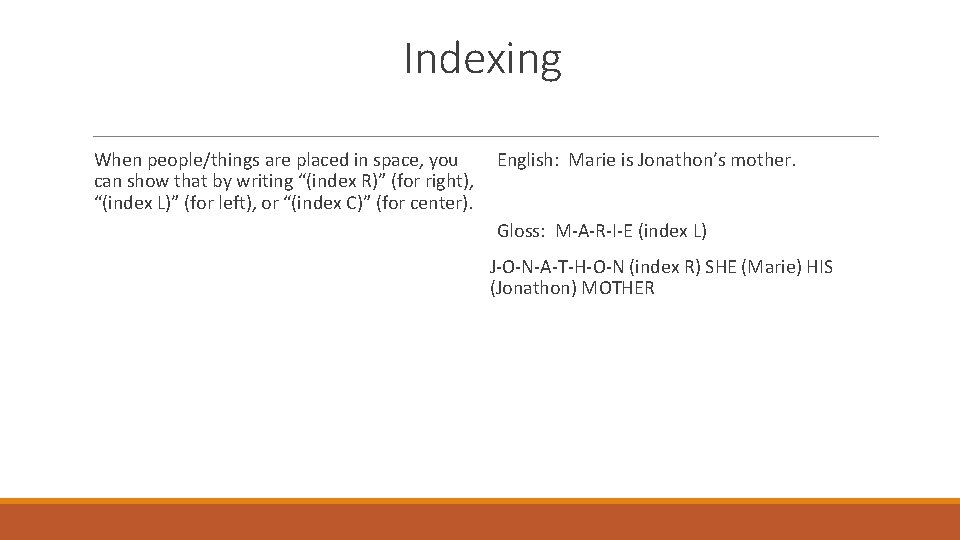
Indexing When people/things are placed in space, you can show that by writing “(index R)” (for right), “(index L)” (for left), or “(index C)” (for center). English: Marie is Jonathon’s mother. Gloss: M-A-R-I-E (index L) J-O-N-A-T-H-O-N (index R) SHE (Marie) HIS (Jonathon) MOTHER
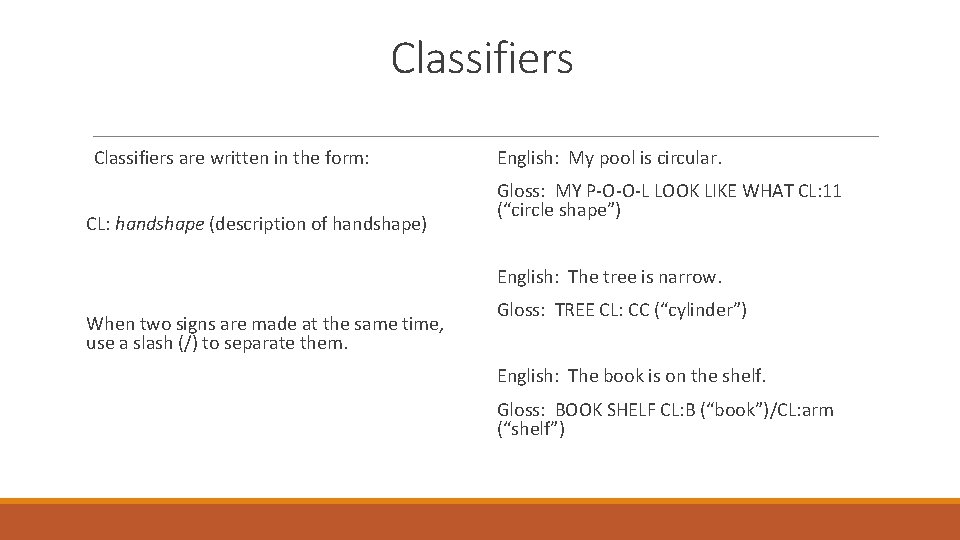
Classifiers are written in the form: CL: handshape (description of handshape) English: My pool is circular. Gloss: MY P-O-O-L LOOK LIKE WHAT CL: 11 (“circle shape”) English: The tree is narrow. When two signs are made at the same time, use a slash (/) to separate them. Gloss: TREE CL: CC (“cylinder”) English: The book is on the shelf. Gloss: BOOK SHELF CL: B (“book”)/CL: arm (“shelf”)