
Ask JAN Cognitive Impairments in the Workplace Melanie
- Slides: 31
Ask JAN Cognitive Impairments in the Workplace Melanie Whetzel, M. A. , CBIS Lead Consultant, Cognitive/Neurological Team Sarah Small, M. S. , CRC Consultant, Cognitive/Neurological Team JAN is funded by a contract with the Office of Disability Employment Policy, U. S. Department of Labor. 1
Cognitive Impairments Common Cognitive Impairments § § § § § Alzheimer’s/Dementia Attention Deficit Hyperactivity Disorder (ADHD) Autism Brain Injury Developmental/Intellectual Disability Learning Disabilities Mental Health Impairments Sleep Disorders Stroke 2
Cognitive Impairments Limitations § Concentration § Memory § Organization § Time Management § Coworker Interaction § Working Effectively § Attendance § Reading § Writing § Mathematics § Spelling 3
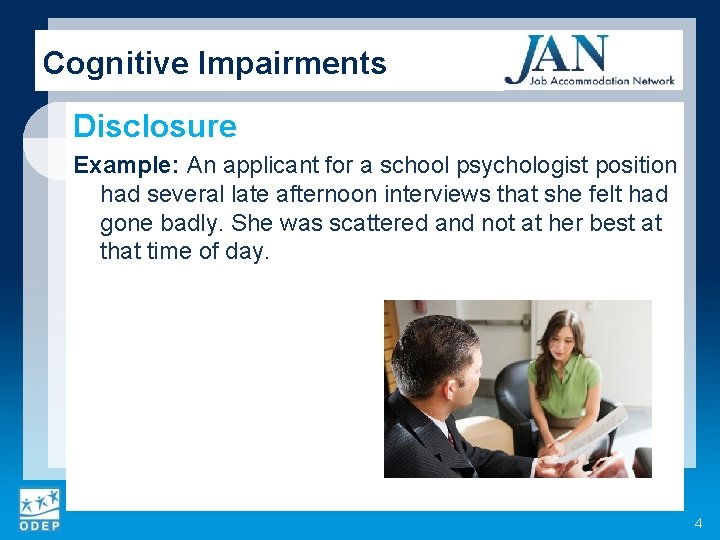
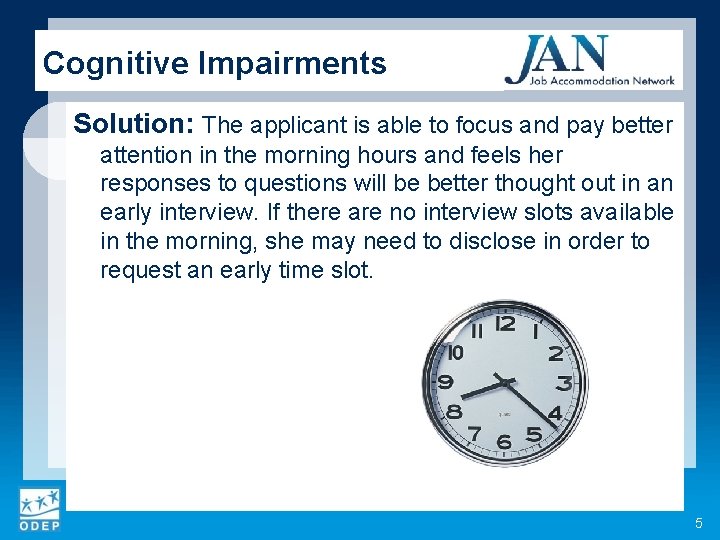
Cognitive Impairments Disclosure Example: An applicant for a school psychologist position had several late afternoon interviews that she felt had gone badly. She was scattered and not at her best at that time of day. 4
Cognitive Impairments Solution: The applicant is able to focus and pay better attention in the morning hours and feels her responses to questions will be better thought out in an early interview. If there are no interview slots available in the morning, she may need to disclose in order to request an early time slot. 5
Cognitive Impairments Seeking Medical Information Example: An employee with a learning disability excelled on the job for years, until the job changed enough that he required extensive training. He asked for an accommodation, and the employer required medical documentation. The employee had no documentation and was at a loss of what to do. 6
Cognitive Impairments Solution: JAN recommended several solutions. The first one was to ask for temporary accommodations to assist him in the training while he was exploring/ getting the testing completed. He was referred to vocational rehabilitation for assistance, as well as a local university. The employer can provide temporary accommodations as a good faith effort while the employee is obtaining the required documentation. 7
Cognitive Impairments 8
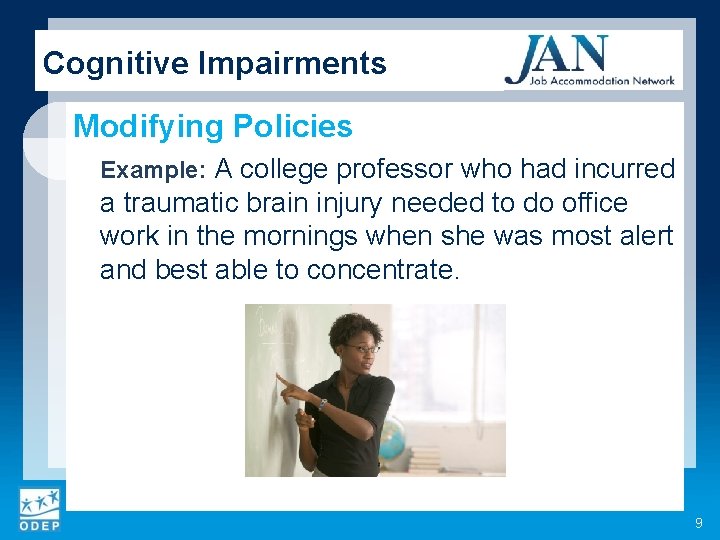
Cognitive Impairments Modifying Policies Example: A college professor who had incurred a traumatic brain injury needed to do office work in the mornings when she was most alert and best able to concentrate. 9
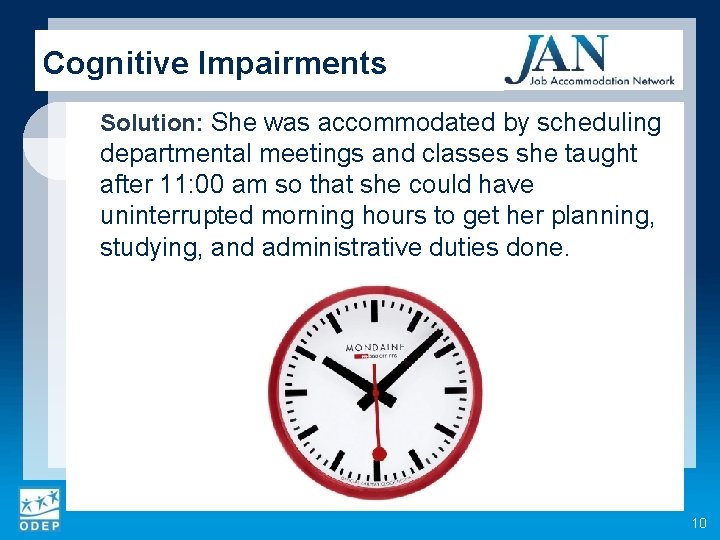
Cognitive Impairments Solution: She was accommodated by scheduling departmental meetings and classes she taught after 11: 00 am so that she could have uninterrupted morning hours to get her planning, studying, and administrative duties done. 10
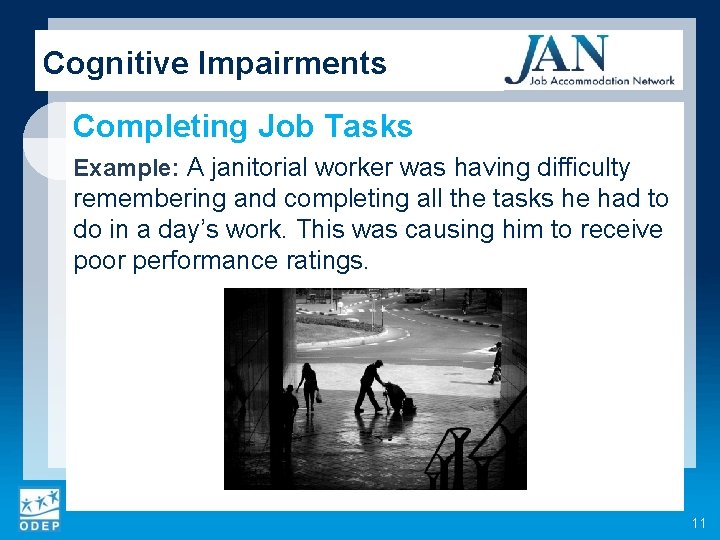
Cognitive Impairments Completing Job Tasks Example: A janitorial worker was having difficulty remembering and completing all the tasks he had to do in a day’s work. This was causing him to receive poor performance ratings. 11
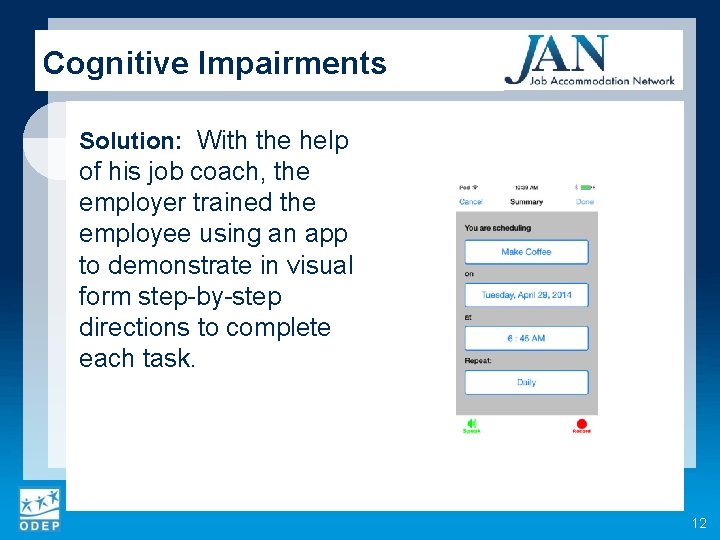
Cognitive Impairments Solution: With the help of his job coach, the employer trained the employee using an app to demonstrate in visual form step-by-step directions to complete each task. 12
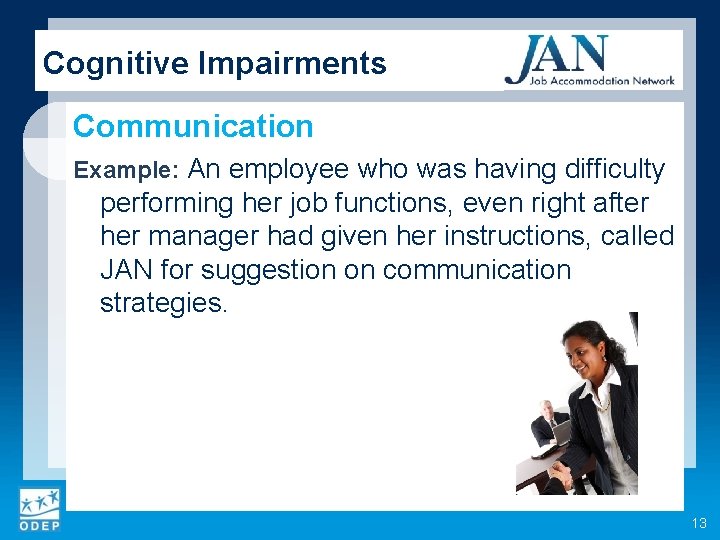
Cognitive Impairments Communication Example: An employee who was having difficulty performing her job functions, even right after her manager had given her instructions, called JAN for suggestion on communication strategies. 13
Cognitive Impairments Solution: JAN suggested strategies for communication that included speaking more slowly, using clear short sentences, and asking the employee to repeat back the information to help determine if she has understood. 14
Cognitive Impairments 15
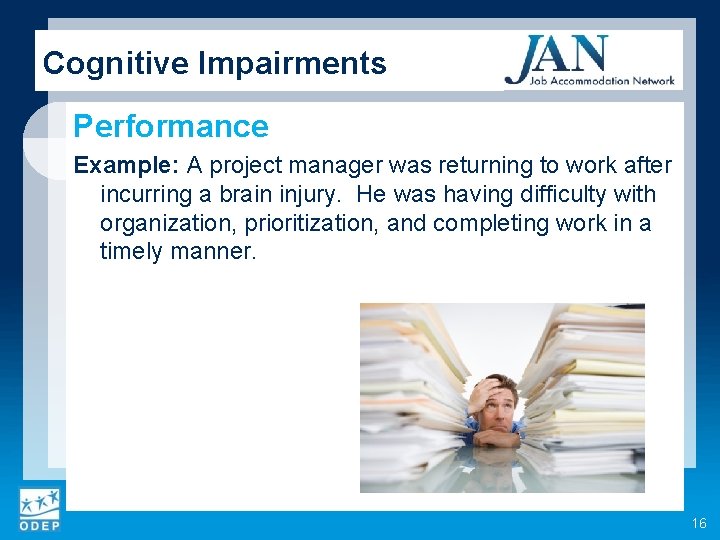
Cognitive Impairments Performance Example: A project manager was returning to work after incurring a brain injury. He was having difficulty with organization, prioritization, and completing work in a timely manner. 16
Cognitive Impairments Solution: The employee was accommodated with project management software, weekly meetings with his supervisor, and a Timer clock to help with task completion timeliness. 17
Cognitive Impairments Conduct Example: A new employee who is quite impulsive was reprimanded several times for interrupting meetings, interjecting his own personal opinions (often unrelated to what is being discussed) in meetings with coworkers as well as clients. When his supervisor gives him a second written warning, he discloses his ADHD and states that he just can’t help himself. 18
Cognitive Impairments Solution: His supervisor provides him with an advanced agenda of meeting topics with a space for notes so the employee can gather his thoughts around what is appropriate to speak about in meetings and what is not. 19
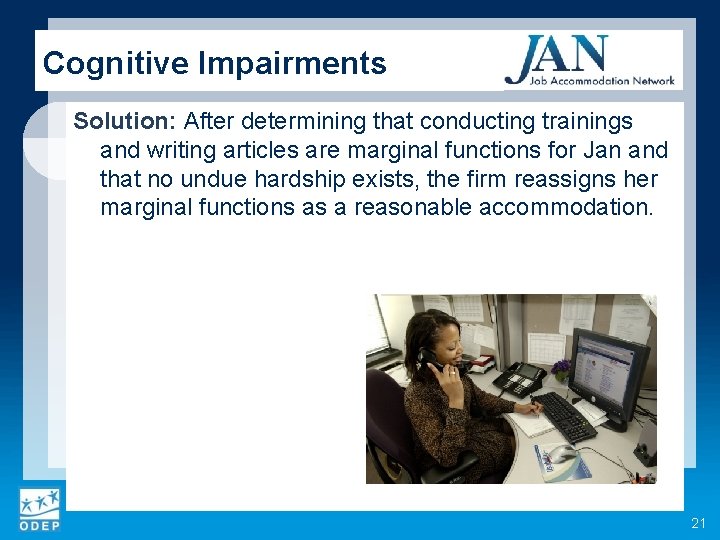
Cognitive Impairments Job Restructuring Example: Jan, an attorney, must maintain a specified number of cases per year in addition to other responsibilities. Due to a worsening in her disability, she is unable to complete the cases while also conducting training and writing articles for a newsletter. Jan tells her supervisor about her disability and requests that she be allowed to eliminate the marginal functions of her job so that she can focus on her cases. 20
Cognitive Impairments Solution: After determining that conducting trainings and writing articles are marginal functions for Jan and that no undue hardship exists, the firm reassigns her marginal functions as a reasonable accommodation. 21
Cognitive Impairments 22
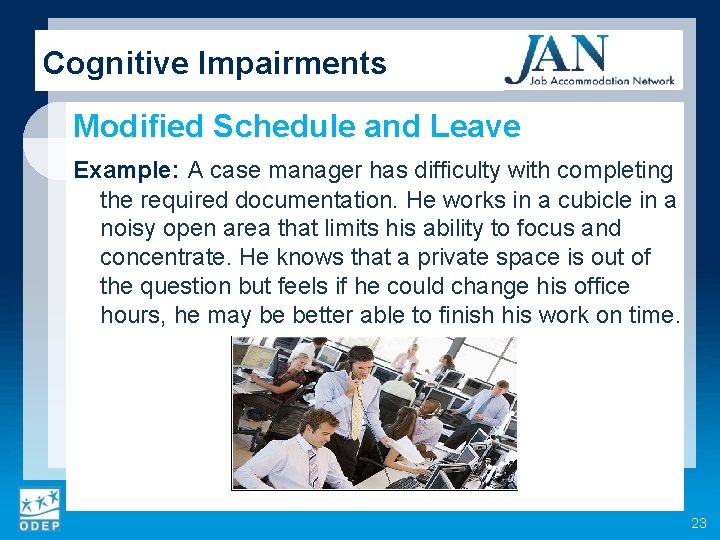
Cognitive Impairments Modified Schedule and Leave Example: A case manager has difficulty with completing the required documentation. He works in a cubicle in a noisy open area that limits his ability to focus and concentrate. He knows that a private space is out of the question but feels if he could change his office hours, he may be better able to finish his work on time. 23
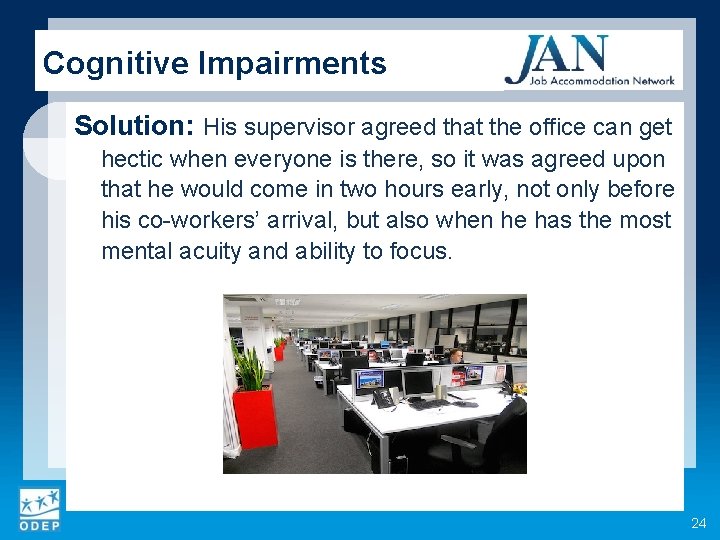
Cognitive Impairments Solution: His supervisor agreed that the office can get hectic when everyone is there, so it was agreed upon that he would come in two hours early, not only before his co-workers’ arrival, but also when he has the most mental acuity and ability to focus. 24
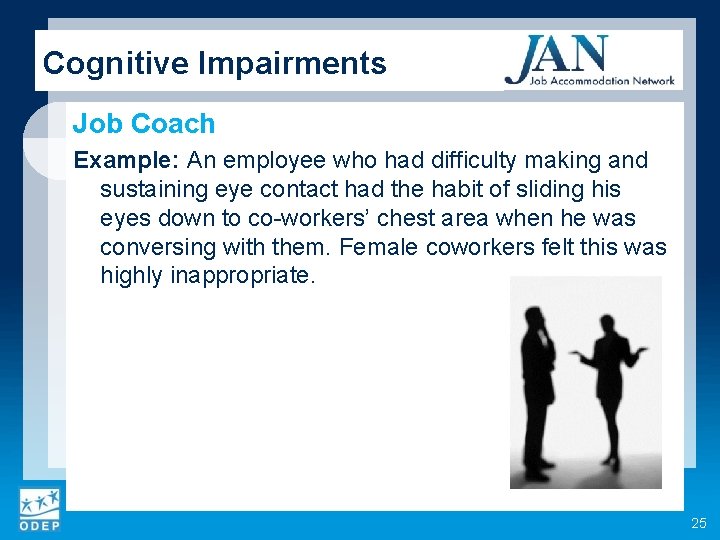
Cognitive Impairments Job Coach Example: An employee who had difficulty making and sustaining eye contact had the habit of sliding his eyes down to co-workers’ chest area when he was conversing with them. Female coworkers felt this was highly inappropriate. 25
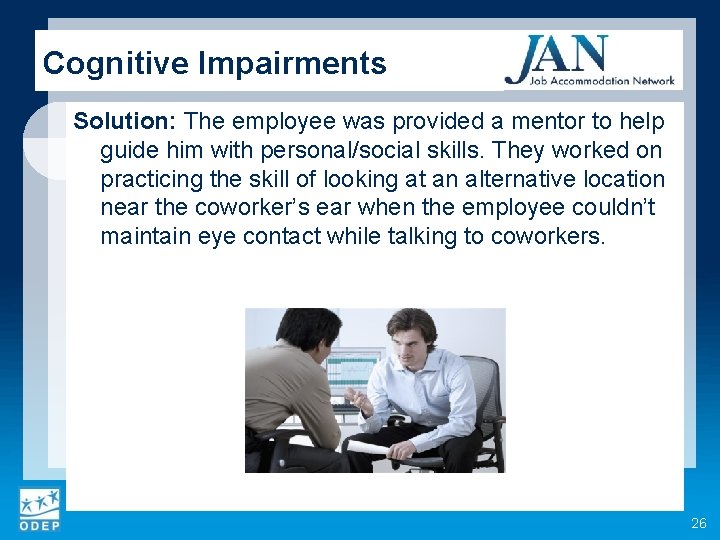
Cognitive Impairments Solution: The employee was provided a mentor to help guide him with personal/social skills. They worked on practicing the skill of looking at an alternative location near the coworker’s ear when the employee couldn’t maintain eye contact while talking to coworkers. 26
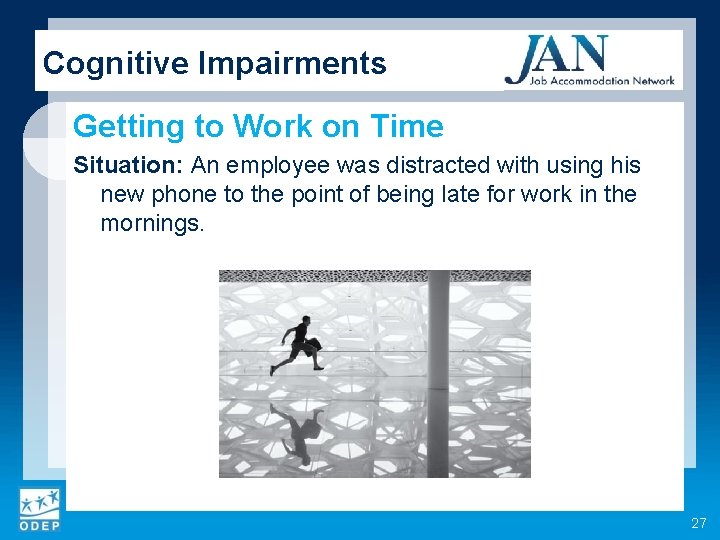
Cognitive Impairments Getting to Work on Time Situation: An employee was distracted with using his new phone to the point of being late for work in the mornings. 27
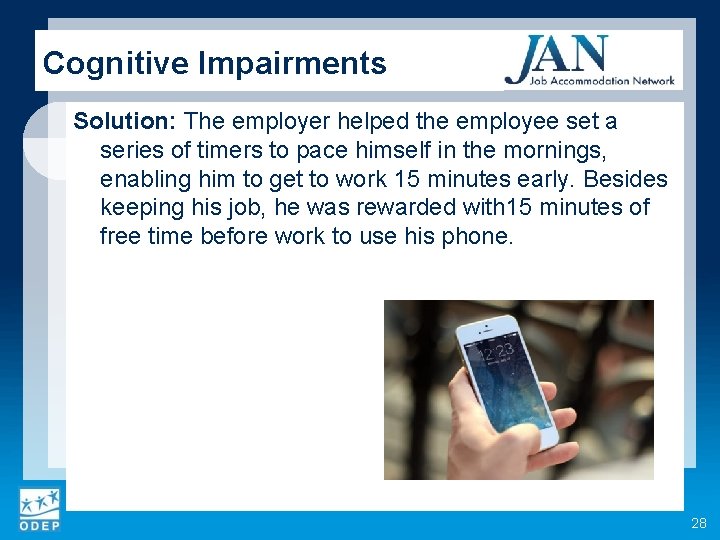
Cognitive Impairments Solution: The employer helped the employee set a series of timers to pace himself in the mornings, enabling him to get to work 15 minutes early. Besides keeping his job, he was rewarded with 15 minutes of free time before work to use his phone. 28
Cognitive Impairments 29
Cognitive Impairments Resources: A to Z of Disabilities and Accommodations https: //Ask. JAN. org/links/atoz. htm Employers' Practical Guide to Reasonable Accommodation Under the Americans with Disabilities Act (ADA) http: //Ask. JAN. org/Erguide 30
Cognitive Impairments Contact § § (800)526 -7234 (V) & (877)781 -9403 (TTY) Ask. JAN. org & jan@askjan. org (304)216 -8189 via Text janconsultants via Skype 31