
Asian Gypsy Moth Lymantria dispar asiatica Asian Gypsy



- Slides: 25
Asian Gypsy Moth Lymantria dispar asiatica
Asian Gypsy Moth • Native pest to Europe and Asia. • Pest of over 500 species of trees and shrubs including oaks. • Lymantria dispar asiatica has been found in North America on several occasions. • Very similar to the European gypsy moth (Lymantria dispar). • Unlike related gypsy moths, the Asian gypsy moth females can fly.
Global Distribution of the Gypsy Moth Distribution of gypsy moths in North America Distribution of gypsy moths in the Eastern hemisphere Image credits: Gypsy Moth Around the World - Sandy Liebhold - http: //www. fs. fed. us/ne/morgantown/4557/gmoth/world/
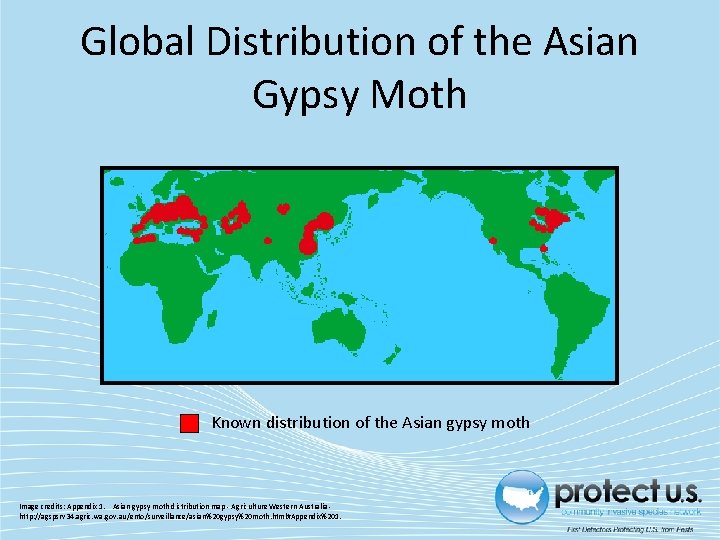
Global Distribution of the Asian Gypsy Moth Known distribution of the Asian gypsy moth Image credits: Appendix 1. Asian gypsy moth distribution map - Agriculture Western Australia - http: //agspsrv 34. agric. wa. gov. au/ento/surveillance/asian%20 gypsy%20 moth. html#Appendix%201.
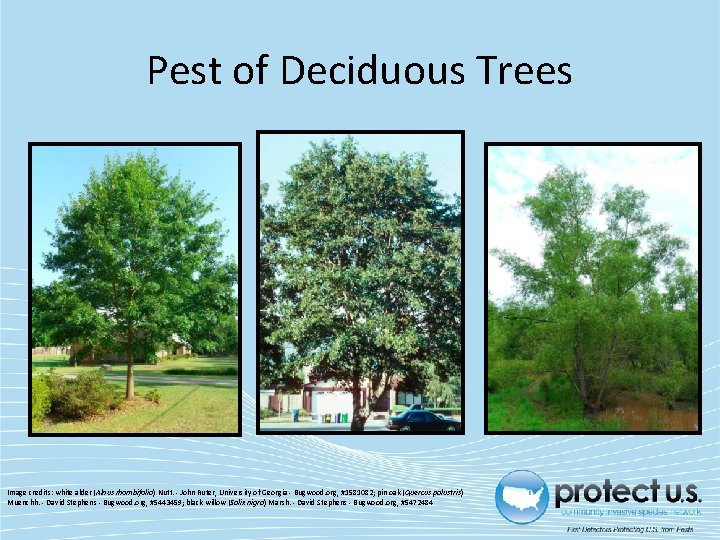
Pest of Deciduous Trees Image credits: white alder (Alnus rhombifolia) Nutt. - John Ruter, University of Georgia - Bugwood. org, #1581082; pin oak (Quercus palustris) Muenchh. - David Stephens - Bugwood. org, #5443459; black willow (Salix nigra) Marsh. - David Stephens - Bugwood. org, #5472484
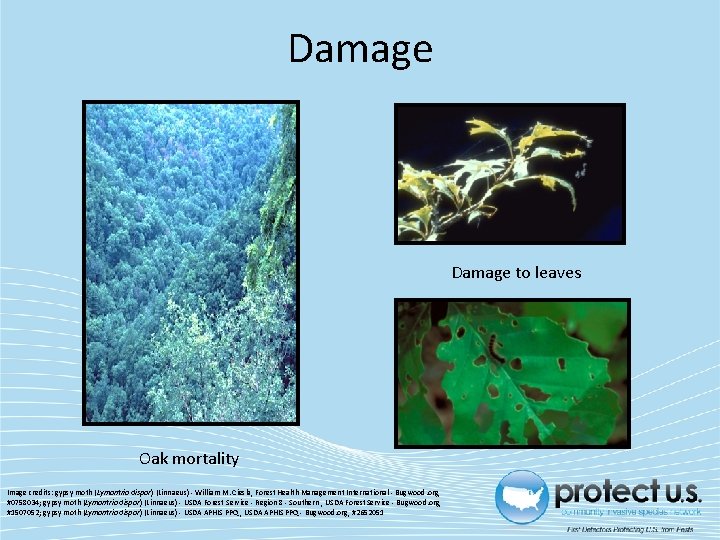
Damage to leaves Oak mortality Image credits: gypsy moth (Lymantria dispar) (Linnaeus) - William M. Ciesla, Forest Health Management International - Bugwood. org, #0758034; gypsy moth (Lymantria dispar) (Linnaeus) - USDA Forest Service - Region 8 - Southern , USDA Forest Service - Bugwood. org, #1507052; gypsy moth (Lymantria dispar) (Linnaeus) - USDA APHIS PPQ , USDA APHIS PPQ - Bugwood. org, #2652051
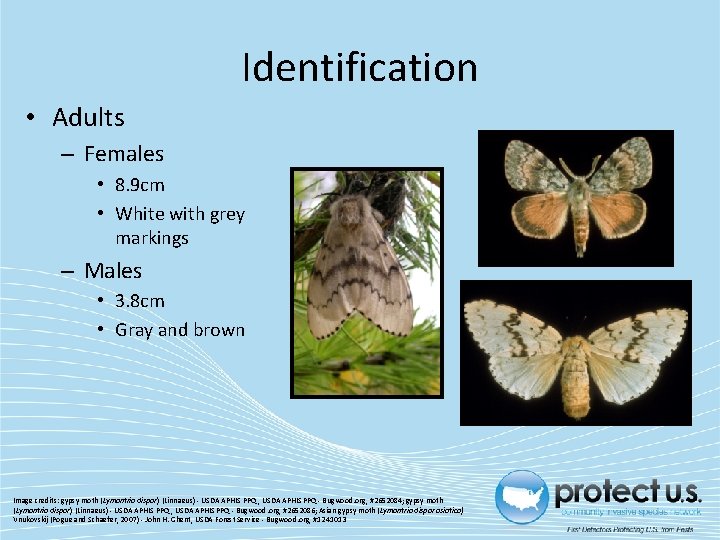
Identification • Adults – Females • 8. 9 cm • White with grey markings – Males • 3. 8 cm • Gray and brown Image credits: gypsy moth (Lymantria dispar) (Linnaeus) - USDA APHIS PPQ , USDA APHIS PPQ - Bugwood. org, #2652084; gypsy moth (Lymantria dispar) (Linnaeus) - USDA APHIS PPQ , USDA APHIS PPQ - Bugwood. org, #2652086; Asian gypsy moth (Lymantria dispar asiatica) Vnukovskij (Pogue and Schaefer, 2007) - John H. Ghent, USDA Forest Service - Bugwood. org, #1241013
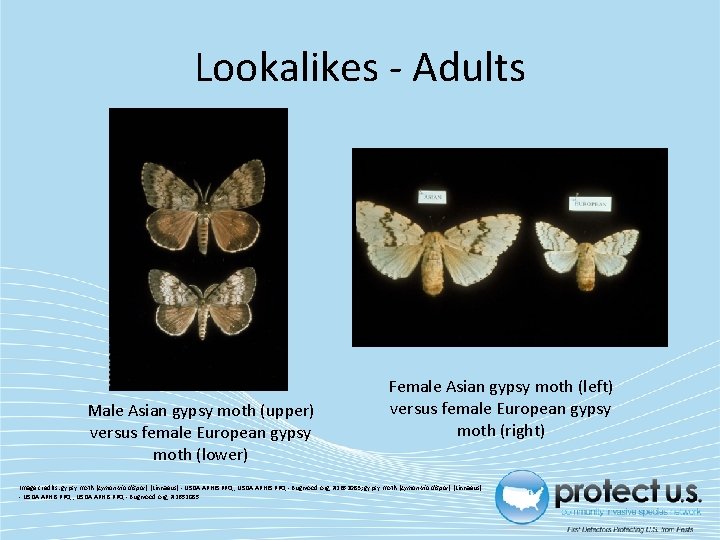
Lookalikes - Adults Male Asian gypsy moth (upper) versus female European gypsy moth (lower) Female Asian gypsy moth (left) versus female European gypsy moth (right) Image credits: gypsy moth (Lymantria dispar) (Linnaeus) - USDA APHIS PPQ , USDA APHIS PPQ - Bugwood. org, #2652083; gypsy moth (Lymantria dispar) (Linnaeus) - USDA APHIS PPQ , USDA APHIS PPQ - Bugwood. org, #2652085
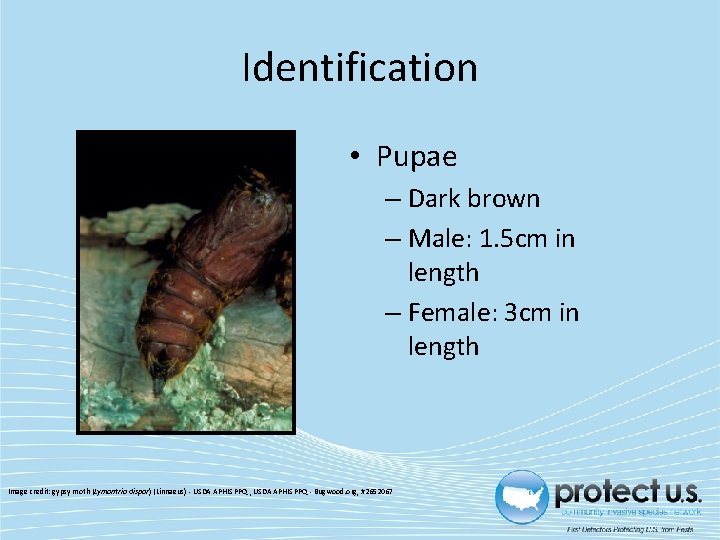
Identification • Pupae – Dark brown – Male: 1. 5 cm in length – Female: 3 cm in length Image credit: gypsy moth (Lymantria dispar) (Linnaeus) - USDA APHIS PPQ , USDA APHIS PPQ - Bugwood. org, #2652067
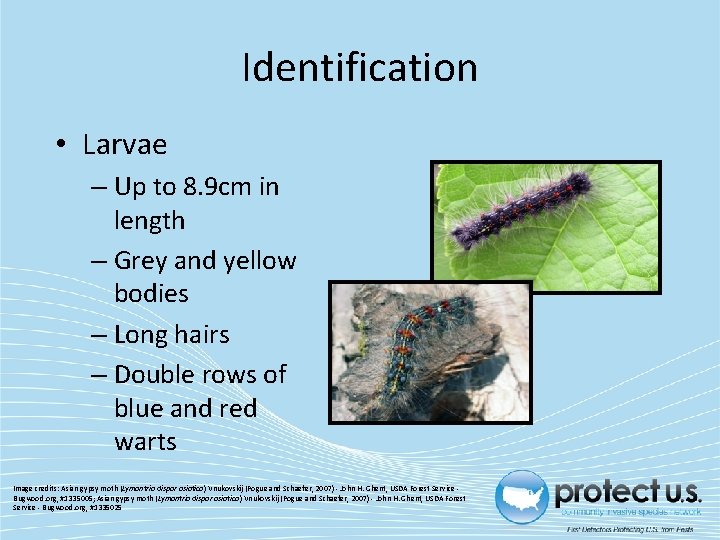
Identification • Larvae – Up to 8. 9 cm in length – Grey and yellow bodies – Long hairs – Double rows of blue and red warts Image credits: Asian gypsy moth (Lymantria dispar asiatica) Vnukovskij (Pogue and Schaefer, 2007) - John H. Ghent, USDA Forest Service - Bugwood. org, #1335005; Asian gypsy moth (Lymantria dispar asiatica) Vnukovskij (Pogue and Schaefer, 2007) - John H. Ghent, USDA Forest Service - Bugwood. org, #1335025
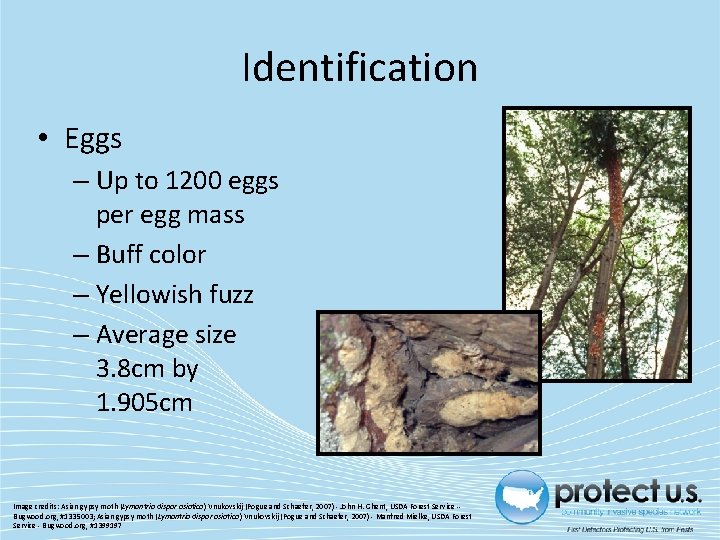
Identification • Eggs – Up to 1200 eggs per egg mass – Buff color – Yellowish fuzz – Average size 3. 8 cm by 1. 905 cm Image credits: Asian gypsy moth (Lymantria dispar asiatica) Vnukovskij (Pogue and Schaefer, 2007) - John H. Ghent, USDA Forest Service -- Bugwood. org, #1335003; Asian gypsy moth (Lymantria dispar asiatica) Vnukovskij (Pogue and Schaefer, 2007) - Manfred Mielke, USDA Forest Service - Bugwood. org, #1399197
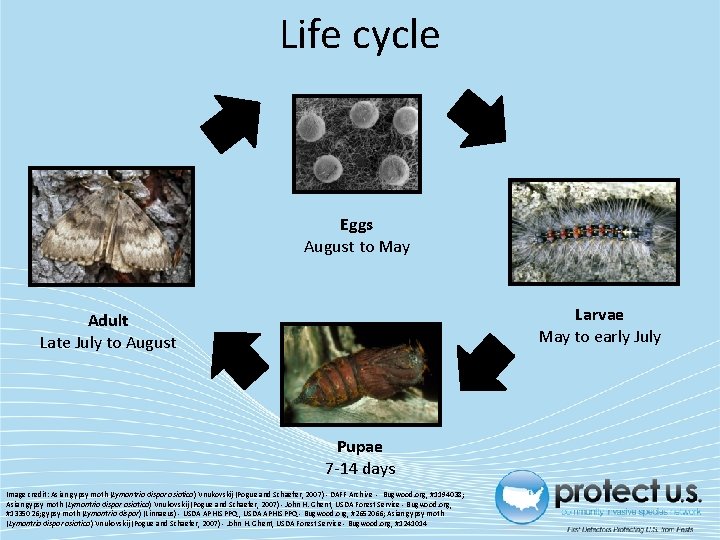
Life cycle Eggs August to May Larvae May to early July Adult Late July to August Pupae 7 -14 days Image credit: Asian gypsy moth (Lymantria dispar asiatica) Vnukovskij (Pogue and Schaefer, 2007) - DAFF Archive - Bugwood. org, #1194038; Asian gypsy moth (Lymantria dispar asiatica) Vnukovskij (Pogue and Schaefer, 2007) - John H. Ghent, USDA Forest Service - Bugwood. org, #1335026; gypsy moth (Lymantria dispar) (Linnaeus) - USDA APHIS PPQ , USDA APHIS PPQ - Bugwood. org, #2652066; Asian gypsy moth (Lymantria dispar asiatica) Vnukovskij (Pogue and Schaefer, 2007) - John H. Ghent, USDA Forest Service - Bugwood. org, #1241014
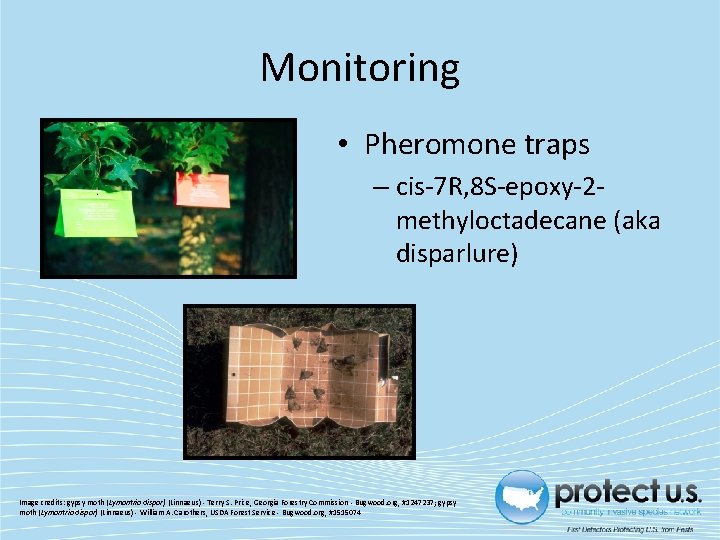
Monitoring • Pheromone traps – cis-7 R, 8 S-epoxy-2 methyloctadecane (aka disparlure) Image credits: gypsy moth (Lymantria dispar) (Linnaeus) - Terry S. Price, Georgia Forestry Commission - Bugwood. org, #1247237; gypsy moth (Lymantria dispar) (Linnaeus) - William A. Carothers, USDA Forest Service - Bugwood. org, #1515074
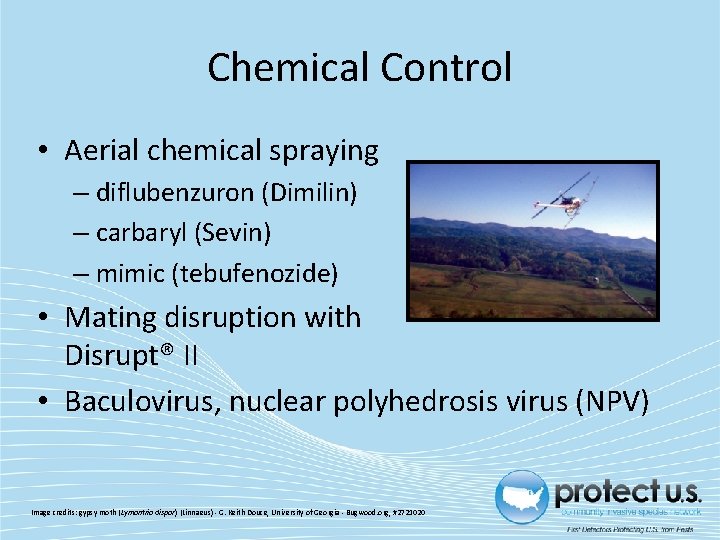
Chemical Control • Aerial chemical spraying – diflubenzuron (Dimilin) – carbaryl (Sevin) – mimic (tebufenozide) • Mating disruption with Disrupt® II • Baculovirus, nuclear polyhedrosis virus (NPV) Image credits: gypsy moth (Lymantria dispar) (Linnaeus) - G. Keith Douce, University of Georgia - Bugwood. org, #2721020
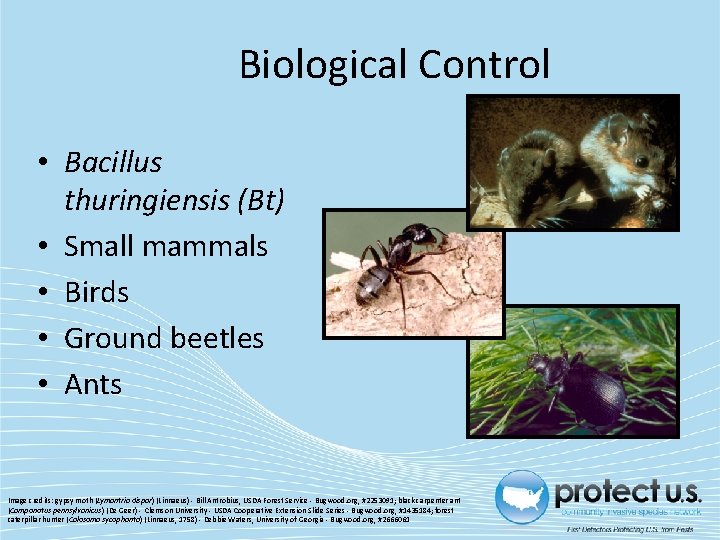
Biological Control • Bacillus thuringiensis (Bt) • Small mammals • Birds • Ground beetles • Ants Image credits: gypsy moth (Lymantria dispar) (Linnaeus) - Bill Antrobius, USDA Forest Service - Bugwood. org, #2253091; black carpenter ant (Camponotus pennsylvanicus) (De Geer) - Clemson University - USDA Cooperative Extension Slide Series - Bugwood. org, #1435184; forest caterpillar hunter (Calosoma sycophanta) (Linnaeus, 1758) - Debbie Waters, University of Georgia - Bugwood. org, #2666061
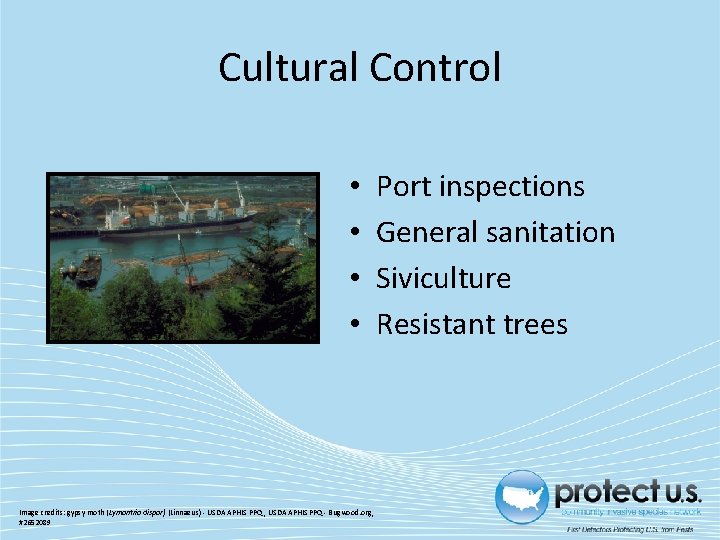
Cultural Control • • Image credits: gypsy moth (Lymantria dispar) (Linnaeus) - USDA APHIS PPQ , USDA APHIS PPQ - Bugwood. org, #2652089 Port inspections General sanitation Siviculture Resistant trees
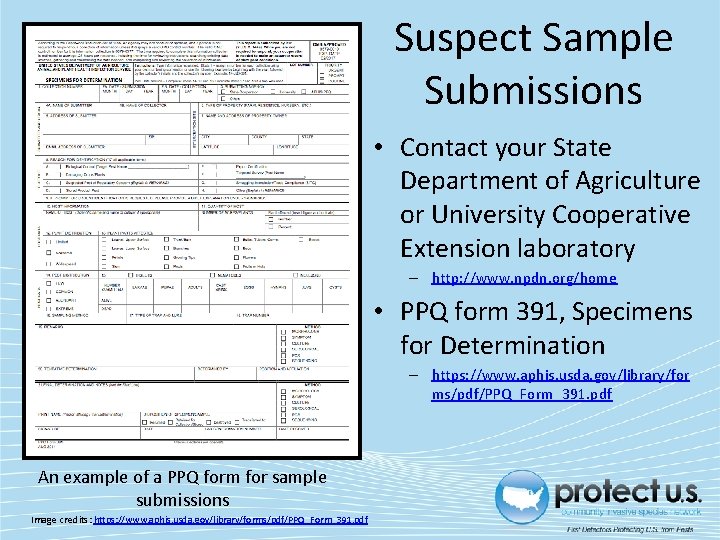
Suspect Sample Submissions • Contact your State Department of Agriculture or University Cooperative Extension laboratory – http: //www. npdn. org/home • PPQ form 391, Specimens for Determination – https: //www. aphis. usda. gov/library/for ms/pdf/PPQ_Form_391. pdf An example of a PPQ form for sample submissions Image credits: https: //www. aphis. usda. gov/library/forms/pdf/PPQ_Form_391. pdf
Communications • Contact your State Plant Health Director – https: //www. aphis. usda. gov/aphis/ ourfocus/planthealth/ppq-program -overview/ct_sphd • Contact your State Plant Regulatory Official – http: //nationalplantboard. org/me mbership/ Image credits: http: //www. usda. gov/wps/portal/usdahome; http: //nationalplantboard. org/
Author and Publication Dates • Morgan Pinkerton – Lab Technician, Department of Entomology and Nematology, University of Florida • Amanda Hodges, Ph. D. – Associate Extension Scientist, Department of Entomology and Nematology, University of Florida Publication date: October 2016
Reviewers • Catherine A. Marzolf – Assistant State Plant Health Director, USDA APHIS PPQ
Educational Disclaimer and Citation • This presentation can be used for educational purposes for NON-PROFIT workshops, trainings, etc. • Citation: Pinkerton, Morgan and Amanda Hodges. 2016. Asian Gypsy Moth. – Lymantria dispar asiatica. Accessed: (add the date) www. protectingusnow. org
Our Partners • United States Department of Agriculture, National Institute of Food and Agriculture (USDA NIFA) • United States Department of Agriculture, Animal and Plant Health Inspection Service, Plant Protection and Quarantine (USDA APHIS PPQ) • Cooperative Agriculture Pest Survey (CAPS) Program • National Plant Board (NPB) • States Department of Agriculture • Extension Disaster Education Network (EDEN) • Center for Invasive Species and Ecosystem Health (Bugwood) • National Plant Diagnostic Network (NPDN) • U. S. Department of Homeland Security (DHS) • U. S. Forest Service (USFS)
References 1. Anonymous. Asian Gypsy Moth Pest Alert. Cooperative Agricultural Pest Survey, NY. Accessed 5/26/2016. – http: //www. agriculture. ny. gov/caps/pdf/Asian%20 Gypsy%20 Moth%20 Pest%20 Alert. pdf 2. Anonymous. 2012. Exotic Pest Alert: Asian gypsy moth. NSW Government: Department of Plant Industries. Accessed 6/3/2016. – http: //www. dpi. nsw. gov. au/__data/assets/pdf_file/0013/443110/Exotic-Pest-Alert. Asian-gypsy-moth. pdf 3. ISSG. Invasive Species Management and Control: Gypsy moth (Lymantria dispar). Invasive Species Specialist Group (ISSG). Accessed 6/3/2016. – http: //issg. org/database/species/reference_files/lymdis_man. pdf 4. Liebhold, S. 2003. Gypsy Moth In North America. USDA Forest Service Northeastern Research Station. Accessed 6/3/2016. – http: //www. fs. fed. us/ne/morgantown/4557/gmoth/
References 5. Molet, T. 2012. CPHST Pest Datasheet for Lymantria dispar asiatica. USDAAPHIS-PPQ-CPHST. Accessed 5/26/2016. – caps. ceris. purdue. edu/dmm/1886 6. USDA. 1999. Plant Protection and Quarantine Factsheet: Asian Gypsy Moth. USDA, Animal and Plant Health Inspection Service. Accessed 5/26/2016. – http: //www. invasive. org/publications/aphis/fsgma. pdf 7. USDA. 2010. Gypsy Moth Program Manual. USDA, Animal and Plant Health Inspection Service. Accessed 6/3/2016. – https: //www. aphis. usda. gov/import_export/plants/manuals/domestic/downloads/ gypsy_moth. pdf 8. USDA. 2014. USDA-APHIS-PPQ Asian Gypsy Moth Survey and Response Guidelines. USDA. Accessed 6/3/2016. – https: //www. aphis. usda. gov/plant_health/plant_pest_info/gypsy_moth/downloads/AGMSurv ey. Response. Guidelines. pdf
References 9. USDA. 2016. Plant Protection and Quarantine Factsheet: Asian Gypsy Moth. USDA, Animal and Plant Health Inspection Service. Accessed 6/2/2016. – https: //www. aphis. usda. gov/publications/plant_health/content/printable_version /fs_phasiangm. pdf 10. Whittle, A, S. Lenhart, K. A. J. White. 2008. Optimal Control of Gypsy Moth Populations. Bulletin of Mathematical Biology 70: 398– 411. Accessed 6/3/2016. – http: //link. springer. com/article/10. 1007%2 Fs 11538 -007 -9260 - 7