
Asian American Masculinity in White Hegemonic Masculine Society
- Slides: 1
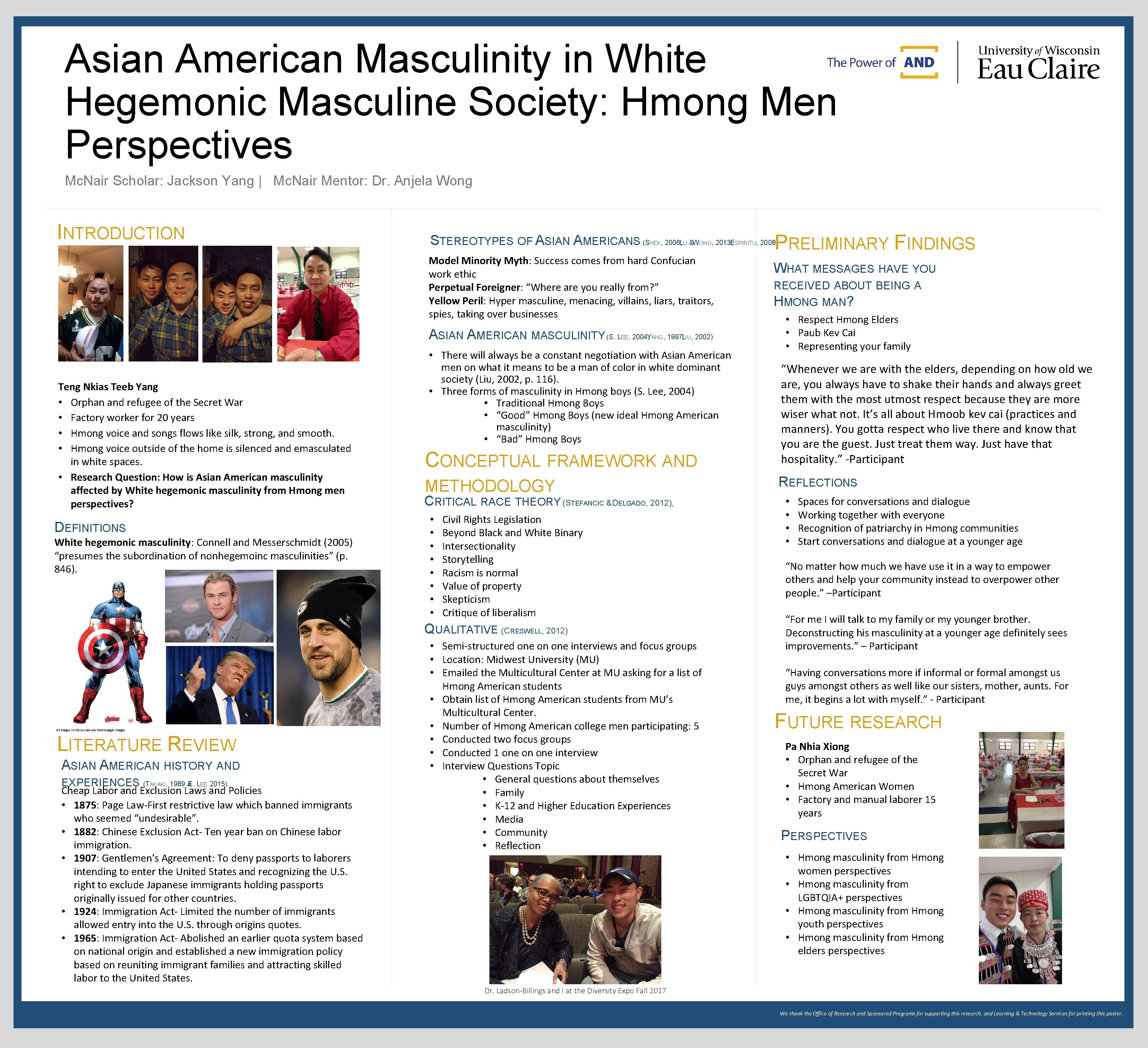
Asian American Masculinity in White Hegemonic Masculine Society: Hmong Men Perspectives Mc. Nair Scholar: Jackson Yang | Mc. Nair Mentor: Dr. Anjela Wong INTRODUCTION STEREOTYPES OF ASIAN AMERICANS (S HEK, Model Minority Myth: Success comes from hard Confucian work ethic Perpetual Foreigner: “Where are you really from? ” Yellow Peril: Hyper masculine, menacing, villains, liars, traitors, spies, taking over businesses ASIAN AMERICAN MASCULINITY (S. L Teng Nkias Teeb Yang • Orphan and refugee of the Secret War • Factory worker for 20 years • Hmong voice and songs flows like silk, strong, and smooth. • Hmong voice outside of the home is silenced and emasculated in white spaces. • Research Question: How is Asian American masculinity affected by White hegemonic masculinity from Hmong men perspectives? DEFINITIONS White hegemonic masculinity: Connell and Messerschmidt (2005) “presumes the subordination of nonhegemoinc masculinities” (p. 846). EE, 2004; YANG, 1997; LIU, 2002) • There will always be a constant negotiation with Asian American men on what it means to be a man of color in white dominant society (Liu, 2002, p. 116). • Three forms of masculinity in Hmong boys (S. Lee, 2004) • Traditional Hmong Boys • “Good” Hmong Boys (new ideal Hmong American masculinity) • “Bad” Hmong Boys LITERATURE REVIEW ASIAN AMERICAN HISTORY AND EXPERIENCES (TAKAKI, 1989 &E. LEE 2015) Cheap Labor and Exclusion Laws and Policies • 1875: Page Law-First restrictive law which banned immigrants who seemed “undesirable”. • 1882: Chinese Exclusion Act- Ten year ban on Chinese labor immigration. • 1907: Gentlemen's Agreement: To deny passports to laborers intending to enter the United States and recognizing the U. S. right to exclude Japanese immigrants holding passports originally issued for other countries. • 1924: Immigration Act- Limited the number of immigrants allowed entry into the U. S. through origins quotes. • 1965: Immigration Act- Abolished an earlier quota system based on national origin and established a new immigration policy based on reuniting immigrant families and attracting skilled labor to the United States. WHAT MESSAGES HAVE YOU RECEIVED ABOUT BEING A HMONG MAN? • Respect Hmong Elders • Paub Kev Cai • Representing your family CONCEPTUAL FRAMEWORK AND “Whenever we are with the elders, depending on how old we are, you always have to shake their hands and always greet them with the most utmost respect because they are more wiser what not. It’s all about Hmoob kev cai (practices and manners). You gotta respect who live there and know that you are the guest. Just treat them way. Just have that hospitality. ” -Participant METHODOLOGY REFLECTIONS CRITICAL RACE THEORY (STEFANCIC &DELGADO, 2012), • • Civil Rights Legislation Beyond Black and White Binary Intersectionality Storytelling Racism is normal Value of property Skepticism Critique of liberalism QUALITATIVE (CRESWELL, 2012) All images in this section are from Google Images PRELIMINARY FINDINGS 2006; LU &WONG, 2013; ESPIRITU, 2008) • Semi-structured one on one interviews and focus groups • Location: Midwest University (MU) • Emailed the Multicultural Center at MU asking for a list of Hmong American students • Obtain list of Hmong American students from MU’s Multicultural Center. • Number of Hmong American college men participating: 5 • Conducted two focus groups • Conducted 1 one on one interview • Interview Questions Topic • General questions about themselves • Family • K-12 and Higher Education Experiences • Media • Community • Reflection • • Spaces for conversations and dialogue Working together with everyone Recognition of patriarchy in Hmong communities Start conversations and dialogue at a younger age “No matter how much we have use it in a way to empower others and help your community instead to overpower other people. ” –Participant “For me I will talk to my family or my younger brother. Deconstructing his masculinity at a younger age definitely sees improvements. ” – Participant “Having conversations more if informal or formal amongst us guys amongst others as well like our sisters, mother, aunts. For me, it begins a lot with myself. ” - Participant FUTURE RESEARCH Pa Nhia Xiong • Orphan and refugee of the Secret War • Hmong American Women • Factory and manual laborer 15 years PERSPECTIVES • Hmong masculinity from Hmong women perspectives • Hmong masculinity from LGBTQIA+ perspectives • Hmong masculinity from Hmong youth perspectives • Hmong masculinity from Hmong elders perspectives Dr. Ladson-Billings and I at the Diversity Expo Fall 2017 We thank the Office of Research and Sponsored Programs for supporting this research, and Learning & Technology Services for printing this poster.