
Asia 2050 Realizing the Asian Century Jayant Menon


- Slides: 21
Asia 2050 Realizing the Asian Century Jayant Menon Office for Regional Economic Integration Asian Development Bank Presentation to the IMF-Treasury-RBA conference on: “Structural Change and the Rise of Asia” Canberra, 19 September 2012 The views expressed in this presentation are those of the author and do not necessarily reflect the views and policies of the Asian Development Bank, or its Board of Governors or the governments they represent.
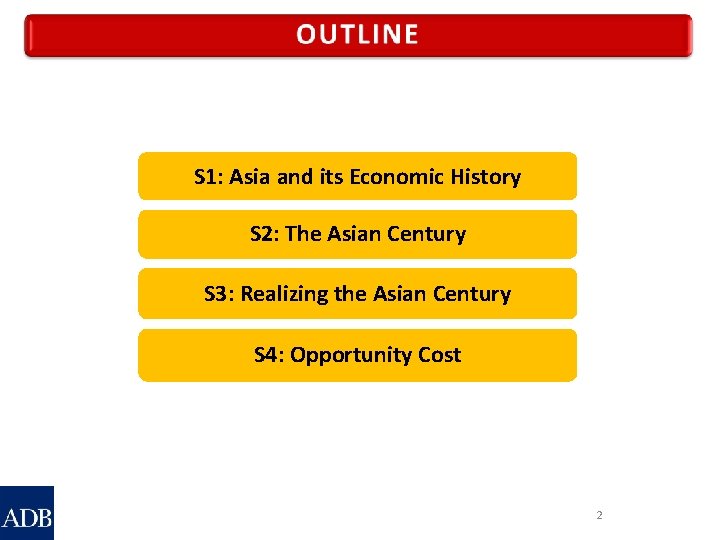
S 1: Asia and its Economic History S 2: The Asian Century S 3: Realizing the Asian Century S 4: Opportunity Cost 2
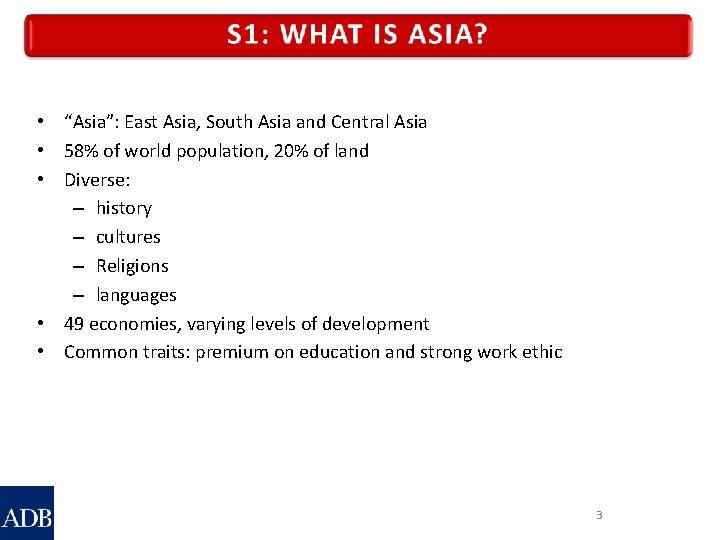
• “Asia”: East Asia, South Asia and Central Asia • 58% of world population, 20% of land • Diverse: – history – cultures – Religions – languages • 49 economies, varying levels of development • Common traits: premium on education and strong work ethic 3
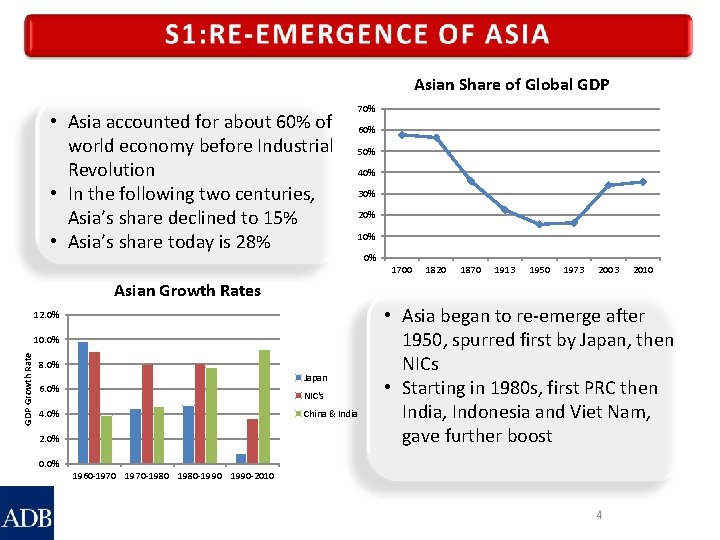
Asian Share of Global GDP • Asia accounted for about 60% of world economy before Industrial Revolution • In the following two centuries, Asia’s share declined to 15% • Asia’s share today is 28% 70% 60% 50% 40% 30% 20% 10% 0% 1700 1820 1870 1913 1950 1973 2003 2010 Asian Growth Rates 12. 0% GDP Growth Rate 10. 0% 8. 0% Japan 6. 0% NIC's China & India 4. 0% 2. 0% • Asia began to re-emerge after 1950, spurred first by Japan, then NICs • Starting in 1980 s, first PRC then India, Indonesia and Viet Nam, gave further boost 0. 0% 1960 -1970 -1980 -1990 -2010 4
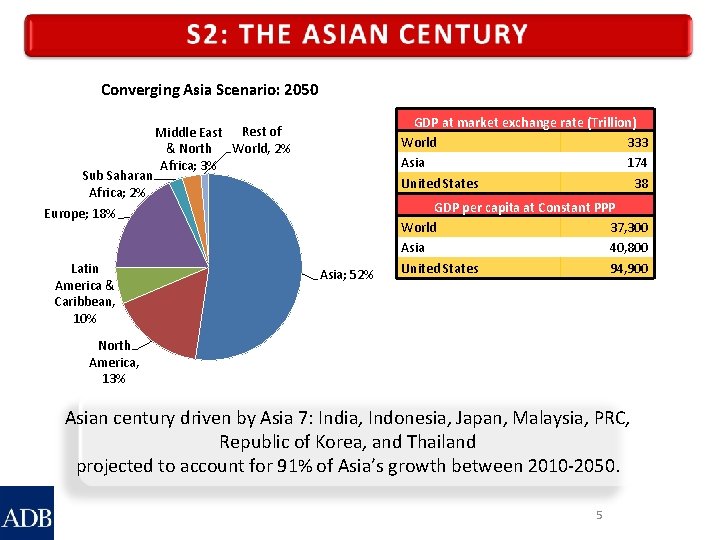
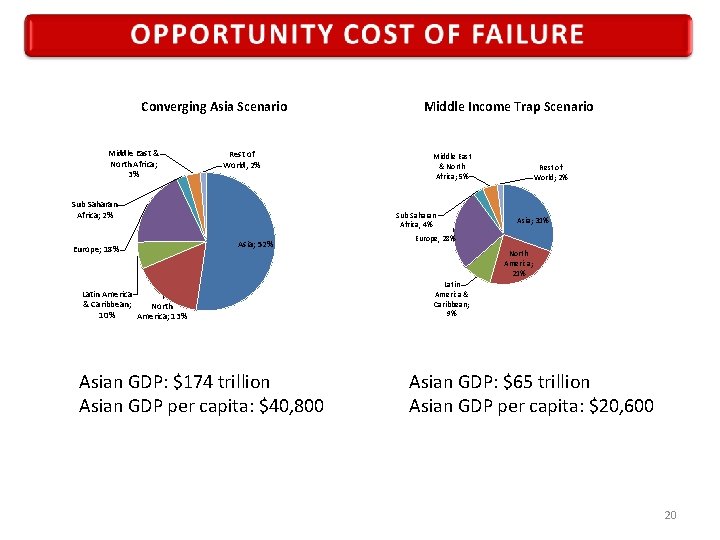
Converging Asia Scenario: 2050 Sub Saharan Africa; 2% GDP at market exchange rate (Trillion) World 333 Asia 174 United States 38 Middle East Rest of & North World, 2% Africa; 3% Europe; 18% Latin America & Caribbean, 10% Asia; 52% GDP per capita at Constant PPP World 37, 300 Asia 40, 800 United States 94, 900 North America, 13% Asian century driven by Asia 7: India, Indonesia, Japan, Malaysia, PRC, Republic of Korea, and Thailand projected to account for 91% of Asia’s growth between 2010 -2050. 5
Technological Changes Demographics & Labor Force Rapid technological change presents both challenges as well as opportunities Asia will still account for over half of the world’s force; aging trends differ greatly by sub-region Capital Deepening Asia’s share of global capital stock accumulation will grow from 45% to almost 75% by 2050 Emerging Asian Middle Class Affluent Asia will have majority of the world’s middle class Climate Change Communication Revolution Climate change presents major risks Powerful impact of communication revolution on society and governance: Are Tunisia and Egypt just starters? 6
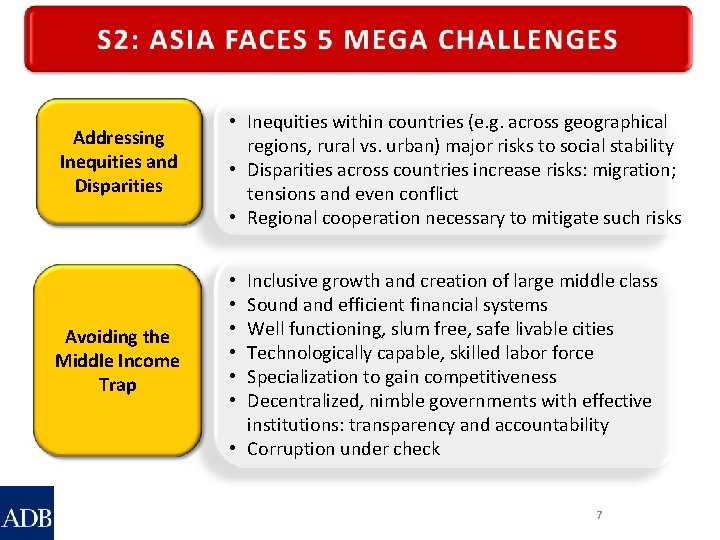
Addressing Inequities and Disparities Avoiding the Middle Income Trap • Inequities within countries (e. g. across geographical regions, rural vs. urban) major risks to social stability 0 increase risks: migration; • Disparities across countries tensions and even conflict • Regional cooperation necessary to mitigate such risks Inclusive growth and creation of large middle class Sound and efficient financial systems Well functioning, slum free, safe livable cities Technologically capable, skilled labor force Specialization to gain competitiveness Decentralized, nimble governments with effective institutions: transparency and accountability • Corruption under check • • • 7
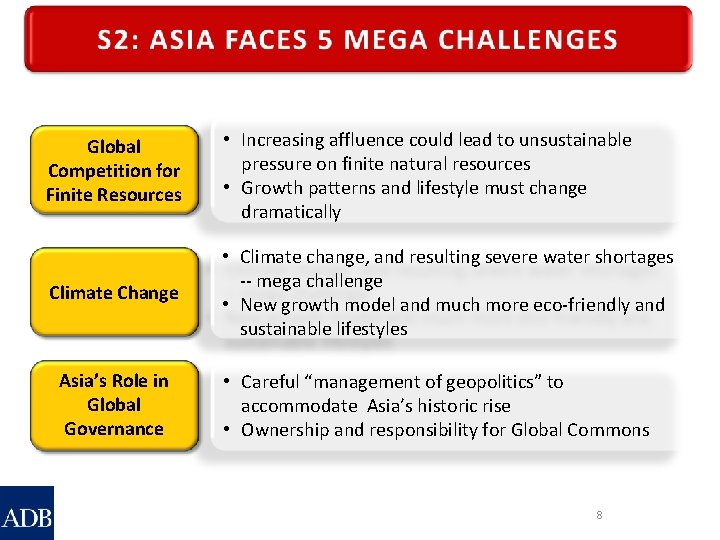
Global Competition for Finite Resources • Increasing affluence could lead to unsustainable pressure on finite natural resources • Growth patterns and lifestyle must change dramatically Climate Change • Climate change, and resulting severe water shortages -- mega challenge • New growth model and much more eco-friendly and sustainable lifestyles Asia’s Role in Global Governance • Careful “management of geopolitics” to accommodate Asia’s historic rise • Ownership and responsibility for Global Commons 8
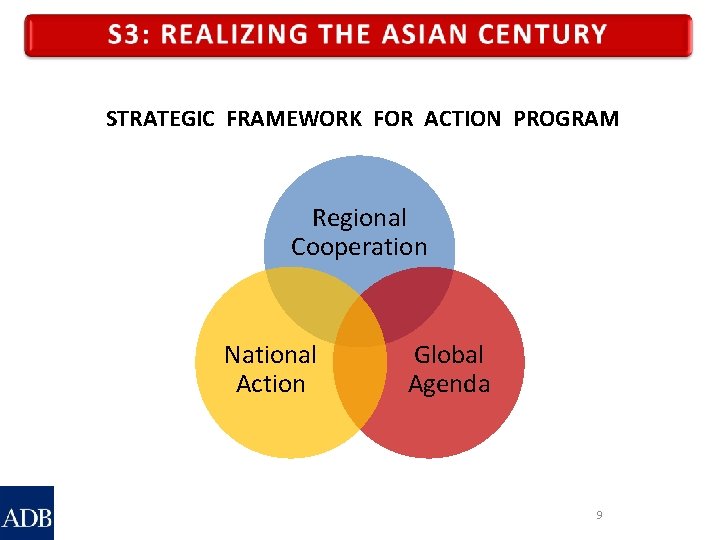
STRATEGIC FRAMEWORK FOR ACTION PROGRAM Regional Cooperation National Action Global Agenda 9
• First and foremost, almost all Asian countries must give much higher priority to inclusion and elimination of inequities as part of growth agenda. This will require increased focus on: • Quality education and learning, • Universal access to quality infrastructure services • Inclusive finance • The Korean experience, as well as of other NICs and Japan, demonstrate importance of these factors, especially education and infrastructure. • In addition are the critical roles that land reform and labor-intensive manufacturing, especially at an early stage of industrialization, can play in achieving growth with equity. 10
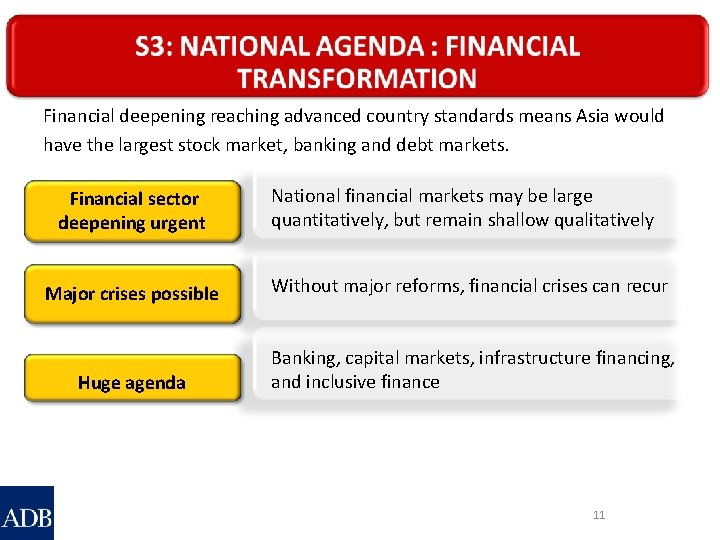
Financial deepening reaching advanced country standards means Asia would have the largest stock market, banking and debt markets. Financial sector deepening urgent National financial markets may be large quantitatively, but remain shallow qualitatively Major crises possible Without major reforms, financial crises can recur Huge agenda Banking, capital markets, infrastructure financing, and inclusive finance 11
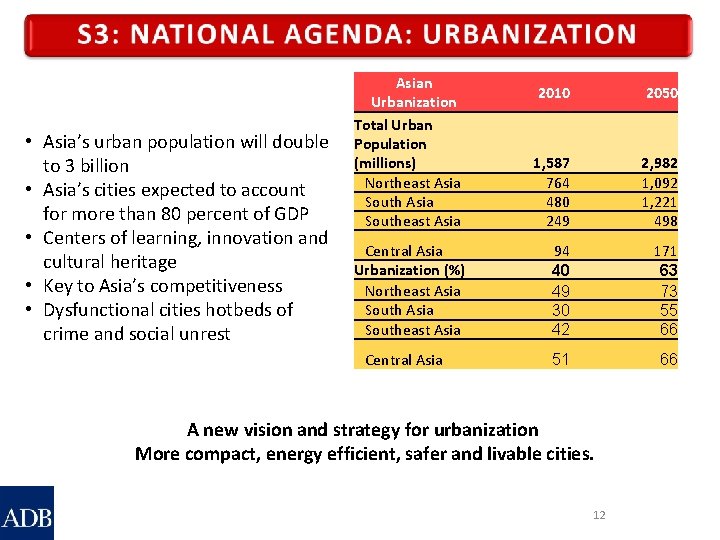
• Asia’s urban population will double to 3 billion • Asia’s cities expected to account for more than 80 percent of GDP • Centers of learning, innovation and cultural heritage • Key to Asia’s competitiveness • Dysfunctional cities hotbeds of crime and social unrest Asian Urbanization Total Urban Population (millions) Northeast Asia Southeast Asia 2010 2050 1, 587 764 480 249 2, 982 1, 092 1, 221 498 Central Asia Urbanization (%) Northeast Asia Southeast Asia 94 40 49 30 42 171 63 73 55 66 51 66 Central Asia A new vision and strategy for urbanization More compact, energy efficient, safer and livable cities. 12
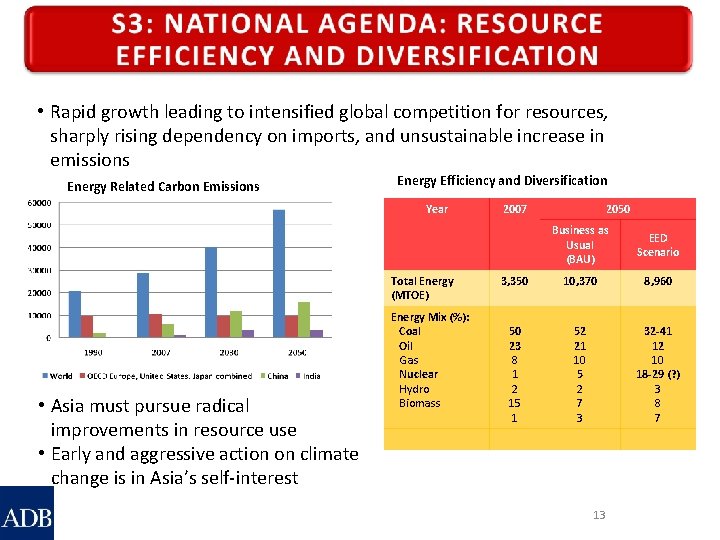
• Rapid growth leading to intensified global competition for resources, sharply rising dependency on imports, and unsustainable increase in emissions Energy Related Carbon Emissions Energy Efficiency and Diversification Year Total Energy (MTOE) • Asia must pursue radical improvements in resource use • Early and aggressive action on climate change is in Asia’s self-interest Energy Mix (%): Coal Oil Gas Nuclear Hydro Biomass 2007 2050 Business as Usual (BAU) EED Scenario 3, 350 10, 370 8, 960 50 23 8 1 2 15 1 52 21 10 5 2 7 3 32 -41 12 10 18 -29 (? ) 3 8 7 13
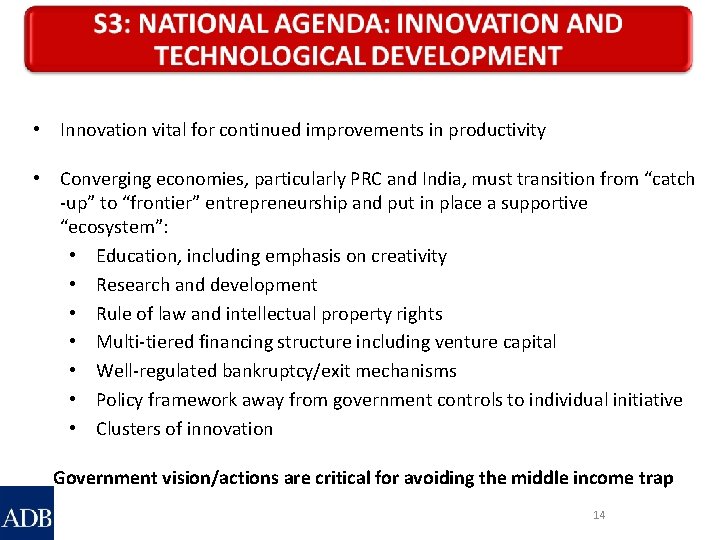
• Innovation vital for continued improvements in productivity • Converging economies, particularly PRC and India, must transition from “catch -up” to “frontier” entrepreneurship and put in place a supportive “ecosystem”: • Education, including emphasis on creativity • Research and development • Rule of law and intellectual property rights • Multi-tiered financing structure including venture capital • Well-regulated bankruptcy/exit mechanisms • Policy framework away from government controls to individual initiative • Clusters of innovation Government vision/actions are critical for avoiding the middle income trap 14
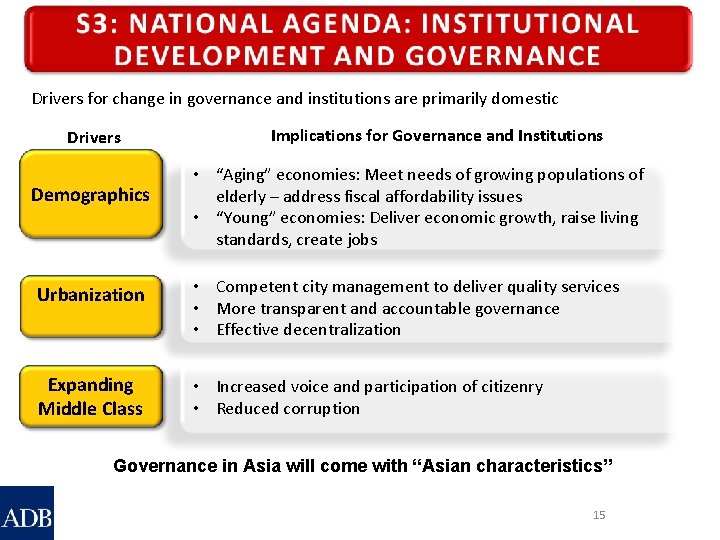
Drivers for change in governance and institutions are primarily domestic Drivers Demographics Implications for Governance and Institutions • “Aging” economies: Meet needs of growing populations of elderly – address fiscal affordability issues • “Young” economies: Deliver economic growth, raise living standards, create jobs Urbanization • Competent city management to deliver quality services • More transparent and accountable governance • Effective decentralization Expanding Middle Class • Increased voice and participation of citizenry • Reduced corruption Governance in Asia will come with “Asian characteristics” 15
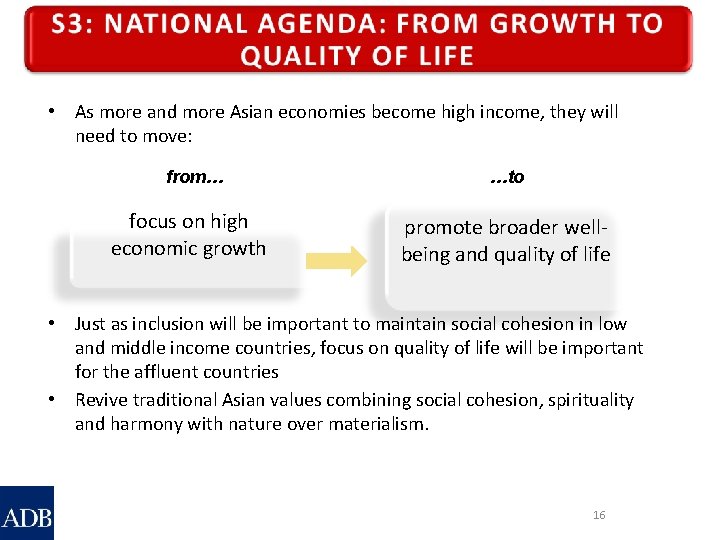
• As more and more Asian economies become high income, they will need to move: from… focus on high economic growth …to promote broader wellbeing and quality of life • Just as inclusion will be important to maintain social cohesion in low and middle income countries, focus on quality of life will be important for the affluent countries • Revive traditional Asian values combining social cohesion, spirituality and harmony with nature over materialism. 16
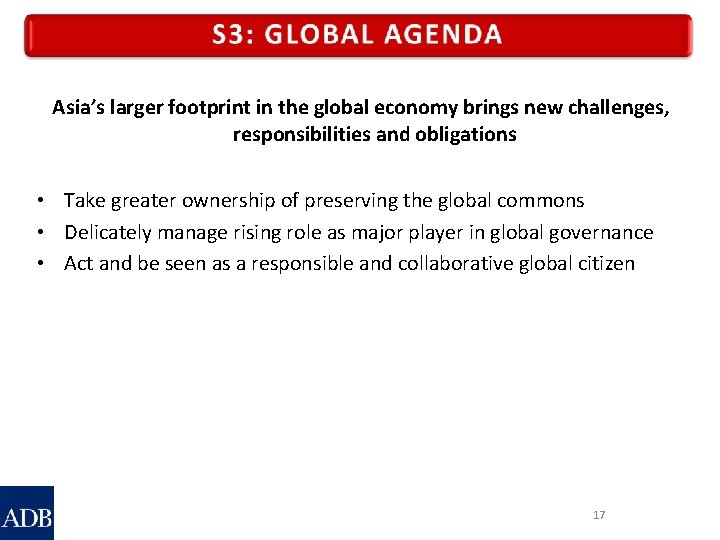
Asia’s larger footprint in the global economy brings new challenges, responsibilities and obligations • Take greater ownership of preserving the global commons • Delicately manage rising role as major player in global governance • Act and be seen as a responsible and collaborative global citizen 17
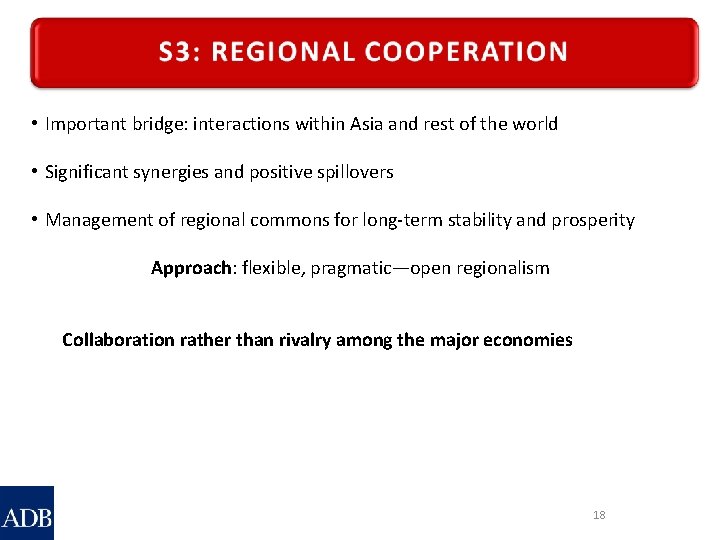
• Important bridge: interactions within Asia and rest of the world • Significant synergies and positive spillovers • Management of regional commons for long-term stability and prosperity Approach: flexible, pragmatic—open regionalism Collaboration rather than rivalry among the major economies 18
Four non-tangibles will determine Asia’s long-term destiny: • Leadership and ability to have a sharp focus on the long-term—vision, strategy, policies, and institution-building. • Effective regional cooperation and integration to: • sustain economic growth over the longer term; • reduce cross-country disparities • play a more influential role on the global scene • Modernize governance and retool institutions to meet rising social expectations. 19
Converging Asia Scenario Middle East & North Africa; 3% Rest of World, 2% Sub Saharan Africa; 2% Europe; 18% Middle Income Trap Scenario Middle East & North Africa; 5% Sub Saharan Africa, 4% Asia; 52% Latin America & Caribbean; North 10% America; 13% Asian GDP: $174 trillion Asian GDP per capita: $40, 800 Rest of World; 2% Asia; 31% Europe, 28% North America; 21% Latin America & Caribbean; 9% Asian GDP: $65 trillion Asian GDP per capita: $20, 600 20
Thank you! For inquiry or comments, please contact: Jayant Menon Lead Economist (Trade and Regional Cooperation) Office of Regional Economic Integration Telephone: (63 -2) 632 -6205 (63) 999 -6205 Email: jmenon@adb. org 21