
ASI Science Programme Barbara Negri Italian Space Agency

ASI Science Programme Barbara Negri - Italian Space Agency (ASI) Head of Exploration and Observation of the Universe Department 10 Years of PAMELA

Observing the Universe Activities of ASI’s Department for the Exploration and Observation of the Universe (EOS) are organized into three main lines: • Exploration of the Solar System (heliophysics, planetology of the Solar System and exo-planets) • Cosmology and Fundamental Physics (general relativity, theory of gravitation, universe on a large scale and early universe) • High Energy Astrophysics (astrophysics and astroparticles) Scientific activities are carried out in collaboration with the National Institute for Astrophysics (INAF), the National Institute for Nuclear Physics (INFN), the National Research Council (CNR) and a number of Universities. ASI has launched national scientific satellites and participated in major missions by ESA, NASA and other agencies (JAXA, Roscosmos, etc. ) 17 - 2

ASI involvement in Science Space Programme ASI involvement in space programs can be grouped as follows: - ESA Scientific Programme: • Cosmic Vision 2015 -2025 (mandatory Science Programme): • Not mandatory programme: Exo. Mars Programme: - Exo. Mars 2016 (launch: 16 March 2016) - Exo. Mars 2018 (launch: 2020) - Programs in cooperation with other agencies (NASA, JAXA, Roscosmos, etc. . . ) - Missions In Operation (Planetary, Astrophysics, Astroparticles) - National scientific satellites in orbit: AGILE and LARES 17 - 3

ESA Scientific Programme building blocks COSMIC VISION 2015 -2025 Large missions, L 2. Medium missions, M 3. Small missions, S 4. Opportunity missions, O (previously known as cooperative) 5. Missions in operation 6. Basic activities a. Preparation for the future b. Technology development 1. 4

ESA programs, I • Horizon 2000+ Cornerstone: GAIA, advanced astrometry, adopted: 2000; launched Dec. 2013. • Cosmic Vision: BEPI-COLOMBO, mission to Mercury, approved in 2007; target launch: Mar. 2017. • M 1: SOLAR ORBITER, adopted: Oct. 2011; launch Oct. 2018. • M 2: EUCLID, adopted: June 2012; target launch: Dec. 2020. • M 3: PLATO extrasolar planet search, selected Feb. 2014; target launch: 2024. • M 4: ARIEL, THOR, XIPE, selection June of 2017 • S 1: CHEOPS Exoplanets, adopted: Jun. 2014; launch Jul. 2018 • M 5: call issued April 29, 2016 5

ESA programs, II • L 1: JUICE, JUpiter Icy moon Explorer, selected: May 2012, target launch: 2022. • L 2: ATHENA, Advanced Telescope for High-Energy Astrophysics, selected: June 2014, target launch: 2028. • L 3: e. LISA Gravitational Wave Observatory 6

Some major steps in ASI Science Programme 2007 Agile 2005 MRO 2007 DAWN 2004 ROSETTA 2004 SWIFT 1997 Cassini. Huygens 2003 Mars Express 1996 Beppo-SAX 1992 Lageos 2 2006 PAMELA

Some major steps in ASI Science Programme 2013 GAIA 2011 Juno AMS 2008 Fermi 2009 Herschel Planck 2015 Lisa -PF 2012 Lares on Vega NUStar
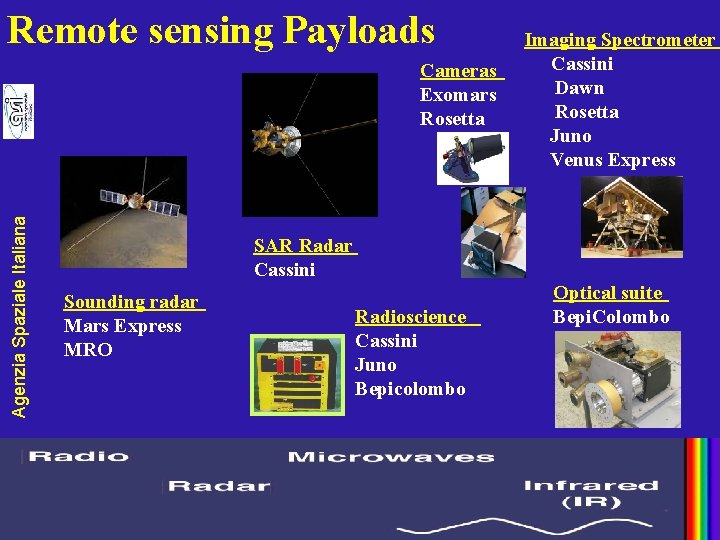
Remote sensing Payloads Agenzia Spaziale Italiana Cameras Exomars Rosetta Imaging Spectrometer Cassini Dawn Rosetta Juno Venus Express SAR Radar Cassini Sounding radar Mars Express MRO Radioscience Cassini Juno Bepicolombo Padua January 2010 Optical suite Bepi. Colombo
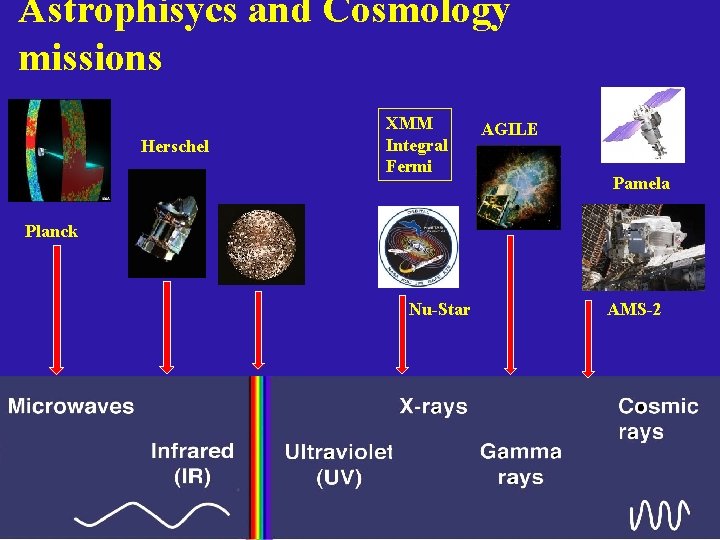
Astrophisycs and Cosmology missions Herschel XMM Integral Fermi AGILE Pamela Planck Nu-Star AMS-2

In situ instruments Philae Agenzia Spaziale Italiana H-ASI SD 2 MA-MISS DREAMS
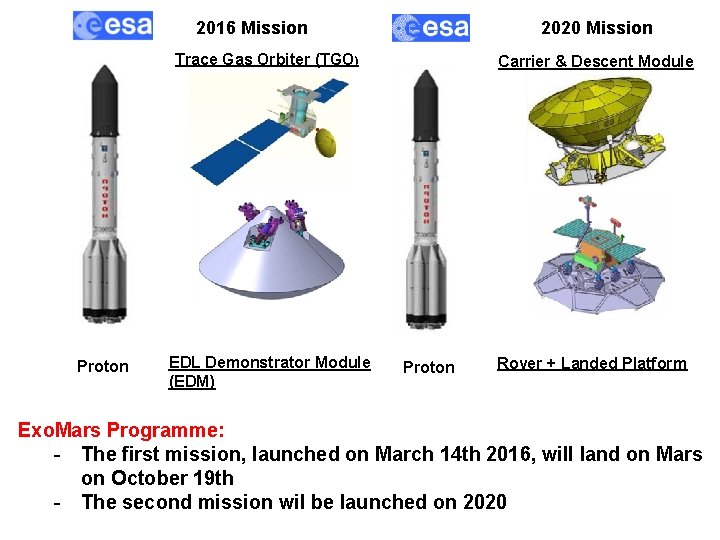
2020 Mission 2016 Mission Trace Gas Orbiter (TGO) Proton EDL Demonstrator Module (EDM) Carrier & Descent Module Proton Rover + Landed Platform Exo. Mars Programme: - The first mission, launched on March 14 th 2016, will land on Mars on October 19 th - The second mission wil be launched on 2020

PAMELA
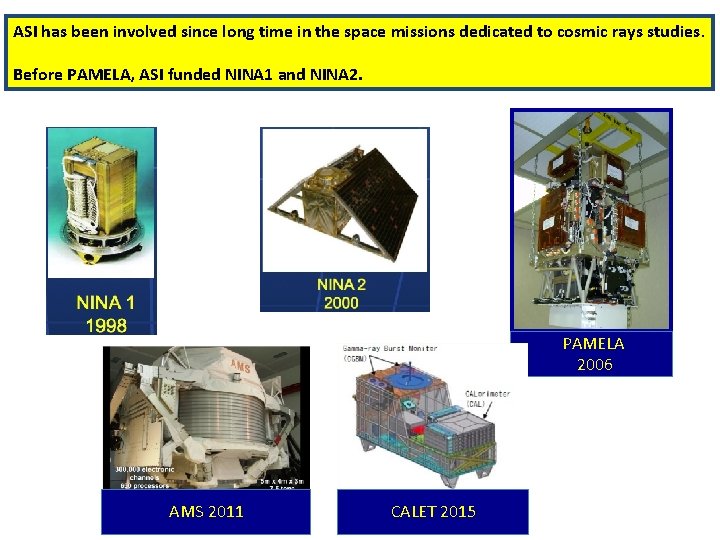
ASI has been involved since long time in the space missions dedicated to cosmic rays studies. Before PAMELA, ASI funded NINA 1 and NINA 2. PAMELA 2006 AMS 2011 CALET 2015
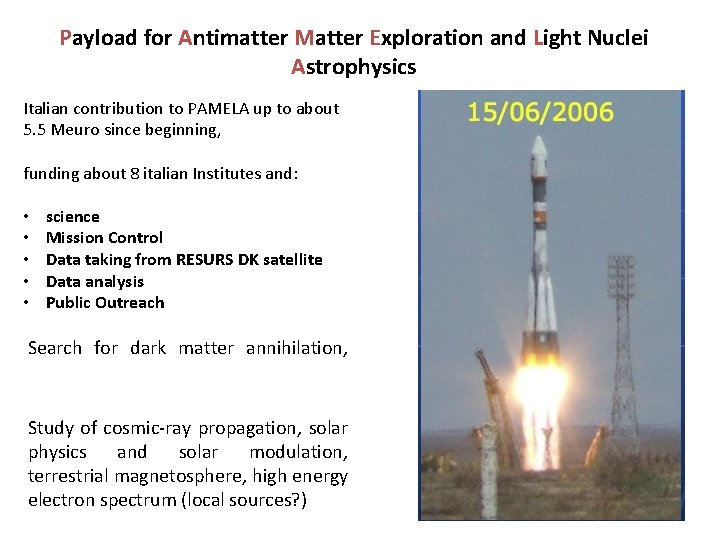
Payload for Antimatter Matter Exploration and Light Nuclei Astrophysics Italian contribution to PAMELA up to about 5. 5 Meuro since beginning, funding about 8 italian Institutes and: • • • science Mission Control Data taking from RESURS DK satellite Data analysis Public Outreach Search for dark matter annihilation, Study of cosmic-ray propagation, solar physics and solar modulation, terrestrial magnetosphere, high energy electron spectrum (local sources? )
- Slides: 15