
ASHRAE Standard 90 119992001 ASHRAEs Newest Commercial Building
ASHRAE Standard 90. 11999/2001 ASHRAE’s Newest Commercial Building Standard
Standard 90. 1 – 1999/2001 Background Features Standard 90. 1 Review
Standard 90. 1 -1999/2001 Developed with participation from many building and construction organizations including: n n n American Institute of Architects (AIA) Building Owners and Managers Association (BOMA) North American Insulation Manufacturer’s Association (NAIMA) Air-Conditioning and Refrigeration Institute (ARI) Gas Appliance Manufacturers Association (GAMA)
Standard 90. 1 -1999 The US DOE has found ASHRAE Standard 90. 1 -1999 does save energy and states are currently required to adopt a code that meets or exceed the provisions of Standard 90. 1 -1999 as their commercial building code by July 15, 2004.
Standard 90. 1 – Present Standard 90. 1 -1999 is the reference standard for the 2001 IECC Standard 90. 1 -2001 will be the reference standard for NFPA 5000 and the 2003 IECC Standard 90. 1 -1999 and 2001’s Energy Cost Budget method is the basis for LEED certification
Mandatory, Enforceable Language Standard 90. 1 -1999 is a code-intended standard. As such, it is written in unambiguous language intended to allow a code official to say “that complies” or “that doesn’t” There are no “shoulds”, “coulds” or “shall consider” phrases – just lots of “shalls”
Based on Consistent Economic Criteria While previous ASHRAE standards were based on professional judgment combined with analysis of energy and cost impacts, Standard 90. 1 -1999 is the first to attempt to use consistent economic criteria as the basis for requirements.
True Prescriptive Paths Anyone who has ever tried to use the ACP tables in Standard 90. 1 -1989 knows that there is not a true prescriptive path for envelope in the older ASHRAE standards. One of the “code friendly” features of codes is that they do have a simple prescriptive path for all buildings.
Renovations and Retrofits Previous ASHRAE Standards were more or less silent on the concept. All standards were designed for “new construction” ASHRAE worked with BOMA on Chapter 4 to develop detailed rules for how Standard 90. 1 -1999 should be applied to renovations and retrofits.
Minimally Conditioned Buildings that are minimally conditioned or minimally used should not need as stringent energy requirements as buildings that are fully conditioned or fully used. Standard 90. 1 -1999 took a first step in dealing with minimally conditioned buildings in its’ semi-heated space envelope requirements.

Climate Zones Use of ASHRAE Standard 90. 1 -1999 requires the specification of only 2 parameters HDD 65 (6474 -Moline) and CDD 50 (3207 -Moline) for envelope requirements and only 4 more parameters for mechanical system requirements. (3 design temps plus one more) All these parameters are listed for numerous locations in Appendix D. (Table B-17 Quad Cities)
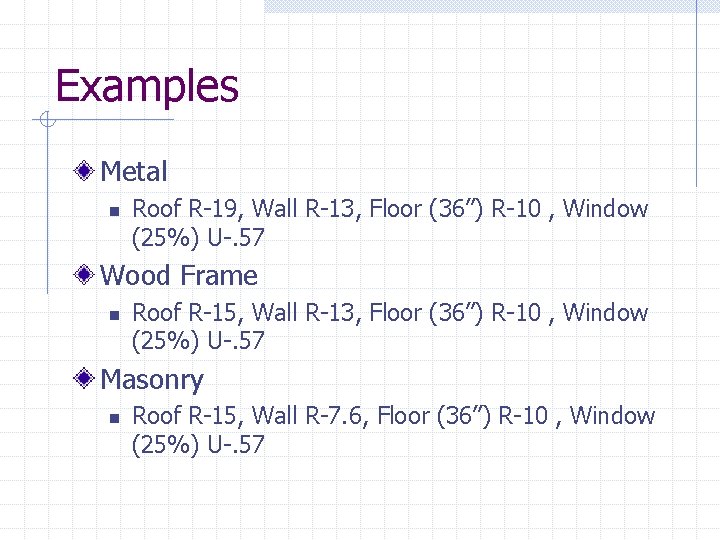
Examples Metal n Roof R-19, Wall R-13, Floor (36”) R-10 , Window (25%) U-. 57 Wood Frame n Roof R-15, Wall R-13, Floor (36”) R-10 , Window (25%) U-. 57 Masonry n Roof R-15, Wall R-7. 6, Floor (36”) R-10 , Window (25%) U-. 57
Now A Look at Standard 90. 1 Organization of Standard Purpose and Scope Administration and Enforcement Envelope Mechanical Lighting and Power Trade-offs
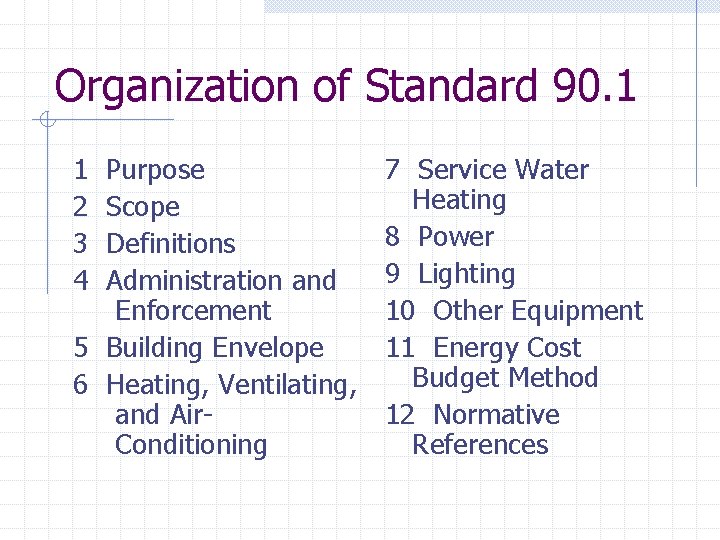
Organization of Standard 90. 1 1 2 3 4 Purpose Scope Definitions Administration and Enforcement 5 Building Envelope 6 Heating, Ventilating, and Air. Conditioning 7 Service Water Heating 8 Power 9 Lighting 10 Other Equipment 11 Energy Cost Budget Method 12 Normative References
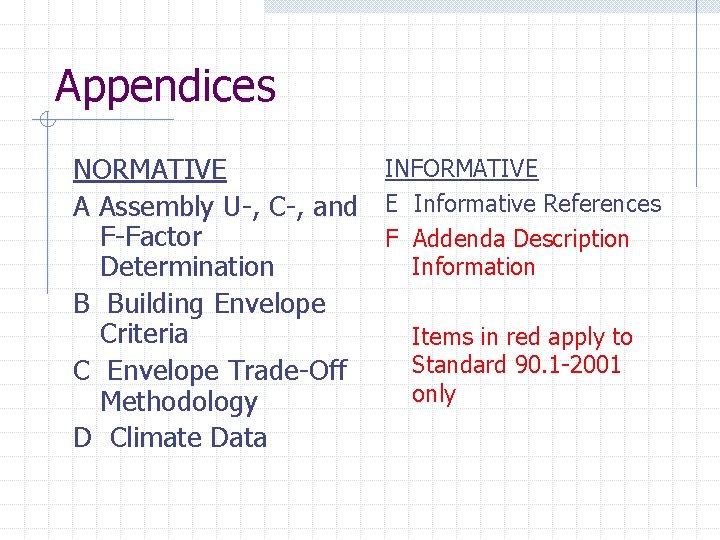
Appendices INFORMATIVE NORMATIVE A Assembly U-, C-, and E Informative References F-Factor F Addenda Description Information Determination B Building Envelope Criteria Items in red apply to Standard 90. 1 -2001 C Envelope Trade-Off only Methodology D Climate Data
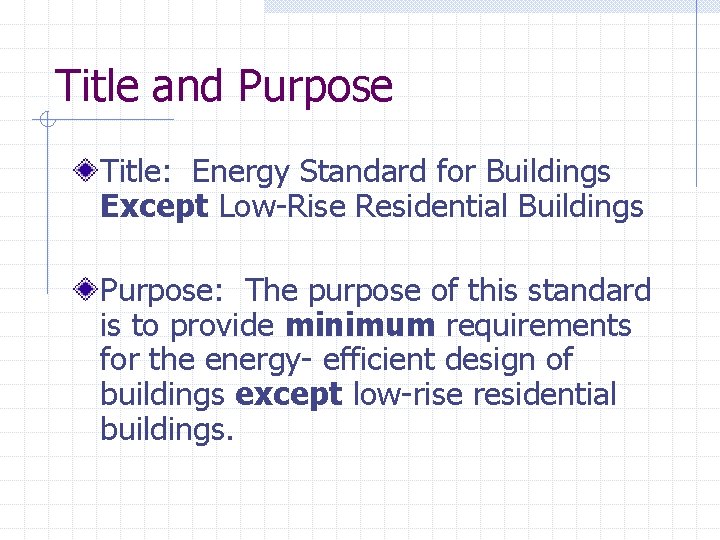
Title and Purpose Title: Energy Standard for Buildings Except Low-Rise Residential Buildings Purpose: The purpose of this standard is to provide minimum requirements for the energy- efficient design of buildings except low-rise residential buildings.
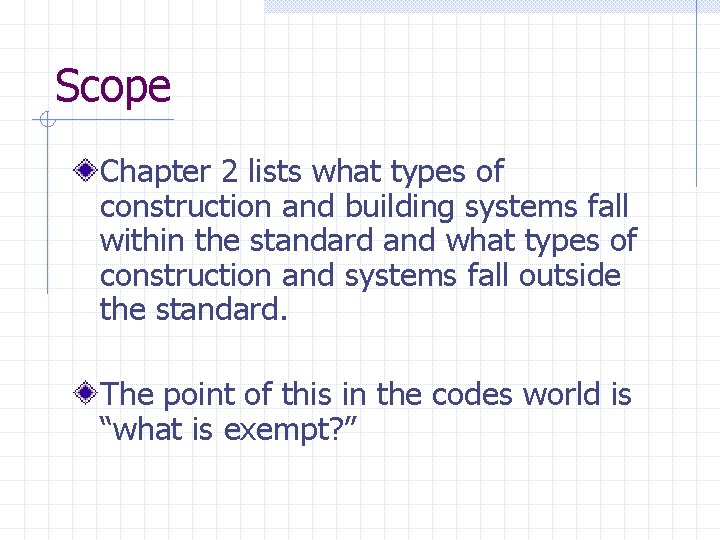
Scope Chapter 2 lists what types of construction and building systems fall within the standard and what types of construction and systems fall outside the standard. The point of this in the codes world is “what is exempt? ”
Scope Exemptions Single-family houses, multi-family structures of three stories or fewer above grade, manufactured houses (mobile homes), and manufactured houses (modular) (Low-Rise Residential) Buildings that do not use either electricity or fossil fuel
More Scope Exemptions Equipment and portions of building systems that use energy primarily to provide for industrial, manufacturing, or commercial purposes. Envelope may be exempt if building has small enough heating and cooling systems
Administration and Enforcement Requirements I Chapter 4 covers compliance for new buildings, existing buildings, additions to existing buildings, alterations to existing buildings, and changes in space conditioning in existing buildings ALL of these events are meant to trigger the requirements of Standard 90. 1
Administration and Enforcement Requirements II To ensure that Standard 90. 1 is not applied too zealously to situations where it is not appropriate, numerous cases are examined in this chapter and exceptions are granted where appropriate Example – changing the refrigerant in existing equipment does not qualify as an alteration
Overview – Std 90. 1 Envelope Requirements Chapter 5 (Building Envelope) regulates the construction and performance of the exterior building envelope Chapter 5 explicitly does not address moisture control or provide guidance on moisture migration that may lead to condensation, mold, mildew, or insulation or equipment deterioration
Envelope Appendices Chapter 5 (Building Envelope) is accompanied by 4 normative appendices n n A – default assemblies and U-, C-, and Ffactor calculations B – the 26 climate zone prescriptive tables C – the envelope trade-off mechanism D – the climate data
Envelope Key Concepts Conditioned versus semiheated versus unconditioned space Residential versus Nonresidential versus Semi-Heated space-conditioning category Assembly Climate
Overview – Std 90. 1 Mechanical Requirements Chapter 6 (Heating, Ventilating, and Air Conditioning) regulates all mechanical equipment serving building HVAC needs Chapter 7 (Service Water Heating) regulates all SWH systems and equipment Chapter 10 (Other Equipment) regulates electric motors (NEMA)
Chapter 6 (Heating, Ventilating and Air Conditioning) Offers a simplified approach for small (less than 25, 000 ft 2), short (less than two stories) buildings with single zone HVAC This section is inspiring the development of “small” or “simple” building sections in each chapter of Standard 90. 1
Chapter 6 (HVAC for Not-So. Simple Buildings) I Requires load calculations Regulates equipment efficiency Requires controls n Zone thermostatic, off-hour, ventilation system, heat pump auxiliary heat, humidifier preheat, humidification and dehumidification, freeze protection and snow/ice melting systems, ventilation controls for high-occupancy areas
Chapter 6 (HVAC for Not-So. Simple Buildings) II Regulates HVAC system construction and insulation n n Duct and plenum insulation, piping insulation Duct and plenum leakage Requires that construction documents and manuals be provided to the owner Requires system balancing in all buildings and commissioning in large buildings
Chapter 6 (HVAC for Not-So. Simple Buildings) III Requires economizers (with lots of exceptions) Regulates simultaneous heating and cooling Regulates air system design and control Regulates hydronic system design and control Regulates heat rejection equipment Requires energy recovery (with exceptions) Regulates exhaust hoods Regulates radiant heating systems
Chapter 7 (Service Water Heating) Requires load calculations Regulates equipment efficiency Requires SWH piping insulation Requires SWH temperature controls Requires pool heater shut-off controls, pool covers, and pool heater/pump shut -off controls Requires heat traps
Overview – Std 90. 1 Lighting and Power Requirements Chapter 8 (Power) regulates voltage drop in feeders and branch circuits and requires that construction documents and manuals be provided to the owner (NEC) Chapter 9 (Lighting) regulates the wattage of lighting installed inside or outside a building, how that lighting should be installed, and how it should be controlled.
Chapter 8 (Power) Regulates voltage drop in feeders and branch circuits (5%) Requires construction drawing and manuals be supplied to owner Chapter was carefully constructed to regulate only aspects of building power systems that are NOT covered in electrical codes

Chapter 9 (Lighting) I Requires interior lighting controls Requires tandem wiring of ballasts Regulates exit signs Defines installed interior lighting power Defines luminaire wattage Regulates exterior lighting efficacy
Chapter 9 (Lighting) II Provides two options for regulating interior lighting power n n Building Area Method Space-By-Space Method Provides additional interior lighting power allowances for specific situations
Standard 90. 1 Tradeoffs – ENVSTD and ECB These are the only two formal tradeoffs within Standard 90. 1 n n ENVelope STan. Dard for tradeoffs among envelope components Energy Cost Budget for whole building tradeoffs Less formally, lighting power may be traded off within spaces in a building
Resources Our state ASHRAE chapters ASHRAE’s website – www. ashrae. org n Interpretations, addenda, mailing lists, videos DOE’s code website – www. energycodes. gov n Presentations, status of states, code comparisons, simplified compliance materials (maps, guides, software), videos
Interpretations for Standard 90. 1 Users Manual n Provides much of the background Formal Interpretations n Formal written interpretations take time Informal Interpretations n Quick, informal answers to questions ASHRAE Manager of Standards (404)636 -8400
Questions? Your ASHRAE chapter representatives have been specifically trained by ASHRAE to answer questions related to Standard 90. 1
- Slides: 38