
ASHRAE Standard 62 What Now IAQ Design Overview
- Slides: 26
ASHRAE Standard 62 – What Now? IAQ Design Overview Alec Carnes PE, LEED AP © Heapy Engineering LLC All Rights Reserved
Program / Learning Objectives § Importance of Building IAQ § ASHRAE 62. 1 -2007 Overview § Ventilation Effectiveness § Variations in Occupancy or Airflow § Relationship to USGBC LEED-NC v 2. 2
Why is IAQ Important? § Not Just Code Compliance § Medical Liability Concerns § Employee Health Concerns § Cost of Poor IAQ
Indoor Air Quality Medical Liability Concerns: § ADA requirements of bio-chemically handicapped – describes people with multiple chemical sensitivity (MCS) § Poor IAQ (a. k. a Sick Building Syndrome – SBS) is the leading cause of MCS according to the World Health Organization
Indoor Air Quality Medical Liability Concerns: § EPA stated that the health risks associated with breathing indoor air are 2 to 5 times the risk of breathing outdoor air. § EPA has poor IAQ cited as the 4 th highest cancer risk (3500 to 6000 annual deaths)
Indoor Air Quality Medical Liability Concerns: § World Health Organization estimates that 30% of all buildings suffer from Sick Building Syndrome. § Improved IAQ in buildings aids in protecting Owners, Developers, and Professional Consultants.
Indoor Air Quality IAQ and the Building Code: § IMC/OMC Chapter 4 – Ventilation § Based on ASHRAE 62 -1999 § Prescriptive Requirements for Ventilation § Permits “Engineered Systems” based on ASHRAE 62. 1 -2004 or most recent version
Indoor Air Quality ASHRAE 62. 1 -2007 Basics: § Ventilation for Acceptable Indoor Air Quality Standard § Industry Standard of Care for IAQ Systems Design and Evaluation § Prerequisite for the LEED – NC v 2. 2 Building Rating System (EQp 1: Minimum IAQ Performance)
Indoor Air Quality ASHRAE 62. 1 -2007 Basics: § Options for Compliance § Outdoor Air Quality § Standard requires a survey of the project site to determine quality of OA § Limit values for various air contaminants § Ohio EPA Website
Indoor Air Quality ASHRAE 62. 1 -2007 Basics: § Options for Compliance § Natural Ventilation § Based on Space Floor Area – Both Interior and Perimeter Spaces § Limitation on Distance of Interior Spaces from Perimeter Openings § Acceptable for Compliance to USGBC LEED-NC v 2. 2 EAp 1 – Minimum IAQ Performance
Indoor Air Quality ASHRAE 62. 1 -2007 Basics: § Options for Compliance § Ventilation Rate Procedure § Forced Airflow to Building Spaces § Must provide the required airflow through-out the occupied range of operation § Must be appropriately dehumidified to limit moisture problems
Indoor Air Quality ASHRAE 62. 1 -2007 Basics: § Ventilation Rate Procedure § Required ventilation is calculated based on occupancy and floor area § This differs from the previous Standard (OBC) and can result in reduced airflow requirements
Indoor Air Quality ASHRAE 62. 1 -2007 Basics: § Ventilation Rate Procedure § Re-circulation (Return) Air now classified by space type § Class 1 thru Class 4 § Limits what classification of air that can be returned § This is more stringent than the previous version of the Standard (OBC)
Indoor Air Quality ASHRAE 62. 1 -2007 Basics: § Ventilation Rate Procedure § Multi-Zone Systems – Typical Application § Each Space OA Requirement is calculated as a ratio to the heat-load required airflow § The highest ratio governs the entire system § This is similar to the previous Standard (OBC), but updated to reflect the new Occupancy and Area requirements
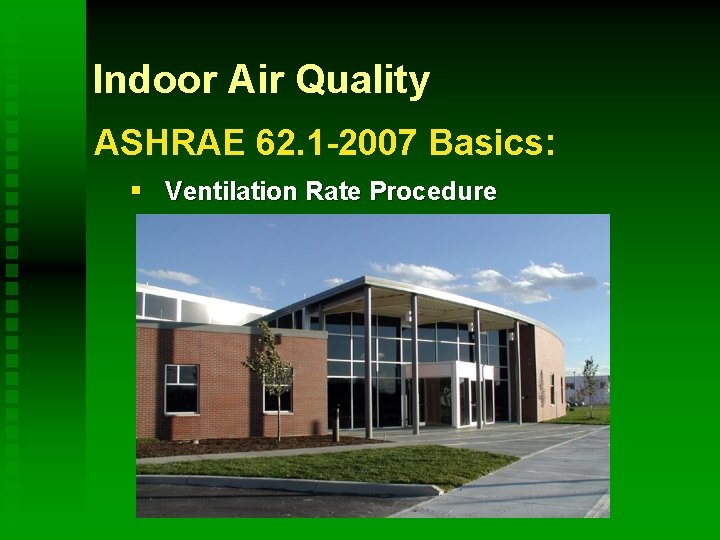
Indoor Air Quality ASHRAE 62. 1 -2007 Basics: § Ventilation Rate Procedure
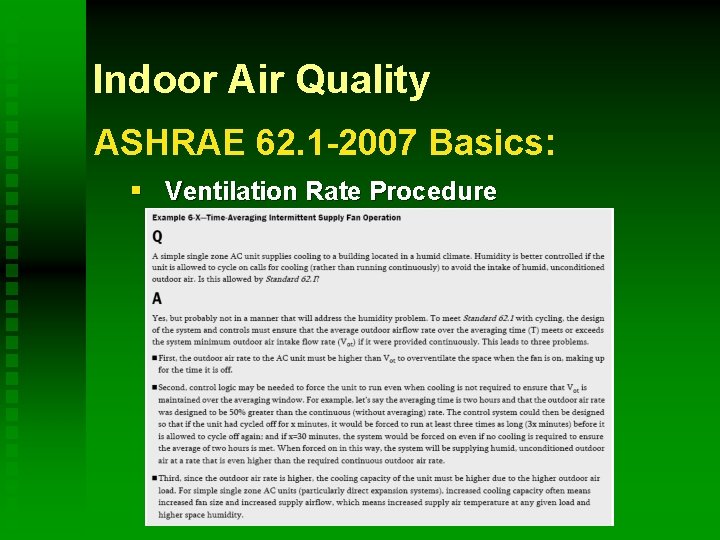
Indoor Air Quality ASHRAE 62. 1 -2007 Basics: § Ventilation Rate Procedure
Indoor Air Quality ASHRAE 62. 1 -2007 Basics: § Ventilation Rate Procedure § Diversity and Variable Occupancy § Diversity in Overall Building Occupancy is applied at the System Level § Short Term Occupancy of each Space may be evaluated during the Occupied time period § Classroom, Theaters, Lobbies § Limited in the previous version
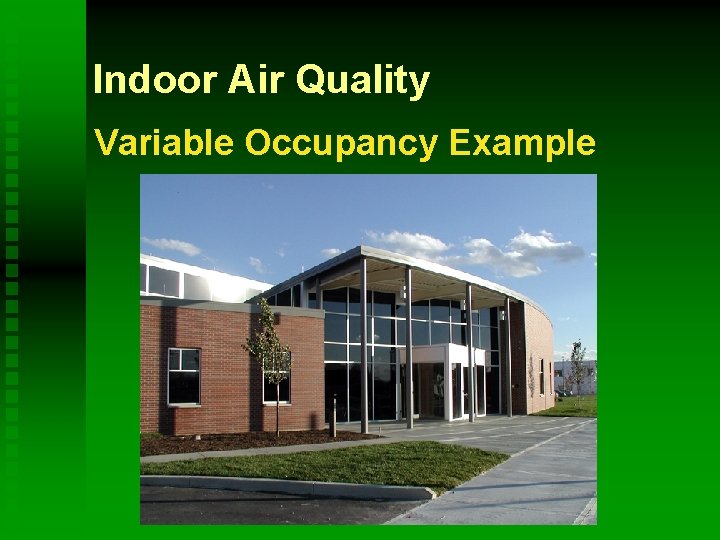
Indoor Air Quality Variable Occupancy Example
Indoor Air Quality Interrupted Airflow Example
Indoor Air Quality ASHRAE 62. 1 -2007 Basics: § IAQ Procedure for Ventilation § Performance Based Calculation and Modeling § Contaminant Sources § Contaminant Concentrations § Target Contaminant Levels § Perceived IAQ § Air cleaning systems
Indoor Air Quality IAQ Procedure System Options: § Mechanical Air Cleaning § Treat Airborne Contaminants § Particulate and Vapor (Fume) § Permits re-circulation of air and reduction of outdoor air requirements § Effective when ambient outdoor air quality is sub-standard – Urban Environments
Indoor Air Quality ASHRAE 62. 1 -2007 Basics: § IAQ Procedure for Ventilation § Acceptable for Alternative Compliance to IMC/OMC – Chapter 4 § NOT Acceptable for Compliance to USGBC LEED-NC v 2. 2 EQp 1 – Minimum IAQ Performance
Indoor Air Quality ASHRAE 62. 1 -2007 Basics: § Construction & Start-up Requirements § Requires protection of occupied spaces adjacent to construction zones § Required Air Balance of Systems § Testing of Condensate Drain Pans § Similarly – ASHRAE 90. 1 requires commissioning of M/E Systems in buildings exceeding 50, 000 SF
Indoor Air Quality Summary: § ASHRAE 62. 1 -2007 is significantly more complex than current IMC/OMC requirements for ventilation § Generally, ASHRAE 62 will result in reduced outdoor airflow requirements and, therefore, reduced energy consumption § USGBC LEED-NC v 2. 2 has differing requirements than IMC/OMC for minimum ventilation requirements
ASHRAE Standard 62 – What Now? IAQ Design Overview Questions?
ASHRAE Standard 62 – What Now? IAQ Design Overview Thank you! Resources: www. ashrae. org www. usgbc. org www. heapy. com © Heapy Engineering LLC All Rights Reserved