
Ashoke Madhab Roy Deputy Secretary Local Govt Division

Ashoke Madhab Roy Deputy Secretary Local Govt. Division Ministry of Local Government Rural Development & Cooperatives
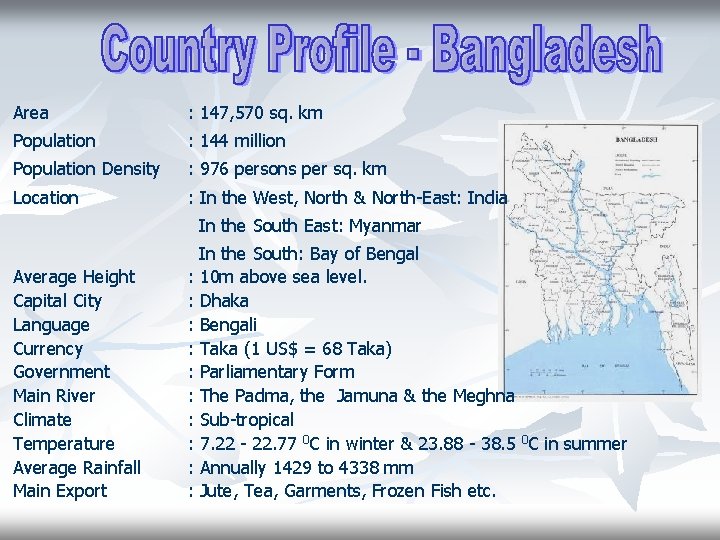
Area : 147, 570 sq. km Population : 144 million Population Density : 976 persons per sq. km Location : In the West, North & North-East: India In the South East: Myanmar Average Height Capital City Language Currency Government Main River Climate Temperature Average Rainfall Main Export In the South: Bay of Bengal : 10 m above sea level. : Dhaka : Bengali : Taka (1 US$ = 68 Taka) : Parliamentary Form : The Padma, the Jamuna & the Meghna : Sub-tropical : 7. 22 - 22. 77 0 C in winter & 23. 88 - 38. 5 0 C in summer : Annually 1429 to 4338 mm : Jute, Tea, Garments, Frozen Fish etc.
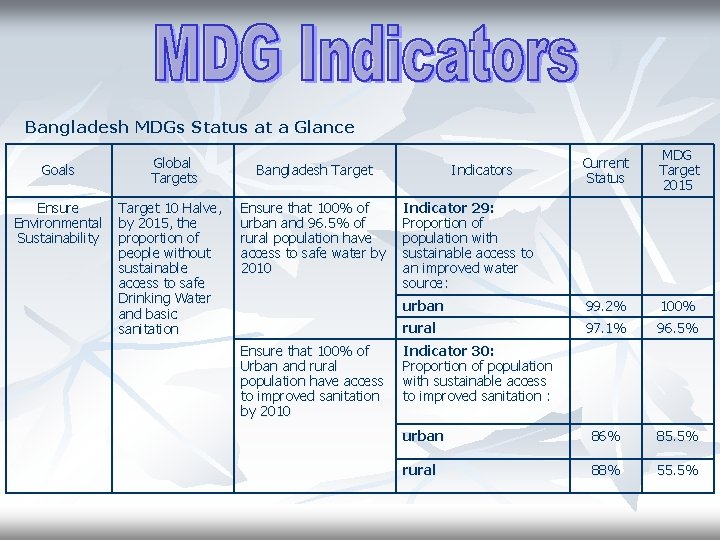
Bangladesh MDGs Status at a Glance Goals Ensure Environmental Sustainability Global Targets Target 10 Halve, by 2015, the proportion of people without sustainable access to safe Drinking Water and basic sanitation Current Status MDG Target 2015 urban 99. 2% 100% rural 97. 1% 96. 5% urban 86% 85. 5% rural 88% 55. 5% Bangladesh Target Ensure that 100% of urban and 96. 5% of rural population have access to safe water by 2010 Ensure that 100% of Urban and rural population have access to improved sanitation by 2010 Indicators Indicator 29: Proportion of population with sustainable access to an improved water source: Indicator 30: Proportion of population with sustainable access to improved sanitation :
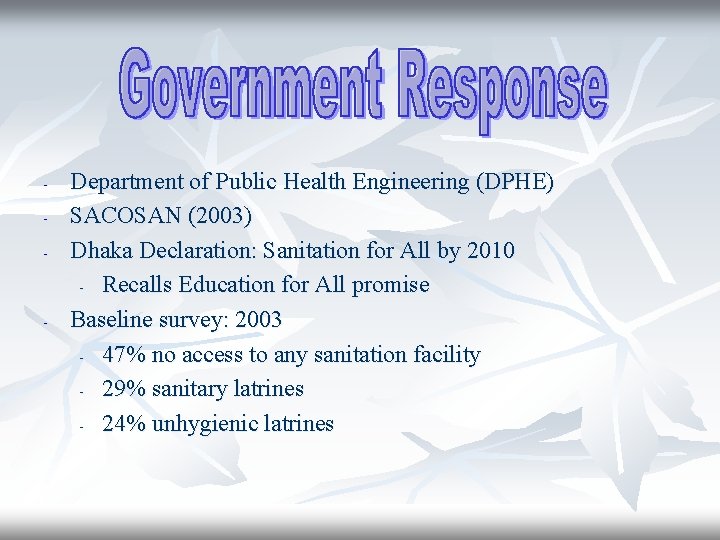
- - Department of Public Health Engineering (DPHE) SACOSAN (2003) Dhaka Declaration: Sanitation for All by 2010 - Recalls Education for All promise Baseline survey: 2003 - 47% no access to any sanitation facility - 29% sanitary latrines - 24% unhygienic latrines
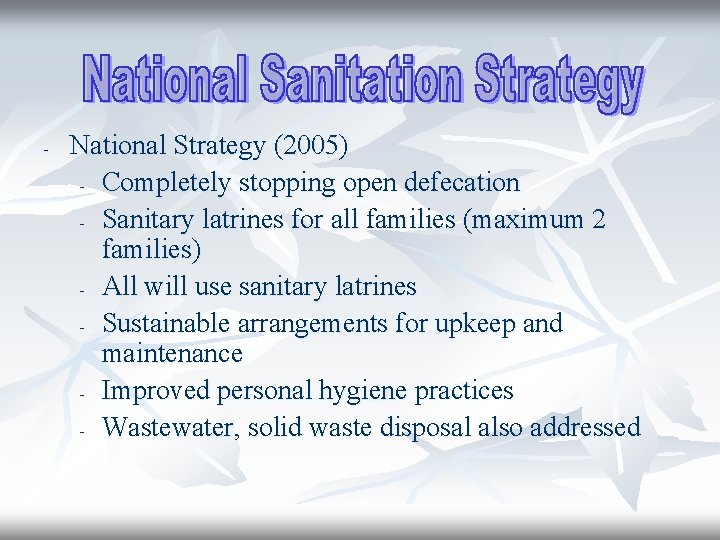
- National Strategy (2005) - Completely stopping open defecation - Sanitary latrines for all families (maximum 2 families) - All will use sanitary latrines - Sustainable arrangements for upkeep and maintenance - Improved personal hygiene practices - Wastewater, solid waste disposal also addressed
Eco. San Technologies for urban sanitation - Low cost appropriate technology (e. g. twin pit, eco san) should be promoted in peri-urban areas as well as in other small to medium sized urban centers where feasible.
- Full political support National Sanitation Secretariat (DPHE) - - Sanitation Task Forces (District, Upazila, Union) Devolution to local government Linkage with Pro-Poor Strategy for Water and Sanitation National Sanitation Month
- - 20% of ADP earmarked for sanitation for hard-core poor FY 2005: Tk 180 million 25% of union sanitation funds (about 20, 000 Tk) for promotional activities 10, 000 Tk each ward member Cash rewards: Open Defecation Free unions (200, 000 Tk) and upazilas (500, 000 Tk). > 1000 UPs by 2007 50 crore Tk (about 7 million USD) to DPHE for latrines
Autonomous organisation supported by Japan (JICA/JADE) and local NGOs have been taken initiative to promote Eco toilet in Bangladesh since 2004. Organizations are mainly: n n n Bangladesh Academy for Rural Development (BARD); Society for People’s Action in Change and Action (SPACE) Bangladesh Association for Social Advancement (BASA)
n n n With financial and technical supports of JADE, a Japanese NGO piloting 15 Eco. San toilets in 2004 ; 135 Eco. San toilets constructed and usage by community so far Over 80% toilets always found well-managed;
SPACE a local NGO supported by JADE/JICA n Constructed 25 Eco toilets in a flood prone areas; n 402 toilets at household level n 15 toilets in 5 schools n Cost of each household toilets Tk. 10, 000 to 12500 (Equivalent to US$ 150 to 180) and toilet owners shared 30% to 40% of total construction costs. n 37 toilets installed by 100% cost paid by owners. n Each Secondary School Eco. San toilets (with 6 vaults, 6 urinals, 3 separate hand washing arrangements and room attached) costs Tk. 80, 000 (Equivalent to US$ 1180). Schools have shared 20% of the total cost. n Initiative taken on micro-finance basis;
n n n BASA, a national NGO and Practical Action have jointly installed 9 Eco. San toilets in Gazipur with financial assistance of WASTE, Netherlands under ISSUE-2 project; Installed 6 Eco. San toilets in Chittagong and Noakhali districts with financial assistance of WHO; BASA has installed double vault household based UDD options Each toilet costs Tk. 18500 to 20000 (equivalent to US$ 250 -300) Toilet owner’s shared 20% to 30% of total construction costs;
n n Practical Action (PA) has piloted 2 Eco. San toilets in urban area of Faridpur and jointly installed 9 Eco. San toilets in Gazipur with BASA; Another 5 local NGOs with technical supports of SPACE have started installation of Eco. San toilets in their project areas;
Initiatives of Eco. San by GOB n n GOB has undertaken initiatives for installation at least one Eco. San toilet in each union (4500 unions) as a demonstration and allocated resources accordingly; 20% Unions could install the allocated Eco. San toilets

Design
Design
Design
Design
Adequacy n n About 3000 Eco toilets are available in Bangladesh Still under observation For R&D it is adequate For implementation it is still too small
Reflection in SACOSAN n Bangladesh experienced shared in the last SACOSAN (lll)
Eco. San potentials n n n n Bangladesh population : 140 m Products about 56 m tons of urine Equivalent to 45 m tons of useable urea Can replace about 30 m tons of chemical urea Produces about 14 m tons of feaces Can be converted to 3. 5 m tons of useable compost Can replace 0. 8 m tons of chemical fertilizers
Eco. San potentials n Bangladesh currently uses around 5 m tons of chemical fertilizers which can be replaced by just bringing 25% of our population under the coverage of eco-sanitation
Challenges n n n n Effective Coordination User’s friendly and affordable designs Limited funds – Govt. and Donors; Absence of user’s friendly guidelines; Building capacities at all levels; Still considered pilot; Local Authorities unaware;

Thank you
- Slides: 24