
Ashfords Integrated Alternatives The Scale Value of Uniting
- Slides: 10
Ashford’s Integrated Alternatives The Scale & Value of Uniting Utilities Dr. Sarah Ward University of Exeter & Dr. Sandip Deshmukh University of Surrey
Ashford’s Integrated Alternatives Introduction • What do we mean by Uniting Utilities? - Integration of services by: - technology (complementary options) - delivery (innovative business models) - administration (required skills) • Opportunities for Uniting Utilities in Ashford - Scale of development - Technical feasibility - Valuing attributes of integrated systems
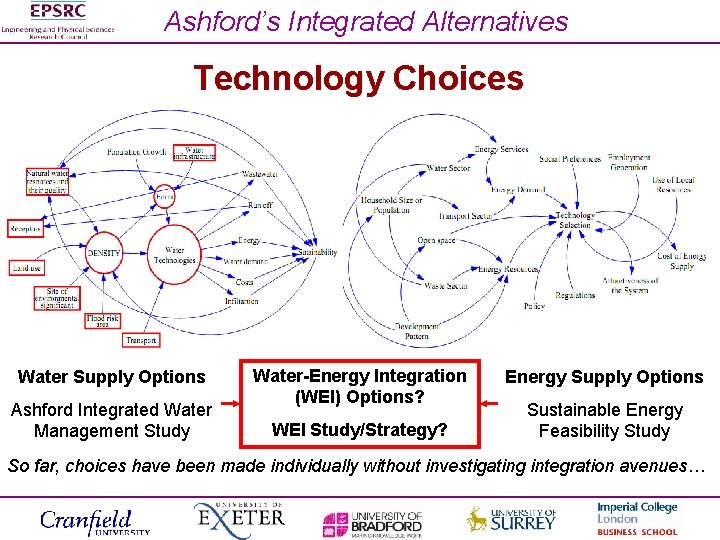
Ashford’s Integrated Alternatives Technology Choices Water Supply Options Ashford Integrated Water Management Study Water-Energy Integration (WEI) Options? WEI Study/Strategy? Energy Supply Options Sustainable Energy Feasibility Study So far, choices have been made individually without investigating integration avenues…
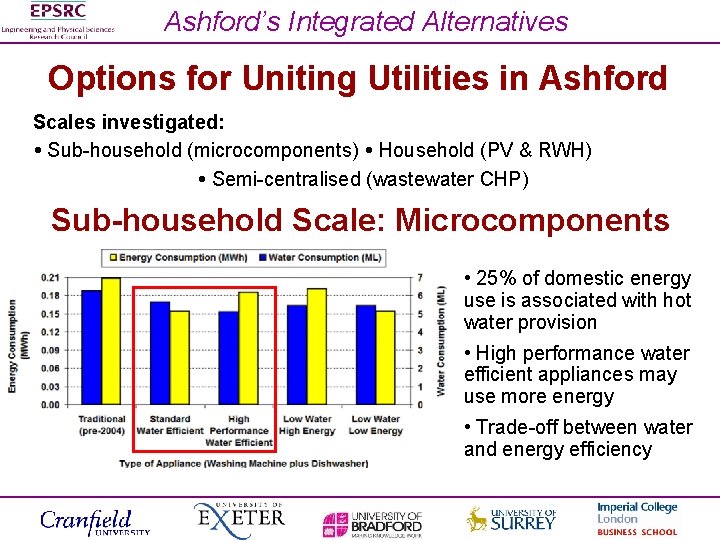
Ashford’s Integrated Alternatives Options for Uniting Utilities in Ashford Scales investigated: Sub-household (microcomponents) Household (PV & RWH) Semi-centralised (wastewater CHP) Sub-household Scale: Microcomponents • 25% of domestic energy use is associated with hot water provision • High performance water efficient appliances may use more energy • Trade-off between water and energy efficiency
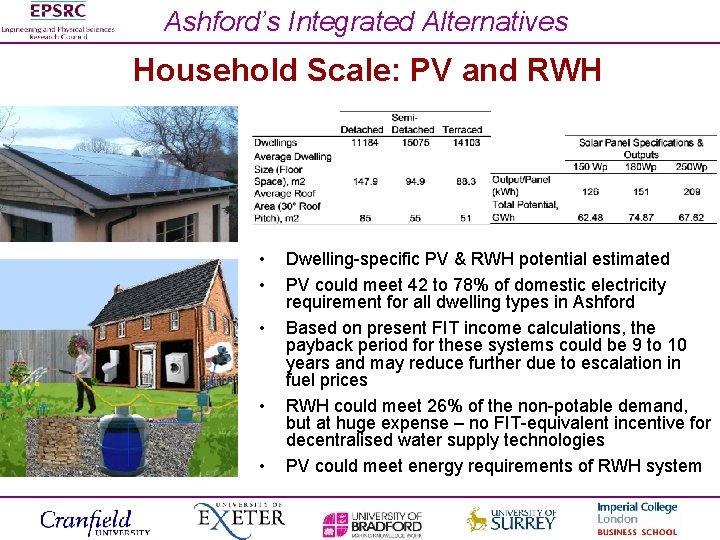
Ashford’s Integrated Alternatives Household Scale: PV and RWH • • • Dwelling-specific PV & RWH potential estimated PV could meet 42 to 78% of domestic electricity requirement for all dwelling types in Ashford Based on present FIT income calculations, the payback period for these systems could be 9 to 10 years and may reduce further due to escalation in fuel prices RWH could meet 26% of the non-potable demand, but at huge expense – no FIT-equivalent incentive for decentralised water supply technologies PV could meet energy requirements of RWH system
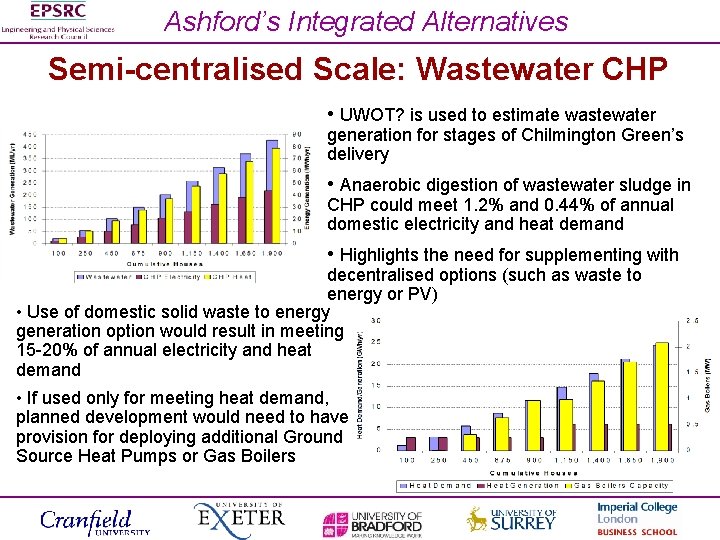
Ashford’s Integrated Alternatives Semi-centralised Scale: Wastewater CHP • UWOT? is used to estimate wastewater generation for stages of Chilmington Green’s delivery • Anaerobic digestion of wastewater sludge in CHP could meet 1. 2% and 0. 44% of annual domestic electricity and heat demand • Highlights the need for supplementing with decentralised options (such as waste to energy or PV) • Use of domestic solid waste to energy generation option would result in meeting 15 -20% of annual electricity and heat demand • If used only for meeting heat demand, planned development would need to have provision for deploying additional Ground Source Heat Pumps or Gas Boilers
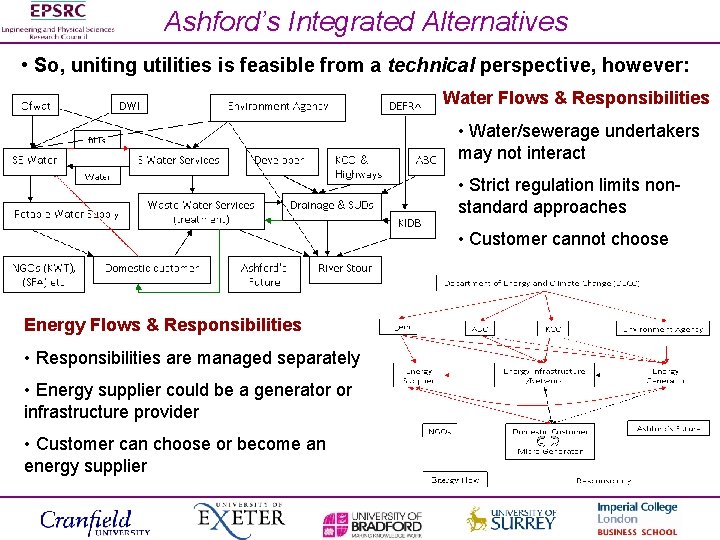
Ashford’s Integrated Alternatives • So, uniting utilities is feasible from a technical perspective, however: Water Flows & Responsibilities • Water/sewerage undertakers may not interact • Strict regulation limits nonstandard approaches • Customer cannot choose Energy Flows & Responsibilities • Responsibilities are managed separately • Energy supplier could be a generator or infrastructure provider • Customer can choose or become an energy supplier
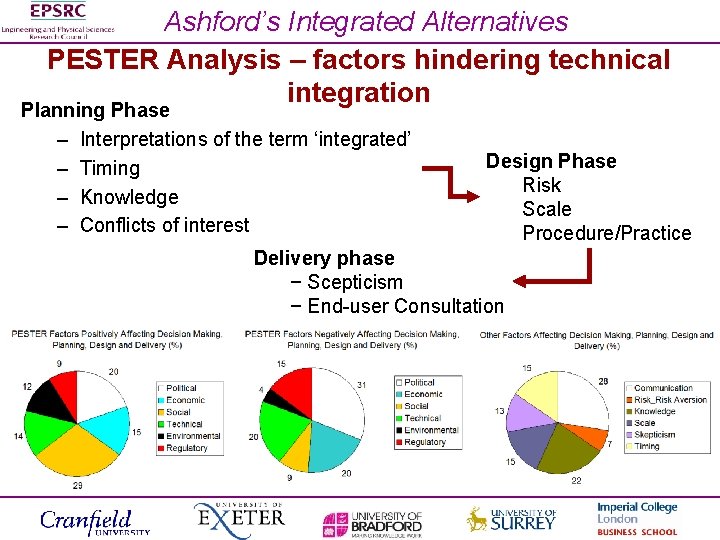
Ashford’s Integrated Alternatives PESTER Analysis – factors hindering technical integration Planning Phase – Interpretations of the term ‘integrated’ – Timing – Knowledge – Conflicts of interest Design Phase Risk Scale Procedure/Practice Delivery phase − Scepticism − End-user Consultation
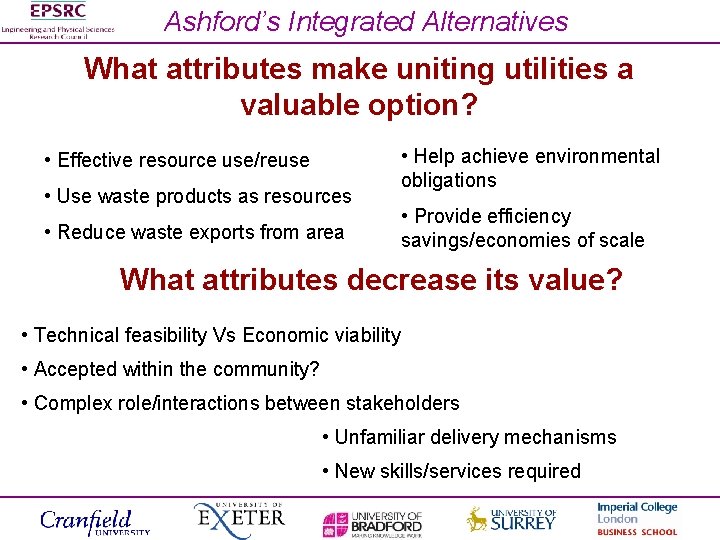
Ashford’s Integrated Alternatives What attributes make uniting utilities a valuable option? • Effective resource use/reuse • Use waste products as resources • Reduce waste exports from area • Help achieve environmental obligations • Provide efficiency savings/economies of scale What attributes decrease its value? • Technical feasibility Vs Economic viability • Accepted within the community? • Complex role/interactions between stakeholders • Unfamiliar delivery mechanisms • New skills/services required
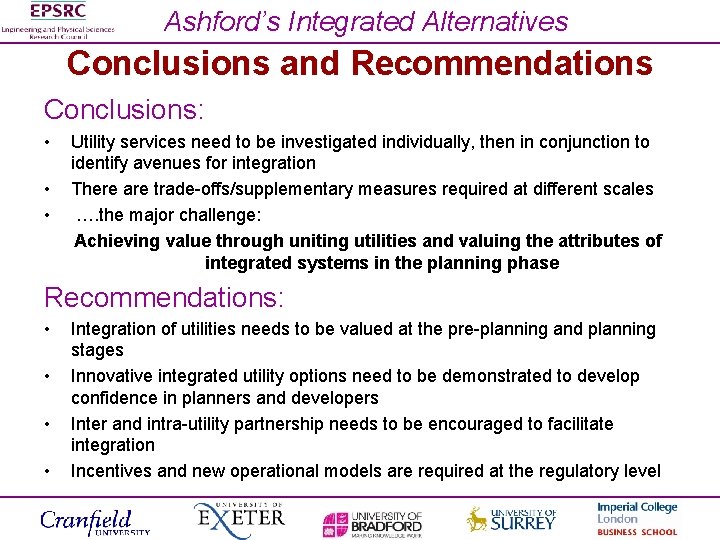
Ashford’s Integrated Alternatives Conclusions and Recommendations Conclusions: • • • Utility services need to be investigated individually, then in conjunction to identify avenues for integration There are trade-offs/supplementary measures required at different scales …. the major challenge: Achieving value through uniting utilities and valuing the attributes of integrated systems in the planning phase Recommendations: • • Integration of utilities needs to be valued at the pre-planning and planning stages Innovative integrated utility options need to be demonstrated to develop confidence in planners and developers Inter and intra-utility partnership needs to be encouraged to facilitate integration Incentives and new operational models are required at the regulatory level