
Ashesh Parekh Principal Product Manager Oracle Application Server


- Slides: 34
Ashesh Parekh Principal Product Manager Oracle Application Server Oracle Corporation
Oracle Application g Server 10 High Availability
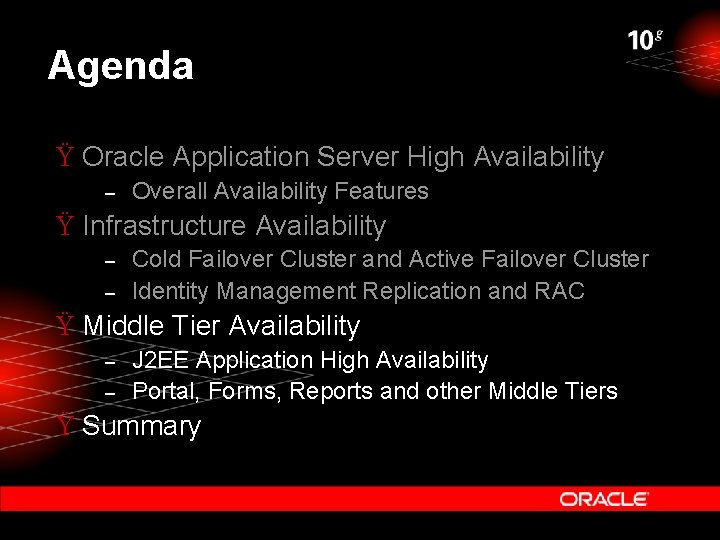
Agenda Ÿ Oracle Application Server High Availability – Overall Availability Features Ÿ Infrastructure Availability – – Cold Failover Cluster and Active Failover Cluster Identity Management Replication and RAC Ÿ Middle Tier Availability – – J 2 EE Application High Availability Portal, Forms, Reports and other Middle Tiers Ÿ Summary
Agenda Ÿ Oracle Application Server High Availability – Overall Availability Features Ÿ Infrastructure Availability – – Cold Failover Cluster and Active Failover Cluster Identity Management Replication and RAC Ÿ Middle Tier Availability – – J 2 EE Application High Availability Portal, Forms, Reports and other Middle Tiers Ÿ Summary
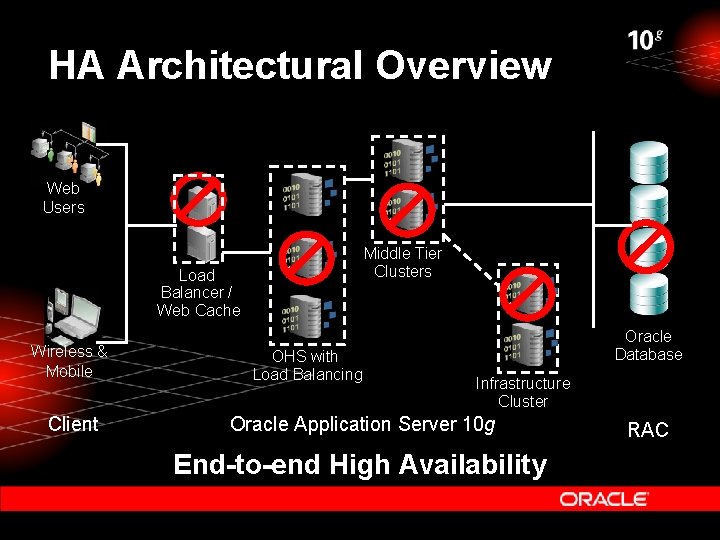
HA Architectural Overview Web Users Middle Tier Clusters Load Balancer / Web Cache Wireless & Mobile Client OHS with Load Balancing Oracle Database Infrastructure Cluster Oracle Application Server 10 g End-to-end High Availability RAC
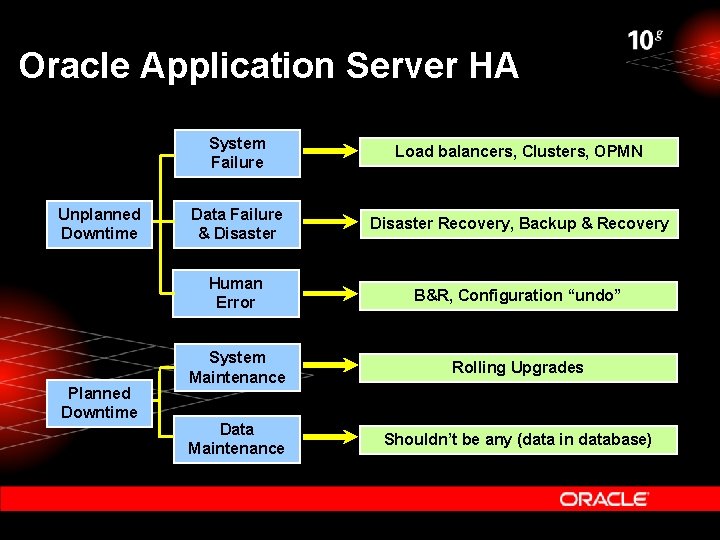
Oracle Application Server HA Unplanned Downtime Planned Downtime System Failure Load balancers, Clusters, OPMN Data Failure & Disaster Recovery, Backup & Recovery Human Error B&R, Configuration “undo” System Maintenance Rolling Upgrades Data Maintenance Shouldn’t be any (data in database)
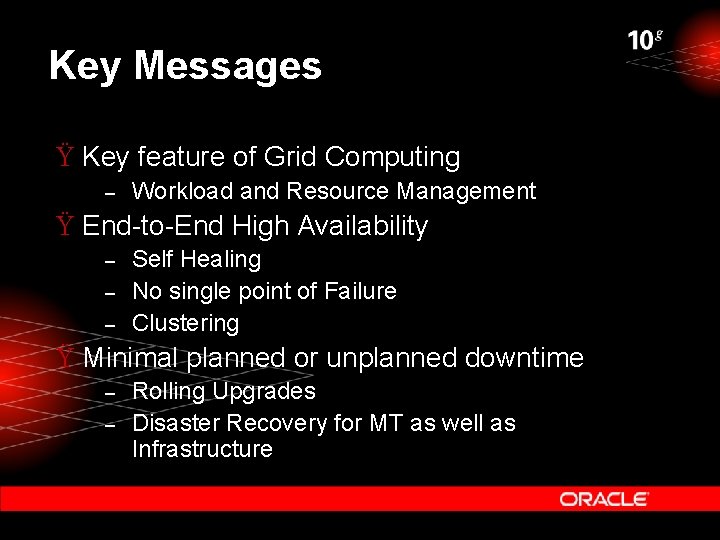
Key Messages Ÿ Key feature of Grid Computing – Workload and Resource Management Ÿ End-to-End High Availability – – – Self Healing No single point of Failure Clustering Ÿ Minimal planned or unplanned downtime – – Rolling Upgrades Disaster Recovery for MT as well as Infrastructure
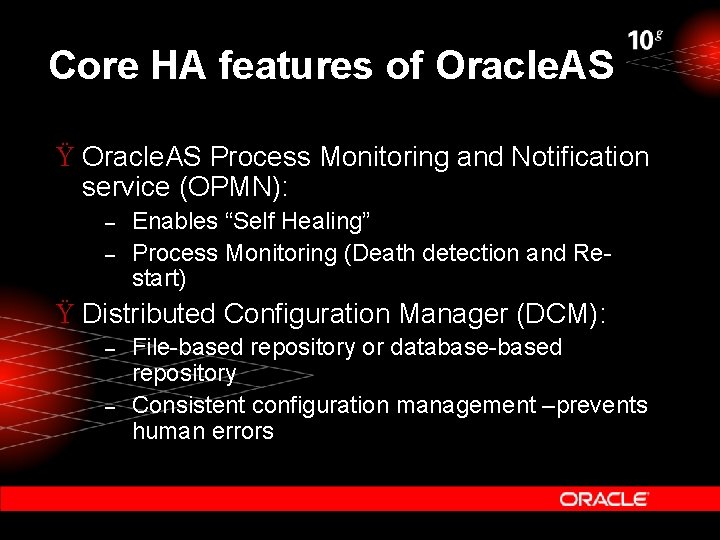
Core HA features of Oracle. AS Ÿ Oracle. AS Process Monitoring and Notification service (OPMN): – – Enables “Self Healing” Process Monitoring (Death detection and Restart) Ÿ Distributed Configuration Manager (DCM): – – File-based repository or database-based repository Consistent configuration management –prevents human errors
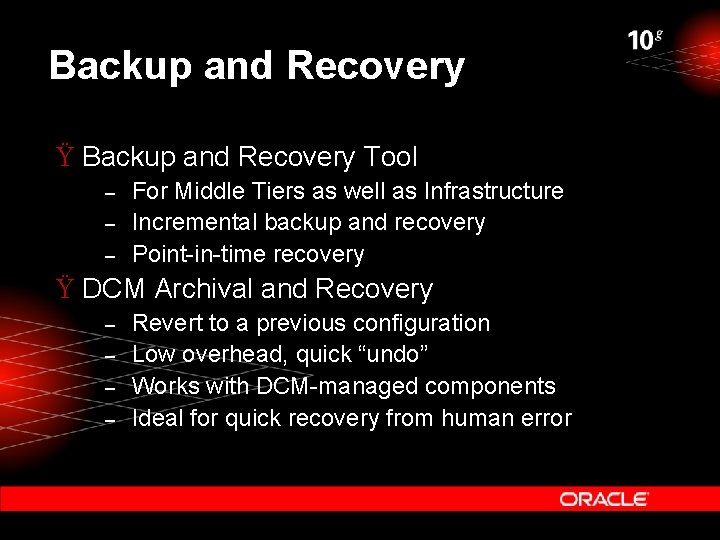
Backup and Recovery Ÿ Backup and Recovery Tool – – – For Middle Tiers as well as Infrastructure Incremental backup and recovery Point-in-time recovery Ÿ DCM Archival and Recovery – – Revert to a previous configuration Low overhead, quick “undo” Works with DCM-managed components Ideal for quick recovery from human error
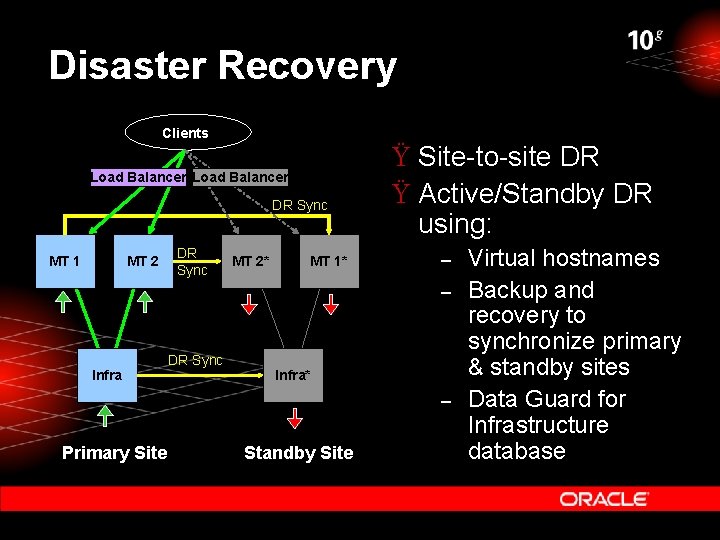
Disaster Recovery Clients Load Balancer DR Sync MT 1 MT 2 DR Sync MT 2* MT 1* Ÿ Site-to-site DR Ÿ Active/Standby DR using: – – Infra DR Sync Infra* – Primary Site Standby Site Virtual hostnames Backup and recovery to synchronize primary & standby sites Data Guard for Infrastructure database
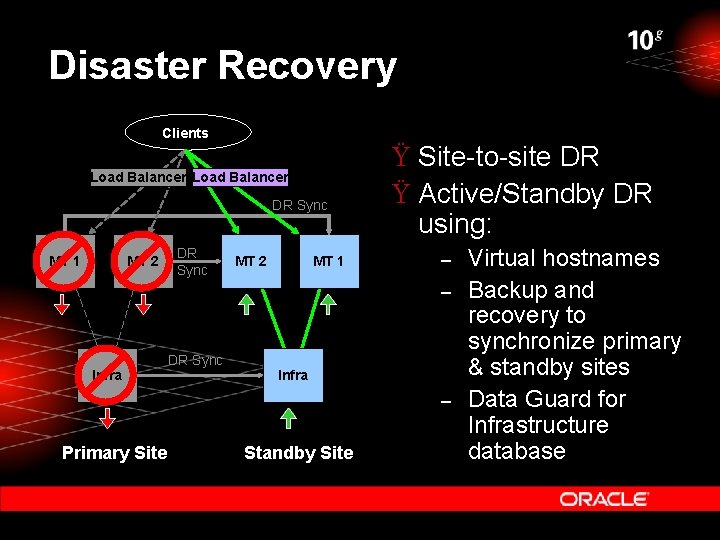
Disaster Recovery Clients Load Balancer DR Sync MT 1 MT 2 DR Sync MT 2 MT 1 Ÿ Site-to-site DR Ÿ Active/Standby DR using: – – Infra DR Sync Infra – Primary Site Standby Site Virtual hostnames Backup and recovery to synchronize primary & standby sites Data Guard for Infrastructure database
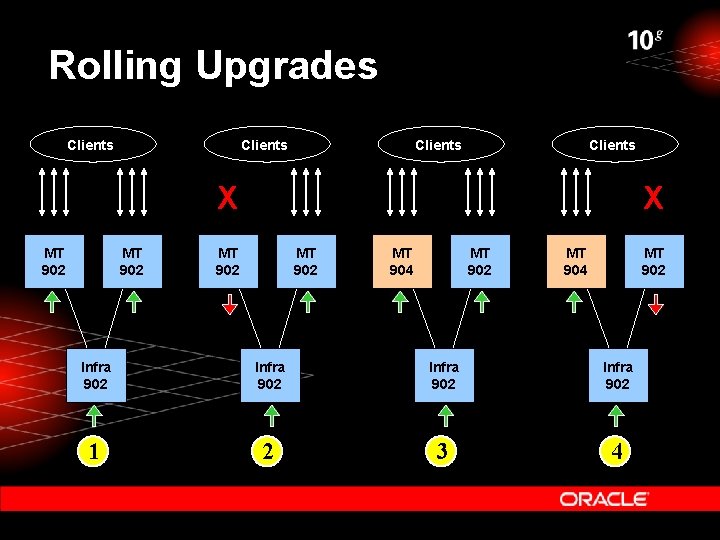
Rolling Upgrades Clients X MT 902 MT 904 MT 902 Infra 902 1 2 3 4
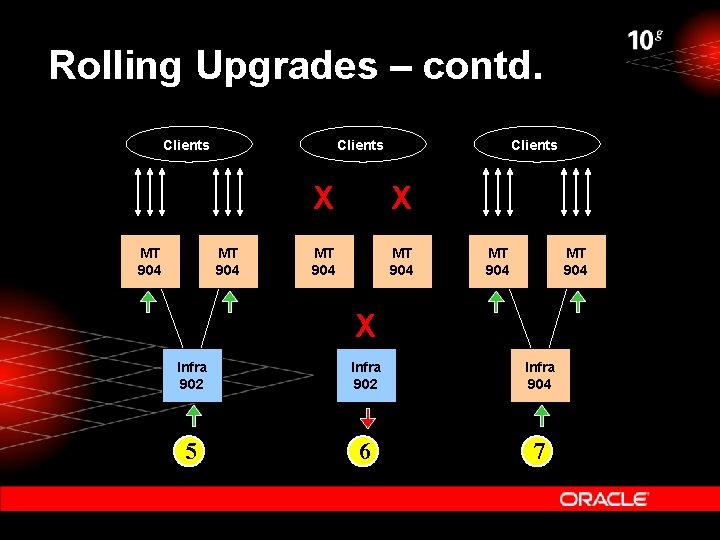
Rolling Upgrades – contd. . ) Clients MT 904 Clients X X MT 904 X Infra 902 Infra 904 5 6 7
Agenda Ÿ Oracle Application Server High Availability – Overall Availability Features Ÿ Infrastructure Availability – – Cold Failover Cluster and Active Failover Cluster Identity Management Replication and RAC Ÿ Middle Tier Availability – – J 2 EE Application High Availability Portal, Forms, Reports and other Middle Tiers Ÿ Summary
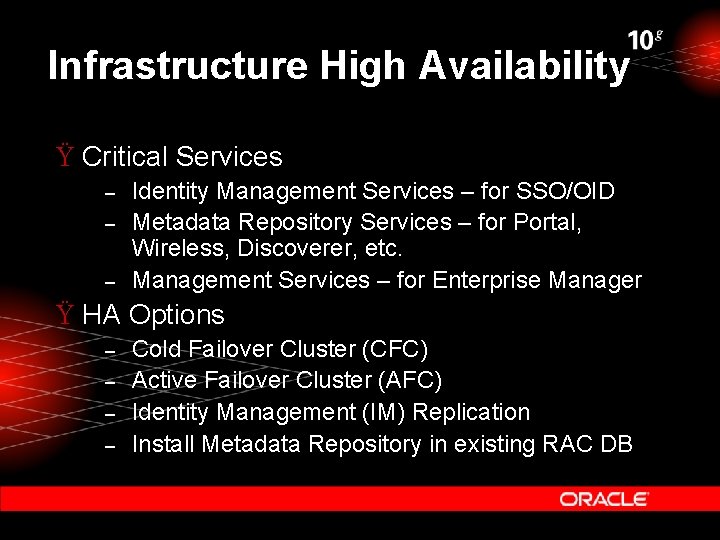
Infrastructure High Availability Ÿ Critical Services – – – Identity Management Services – for SSO/OID Metadata Repository Services – for Portal, Wireless, Discoverer, etc. Management Services – for Enterprise Manager Ÿ HA Options – – Cold Failover Cluster (CFC) Active Failover Cluster (AFC) Identity Management (IM) Replication Install Metadata Repository in existing RAC DB
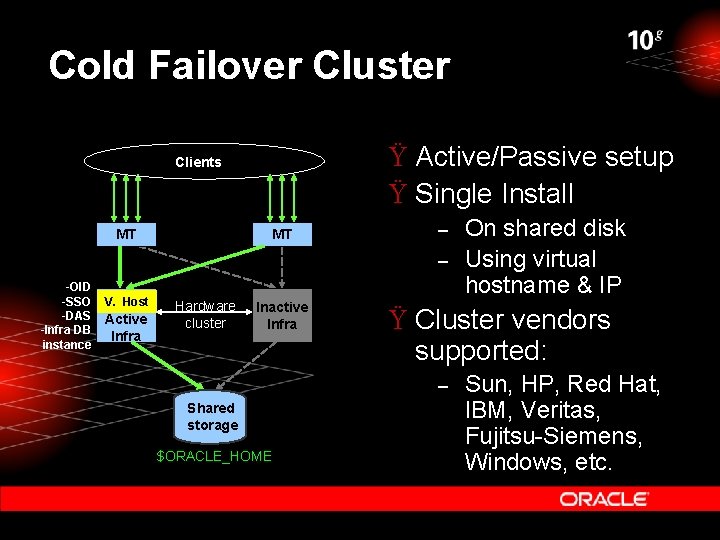
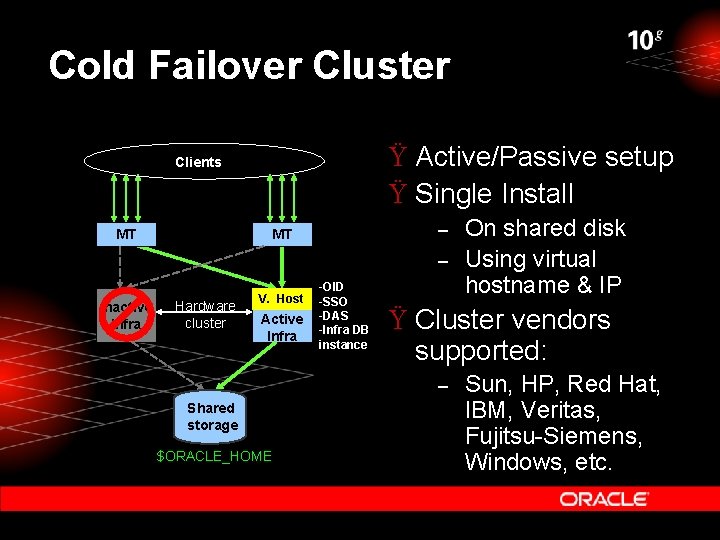
Cold Failover Cluster Ÿ Active/Passive setup Ÿ Single Install Clients MT MT – – -OID -SSO -DAS -Infra DB instance V. Host Active Infra Hardware cluster Inactive Infra Ÿ Cluster vendors supported: – Shared storage $ORACLE_HOME On shared disk Using virtual hostname & IP Sun, HP, Red Hat, IBM, Veritas, Fujitsu-Siemens, Windows, etc.
Cold Failover Cluster Ÿ Active/Passive setup Ÿ Single Install Clients MT – Inactive Infra Hardware cluster V. Host Active Infra -OID -SSO -DAS -Infra DB instance Ÿ Cluster vendors supported: – Shared storage $ORACLE_HOME On shared disk Using virtual hostname & IP Sun, HP, Red Hat, IBM, Veritas, Fujitsu-Siemens, Windows, etc.
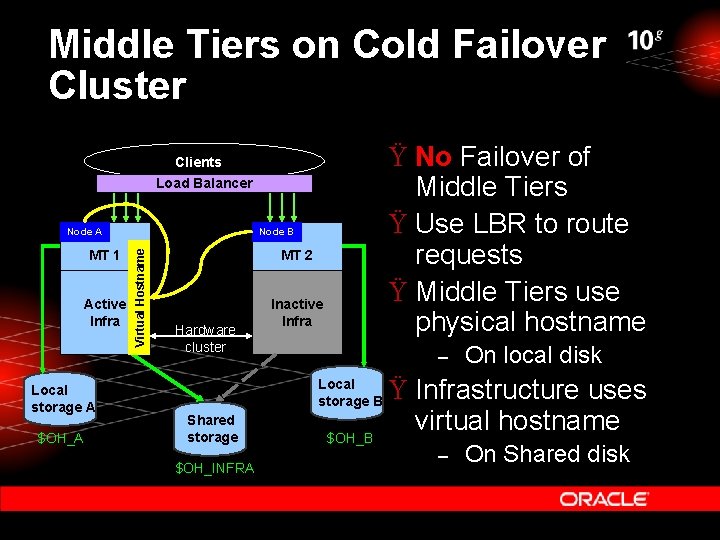
Middle Tiers on Cold Failover Cluster Ÿ No Failover of Middle Tiers Ÿ Use LBR to route requests Ÿ Middle Tiers use physical hostname Clients Load Balancer MT 1 Active Infra Local storage A $OH_A Node B Virtual Hostname Node A MT 2 Hardware cluster Inactive Infra – Local storage B Shared storage $OH_INFRA $OH_B On local disk Ÿ Infrastructure uses virtual hostname – On Shared disk
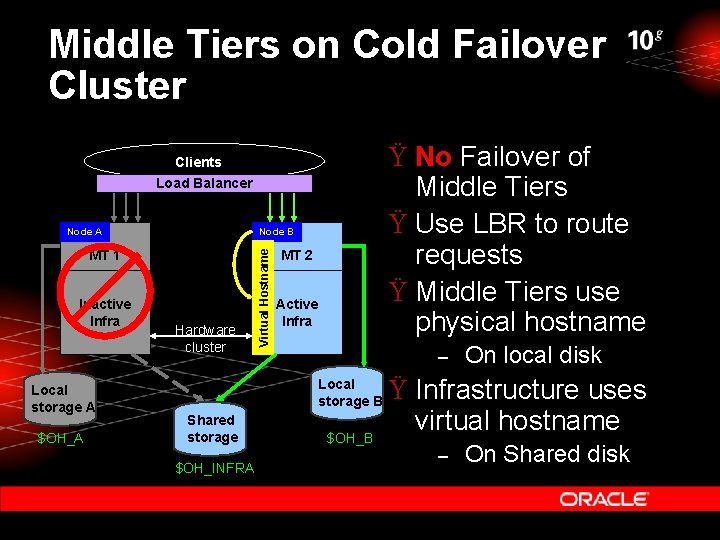
Middle Tiers on Cold Failover Cluster Ÿ No Failover of Middle Tiers Ÿ Use LBR to route requests Ÿ Middle Tiers use physical hostname Clients Load Balancer Node B MT 1 Inactive Infra Local storage A $OH_A Hardware cluster Virtual Hostname Node A MT 2 Active Infra – Local storage B Shared storage $OH_INFRA $OH_B On local disk Ÿ Infrastructure uses virtual hostname – On Shared disk
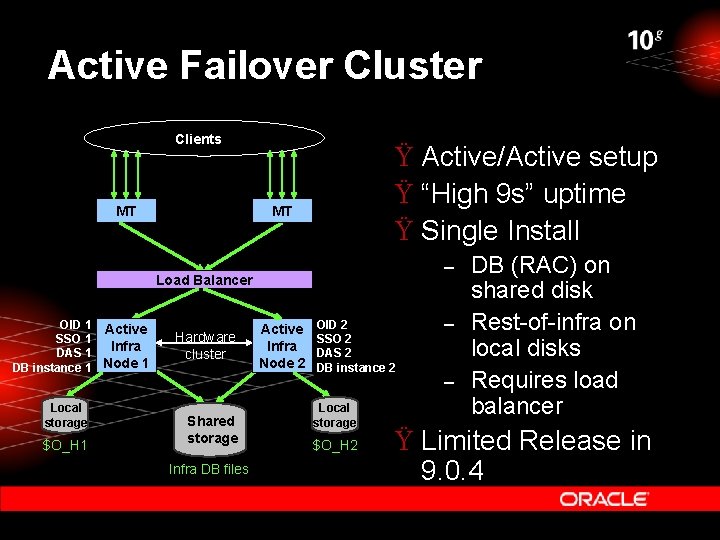
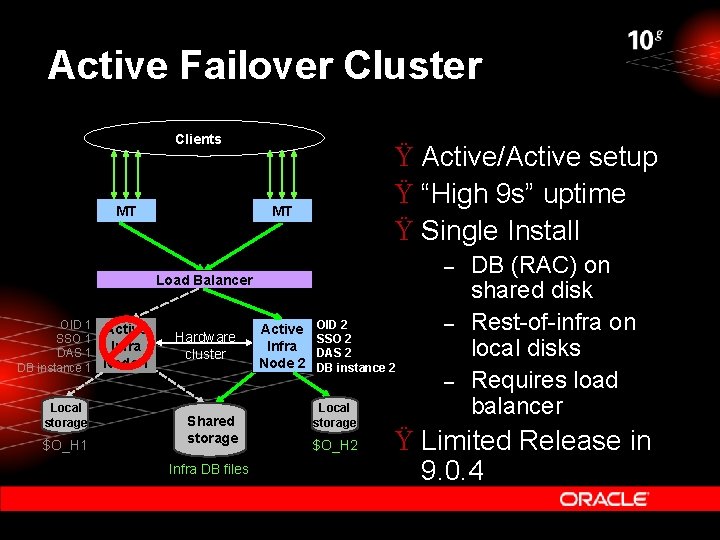
Active Failover Cluster Clients MT Ÿ Active/Active setup Ÿ “High 9 s” uptime Ÿ Single Install MT – Load Balancer OID 1 Active SSO 1 Infra DAS 1 DB instance 1 Node 1 Local storage $O_H 1 Hardware cluster Shared storage Infra DB files Active Infra Node 2 OID 2 SSO 2 DAS 2 DB instance 2 Local storage $O_H 2 – – DB (RAC) on shared disk Rest-of-infra on local disks Requires load balancer Ÿ Limited Release in 9. 0. 4
Active Failover Cluster Clients MT Ÿ Active/Active setup Ÿ “High 9 s” uptime Ÿ Single Install MT – Load Balancer OID 1 Active SSO 1 Infra DAS 1 DB instance 1 Node 1 Local storage $O_H 1 Hardware cluster Shared storage Infra DB files Active Infra Node 2 OID 2 SSO 2 DAS 2 DB instance 2 Local storage $O_H 2 – – DB (RAC) on shared disk Rest-of-infra on local disks Requires load balancer Ÿ Limited Release in 9. 0. 4
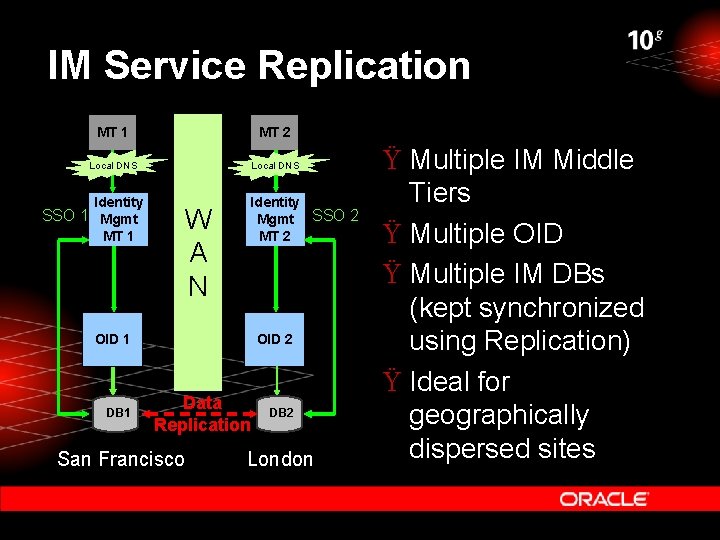
IM Service Replication MT 1 MT 2 Local DNS Identity SSO 1 Mgmt MT 1 W A N Identity Mgmt SSO 2 MT 2 OID 1 DB 1 OID 2 Data Replication San Francisco DB 2 London Ÿ Multiple IM Middle Tiers Ÿ Multiple OID Ÿ Multiple IM DBs (kept synchronized using Replication) Ÿ Ideal for geographically dispersed sites
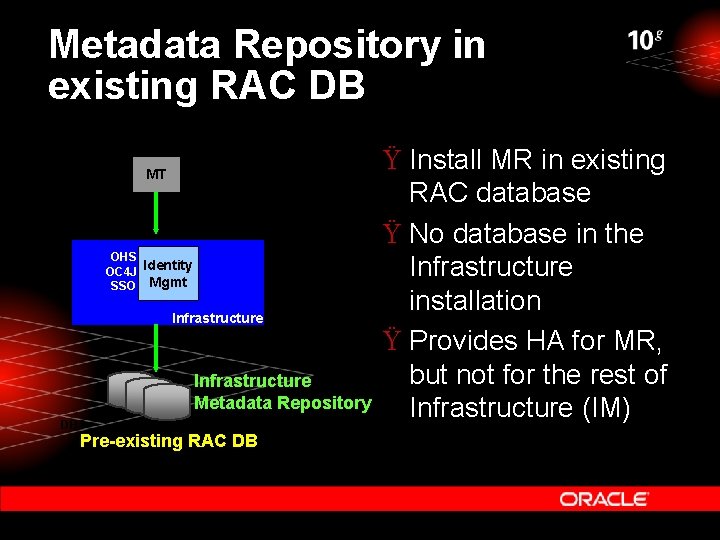
Metadata Repository in existing RAC DB MT OHS OC 4 J Identity SSO Mgmt Infrastructure DB 2 Infrastructure Metadata Repository DB 1 Pre-existing RAC DB Ÿ Install MR in existing RAC database Ÿ No database in the Infrastructure installation Ÿ Provides HA for MR, but not for the rest of Infrastructure (IM)
Agenda Ÿ Oracle Application Server High Availability – Overall Availability Features Ÿ Infrastructure Availability – – Cold Failover Cluster and Active Failover Cluster Identity Management Replication and RAC Ÿ Middle Tier Availability – – J 2 EE Application High Availability Portal, Forms, Reports and other Middle Tiers Ÿ Summary
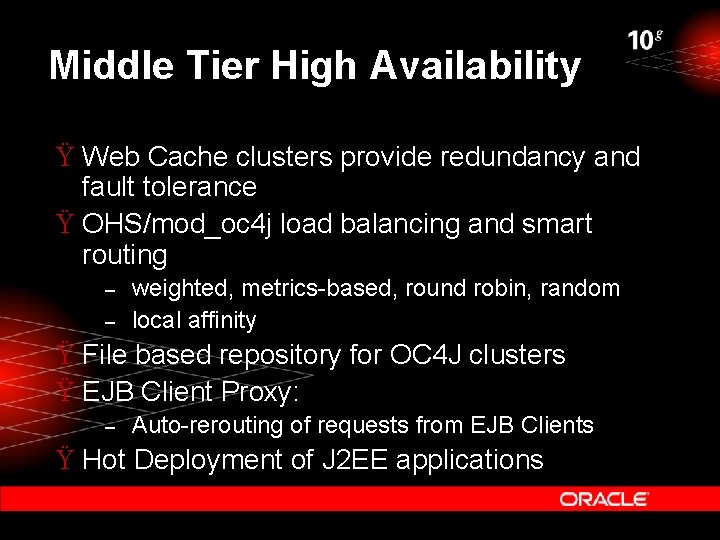
Middle Tier High Availability Ÿ Web Cache clusters provide redundancy and fault tolerance Ÿ OHS/mod_oc 4 j load balancing and smart routing – – weighted, metrics-based, round robin, random local affinity Ÿ File based repository for OC 4 J clusters Ÿ EJB Client Proxy: – Auto-rerouting of requests from EJB Clients Ÿ Hot Deployment of J 2 EE applications
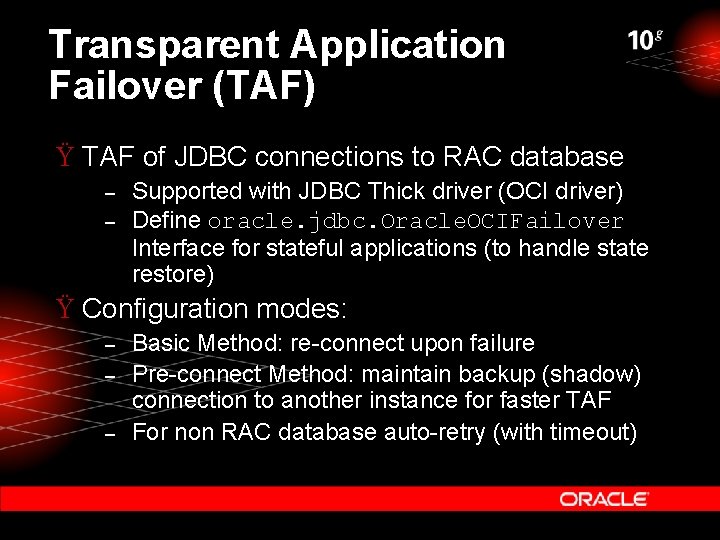
Transparent Application Failover (TAF) Ÿ TAF of JDBC connections to RAC database – – Supported with JDBC Thick driver (OCI driver) Define oracle. jdbc. Oracle. OCIFailover Interface for stateful applications (to handle state restore) Ÿ Configuration modes: – – – Basic Method: re-connect upon failure Pre-connect Method: maintain backup (shadow) connection to another instance for faster TAF For non RAC database auto-retry (with timeout)
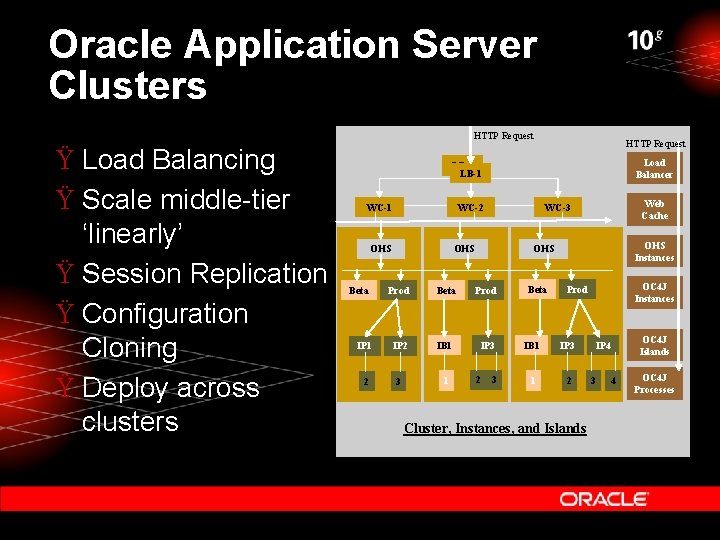
Oracle Application Server Clusters HTTP Request Ÿ Load Balancing Ÿ Scale middle-tier ‘linearly’ Ÿ Session Replication Ÿ Configuration Cloning Ÿ Deploy across clusters HTTP Request Load Balancer LB-1 WC-1 WC-2 OHS Beta Web Cache WC-3 OHS Instances OHS Prod Beta Prod IP 1 IP 2 IB 1 IP 3 2 3 1 2 3 Beta OC 4 J Instances Prod IB 1 IP 3 1 2 Cluster, Instances, and Islands IP 4 3 4 OC 4 J Islands OC 4 J Processes
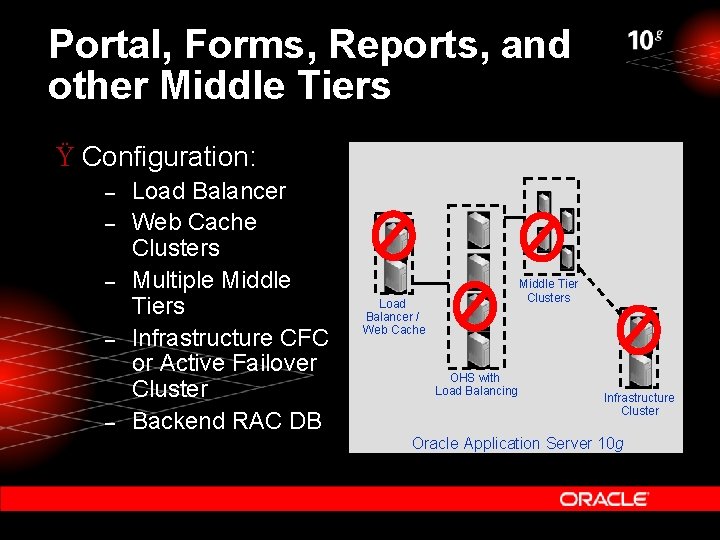
Portal, Forms, Reports, and other Middle Tiers Ÿ Configuration: – – – Load Balancer Web Cache Clusters Multiple Middle Tiers Infrastructure CFC or Active Failover Cluster Backend RAC DB Middle Tier Clusters Load Balancer / Web Cache OHS with Load Balancing Infrastructure Cluster Oracle Application Server 10 g
Oracle Application Server Future Roadmap Ÿ Active Failover Cluster enhancements Ÿ Improve Cloning capabilities Ÿ Disaster Recovery enhancements Ÿ Maximum Availability Architecture (MAA)
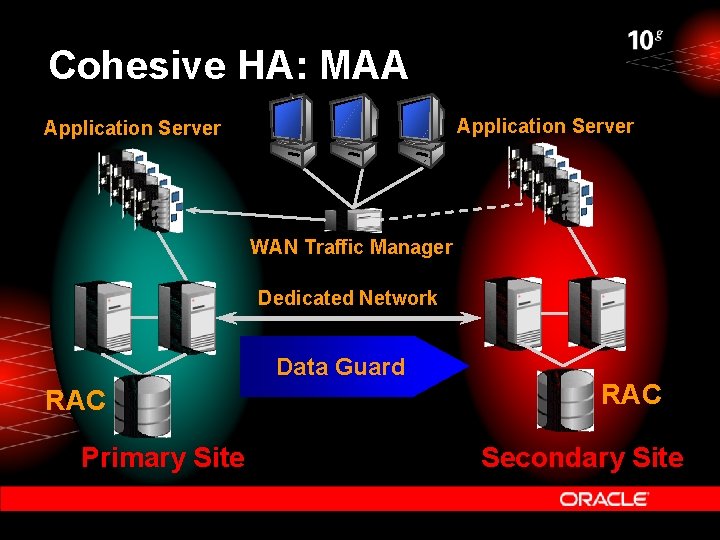
Cohesive HA: MAA Application Server WAN Traffic Manager Dedicated Network Data Guard RAC Primary Site RAC Secondary Site
Resources Ÿ Oracle Technology Network (OTN): – – – http: //otn. oracle. com/products/ias/hi_av/content. html http: //otn. oracle. com/deploy/availability/htdocs/maa. htm Ÿ Oracle Application Server 10 g (9. 0. 4) Documentation: – High Availability Guide, Install Guide, Admin Guide Ÿ Oracle University Curriculum: – Admin courses, OUOnline courses
Summary Ÿ End-to-End High Availability – No Single Point of Failure Ÿ Self Healing – Quick Recovery Ÿ Ease of Configuration – Minimize human errors Ÿ Rolling Upgrades Ÿ Minimal planned or unplanned downtime