
ASFARVIRIDAE VMC 321 DR MANOJ KUMAR CLASSIFICATION Family

- Slides: 26
ASFARVIRIDAE VMC 321 DR MANOJ KUMAR
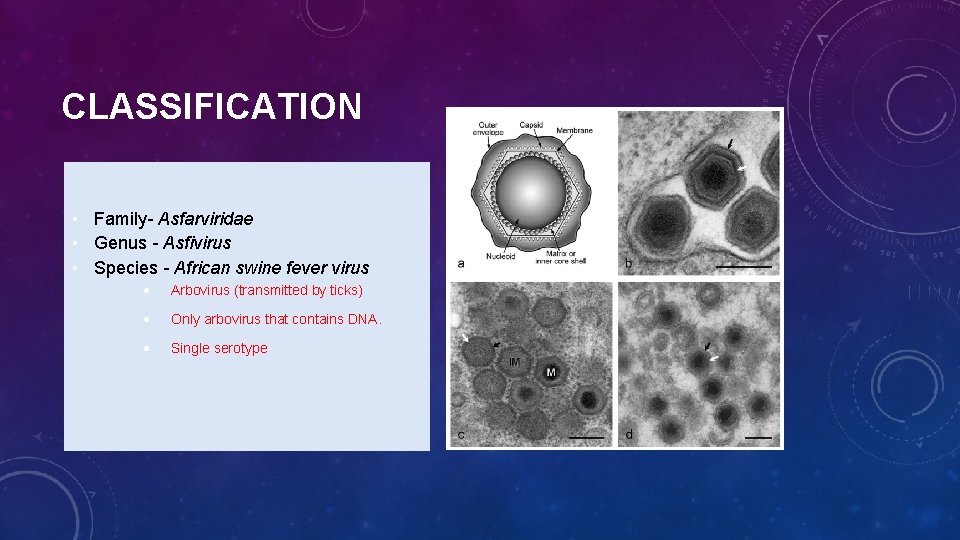
CLASSIFICATION • Family- Asfarviridae • Genus - Asfivirus • Species - African swine fever virus Arbovirus (transmitted by ticks) Only arbovirus that contains DNA. Single serotype
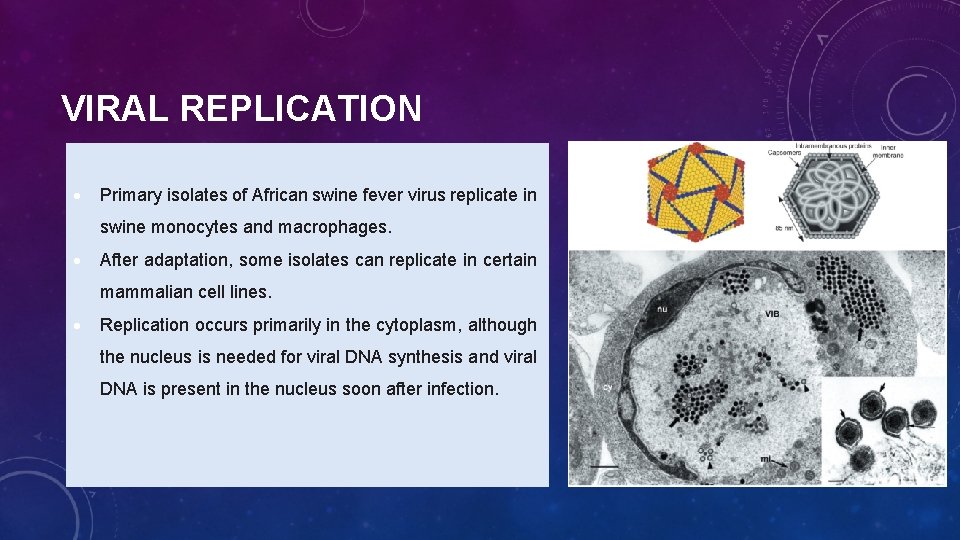
VIRAL CHARACTERISTICS The virions - large, complex and in some structural respects resembles poxviruses. Enveloped, approximately 200 nm in diameter, Contain a complex icosahedral capsid, approximately 180 nm in diameter Virus consists of a nucleoprotein (70 -100 nm in diameter) surrounded by an icosahedral capsid and externally by a lipid layer. Genome linear, double stranded (170 - 190 kb in length) Encodes 150 - 200 proteins.
CONT… Virus replicates in cytoplasm of host cells (swine macrophages in vivo and in vitro) and in soft ticks of the genus Ornithodorus. virus particles are stable in the environment being considerably resistant to heat and to a wide p. H changes (several hours at p. H 4 or p. H 13). African swine fever virus is thermolabile and sensitive to lipid solvents. Survives for months and even years in refrigerated meat.
VIRUS SURVIVAL (IN THE ENVIRONMENT) ASF virus, in a suitable protein environment, is stable over a wide range of temperature and p. H. It survive in serum at room temperature for 18 months, in refrigerated blood for six years and in blood at 37°C for a month. Heating at 60°C for 30 minutes will inactivate the virus. In the absence of a protein medium, viability is greatly reduced. ASF virus is generally stable over a p. H range of 4– 10 but in a suitable medium (serum) has been shown to remain active at lower and higher values for between a few hours and three days. Putrefaction does not necessarily inactivate the virus, which may remain viable in faeces for at least 11 days, in decomposed serum for 15 weeks and in bone marrow for months. As a result of its tolerance to a wide range of environmental factors, only certain disinfectants are effective in the control of ASF.
VIRUS SURVIVAL (in the HOST) After infection with ASF virus, domestic pigs may shed infective amounts of virus for 24– 48 hours before clinical signs appear. During the acute stage of disease, enormous amounts of virus are shed in all secretions and excretions and high levels of virus are present in tissues and blood. Pigs that survive the acute disease remain infected for several months but do not readily shed virus for more than 30 days. As in wild suids, infective levels of virus are found only in lymph nodes; other tissues are unlikely to contain infective levels of virus for more than two months after infection. The exact length of time over which infective levels of virus are maintained in lymphoid tissues in either wild suids or domestic pigs is unknown and is probably subject to considerable individual variation.
VIRAL REPLICATION Primary isolates of African swine fever virus replicate in swine monocytes and macrophages. After adaptation, some isolates can replicate in certain mammalian cell lines. Replication occurs primarily in the cytoplasm, although the nucleus is needed for viral DNA synthesis and viral DNA is present in the nucleus soon after infection.
VIRAL REPLICATION IN HOST Virus enters susceptible cells by receptor-mediated endocytosis After entry into the cytoplasm, virions are uncoated and their DNA is transcribed by a virion-associated, DNA-dependent RNA polymerase (transcriptase). DNA replication: parental genomic DNA serves as the template for the first round of DNA replication, the product of which then serves as a template for the synthesis of large replicative complexes that are cleaved to produce mature virion DNA. Late in infection, African swine fever virus produces arrays of virions in the cytoplasm. Infected cells form many microvillus-like projections through which virions bud out.
PATHOGENESIS After infection by the oronasal route the virus replicates in the pharynx, tonsils and dependent lymph nodes. Viremia is followed by infection of bone marrow, lymph nodes, lungs, kidneys and liver where further replication takes place in cells of the lymphoreticular system.
THE DISEASE - AFRICAN SWINE FEVER (WARTHOG DISEASE) • DEFINITION: • “ASF is a highly contagious viral disease of domestic pigs, ASF manifests itself as a haemorrhagic fever and results in up to 100 percent mortality. The catastrophic effect of this disease on pig production, from household to commercial level, has serious socioeconomic consequences and implications for food security. It is a serious transboundary animal disease with the potential for rapid international spread”.
EPIDEMIOLOGICAL FEATURES • Susceptible species Only species of the pig family (Suidae) are susceptible to infection with ASF virus. Domestic pigs are highly susceptible to ASF, which shows no breed, age or sex preference. • A high proportion of the pigs in these populations are serologically positive for ASF and apparently healthy
EPIDEMIOLOGICAL FEATURES Transmission Transmitted by arthropods Soft ticks (Ornithodoros), which are likely vectors and act as reservoirs ASFV is transmitted from tick to tick sexually, transovarially and transstadially and sexually from males to females via the spermotheca. Infected ticks feeding on piglets transmit infective levels of virus in their saliva, which acts as an anticoagulant, to cause viraemia in the pigs sufficient to infect other ticks During an epizootic, transmission is by direct contact between infected pigs and their secretions and excretions. Infection generally occurs via the oronasal route. Aerosol transmission occur only over very short distances. Spread via fomites - contaminated vehicles, equipment and clothing - is likely when there are high levels of environmental contamination. Iatrogenic spread via contaminated needles
• PATHOGENESIS After infection by the oronasal route the virus replicates in the pharynx, tonsils and dependent lymph nodes. Viremia is followed by infection of bone marrow, lymph nodes, lungs, kidneys and liver where further replication takes place in cells of the lymphoreticular system.
CLINICAL SIGNS The clinical symptoms of ASFV are very similar to classical swine fever virus and the two diseases normally have to be distinguished by laboratory diagnosis. Clinical disease is usually peracute or acute. Subacute or chronic manifestations of ASF may occur, particularly when less virulent strains are involved,
A. PERACUTE ASF Pigs are usually found dead without premonitory signs. Recumbency, accompanied by high fever, indicated by flushing of the ventral area and extremities in white-skinned pigs, shade seeking, huddling together and rapid shallow breathing may be observed in some animals before death.
ACUTE ASF Pigs develop a persistent fever of up to 42°C. They become listless and anorexic, huddle together, seek shade and sometimes water and are reluctant to move. White-skinned pigs become flushed to cyanotic, particularly the ears, lower legs, and ventral abdomen. Mucopurulent ocular and nasal discharges may be evident. Signs of abdominal pain such as arching of the back, uncomfortable movements and flank kicking may occur. Vomiting is common and pigs may develop either constipation, with hard small faeces covered in blood and mucus, or bloody diarrhoea, with soiling of the tail and perineum. Ataxia due to hind-limb weakness usually develops.
COND…. Difficult breathing, sometimes with froth that may be bloody at the mouth and nostrils, often occurs and is indicative of the lung oedema that is often the primary cause of death. Pigs that survive longer may develop nervous signs, including convulsions. Pinpoint to larger haemorrhages may be visible on the mucosa and skin. Abortions may occur at any stage of pregnancy. Duration of clinical signs is generally short - two to seven days - but may be longer and apparent recovery may be followed by relapse and death. Mortality approaches 100 percent. Pigs that do recover from acute infection are generally asymptomatic.
SUB ACUTE ASF Pigs that survive longer, usually after infection with less virulent strains, may have a fluctuant fever and usually lose condition. An interstitial pneumonia is usually present, which may result in respiratory distress and moist coughing. Secondary bacterial infection may occur. Joints may be painful and swollen. Death may occur after a variable period of weeks to months, or the pigs may recover or progress to the chronic from of the disease. Cardiac damage may result in death from acute or congestive heart failure. • loss of condition to emaciation
CHRONIC ASF Chronically infected pigs are usually severely emaciated and stunted, with a long dull hair coat. Signs of pneumonia may be present, as well as lameness and ulcers over bony points. These pigs are subject to secondary bacterial infections. They may survive for several months but recovery is unlikely. loss of condition to emaciation
IMMUNITY Antibodies against ASF are detectable in serum 7– 12 days after clinical signs appear and persist for long periods, possibly for life, in both warthogs and domestic pigs. They do not protect fully against subsequent infection in domestic pigs, although a degree of immunity to infection with homologous strains of virus has been reported. Serologically positive sows transmit antibodies to piglets in colostrum. In subacutely and chronically infected pigs, virus replication continues in the presence of antibodies. The deposition of immune complexes in tissue may account for many of the lesions observed in these forms of disease. There are no known serological cross-reactions with other viruses.
LABORATORY DIAGNOSIS Laboratory confirmation of a presumptive diagnosis of ASF depends upon detection of the virus or detection of antibodies. Since most pigs die of acute ASF before antibodies are produced, detection of the virus is the most important method of diagnosis. • Collection and transport of diagnostic specimens. • Preferred samples for virus isolation/antigen detection are: ü tissue samples from lymph nodes, spleen and tonsils collected aseptically and kept chilled but not frozen; ü Whole (unclotted) blood collected aseptically into ethylenediamine tetra-acetic acid (EDTA) or heparin from febrile pigs up to five days after the onset of fever.
A. VIRUS ISOLATION • ASF virus may be isolated by the methods given below. Inoculation of primary pig leucocyte cell cultures and subsequent identification of ASF virus by haemadsorption and cytolytic effect, which may be confirmed by other tests such as fluorescent antibody tests. Inoculation of pigs. Pigs are monitored daily for febrile reactions and fresh tissues are collected from pigs that die or are euthanized for virus isolation.
B. ANTIGEN DETECTION. The following tests may be used: Fluorescent antibody test; Immunoperoxidase staining of histopathological specimens; this is not the test of choice, as preparation takes at least 24 hours and it can only be done in a reference laboratory with the capacity to perform histopathology; it is, however, useful if the only specimens available have been preserved in formalin.
C. ANTIBODY DETECTION. Serological tests for ASF include: • Enzyme linked immunosorbent assay (ELISA) • Hemadsorption inhibition (HADI), • Indirect fluorescent antibody test (IIF) • Immunoblotting • Counter-immuno-electrophoresis test (CIEP) • Agar gel precipitation test (AGPT), • Complement fixation test (CFT), • Immunofluorescence plaque assay (IPA) • Radial immunoassay (RIA), • Reverse radial immunodiffusion (RRID)
D. DETECTION OF VIRAL GENETIC MATERIAL. • A polymerase chain reaction (PCR) test is done for ASF. • PCR is a highly sensitive and specific technique.
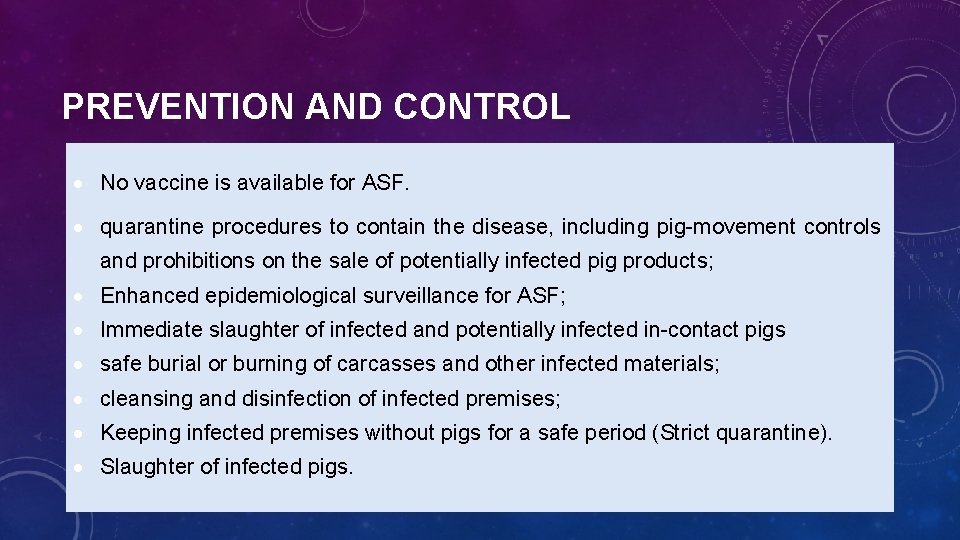
PREVENTION AND CONTROL No vaccine is available for ASF. quarantine procedures to contain the disease, including pig-movement controls and prohibitions on the sale of potentially infected pig products; Enhanced epidemiological surveillance for ASF; Immediate slaughter of infected and potentially infected in-contact pigs safe burial or burning of carcasses and other infected materials; cleansing and disinfection of infected premises; Keeping infected premises without pigs for a safe period (Strict quarantine). Slaughter of infected pigs.