
Asexual Reproduction The Cell Cycle The time taken
- Slides: 5
Asexual Reproduction The Cell Cycle: • The time taken for a new cell to reach maturity and produce two new cells is called the CELL CYCLE. • The process used to produce new cells is called MITOSIS. • The process of mitosis ensures that each new cell has the same amount of genetic material (DNA) as the original cell in its nucleus. • Mitosis is essentially the same in both plants and animals. • There are FIVE stages in mitosis.
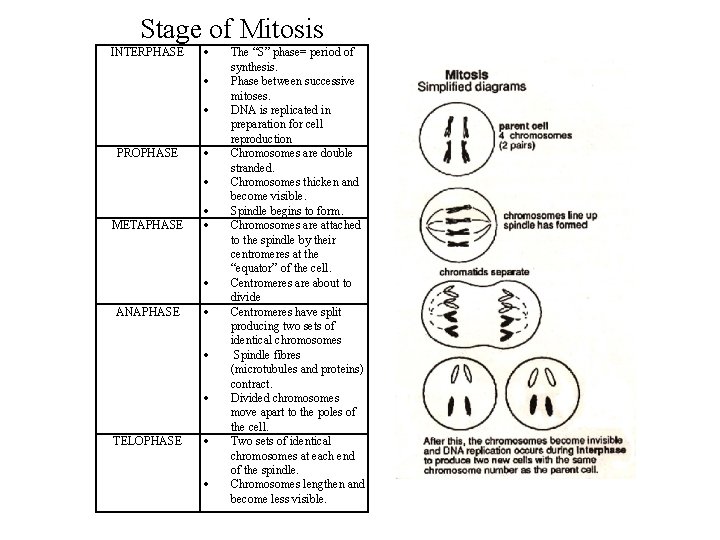
Stage of Mitosis INTERPHASE PROPHASE METAPHASE ANAPHASE TELOPHASE The “S” phase= period of synthesis. Phase between successive mitoses. DNA is replicated in preparation for cell reproduction Chromosomes are double stranded. Chromosomes thicken and become visible. Spindle begins to form. Chromosomes are attached to the spindle by their centromeres at the “equator” of the cell. Centromeres are about to divide Centromeres have split producing two sets of identical chromosomes Spindle fibres (microtubules and proteins) contract. Divided chromosomes move apart to the poles of the cell. Two sets of identical chromosomes at each end of the spindle. Chromosomes lengthen and become less visible.
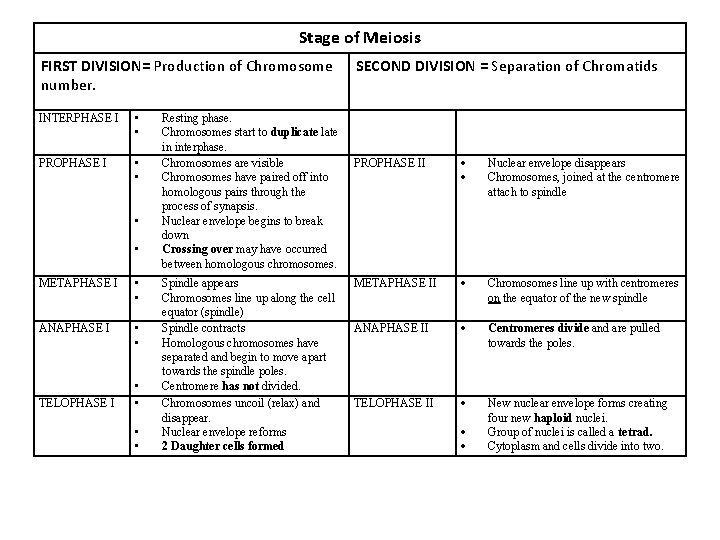
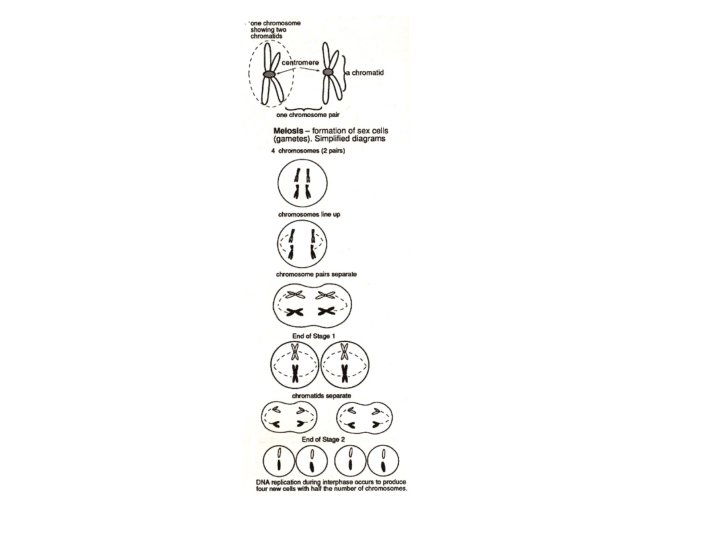
Stage of Meiosis FIRST DIVISION= Production of Chromosome number. INTERPHASE I • • PROPHASE I • • METAPHASE I • • ANAPHASE I • • TELOPHASE I • • Resting phase. Chromosomes start to duplicate late in interphase. Chromosomes are visible Chromosomes have paired off into homologous pairs through the process of synapsis. Nuclear envelope begins to break down Crossing over may have occurred between homologous chromosomes. Spindle appears Chromosomes line up along the cell equator (spindle) Spindle contracts Homologous chromosomes have separated and begin to move apart towards the spindle poles. Centromere has not divided. Chromosomes uncoil (relax) and disappear. Nuclear envelope reforms 2 Daughter cells formed SECOND DIVISION = Separation of Chromatids PROPHASE II Nuclear envelope disappears Chromosomes, joined at the centromere attach to spindle METAPHASE II Chromosomes line up with centromeres on the equator of the new spindle ANAPHASE II Centromeres divide and are pulled towards the poles. TELOPHASE II New nuclear envelope forms creating four new haploid nuclei. Group of nuclei is called a tetrad. Cytoplasm and cells divide into two.
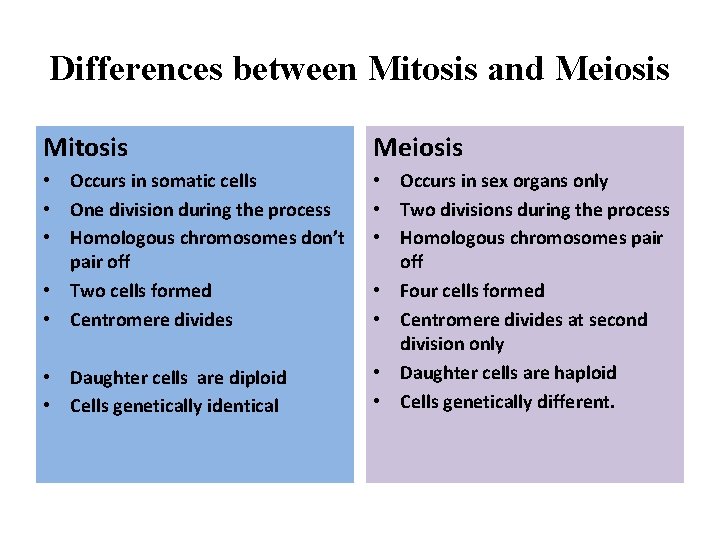
Differences between Mitosis and Meiosis Mitosis Meiosis • Occurs in somatic cells • One division during the process • Homologous chromosomes don’t pair off • Two cells formed • Centromere divides • Occurs in sex organs only • Two divisions during the process • Homologous chromosomes pair off • Four cells formed • Centromere divides at second division only • Daughter cells are haploid • Cells genetically different. • Daughter cells are diploid • Cells genetically identical