
Asexual Reproduction Offspring are produced by only one


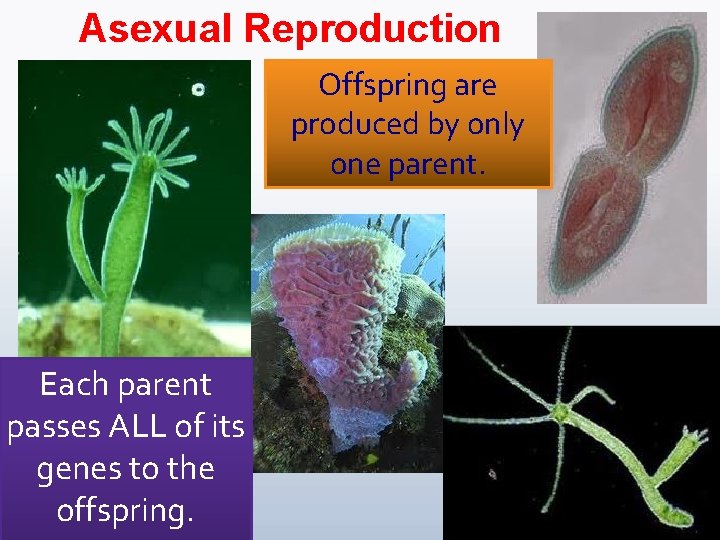
Asexual Reproduction Offspring are produced by only one parent. Each parent passes ALL of its genes to the offspring.
Asexual Reproduction Advantages l It is faster l Large numbers of offspring are produced. l The parent does not have to find a mate. l All of the offspring are exactly alike. There is no variation. l The ability to adapt to a changing environment is greatly reduced.
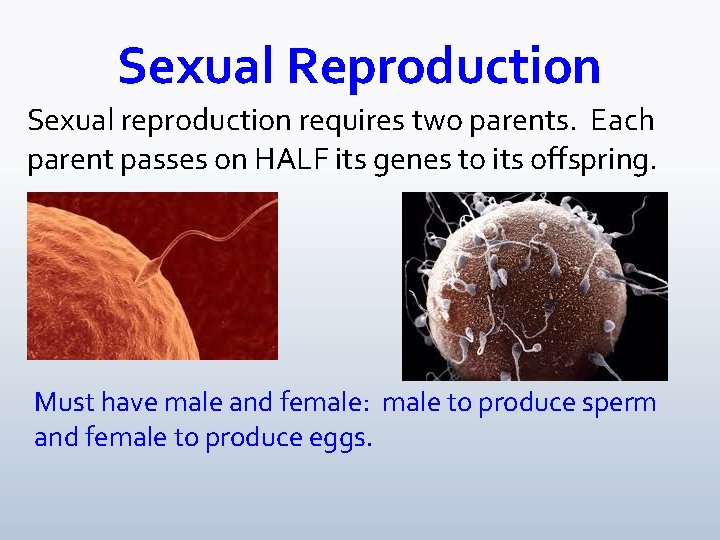
Sexual Reproduction Sexual reproduction requires two parents. Each parent passes on HALF its genes to its offspring. Must have male and female: male to produce sperm and female to produce eggs.
Sexual Reproduction Advantages l All of the offspring l The parent must are genetically find a mate. different from l Fewer offspring each other. will be produced. Sexual Reproduction involves: Gametes: Sex cells (egg and l It takes longer. sperm) Fertilization: The union of sperm and egg. Zygote: A fertilized egg.
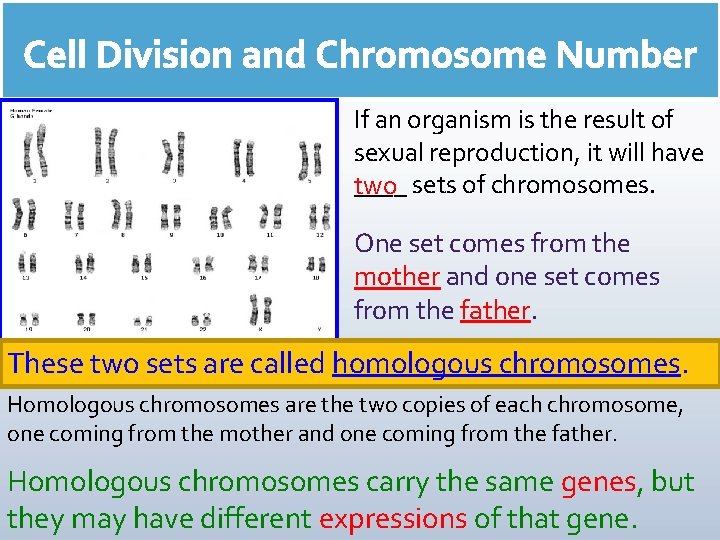
If an organism is the result of sexual reproduction, it will have ____ two sets of chromosomes. One set comes from the mother and one set comes from the father. These two sets are called homologous chromosomes. Homologous chromosomes are the two copies of each chromosome, one coming from the mother and one coming from the father. Homologous chromosomes carry the same genes, but they may have different expressions of that gene.
Diploid means that … …there are two of each kind of chromosome in each cell. The symbol for diploid is 2 N. is t a h W ? ? d i diplo You are a “diploid” organism. “N” is the number of different chromosomes an organism has. Humans are 2 N because we have 2 of each kind of chromosome. Diploid cells contain two complete sets of chromosomes. So in mitosis: 1 (2 N) cell -------> 2 (2 N) cells
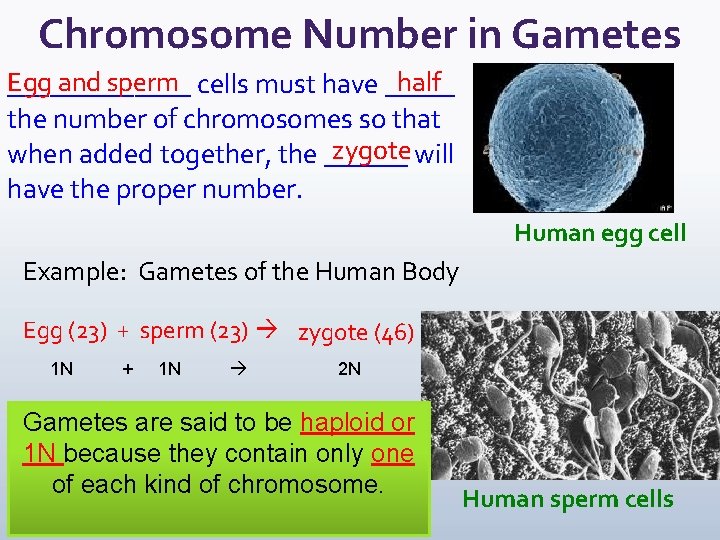
Chromosome Number in Gametes Egg and sperm cells must have _____ half _______ the number of chromosomes so that zygote will when added together, the ______ have the proper number. Human egg cell Example: Gametes of the Human Body Egg (23) + sperm (23) zygote (46) 1 N + 1 N 2 N Gametes are said to be haploid or 1 N because they contain only one of each kind of chromosome. Human sperm cells
The cells which produce eggs and the cells which produce sperm are diploid or 2 N. So how do the egg and sperm cells get to be 1 N? ! ! s i s Meiosis is a process of reduction division in which the number of chromosomes per cell is cut in half through the separation of homologous chromosomes.
Phases of Meiosis Occurs in the sex cells only: the egg and sperm. Purpose is to reduce the chromosome number of the egg and sperm by half. Meiosis, like mitosis, is preceded by the replication of chromosomes. Unlike mitosis, this replication is then followed by two divisions: meiosis I and meiosis II.
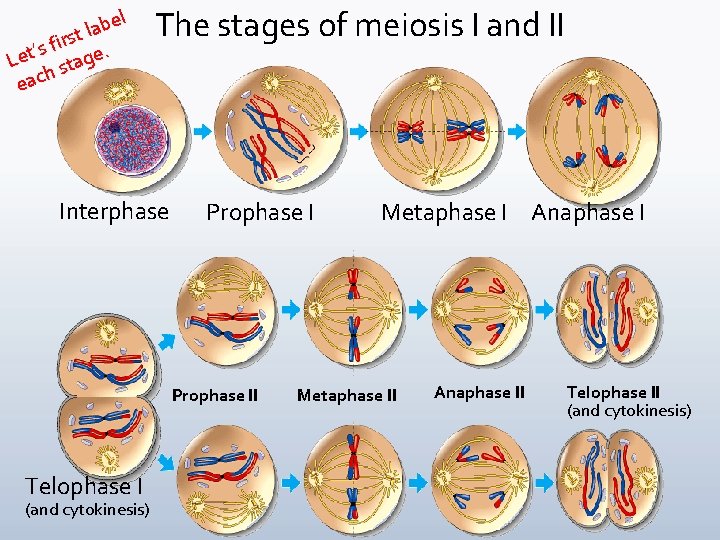
el b a l st r i f s Let’ stage. h eac The stages of meiosis I and II Interphase Prophase II Telophase I (and cytokinesis) Metaphase I Anaphase I Metaphase II Anaphase II Telophase II (and cytokinesis)
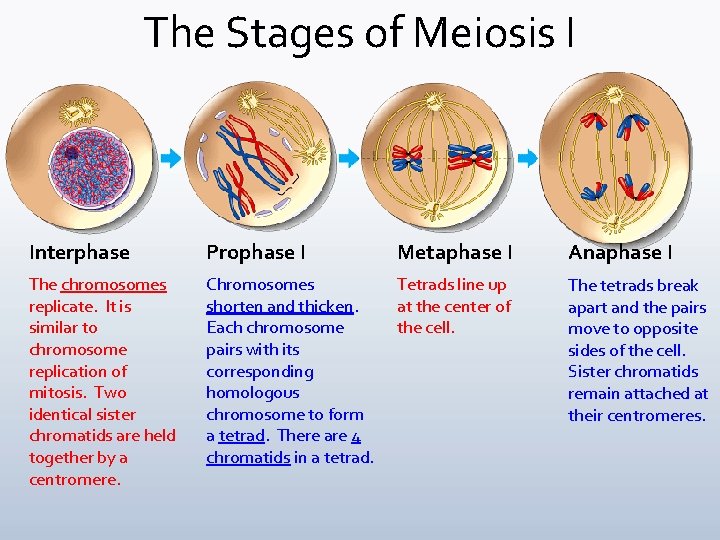
The Stages of Meiosis I Interphase Prophase I Metaphase I Anaphase I The chromosomes replicate. It is similar to chromosome replication of mitosis. Two identical sister chromatids are held together by a centromere. Chromosomes shorten and thicken. Each chromosome pairs with its corresponding homologous chromosome to form a tetrad. There are 4 chromatids in a tetrad. Tetrads line up at the center of the cell. The tetrads break apart and the pairs move to opposite sides of the cell. Sister chromatids remain attached at their centromeres.
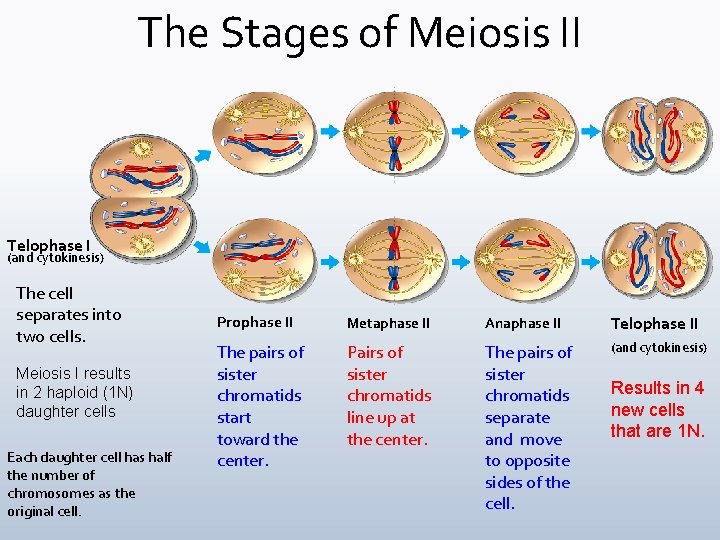
The Stages of Meiosis II Telophase I (and cytokinesis) The cell separates into two cells. Meiosis I results in 2 haploid (1 N) daughter cells Each daughter cell has half the number of chromosomes as the original cell. Prophase II Metaphase II Anaphase II Telophase II The pairs of sister chromatids start toward the center. Pairs of sister chromatids line up at the center. The pairs of sister chromatids separate and move to opposite sides of the cell. (and cytokinesis) Results in 4 new cells that are 1 N.

The Importance of Meiosis 1 (2 N) cell -------> 4 (1 N) cells The chromosome number of the egg and sperm is cut in half to insure that the zygote will have the proper number of chromosomes.
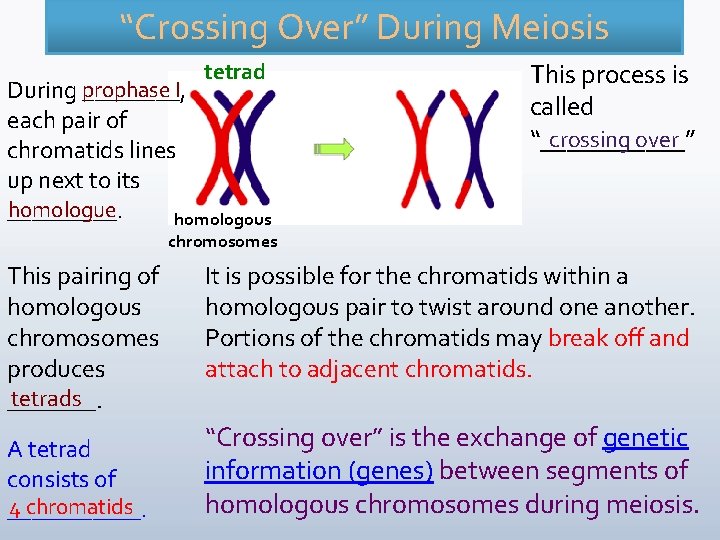
“Crossing Over” During Meiosis tetrad During prophase ____, I each pair of chromatids lines up next to its homologue _____. homologous This process is called crossing over “______” chromosomes This pairing of homologous chromosomes produces tetrads _______. A tetrad consists of 4 chromatids ______. It is possible for the chromatids within a homologous pair to twist around one another. Portions of the chromatids may break off and attach to adjacent chromatids. “Crossing over” is the exchange of genetic information (genes) between segments of homologous chromosomes during meiosis.
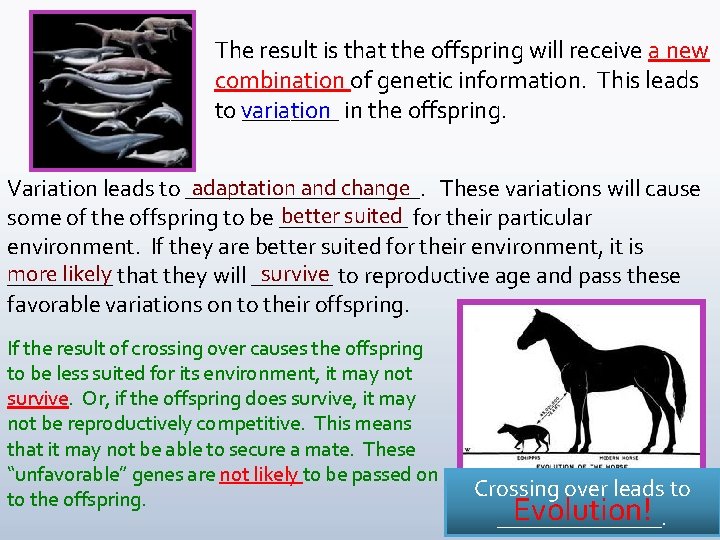
The result is that the offspring will receive a new combination of genetic information. This leads to variation ____ in the offspring. adaptation and change These variations will cause Variation leads to __________. better suited for their particular some of the offspring to be ______ environment. If they are better suited for their environment, it is survive to reproductive age and pass these more likely that they will _________ favorable variations on to their offspring. If the result of crossing over causes the offspring to be less suited for its environment, it may not survive. Or, if the offspring does survive, it may not be reproductively competitive. This means that it may not be able to secure a mate. These “unfavorable” genes are not likely to be passed on to the offspring. Crossing over leads to Evolution! _______.
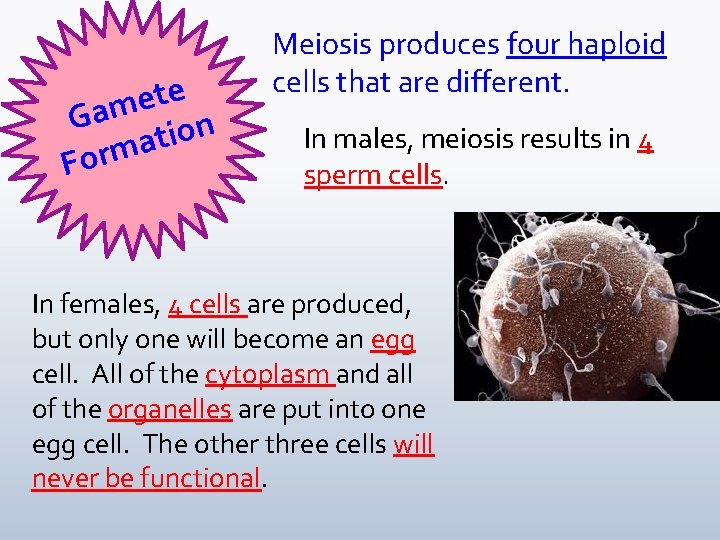
e t e Gam ion t a m For Meiosis produces four haploid cells that are different. In males, meiosis results in 4 sperm cells. In females, 4 cells are produced, but only one will become an egg cell. All of the cytoplasm and all of the organelles are put into one egg cell. The other three cells will never be functional.
Mitosis occurs in all cells of the egg and sperm _____ except _______. body Meiosis only occurs in the egg and sperm formation of _______.
diploid cell In meiosis, each _______ divides ______ twice to produce a total of 4 cells. ___ diploid cell divides In mitosis each _______ 2 cells. once to form _____
Comparison of Mitosis and Meiosis In meiosis, each of the four cells contains half the number of chromosomes as the _____ parent cell. In mitosis, each new cell contains the same number of chromosomes as the ______ original cell.
Comparison of Mitosis and Meiosis In mitosis, the homologous pairs do not tetrads come together to form _______. In meiosis, the homologous pairs do come tetrads While the together to form _______. crossing over chromosomes are in tetrads, _______ may occur. There will be no crossing over in mitosis _______.
Comparison of Mitosis and Meiosis In meiosis, the four haploid cells different combinations of contain ____ chromosomes from each other. In mitosis, the new cells contain identical copies. ____
- Slides: 24