
ASEXUAL REPRODUCTION Chpt 5 Budding Areas of an
ASEXUAL REPRODUCTION Chpt 5.
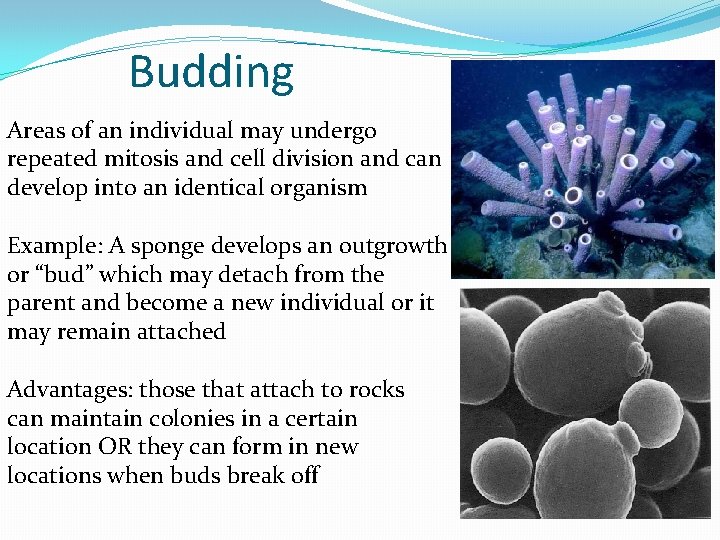
Budding Areas of an individual may undergo repeated mitosis and cell division and can develop into an identical organism Example: A sponge develops an outgrowth or “bud” which may detach from the parent and become a new individual or it may remain attached Advantages: those that attach to rocks can maintain colonies in a certain location OR they can form in new locations when buds break off
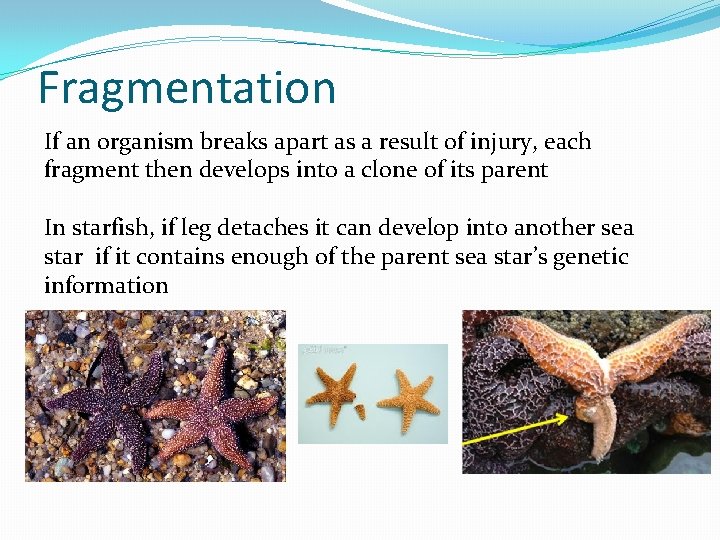
Fragmentation If an organism breaks apart as a result of injury, each fragment then develops into a clone of its parent In starfish, if leg detaches it can develop into another sea star if it contains enough of the parent sea star’s genetic information
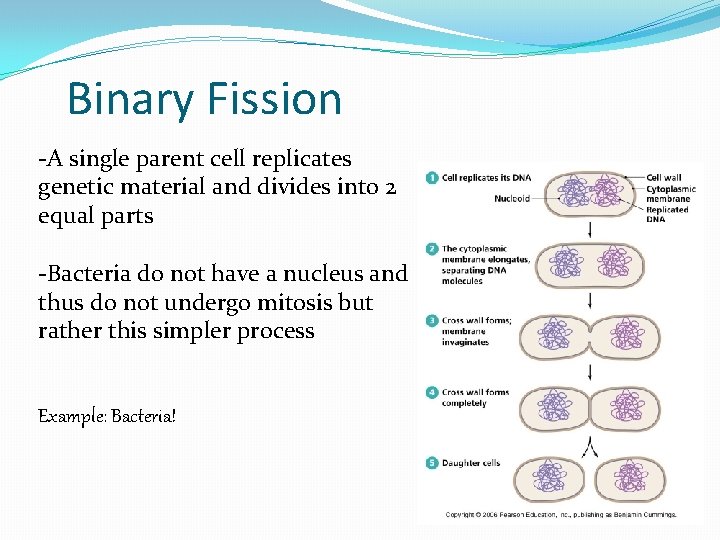
Binary Fission -A single parent cell replicates genetic material and divides into 2 equal parts -Bacteria do not have a nucleus and thus do not undergo mitosis but rather this simpler process Example: Bacteria!
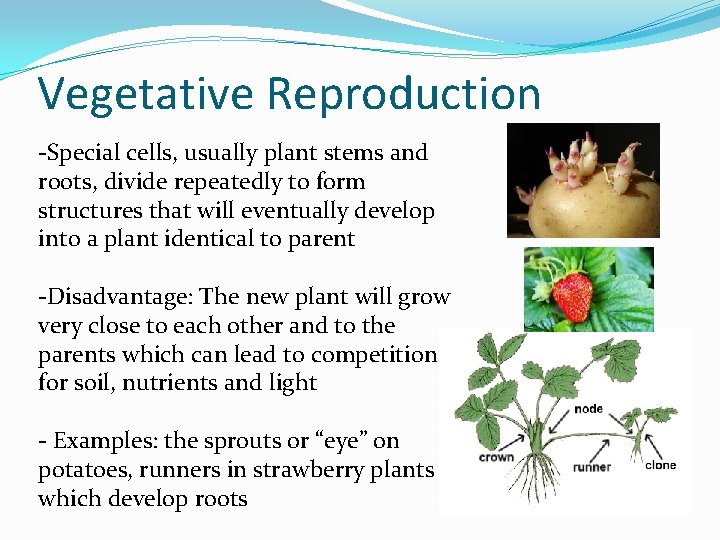
Vegetative Reproduction -Special cells, usually plant stems and roots, divide repeatedly to form structures that will eventually develop into a plant identical to parent -Disadvantage: The new plant will grow very close to each other and to the parents which can lead to competition for soil, nutrients and light - Examples: the sprouts or “eye” on potatoes, runners in strawberry plants which develop roots
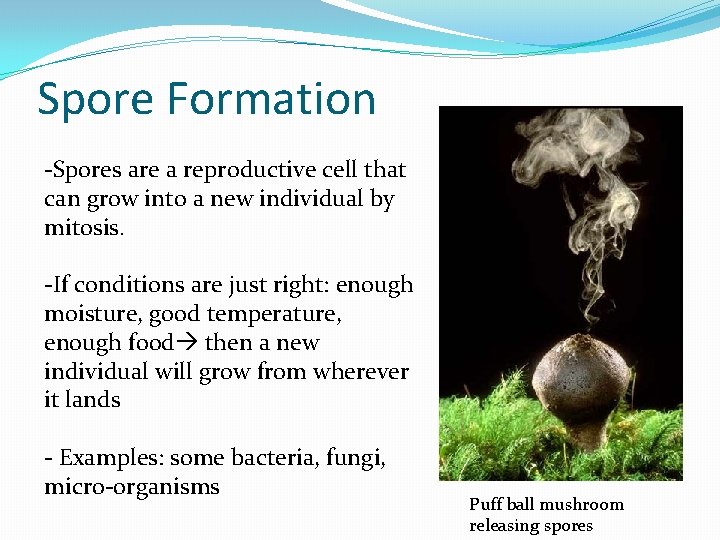
Spore Formation -Spores are a reproductive cell that can grow into a new individual by mitosis. -If conditions are just right: enough moisture, good temperature, enough food then a new individual will grow from wherever it lands - Examples: some bacteria, fungi, micro-organisms Puff ball mushroom releasing spores
Advantages vs Disadvantages? ?
- Slides: 7