
Asexual Reproduction Asexual Reproduction involving only one parent
- Slides: 14
Asexual Reproduction
Asexual Reproduction involving only one parent, offspring are identical to parent. – No special reproductive cells or organs.
Asexual Reproduction – Accomplished by mitosis and cytokinesis. l Offspring have little variation because they are identical to each other and to the parent. – Rapid, results in large numbers of offspring.
Asexual Reproduction 1. 2. 3. 4. 5. Binary Fission Budding Spore Formation Regeneration Vegetative Propagation
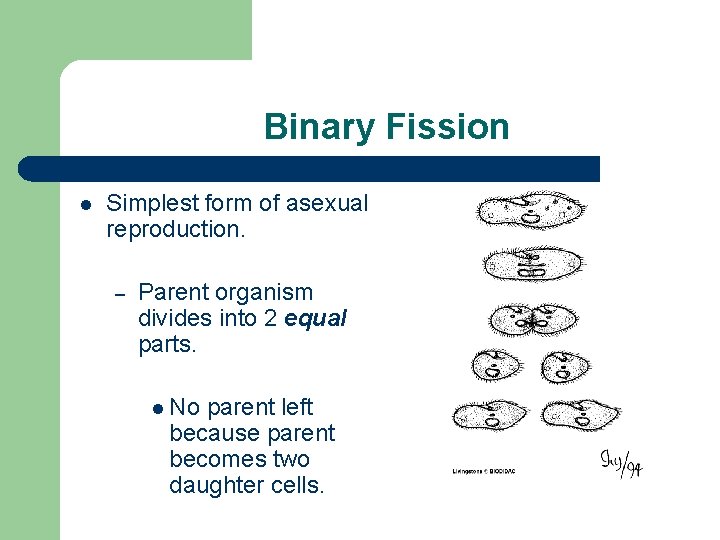
Binary Fission l Simplest form of asexual reproduction. – Parent organism divides into 2 equal parts. l No parent left because parent becomes two daughter cells.
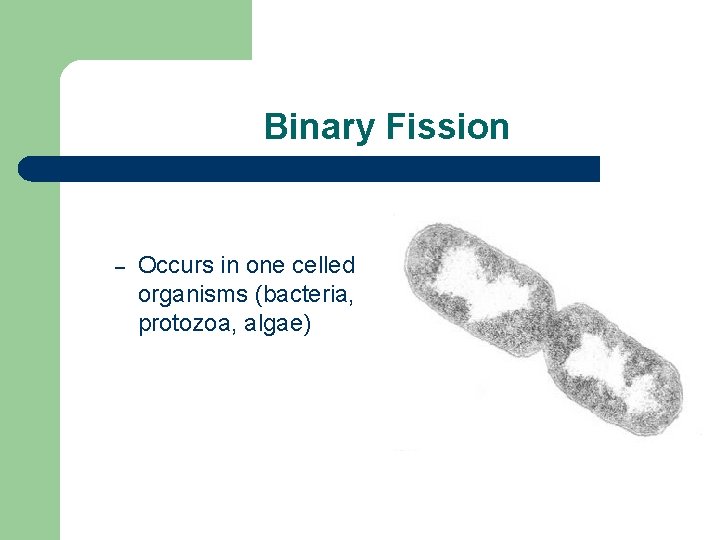
Binary Fission – Occurs in one celled organisms (bacteria, protozoa, algae)
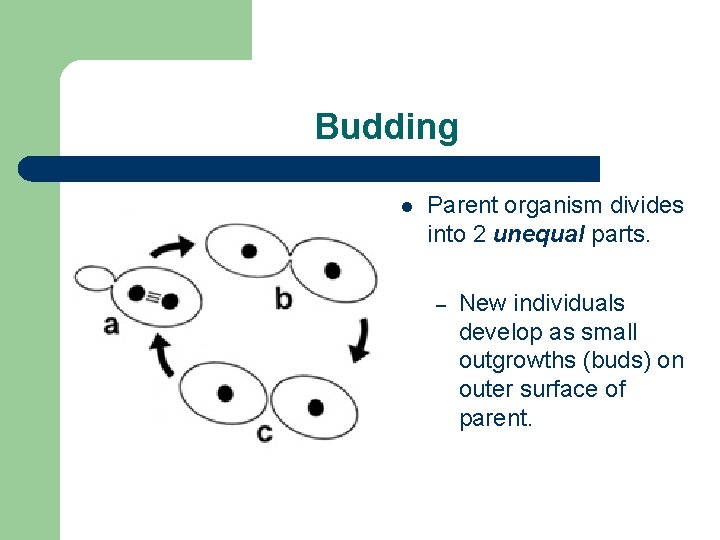
Budding l Parent organism divides into 2 unequal parts. – New individuals develop as small outgrowths (buds) on outer surface of parent.
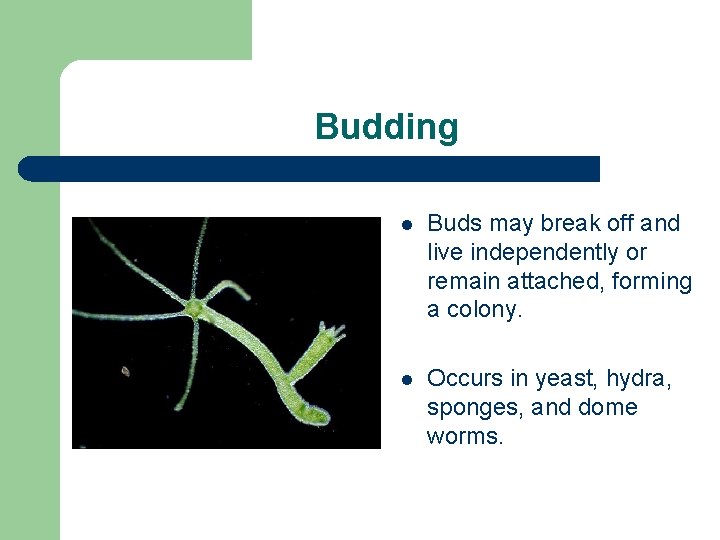
Budding l Buds may break off and live independently or remain attached, forming a colony. l Occurs in yeast, hydra, sponges, and dome worms.
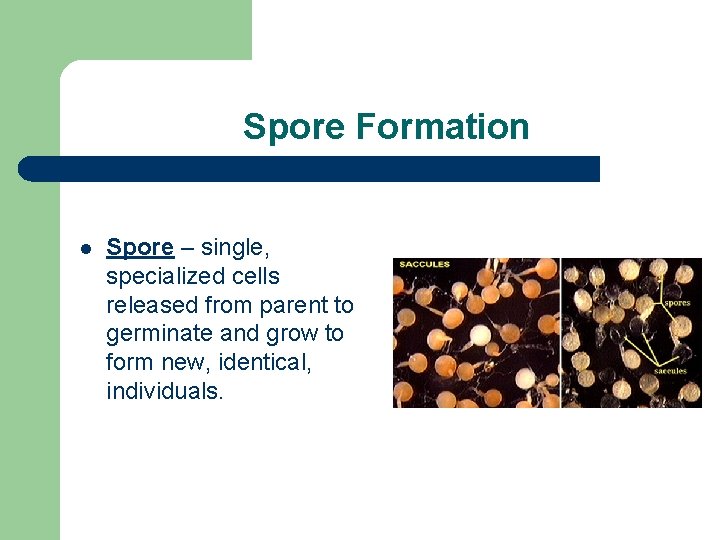
Spore Formation l Spore – single, specialized cells released from parent to germinate and grow to form new, identical, individuals.
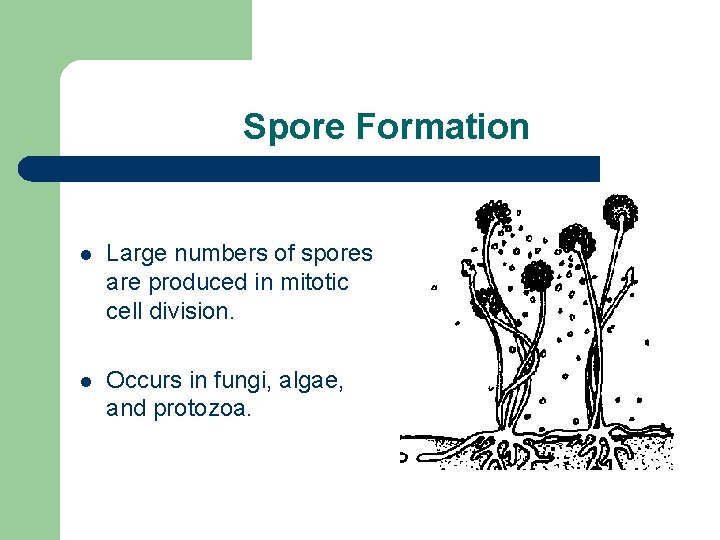
Spore Formation l Large numbers of spores are produced in mitotic cell division. l Occurs in fungi, algae, and protozoa.
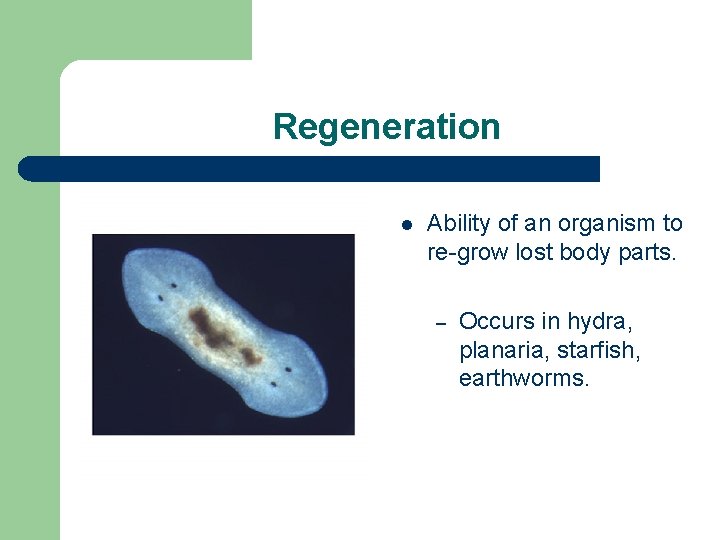
Regeneration l Ability of an organism to re-grow lost body parts. – Occurs in hydra, planaria, starfish, earthworms.
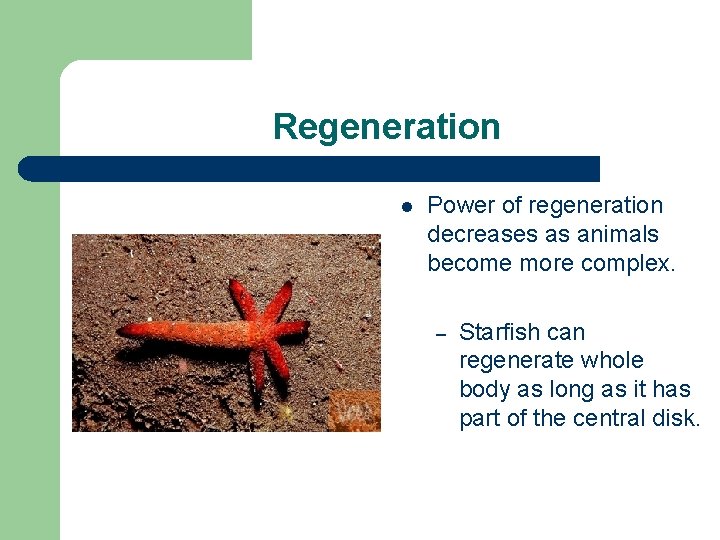
Regeneration l Power of regeneration decreases as animals become more complex. – Starfish can regenerate whole body as long as it has part of the central disk.
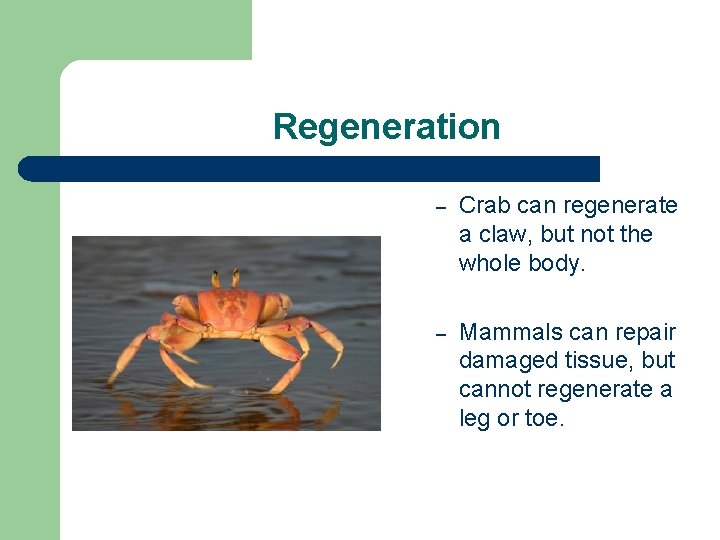
Regeneration – Crab can regenerate a claw, but not the whole body. – Mammals can repair damaged tissue, but cannot regenerate a leg or toe.
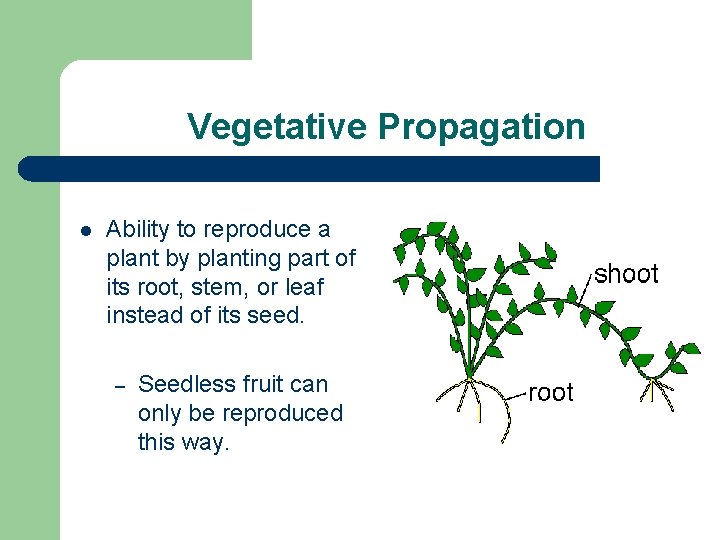
Vegetative Propagation l Ability to reproduce a plant by planting part of its root, stem, or leaf instead of its seed. – Seedless fruit can only be reproduced this way.