
ASER TEST REPORT TDH PROJECT BENGTOL METHODOLOGY Selection
ASER* TEST REPORT TDH PROJECT, BENGTOL

METHODOLOGY Selection of villages and nos. 24 lower primary schools and 3 middle schools covering 25 villages Selection of households/ children and nos. All lower primary and middle schools under the two VCDCs were selected for the ASER test Types of tests – Reading, ‘riting and ‘rithmetic Type of tools used - ASER tools adapted in Bodo & Assamese Language of tests and marking/evaluation - Bodo & Assamese Categorisation by scholastic achievement - children from standard III – VIII Period of study – Oct – Dec, 2016 Purpose of study - To assess the learning levels of primary and middle school children and plan for intervention. To address the critical areas of learning levels a child need to achieve to progress to the next level of education ANNUAL STATUS OF EDUCATION REPORT 2
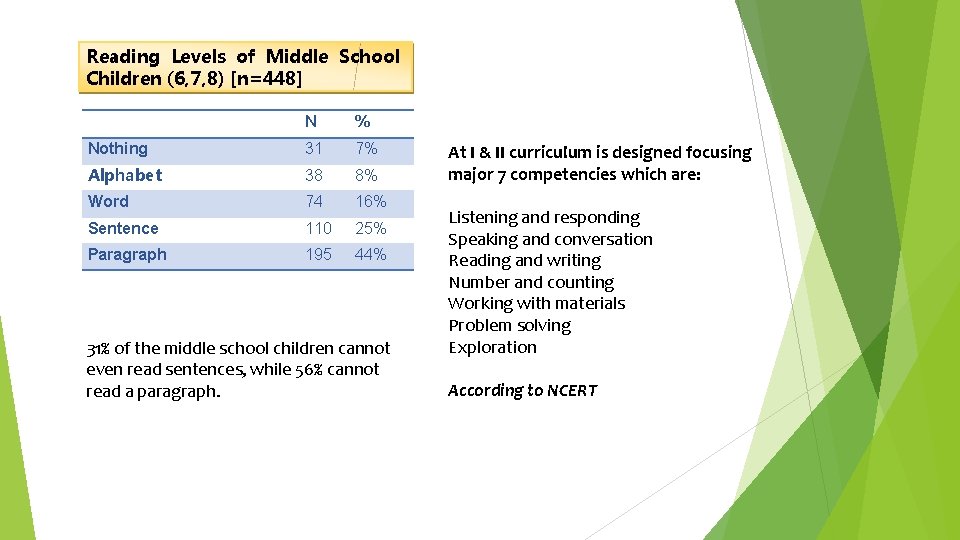
Reading Levels of Middle School Children (6, 7, 8) [n=448] N % Nothing 31 7% Alphabet 38 8% Word 74 16% Sentence 110 25% Paragraph 195 44% 31% of the middle school children cannot even read sentences, while 56% cannot read a paragraph. At I & II curriculum is designed focusing major 7 competencies which are: Listening and responding Speaking and conversation Reading and writing Number and counting Working with materials Problem solving Exploration According to NCERT

Writing Levels of Middle School Children (6, 7, 8) [n=448] N % Able to copy down text 428 96% Can write what is dictated N 328 Unable to copy down 20 text 4% Cannot write what is dictated 120 27% Total 100 Total 448 100 448 4% of the middle school children are unable to copy text while looking at a written text. 27% are unable to write down what is orally dictated. % 73%

Maths level achieved (6, 7, 8) [n=448] Nothing Identifying Numbers Addition Subtraction Multiplication Division Total N 22 57 88 74 98 109 448 % 5% 13% 20% 16% 22% 24% 100 38% of middle school children cant even perform simple subtraction while only 76% of them haven’t learnt how to simply divide! At primary school children are expected to learn: - Pre number concept - Number concept - Four operation (in spiralling order in accordance with the competency of number) - Measurement - Fraction - Time - Shape (Geometry) - Puzzle, riddle, rhythm, etc. Std II simple subtraction 52 -24 ____

COMPARISON BETWEEN BODO AND ASSAMESE MEDIUM MIDDLE SCHOOLS Assamese Medium Students [n=172] Nothing Alphabet Word Sentence Paragraph Total N 29 29 35 33 46 172 % 17 17 20 19 27 100 Bodo Medium Students [n=276] Nothing Alphabet Word Sentence Paragraph N 2 9 39 77 149 % 1 3 14 28 54 Total 276 100 Students In Assamese Medium Middle Schools 34% children haven't graduated beyond reading alphabets while 54% cant even read a full sentence. Students In Bodo Medium Middle Schools Comparatively, only 4% children of Bodo Medium schools cant read words and 82% can read either sentences or full paragraphs.

Writing Levels by Medium of Language in Middle Schools Assamese Medium Students [n=172] Assamese Medium Able to copy down text N 162 Unable to copy down 10 text Total 172 Bodo Medium Students [n=276] % 94 Bodo Medium N % Able to copy down text 266 96 6 Unable to copy down text 10 4 Total 276 100
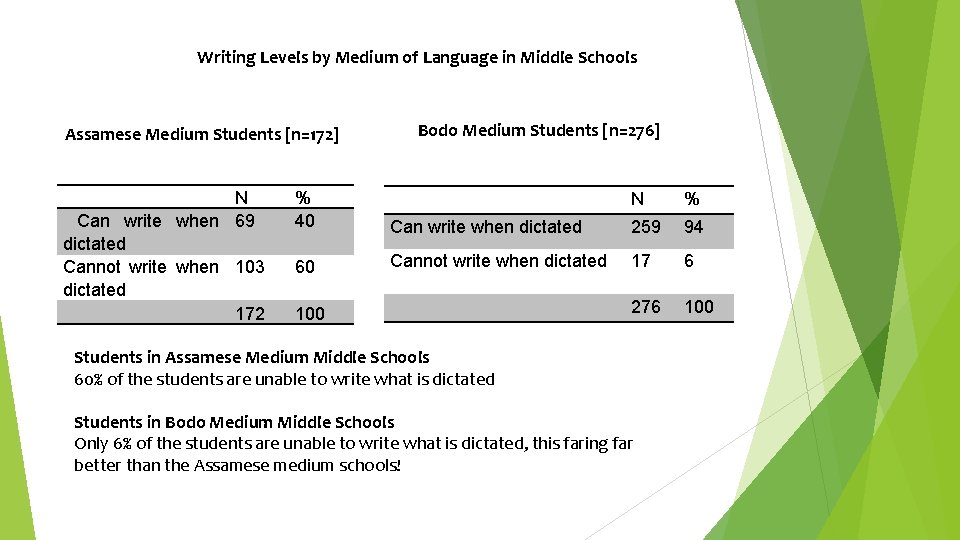
Writing Levels by Medium of Language in Middle Schools Assamese Medium Students [n=172] N Can write when 69 dictated Cannot write when 103 dictated 172 % 40 60 Bodo Medium Students [n=276] N % Can write when dictated 259 94 Cannot write when dictated 17 6 276 100 Students in Assamese Medium Middle Schools 60% of the students are unable to write what is dictated Students in Bodo Medium Middle Schools Only 6% of the students are unable to write what is dictated, this faring far better than the Assamese medium schools!
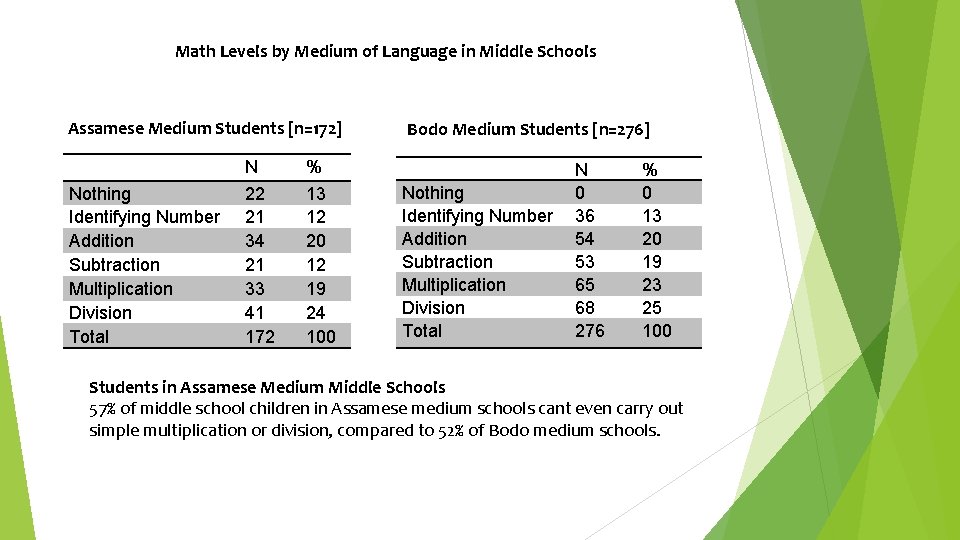
Math Levels by Medium of Language in Middle Schools Assamese Medium Students [n=172] Nothing Identifying Number Addition Subtraction Multiplication Division Total N 22 21 34 21 33 41 172 % 13 12 20 12 19 24 100 Bodo Medium Students [n=276] Nothing Identifying Number Addition Subtraction Multiplication Division Total N 0 36 54 53 65 68 276 % 0 13 20 19 23 25 100 Students in Assamese Medium Middle Schools 57% of middle school children in Assamese medium schools cant even carry out simple multiplication or division, compared to 52% of Bodo medium schools.
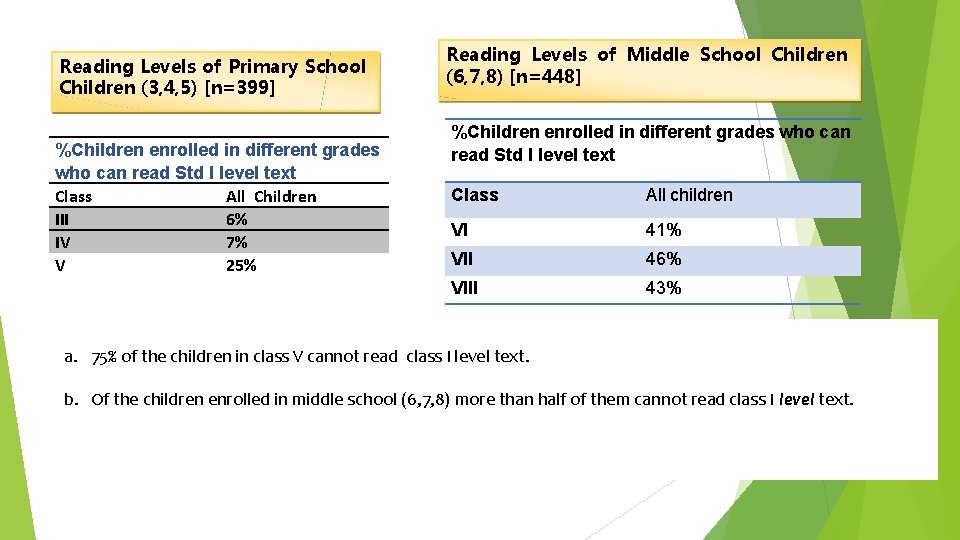
Reading Levels of Primary School Children (3, 4, 5) [n=399] %Children enrolled in different grades who can read Std I level text Class All Children III 6% IV 7% V 25% Reading Levels of Middle School Children (6, 7, 8) [n=448] %Children enrolled in different grades who can read Std I level text Class All children VI 41% VII 46% VIII 43% a. 75% of the children in class V cannot read class I level text. b. Of the children enrolled in middle school (6, 7, 8) more than half of them cannot read class I level text.
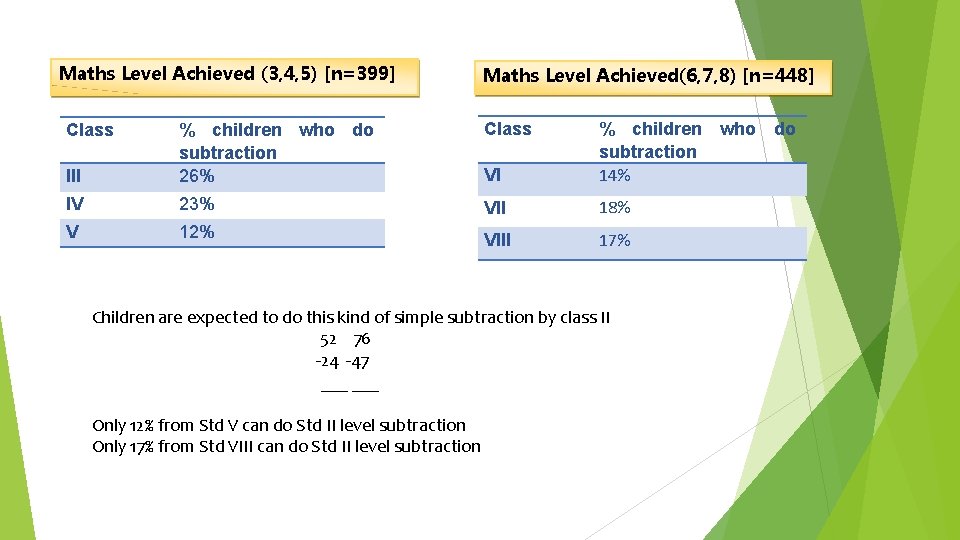
Maths Level Achieved (3, 4, 5) [n=399] Maths Level Achieved(6, 7, 8) [n=448] Class III % children who do subtraction 26% VI % children who do subtraction 14% IV 23% VII 18% V 12% VIII 17% Class Children are expected to do this kind of simple subtraction by class II 52 76 -24 -47 ___ Only 12% from Std V can do Std II level subtraction Only 17% from Std VIII can do Std II level subtraction
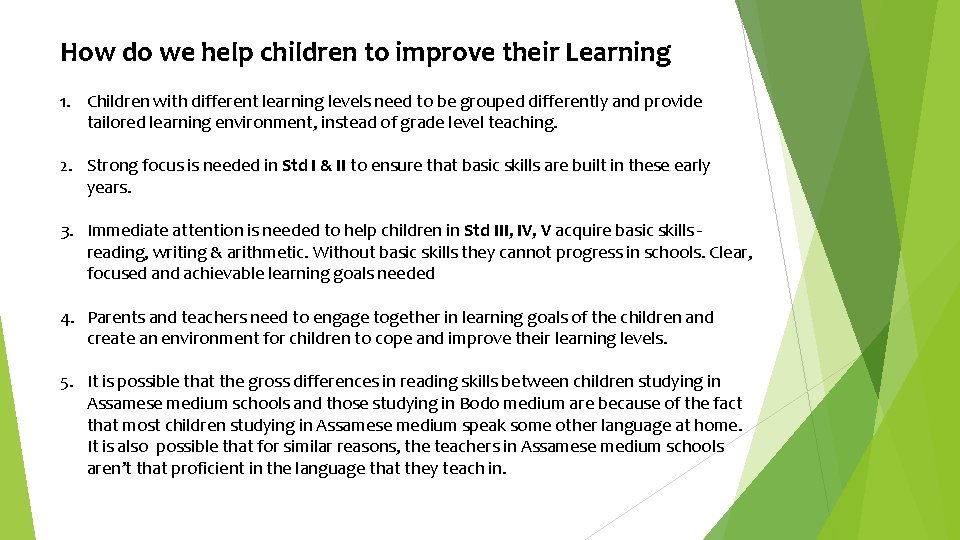
How do we help children to improve their Learning 1. Children with different learning levels need to be grouped differently and provide tailored learning environment, instead of grade level teaching. 2. Strong focus is needed in Std I & II to ensure that basic skills are built in these early years. 3. Immediate attention is needed to help children in Std III, IV, V acquire basic skills - reading, writing & arithmetic. Without basic skills they cannot progress in schools. Clear, focused and achievable learning goals needed 4. Parents and teachers need to engage together in learning goals of the children and create an environment for children to cope and improve their learning levels. 5. It is possible that the gross differences in reading skills between children studying in Assamese medium schools and those studying in Bodo medium are because of the fact that most children studying in Assamese medium speak some other language at home. It is also possible that for similar reasons, the teachers in Assamese medium schools aren’t that proficient in the language that they teach in.

THANK YOU
- Slides: 13