
ASEP Revision of DF and OICA methods GRB
ASEP -- Revision of D/F and OICA methods -- GRB informal meeting #13 6 -7 November 2008 JASIC
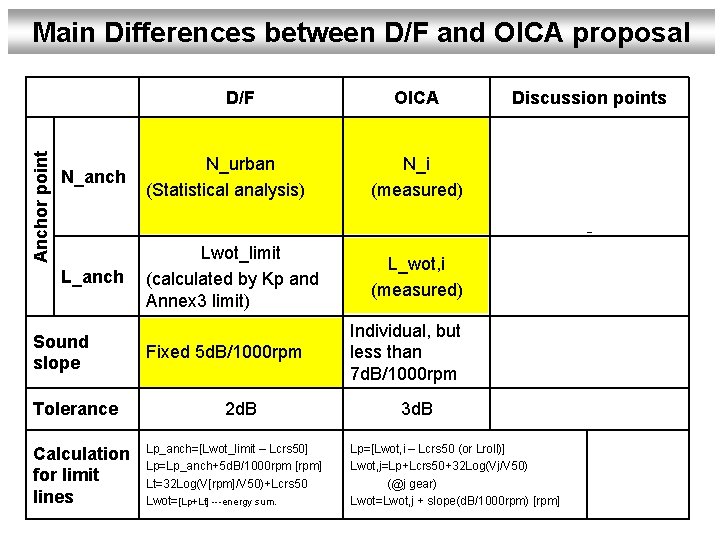
Main Differences between D/F and OICA proposal Anchor point D/F OICA Discussion points N_anch N_urban (Statistical analysis) N_i (measured) Gap of Average and measured engine speed. Case of exceeding 2 m/s^2 on gear i L_anch Lwot_limit (calculated by Kp and Annex 3 limit) L_wot, i (measured) Consideration for low noise vehicles Sound slope Tolerance Calculation for limit lines Fixed 5 d. B/1000 rpm 2 d. B Lp_anch=[Lwot_limit – Lcrs 50] Lp=Lp_anch+5 d. B/1000 rpm [rpm] Lt=32 Log(V[rpm]/V 50)+Lcrs 50 Lwot=[Lp+Lt] ---energy sum. Individual, but less than 7 d. B/1000 rpm 5 d. B/1000 rpm is average. A half of data base are higher slope. 3 d. B Lp=[Lwot, i – Lcrs 50 (or Lroll)] Lwot, j=Lp+Lcrs 50+32 Log(Vj/V 50) (@j gear) Lwot=Lwot, j + slope(d. B/1000 rpm) [rpm]
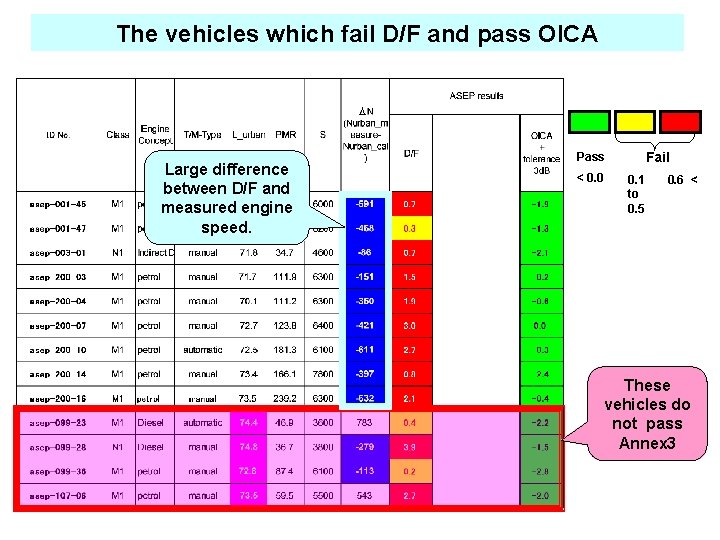
The vehicles which fail D/F and pass OICA Large difference between D/F and measured engine speed. Pass < 0. 0 Fail 0. 1 to 0. 5 0. 6 < These vehicles do not pass Annex 3
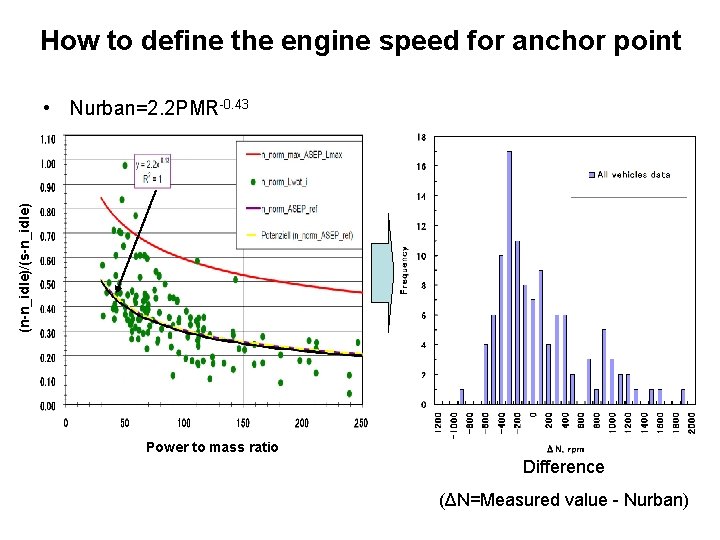
How to define the engine speed for anchor point (n-n_idle)/(s-n_idle) • Nurban=2. 2 PMR-0. 43 Power to mass ratio Difference (ΔN=Measured value - Nurban)
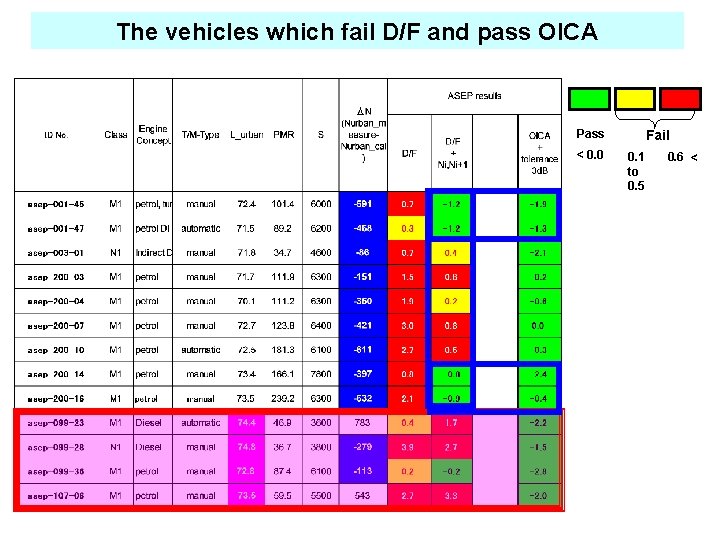
The vehicles which fail D/F and pass OICA Pass < 0. 0 Fail 0. 1 to 0. 5 0. 6 <
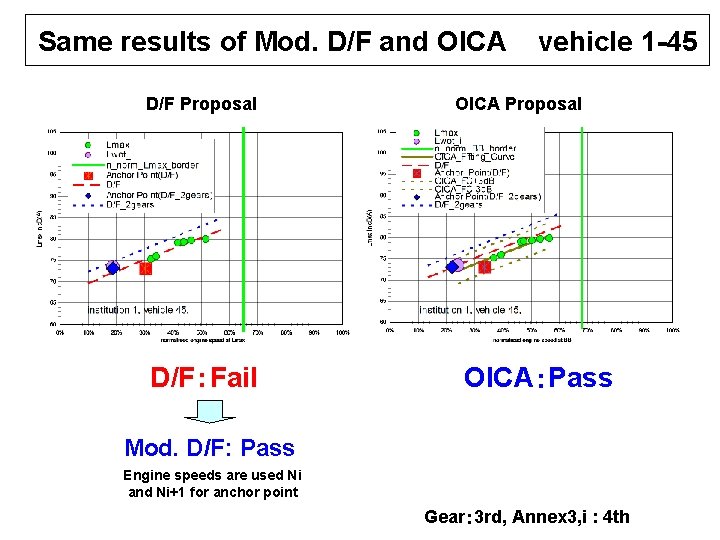
Same results of Mod. D/F and OICA D/F Proposal D/F:Fail vehicle 1 -45 OICA Proposal OICA:Pass Mod. D/F: Pass Engine speeds are used Ni and Ni+1 for anchor point Gear: 3 rd, Annex 3, i : 4 th
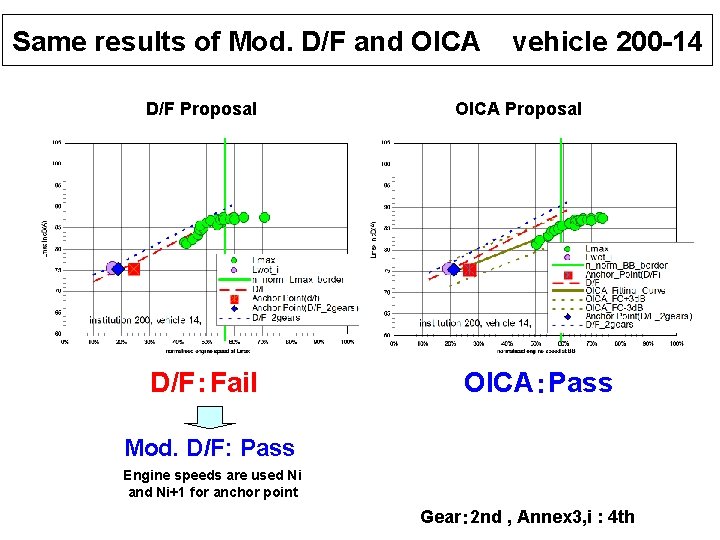
Same results of Mod. D/F and OICA D/F Proposal D/F:Fail vehicle 200 -14 OICA Proposal OICA:Pass Mod. D/F: Pass Engine speeds are used Ni and Ni+1 for anchor point Gear: 2 nd , Annex 3, i : 4 th
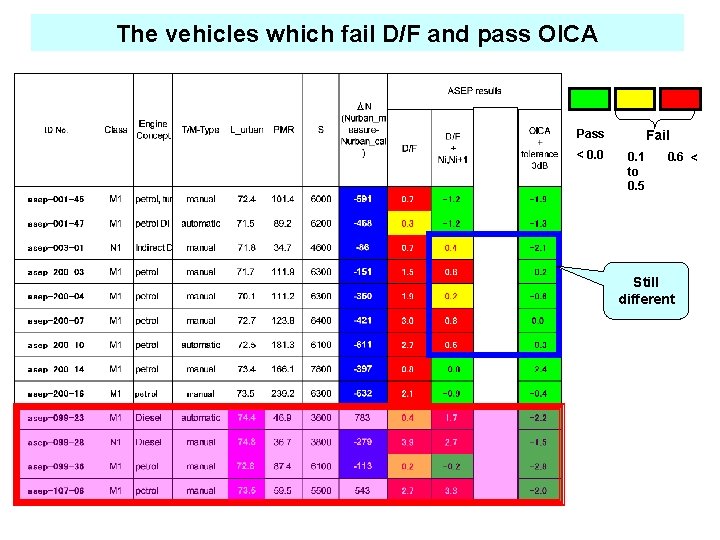
The vehicles which fail D/F and pass OICA Pass < 0. 0 Fail 0. 1 to 0. 5 0. 6 < Still different
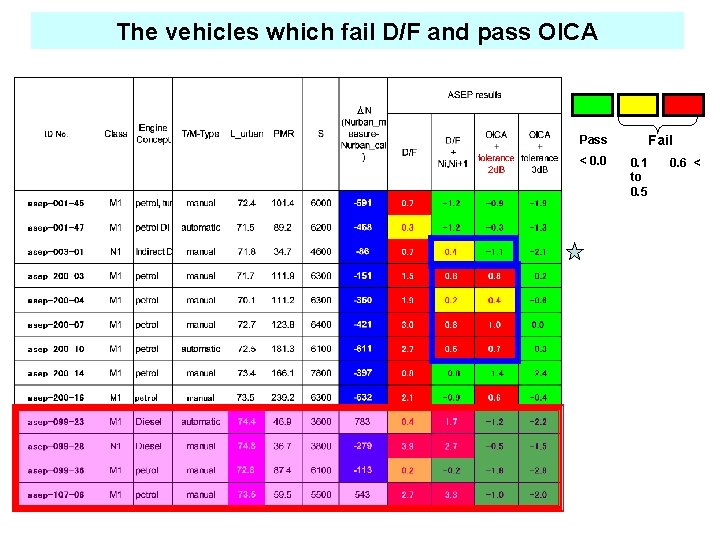
The vehicles which fail D/F and pass OICA Pass < 0. 0 Fail 0. 1 to 0. 5 0. 6 <
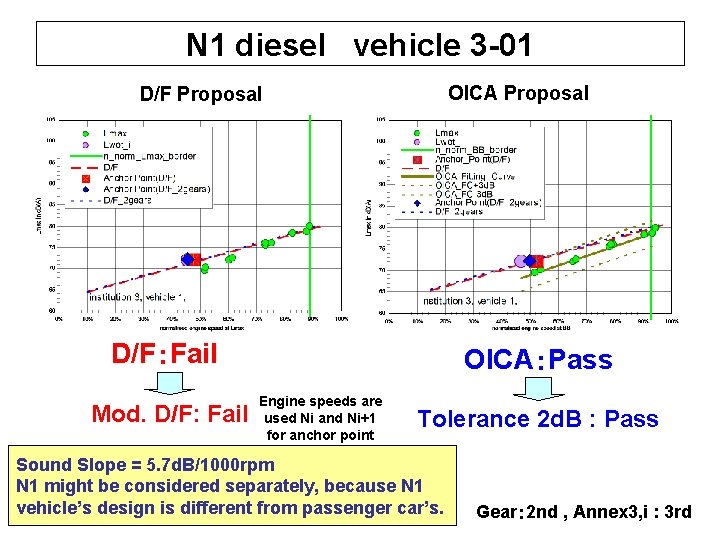
N 1 diesel vehicle 3 -01 OICA Proposal D/F:Fail Mod. D/F: Fail OICA:Pass Engine speeds are used Ni and Ni+1 for anchor point Tolerance 2 d. B : Pass Sound Slope = 5. 7 d. B/1000 rpm N 1 might be considered separately, because N 1 vehicle’s design is different from passenger car’s. Gear: 2 nd , Annex 3, i : 3 rd
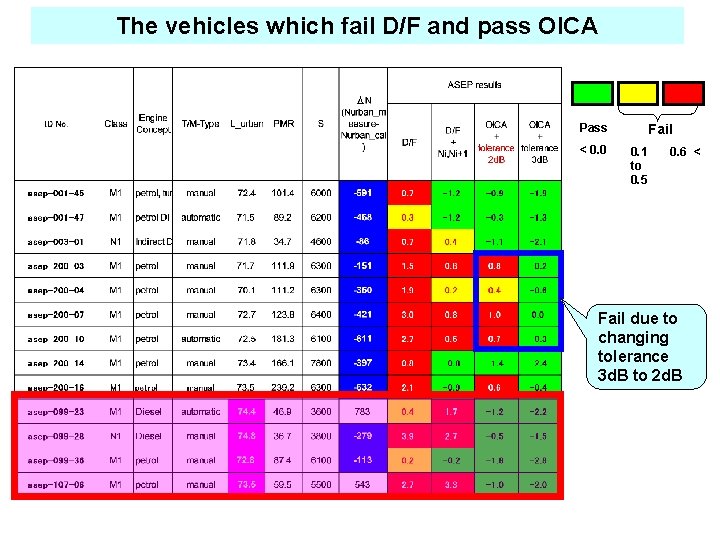
The vehicles which fail D/F and pass OICA Pass < 0. 0 Fail 0. 1 to 0. 5 0. 6 < Fail due to changing tolerance 3 d. B to 2 d. B
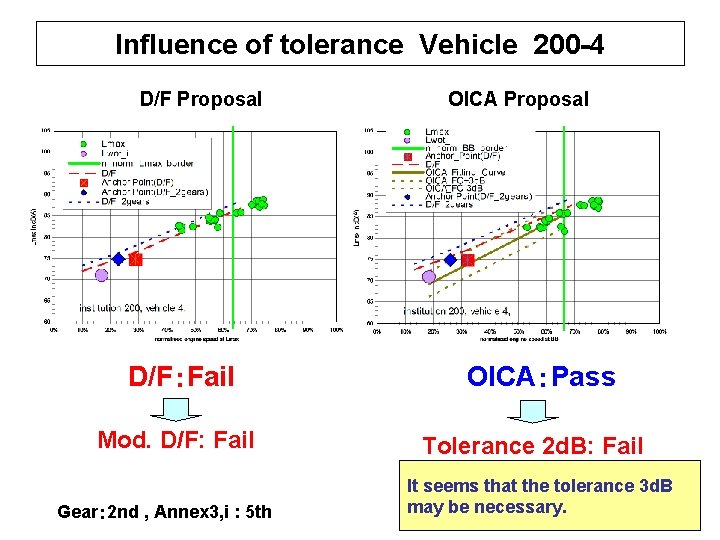
Influence of tolerance Vehicle 200 -4 D/F Proposal D/F:Fail Mod. D/F: Fail Gear: 2 nd , Annex 3, i : 5 th OICA Proposal OICA:Pass Tolerance 2 d. B: Fail It seems that the tolerance 3 d. B may be necessary.
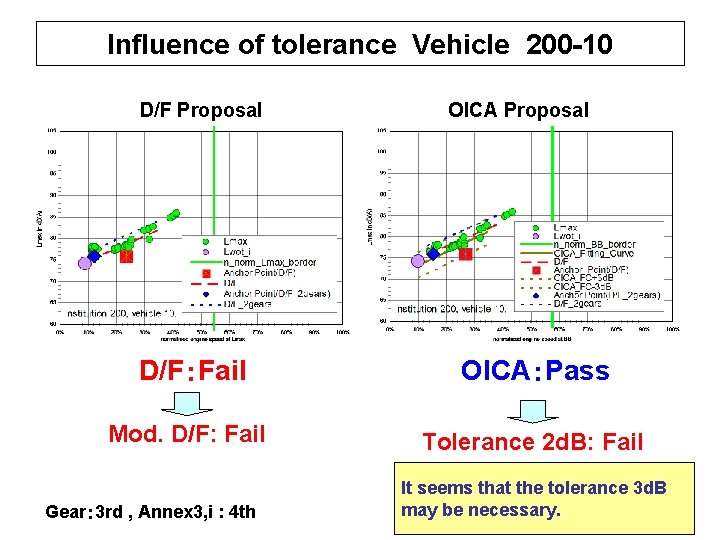
Influence of tolerance Vehicle 200 -10 D/F Proposal OICA Proposal D/F:Fail OICA:Pass Mod. D/F: Fail Tolerance 2 d. B: Fail Gear: 3 rd , Annex 3, i : 4 th It seems that the tolerance 3 d. B may be necessary.
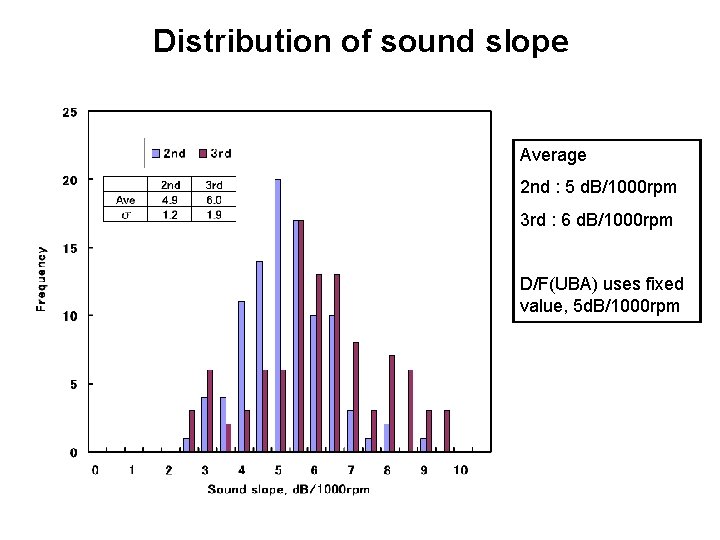
Distribution of sound slope Average 2 nd : 5 d. B/1000 rpm 3 rd : 6 d. B/1000 rpm D/F(UBA) uses fixed value, 5 d. B/1000 rpm
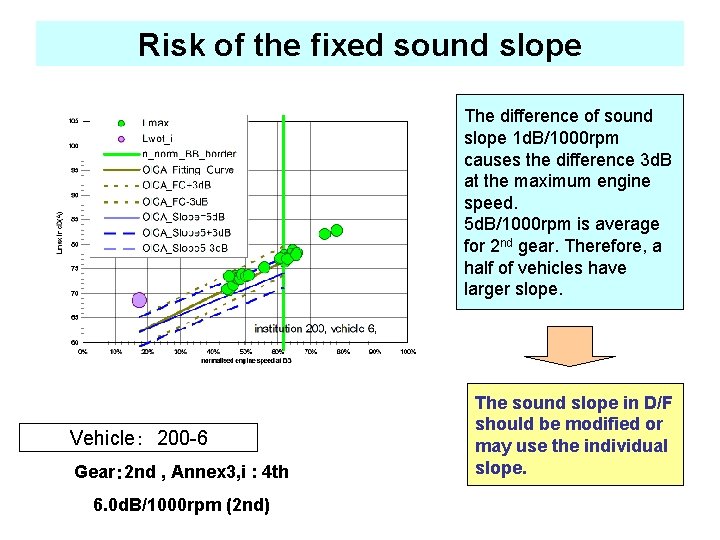
Risk of the fixed sound slope The difference of sound slope 1 d. B/1000 rpm causes the difference 3 d. B at the maximum engine speed. 5 d. B/1000 rpm is average for 2 nd gear. Therefore, a half of vehicles have larger slope. Vehicle: 200 -6 Gear: 2 nd , Annex 3, i : 4 th 6. 0 d. B/1000 rpm (2 nd) The sound slope in D/F should be modified or may use the individual slope.
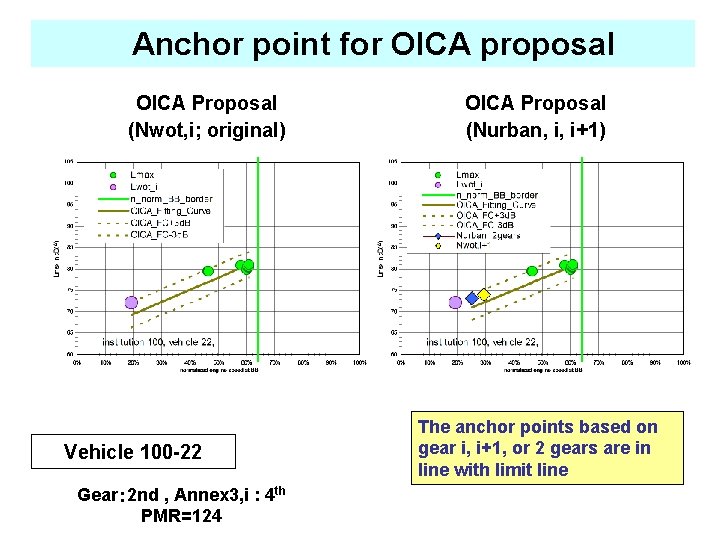
Anchor point for OICA proposal OICA Proposal (Nwot, i; original) Vehicle 100 -22 Gear: 2 nd , Annex 3, i : 4 th PMR=124 OICA Proposal (Nurban, i, i+1) The anchor points based on gear i, i+1, or 2 gears are in line with limit line
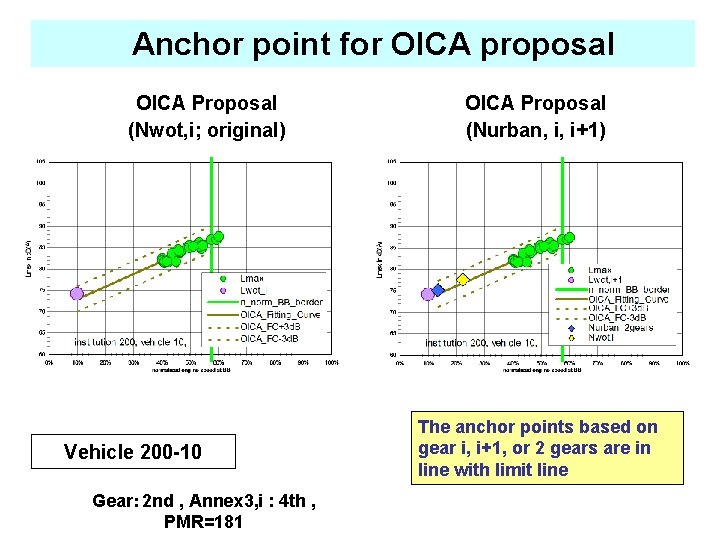
Anchor point for OICA proposal OICA Proposal (Nwot, i; original) Vehicle 200 -10 Gear: 2 nd , Annex 3, i : 4 th , PMR=181 OICA Proposal (Nurban, i, i+1) The anchor points based on gear i, i+1, or 2 gears are in line with limit line
Summary (1) • The result of D/F proposal with modified engine speed for anchor point is same as that of OICA method with 2 d. B tolerance. (But the tolerance should be optimized. ) • The sound slope in D/F should be modified or may use the individual slope. • N 1 might be considered separately, because N 1 vehicle’s design is different from passenger car’s. However, D-range tests on automatic transmission have the other problem.
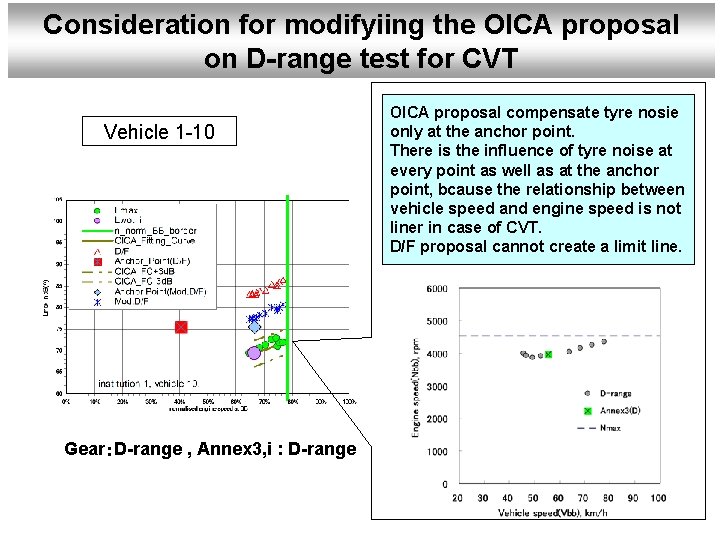
Consideration for modifyiing the OICA proposal on D-range test for CVT Vehicle 1 -10 Gear:D-range , Annex 3, i : D-range OICA proposal compensate tyre nosie only at the anchor point. There is the influence of tyre noise at every point as well as at the anchor point, bcause the relationship between vehicle speed and engine speed is not liner in case of CVT. D/F proposal cannot create a limit line.
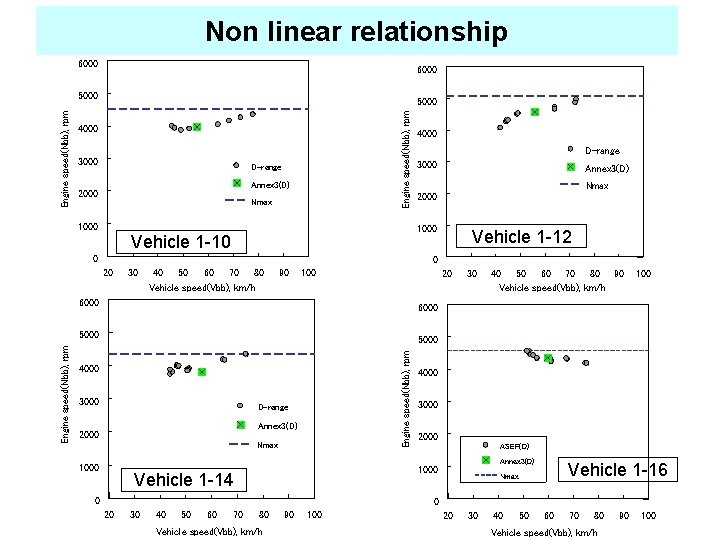
Non linear relationship 6000 5000 Engine speed(Nbb), rpm 5000 4000 3000 D-range Annex 3(D) 2000 Nmax 1000 D-range 3000 Annex 3(D) Nmax 2000 1000 Vehicle 1 -10 0 Vehicle 1 -12 0 20 30 40 50 60 70 80 Vehicle speed(Vbb), km/h 90 100 20 6000 30 40 50 60 70 80 90 Vehicle speed(Vbb), km/h 100 6000 5000 Engine speed(Nbb), rpm 4000 3000 D-range Annex 3(D) 2000 Nmax 1000 4000 3000 2000 ASEP(D) Annex 3(D) 1000 Vehicle 1 -14 0 Vehicle 1 -16 Nmax 0 20 30 40 50 60 70 80 Vehicle speed(Vbb), km/h 90 100
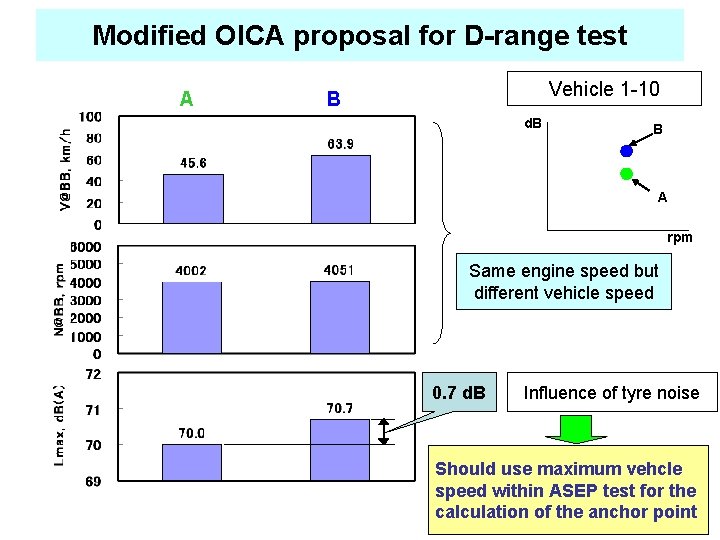
Modified OICA proposal for D-range test A Vehicle 1 -10 B d. B B A rpm Same engine speed but different vehicle speed 0. 7 d. B Influence of tyre noise Should use maximum vehcle speed within ASEP test for the calculation of the anchor point
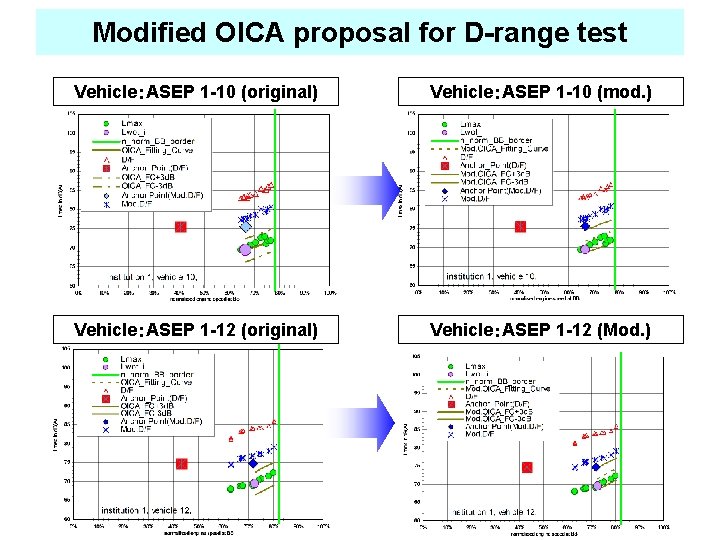
Modified OICA proposal for D-range test Vehicle:ASEP 1 -10 (original) Vehicle:ASEP 1 -10 (mod. ) Vehicle:ASEP 1 -12 (original) Vehicle:ASEP 1 -12 (Mod. )
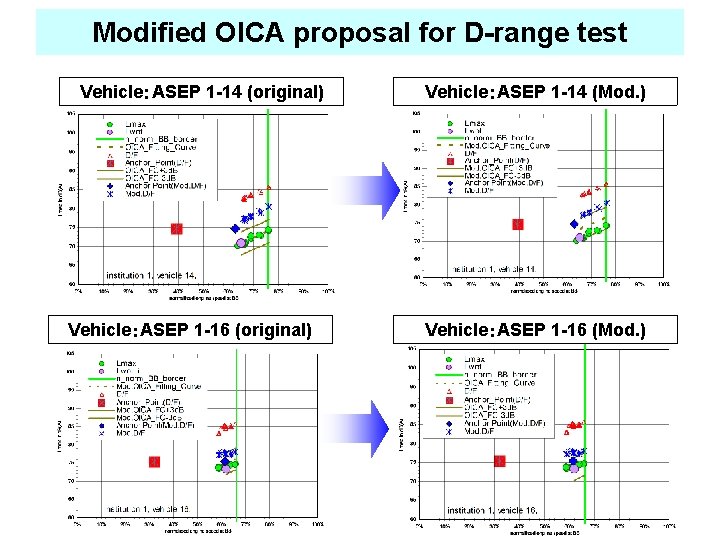
Modified OICA proposal for D-range test Vehicle:ASEP 1 -14 (original) Vehicle:ASEP 1 -16 (original) Vehicle:ASEP 1 -14 (Mod. ) Vehicle:ASEP 1 -16 (Mod. )
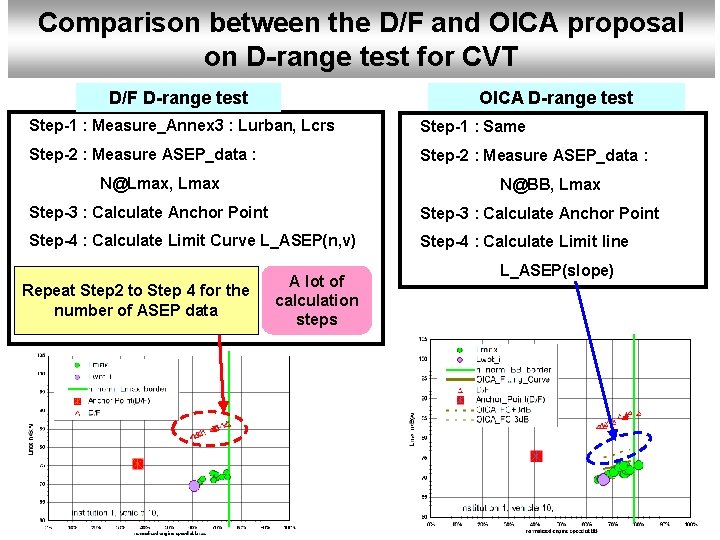
Comparison between the D/F and OICA proposal on D-range test for CVT D/F D-range test OICA D-range test Step-1 : Measure_Annex 3 : Lurban, Lcrs Step-1 : Same Step-2 : Measure ASEP_data : N@Lmax, Lmax N@BB, Lmax Step-3 : Calculate Anchor Point Step-4 : Calculate Limit Curve L_ASEP(n, v) Step-4 : Calculate Limit line Repeat Step 2 to Step 4 for the number of ASEP data A lot of calculation steps L_ASEP(slope)
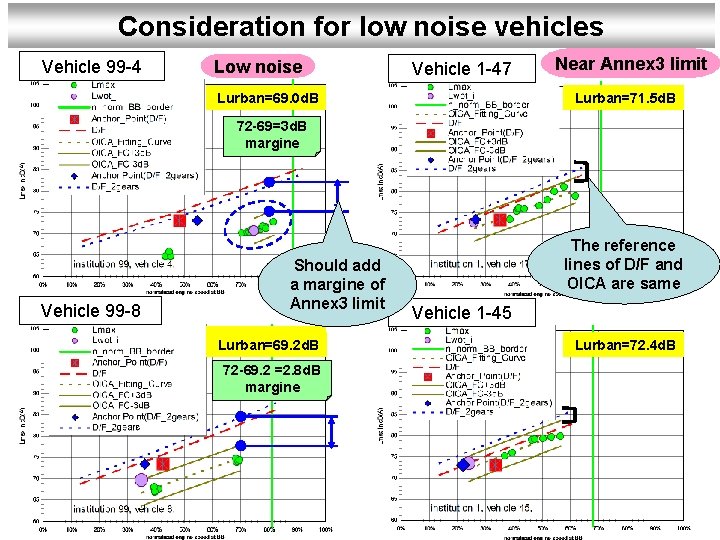
Consideration for low noise vehicles Vehicle 99 -4 Low noise Vehicle 1 -47 Near Annex 3 limit Lurban=71. 5 d. B Lurban=69. 0 d. B 72 -69=3 d. B margine Vehicle 99 -8 Should add a margine of Annex 3 limit Lurban=69. 2 d. B 72 -69. 2 =2. 8 d. B margine The reference lines of D/F and OICA are same Vehicle 1 -45 Lurban=72. 4 d. B
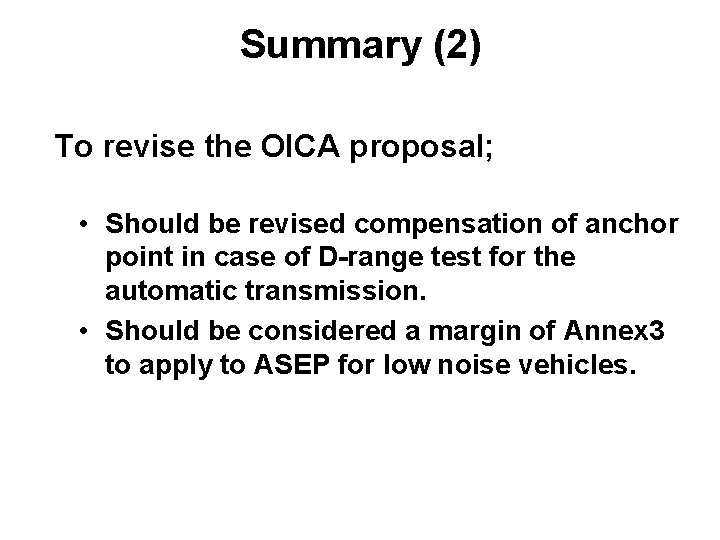
Summary (2) To revise the OICA proposal; • Should be revised compensation of anchor point in case of D-range test for the automatic transmission. • Should be considered a margin of Annex 3 to apply to ASEP for low noise vehicles.
Exemption (Simplification)
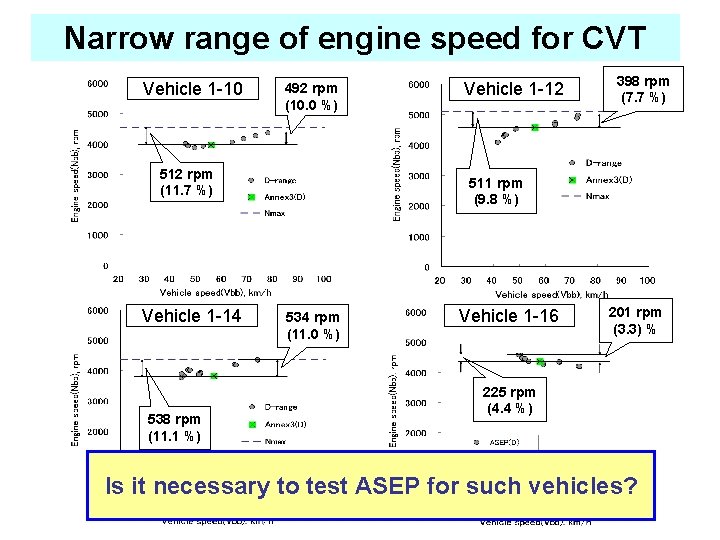
Narrow range of engine speed for CVT Vehicle 1 -10 492 rpm (10. 0 %) 512 rpm (11. 7 %) Vehicle 1 -14 538 rpm (11. 1 %) Vehicle 1 -12 398 rpm (7. 7 %) 511 rpm (9. 8 %) 534 rpm (11. 0 %) Vehicle 1 -16 201 rpm (3. 3) % 225 rpm (4. 4 %) Is it necessary to test ASEP for such vehicles?
How about lower engine speed of Annex 3? There is no example that exceeds the noise level of Annex 3 below the engine speed of Annex 3.
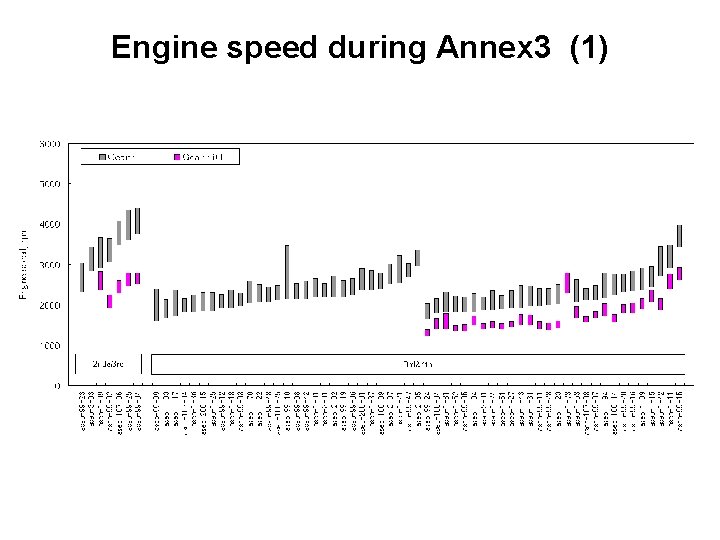
Engine speed during Annex 3 (1)
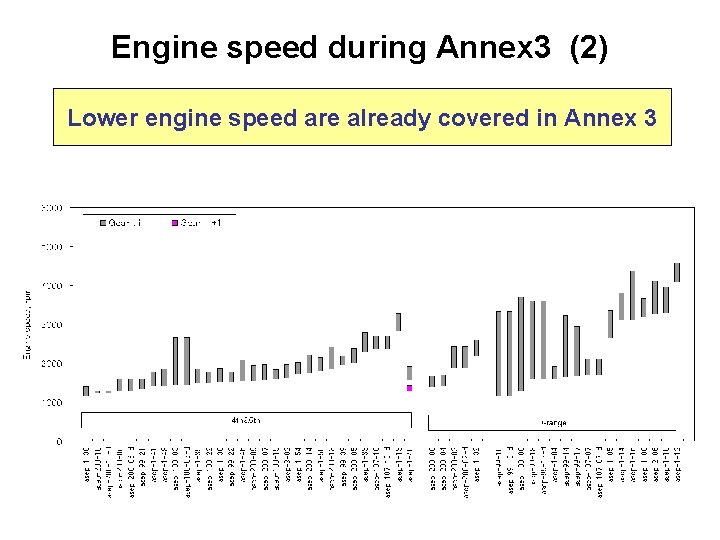
Engine speed during Annex 3 (2) Lower engine speed are already covered in Annex 3
Summary (3) • May skip ASEP test when Annex 3 covers the engine speed in ASEP. • Not necessary to test below Annex 3 (anchor point)
Appendix
- Slides: 33