
ASEAN ESC Model Cities Programme ASEANJapan Ministerial Dialogue
- Slides: 14
ASEAN ESC Model Cities Programme ASEAN-Japan Ministerial Dialogue on Environmental Cooperation 26 Sep. 2013 Surabaya, Indonesia ASEAN Secretariat
ASEAN ESC Model Cities Programme (Year 1) Designed as an umbrella initiative to support EAS Environment Ministers’ priority area for regional collaboration on ‘ESC’ Funder Japan-ASEAN Integration Fund (JAIF) Regional Secretariat • Objective: Promoting ESC development by supporting capacity building for bottom-up initiatives of ASEAN cities and strengthening national ESC frameworks. • Year 1: Apr. 2011 - Mar. 2012 (extension in progress) ASEAN Secretariat • Assistance to: 14 cities in 8 countries (Cambodia, Indonesia, Lao PDR, Myanmar, Malaysia, Philippines, Thailand Viet Nam)
The programme’s approach and implementation • Local: Cities as ‘role models’ and champions • Establish visions, goals and plans • Take practical actions • Innovate, inspire and spread good practices/policies to other cities • National: Country-based Model Cities Programme - provide/design enabling frameworks as well as dissemination, replication and scale-up of good practices • Regional: Reporting & networking platform - provide appreciation and recognition, facilitate cross country city-to-city learning, matching ‘demand’ and ‘supply’ of resources • Other stakeholders: Partners to the programme providing additional resources (technical assistance, financial, networks etc. )
Summary of Achievements Year 1 • National ESC Frameworks o Synergised or linked with existing ESC related national programmes, particularly existing sustainable city award programmes o Helped to initiate process of formulating national ESC frameworks, particularly in Cambodia and Viet Nam • Local Capacity Building o Provided seed funding, technical assistance and others forms of support for achieving local ESC visions and goals of 14 cities o Main sectors/themes: Solid waste management, water and sanitation, urban greenery, low carbon city development • City-to-city Cooperation o o Kuching – Nonthaburi – Kitakyushu Puerto Princesa – Palo Jogjakarta – Malang – Surabaya – Palembang Yangon – Penang
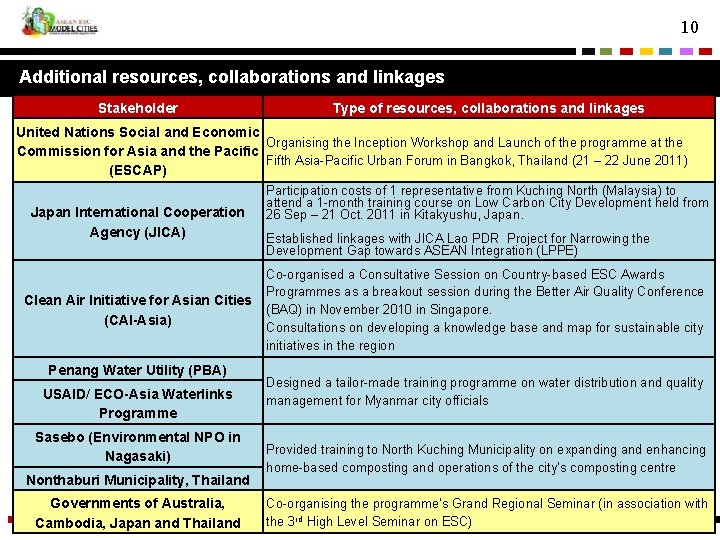
10 Additional resources, collaborations and linkages Stakeholder Type of resources, collaborations and linkages United Nations Social and Economic Organising the Inception Workshop and Launch of the programme at the Commission for Asia and the Pacific Fifth Asia-Pacific Urban Forum in Bangkok, Thailand (21 – 22 June 2011) (ESCAP) Japan International Cooperation Agency (JICA) Clean Air Initiative for Asian Cities (CAI-Asia) Penang Water Utility (PBA) USAID/ ECO-Asia Waterlinks Programme Sasebo (Environmental NPO in Nagasaki) Nonthaburi Municipality, Thailand Governments of Australia, Cambodia, Japan and Thailand Participation costs of 1 representative from Kuching North (Malaysia) to attend a 1 -month training course on Low Carbon City Development held from 26 Sep – 21 Oct. 2011 in Kitakyushu, Japan. Established linkages with JICA Lao PDR Project for Narrowing the Development Gap towards ASEAN Integration (LPPE) Co-organised a Consultative Session on Country-based ESC Awards Programmes as a breakout session during the Better Air Quality Conference (BAQ) in November 2010 in Singapore. Consultations on developing a knowledge base and map for sustainable city initiatives in the region Designed a tailor-made training programme on water distribution and quality management for Myanmar city officials Provided training to North Kuching Municipality on expanding and enhancing home-based composting and operations of the city’s composting centre Co-organising the programme’s Grand Regional Seminar (in association with the 3 rd High Level Seminar on ESC)
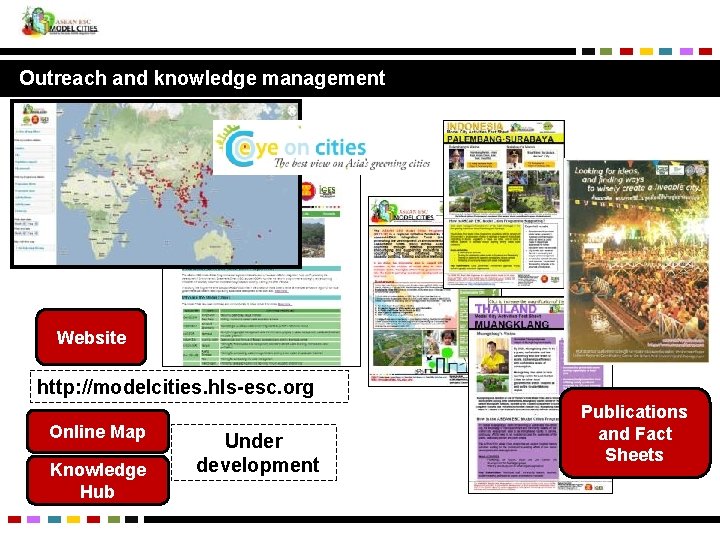
Outreach and knowledge management Website http: //modelcities. hls-esc. org Online Map Knowledge Hub Under development Publications and Fact Sheets
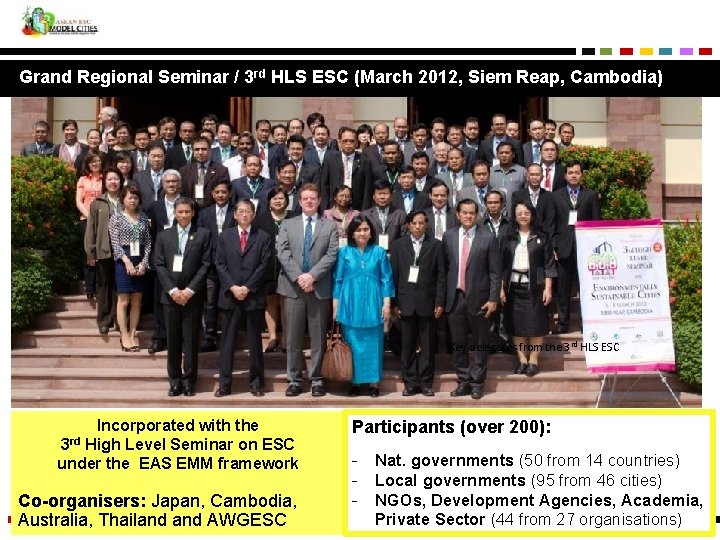
Grand Regional Seminar / 3 rd HLS ESC (March 2012, Siem Reap, Cambodia) Key delegates from the 3 rd HLS ESC Incorporated with the 3 rd High Level Seminar on ESC under the EAS EMM framework Co-organisers: Japan, Cambodia, Australia, Thailand AWGESC Participants (over 200): - Nat. governments (50 from 14 countries) - Local governments (95 from 46 cities) - NGOs, Development Agencies, Academia, Private Sector (44 from 27 organisations)
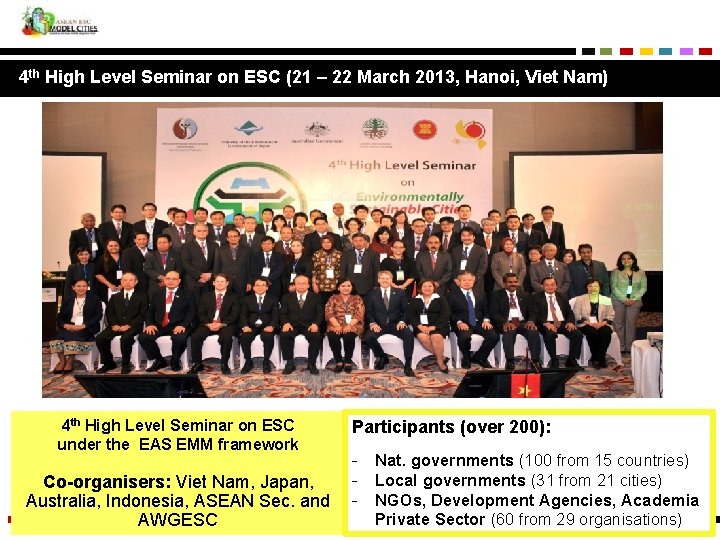
4 th High Level Seminar on ESC (21 – 22 March 2013, Hanoi, Viet Nam) 4 th High Level Seminar on ESC under the EAS EMM framework Co-organisers: Viet Nam, Japan, Australia, Indonesia, ASEAN Sec. and AWGESC Participants (over 200): - Nat. governments (100 from 15 countries) - Local governments (31 from 21 cities) - NGOs, Development Agencies, Academia Private Sector (60 from 29 organisations)
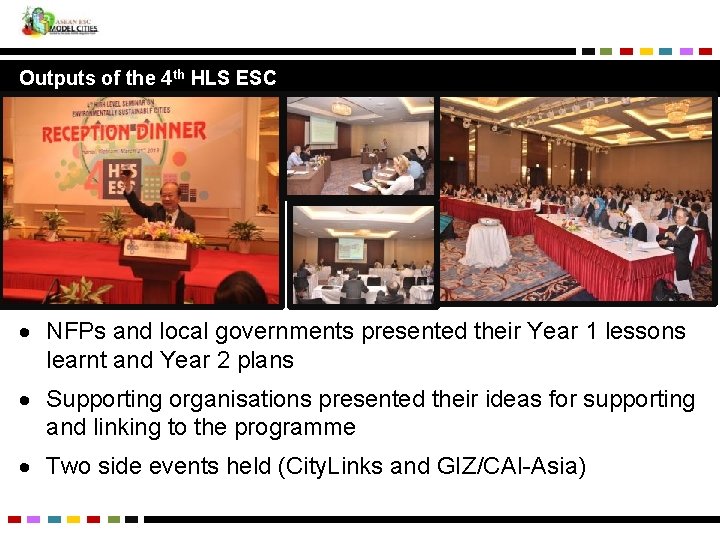
Outputs of the 4 th HLS ESC NFPs and local governments presented their Year 1 lessons learnt and Year 2 plans Supporting organisations presented their ideas for supporting and linking to the programme Two side events held (City. Links and GIZ/CAI-Asia)
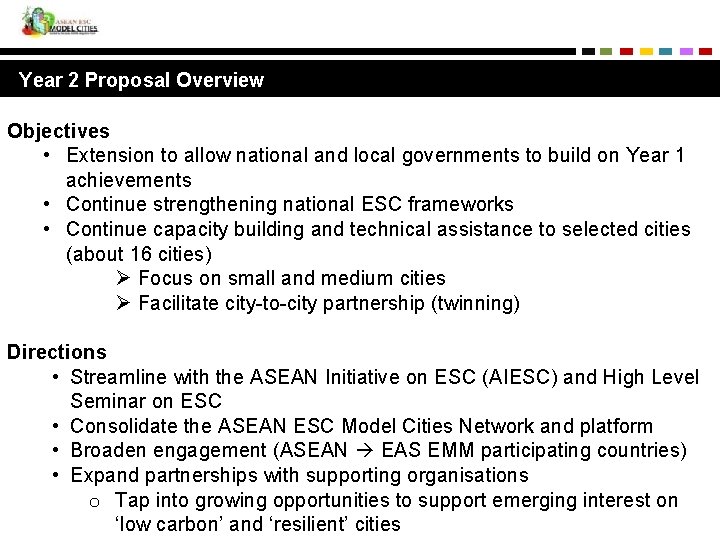
Year 2 Proposal Overview Objectives • Extension to allow national and local governments to build on Year 1 achievements • Continue strengthening national ESC frameworks • Continue capacity building and technical assistance to selected cities (about 16 cities) Ø Focus on small and medium cities Ø Facilitate city-to-city partnership (twinning) Directions • Streamline with the ASEAN Initiative on ESC (AIESC) and High Level Seminar on ESC • Consolidate the ASEAN ESC Model Cities Network and platform • Broaden engagement (ASEAN EAS EMM participating countries) • Expand partnerships with supporting organisations o Tap into growing opportunities to support emerging interest on ‘low carbon’ and ‘resilient’ cities
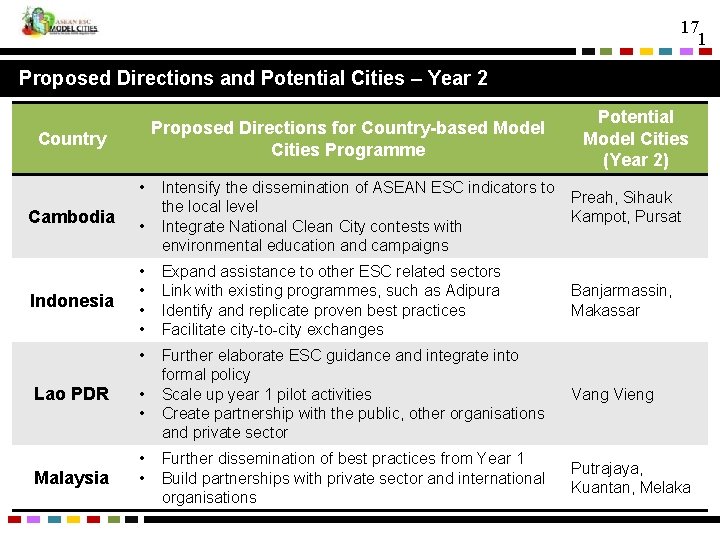
17 1 Proposed Directions and Potential Cities – Year 2 Proposed Directions for Country-based Model Cities Programme Country • Cambodia Indonesia Lao PDR Malaysia • Intensify the dissemination of ASEAN ESC indicators to the local level Integrate National Clean City contests with environmental education and campaigns Potential Model Cities (Year 2) Preah, Sihauk Kampot, Pursat • • Expand assistance to other ESC related sectors Link with existing programmes, such as Adipura Identify and replicate proven best practices Facilitate city-to-city exchanges Banjarmassin, Makassar • Further elaborate ESC guidance and integrate into formal policy Scale up year 1 pilot activities Create partnership with the public, other organisations and private sector Vang Vieng Further dissemination of best practices from Year 1 Build partnerships with private sector and international organisations Putrajaya, Kuantan, Melaka • •
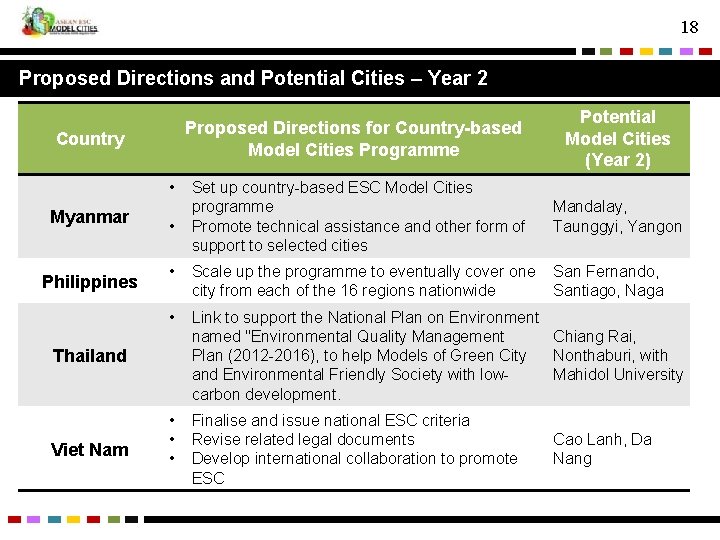
18 Proposed Directions and Potential Cities – Year 2 Proposed Directions for Country-based Model Cities Programme Country • Myanmar Philippines Set up country-based ESC Model Cities programme Promote technical assistance and other form of support to selected cities Mandalay, Taunggyi, Yangon • Scale up the programme to eventually cover one city from each of the 16 regions nationwide San Fernando, Santiago, Naga • Link to support the National Plan on Environment named "Environmental Quality Management Chiang Rai, Plan (2012 -2016), to help Models of Green City Nonthaburi, with and Environmental Friendly Society with low. Mahidol University carbon development. • • • Finalise and issue national ESC criteria Revise related legal documents Develop international collaboration to promote ESC • Thailand Viet Nam Potential Model Cities (Year 2) Cao Lanh, Da Nang
Current status • Latest comments received from JAIF (21 Aug. 2013) – Proposal revisions in progress • Aiming for proposal approval within 2013 (t. b. c. ) and commencement of Year 2 in 2014 ASEAN Secretariat
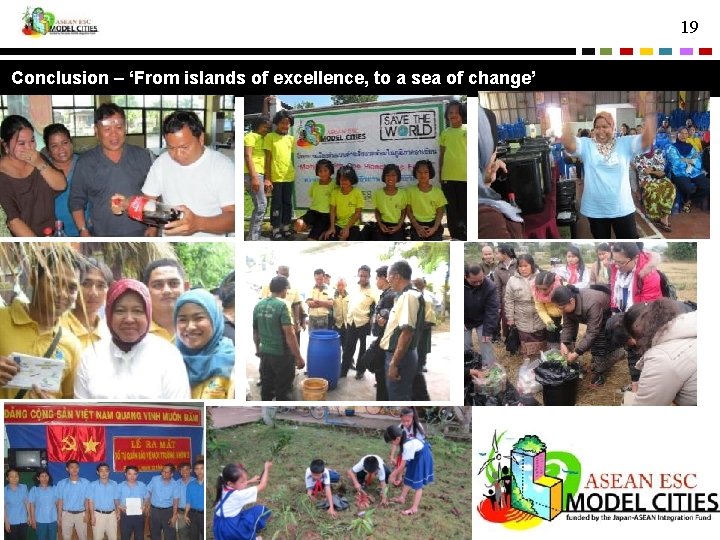
19 Conclusion – ‘From islands of excellence, to a sea of change’ Thank you