
ASDC Data Distribution Architecture Michael M Little m
ASDC Data Distribution Architecture Michael M. Little m. m. little@nasa. gov Ver 0. 4. 2 01/26/14
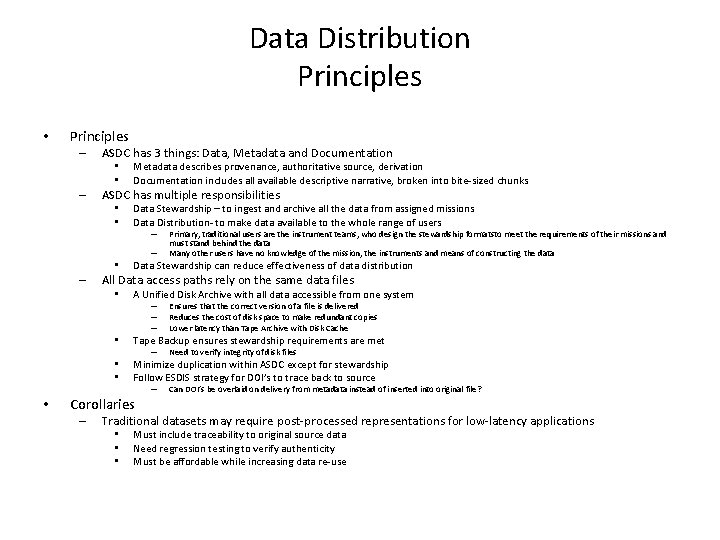
Data Distribution Principles • Principles – ASDC has 3 things: Data, Metadata and Documentation • • – Metadata describes provenance, authoritative source, derivation Documentation includes all available descriptive narrative, broken into bite-sized chunks ASDC has multiple responsibilities • • Data Stewardship – to ingest and archive all the data from assigned missions Data Distribution- to make data available to the whole range of users – – • – Data Stewardship can reduce effectiveness of data distribution All Data access paths rely on the same data files • A Unified Disk Archive with all data accessible from one system – – – Ensures that the correct version of a file is delivered Reduces the cost of disk space to make redundant copies Lower latency than Tape Archive with Disk Cache • Tape Backup ensures stewardship requirements are met • • Minimize duplication within ASDC except for stewardship Follow ESDIS strategy for DOI’s to trace back to source – – • Primary, traditional users are the instrument teams, who design the stewardship formatsto meet the requirements of their missions and must stand behind the data Many other users have no knowledge of the mission, the instruments and means of constructing the data Need to verify integrity of disk files Can DOI’s be overlaid on delivery from metadata instead of inserted into original file? Corollaries – Traditional datasets may require post-processed representations for low-latency applications • • • Must include traceability to original source data Need regression testing to verify authenticity Must be affordable while increasing data re-use
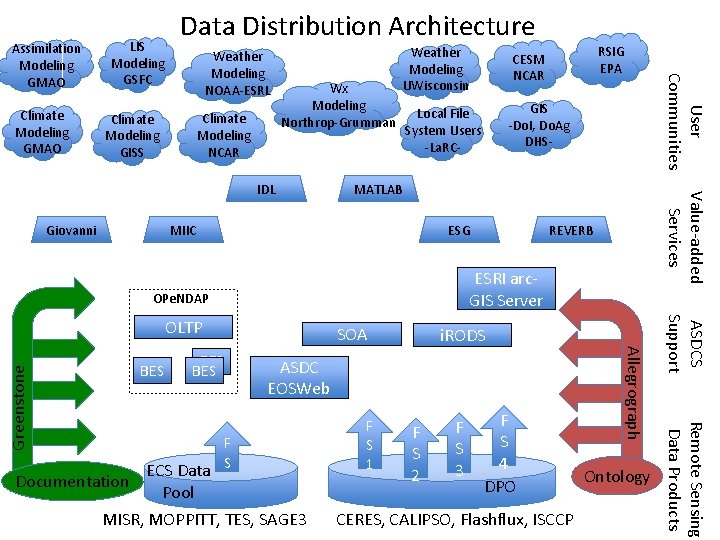
Climate Modeling GMAO LIS Modeling GSFC Weather Modeling NOAA-ESRL Climate Modeling NCAR Climate Modeling GISS Wx Modeling Northrop-Grumman Giovanni CESM NCAR Local File System Users -La. RC- GIS -Do. I, Do. Ag DHS- MATLAB MIIC ESG BES ASDC EOSWeb F S MISR, MOPPITT, TES, SAGE 3 F S 1 F S 2 F S 3 F S 4 DPO CERES, CALIPSO, Flashflux, ISCCP Ontology Remote Sensing Data Products ECS Data Pool i. RODS Allegrograph Greenstone SOA ASDCS Support OLTP Documentation REVERB ESRI arc. GIS Server OPe. NDAP BES Value-added Services IDL RSIG EPA Weather Modeling UWisconsin User Communities Assimilation Modeling GMAO Data Distribution Architecture
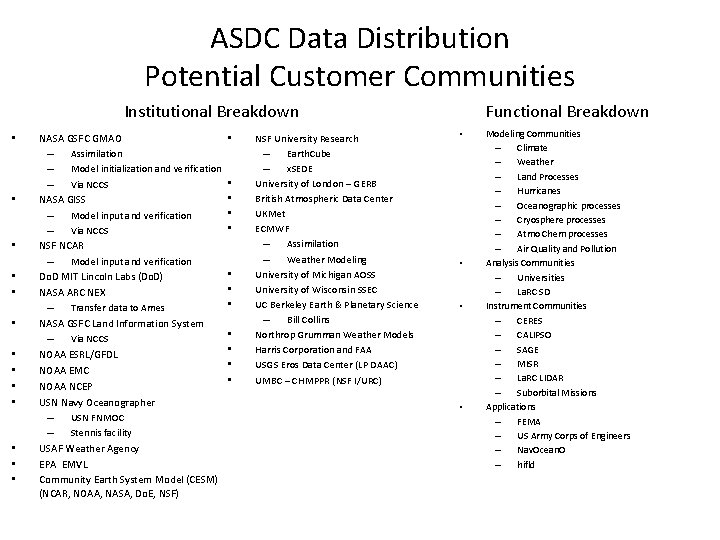
ASDC Data Distribution Potential Customer Communities Institutional Breakdown • • • • NASA GSFC GMAO – Assimilation – Model initialization and verification – Via NCCS NASA GISS – Model input and verification – Via NCCS NSF NCAR – Model input and verification Do. D MIT Lincoln Labs (Do. D) NASA ARC NEX – Transfer data to Ames NASA GSFC Land Information System – Via NCCS NOAA ESRL/GFDL NOAA EMC NOAA NCEP USN Navy Oceanographer – USN FNMOC – Stennis facility USAF Weather Agency EPA EMVL Community Earth System Model (CESM) (NCAR, NOAA, NASA, Do. E, NSF) • • • NSF University Research – Earth. Cube – x. SEDE University of London – GERB British Atmospheric Data Center UKMet ECMWF – Assimilation – Weather Modeling University of Michigan AOSS University of Wisconsin SSEC UC Berkeley Earth & Planetary Science – Bill Collins Northrop Grumman Weather Models Harris Corporation and FAA USGS Eros Data Center (LP DAAC) UMBC – CHMPPR (NSF I/URC) Functional Breakdown • • Modeling Communities – Climate – Weather – Land Processes – Hurricanes – Oceanographic processes – Cryosphere processes – Atmo Chem processes – Air Quality and Pollution Analysis Communities – Universities – La. RC SD Instrument Communities – CERES – CALIPSO – SAGE – MISR – La. RC LIDAR – Suborbital Missions Applications – FEMA – US Army Corps of Engineers – Nav. Ocean. O – hifld
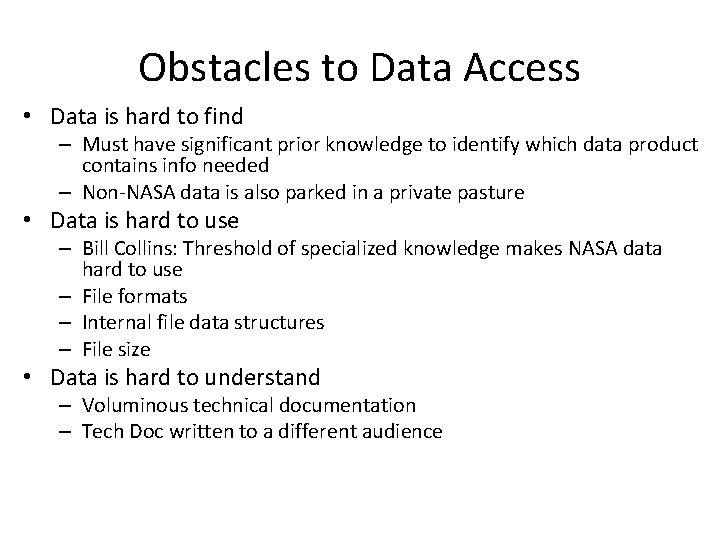
Obstacles to Data Access • Data is hard to find – Must have significant prior knowledge to identify which data product contains info needed – Non-NASA data is also parked in a private pasture • Data is hard to use – Bill Collins: Threshold of specialized knowledge makes NASA data hard to use – File formats – Internal file data structures – File size • Data is hard to understand – Voluminous technical documentation – Tech Doc written to a different audience
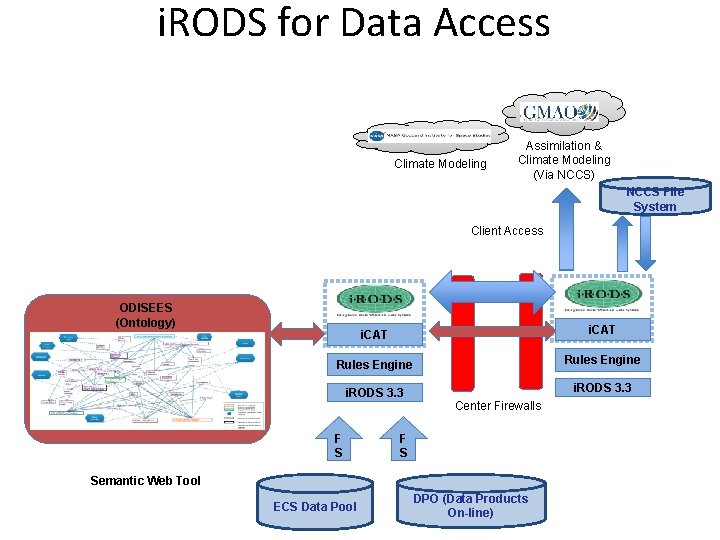
i. RODS for Data Access Climate Modeling Assimilation & Climate Modeling (Via NCCS) NCCS File System Client Access ODISEES (Ontology) i. CAT Rules Engine i. RODS 3. 3 F S Center Firewalls F S Semantic Web Tool ECS Data Pool DPO (Data Products On-line)
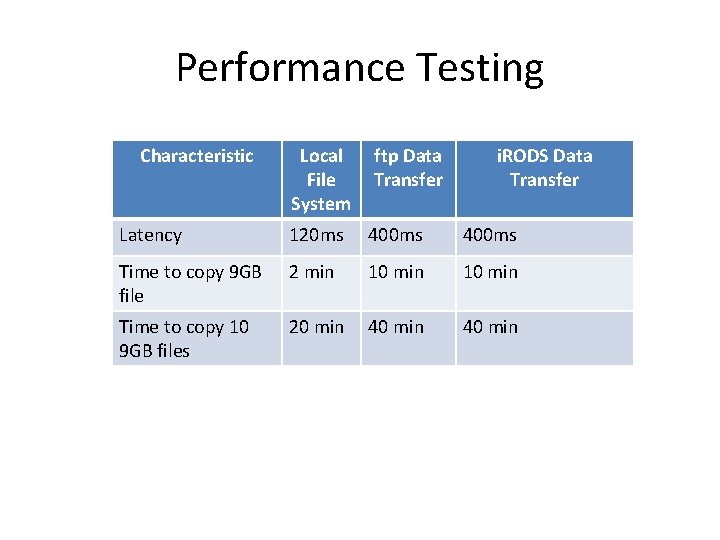
Performance Testing Characteristic Local File System ftp Data Transfer i. RODS Data Transfer Latency 120 ms 400 ms Time to copy 9 GB file 2 min 10 min Time to copy 10 9 GB files 20 min 40 min
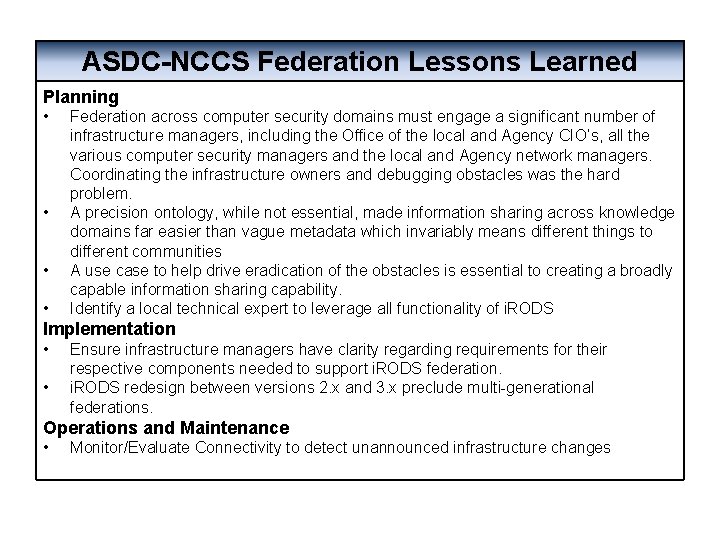
ASDC-NCCS Federation Lessons Learned Planning • • Federation across computer security domains must engage a significant number of infrastructure managers, including the Office of the local and Agency CIO’s, all the various computer security managers and the local and Agency network managers. Coordinating the infrastructure owners and debugging obstacles was the hard problem. A precision ontology, while not essential, made information sharing across knowledge domains far easier than vague metadata which invariably means different things to different communities A use case to help drive eradication of the obstacles is essential to creating a broadly capable information sharing capability. Identify a local technical expert to leverage all functionality of i. RODS Implementation • • Ensure infrastructure managers have clarity regarding requirements for their respective components needed to support i. RODS federation. i. RODS redesign between versions 2. x and 3. x preclude multi-generational federations. Operations and Maintenance • Monitor/Evaluate Connectivity to detect unannounced infrastructure changes
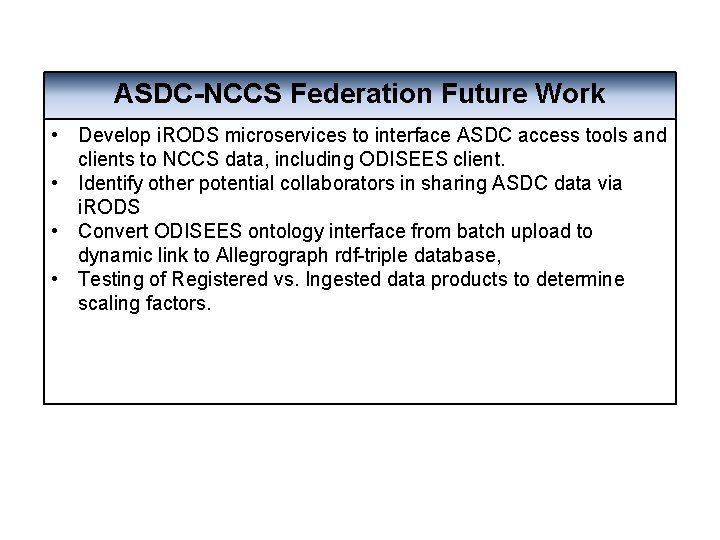
ASDC-NCCS Federation Future Work • Develop i. RODS microservices to interface ASDC access tools and clients to NCCS data, including ODISEES client. • Identify other potential collaborators in sharing ASDC data via i. RODS • Convert ODISEES ontology interface from batch upload to dynamic link to Allegrograph rdf-triple database, • Testing of Registered vs. Ingested data products to determine scaling factors.
- Slides: 9