
ASCLS History Origins Founded in 1932 in Chicago
- Slides: 16
ASCLS History
Origins • Founded in 1932 in Chicago at an ASCP meeting as American Society of Clinical Laboratory Technologists (ASCLT) • Incorporated in MI in 1936 • Subsidiary organization of ASCP – Met annually with ASCP • Changed name to American Society of Medical Technologists
Early Activity • • Started a journal Wrote bylaws State chapters started Worked to get articles about the profession into local and national media • Supported the Board of Registry – To be a member, had to be registered by the BOR
1940’s • Obtained commissions (officer's status) with the Armed Services, • Gained representation in credentialing on the Board of Registry of ASCP (certification) and the accreditation of education programs by the Board of Schools. • Membership grew – largely due to the Society's advocacy of properly educated and credentialed personnel.
• By 1947 ASMT held its first independent convention. • Established office in Houston, TX in 1949 • Laboratory personnel were in short supply, and educational programs, all on the associates degree level, grew.
1950’s • Continued attempts to achieve professional status with the Civil Service and the Armed Forces • Attempted to upgrade educational/certification qualifications. • First paper on quality control – establishing research in the field – published • ASMT Education and Research Fund established to advance research efforts
1960’s • Very controversial years • Struggles with ASCP Board of Schools and Board of Registry – ASMT members and others in the profession wanted more representation on both boards – Questioned need for so many pathologists on these boards
1960’s • ASMT joined the International Association of Medical Laboratory Technologists (IAMLT) • This organization is now the International Federation of Biomedical Laboratory Scientists – Viewed by our international colleagues as the standard-holder in laboratory science associations.
1960’s • Qualifications for the Medical Technologist changed to require a baccalaureate degree (1962) • Established a new category: Laboratory Technician – Also discussed Lab Assistant level
1970’s • Changed name to American Society for Medical Technology – Membership around 40, 000 • ASMT left Board of Registry in 1976 – Lost members who didn’t agree with this • Formed the National Certification Agency for Medical Laboratory Personnel (NCA) in 1978 with Association of Genetic Technologists
• Help found NAACLS • Started P. A. C. E. ® • Published “Statement of Competencies” – Start of defining scope of practice • Published Future Directions Plan • Established the Political Action Committee (PAC)
1980’s • ASMT became very involved in national and state legislative and regulatory activities. – Supported legislation called TEFRA that angered some members • Attempted merger with American Medical Technologists (AMT) • Held first Clinical Laboratory Educators’ Conference (CLEC) • Moved offices from Houston to Washington DC – Due to financial difficulties
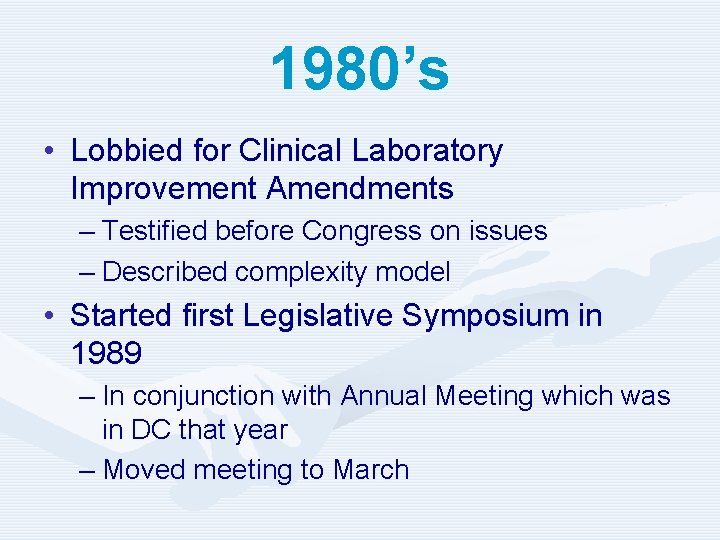
1980’s • Lobbied for Clinical Laboratory Improvement Amendments – Testified before Congress on issues – Described complexity model • Started first Legislative Symposium in 1989 – In conjunction with Annual Meeting which was in DC that year – Moved meeting to March
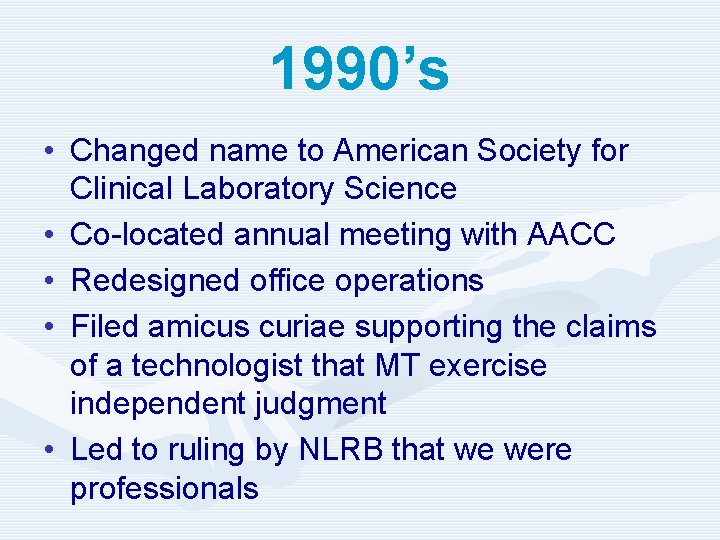
1990’s • Changed name to American Society for Clinical Laboratory Science • Co-located annual meeting with AACC • Redesigned office operations • Filed amicus curiae supporting the claims of a technologist that MT exercise independent judgment • Led to ruling by NLRB that we were professionals
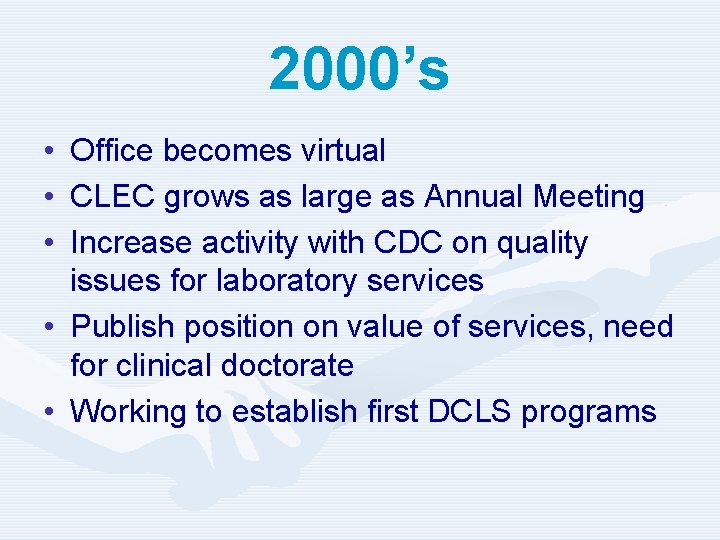
2000’s • Office becomes virtual • CLEC grows as large as Annual Meeting • Increase activity with CDC on quality issues for laboratory services • Publish position on value of services, need for clinical doctorate • Working to establish first DCLS programs
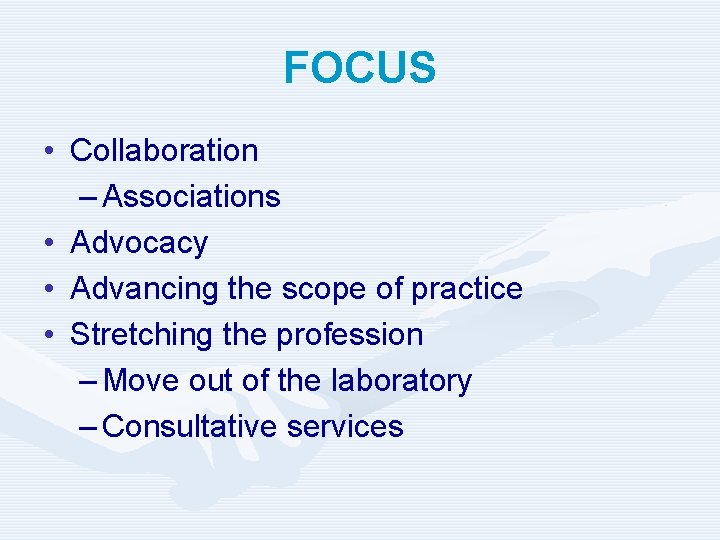
FOCUS • Collaboration – Associations • Advocacy • Advancing the scope of practice • Stretching the profession – Move out of the laboratory – Consultative services