
ASCE PEV Training ASCE Committee on Accreditation Operations
- Slides: 36
ASCE PEV Training ASCE Committee on Accreditation Operations (COAO) Updated April 2019
Purpose • Supplement ABET PEV training by providing information related to – ASCE reporting structure – Best practices in completing PEV forms – Program specific criteria – Review most commonly cited shortcomings
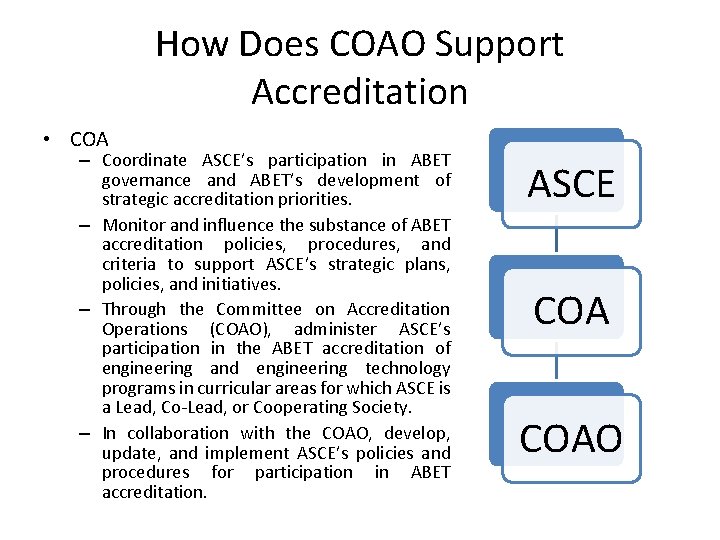
How Does COAO Support Accreditation • COA – Coordinate ASCE’s participation in ABET governance and ABET’s development of strategic accreditation priorities. – Monitor and influence the substance of ABET accreditation policies, procedures, and criteria to support ASCE’s strategic plans, policies, and initiatives. – Through the Committee on Accreditation Operations (COAO), administer ASCE’s participation in the ABET accreditation of engineering and engineering technology programs in curricular areas for which ASCE is a Lead, Co-Lead, or Cooperating Society. – In collaboration with the COAO, develop, update, and implement ASCE’s policies and procedures for participation in ABET accreditation. ASCE COAO
What does COAO Do? • Committee on Accreditation Operations (COAO) focuses on the – Recruitment, training, evaluation, and assignment of program evaluators for the accreditation of architectural, civil, and construction engineering programs and architectural engineering, civil engineering, and construction engineering technology programs; and – Implementation of the associated ABET program criteria • Commentary • Training
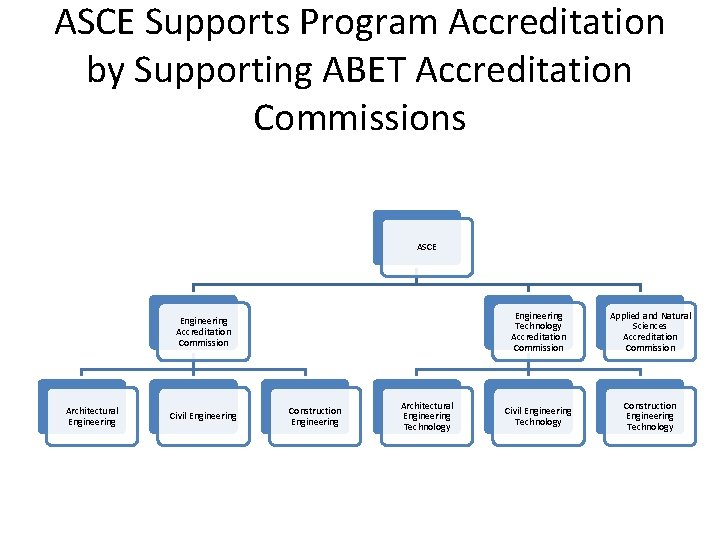
ASCE Supports Program Accreditation by Supporting ABET Accreditation Commissions ASCE Engineering Accreditation Commission Architectural Engineering Civil Engineering Construction Engineering Architectural Engineering Technology Accreditation Commission Applied and Natural Sciences Accreditation Commission Civil Engineering Technology Construction Engineering Technology
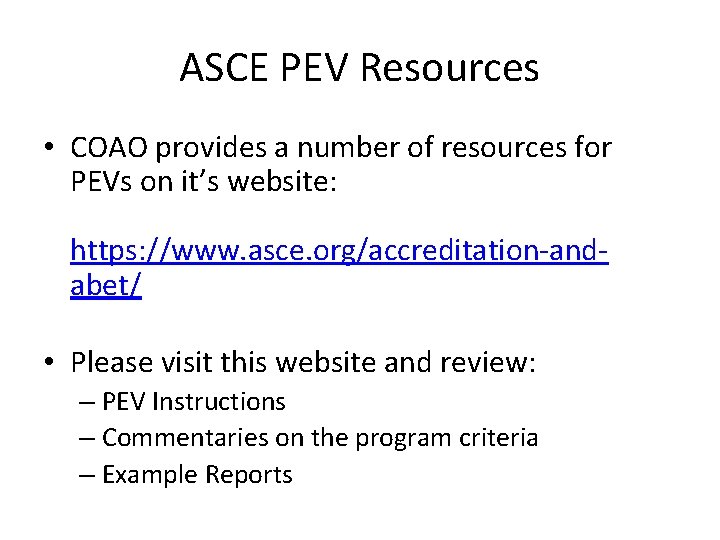
ASCE PEV Resources • COAO provides a number of resources for PEVs on it’s website: https: //www. asce. org/accreditation-andabet/ • Please visit this website and review: – PEV Instructions – Commentaries on the program criteria – Example Reports
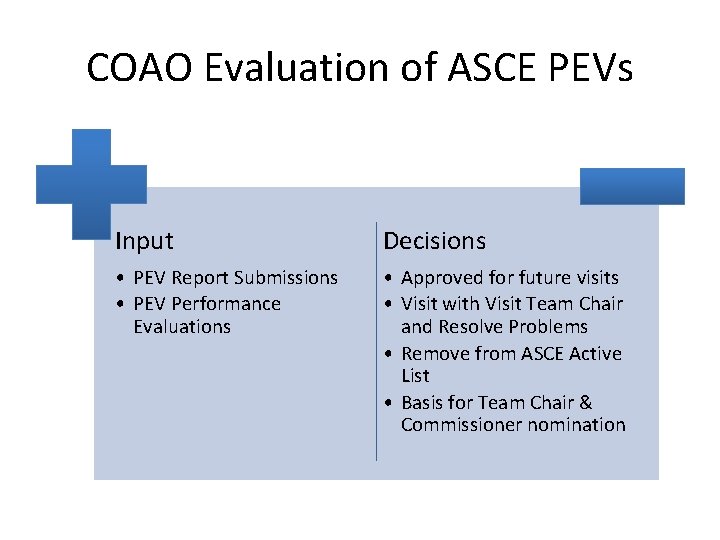
COAO Evaluation of ASCE PEVs Input Decisions • PEV Report Submissions • PEV Performance Evaluations • Approved for future visits • Visit with Visit Team Chair and Resolve Problems • Remove from ASCE Active List • Basis for Team Chair & Commissioner nomination
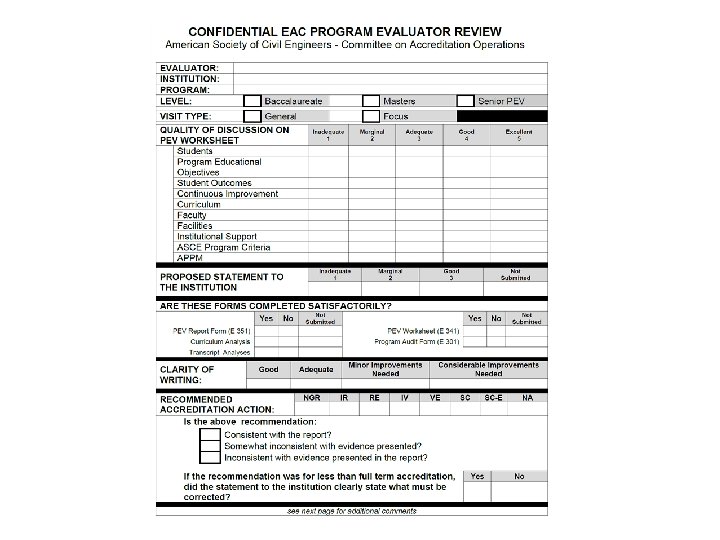
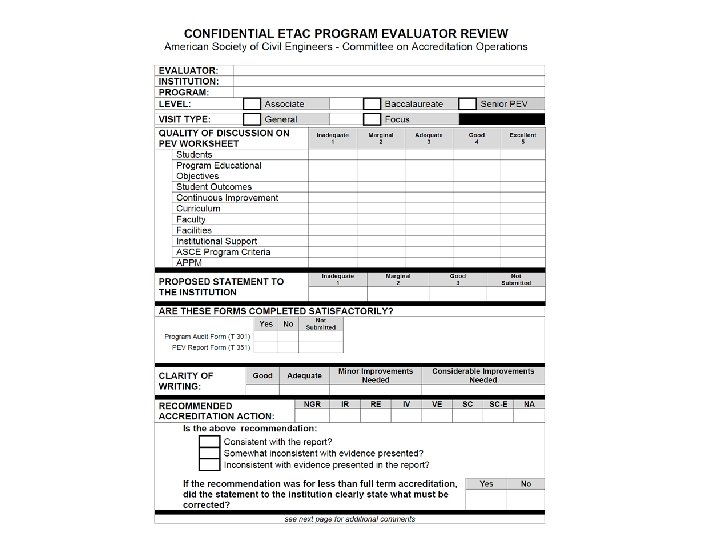
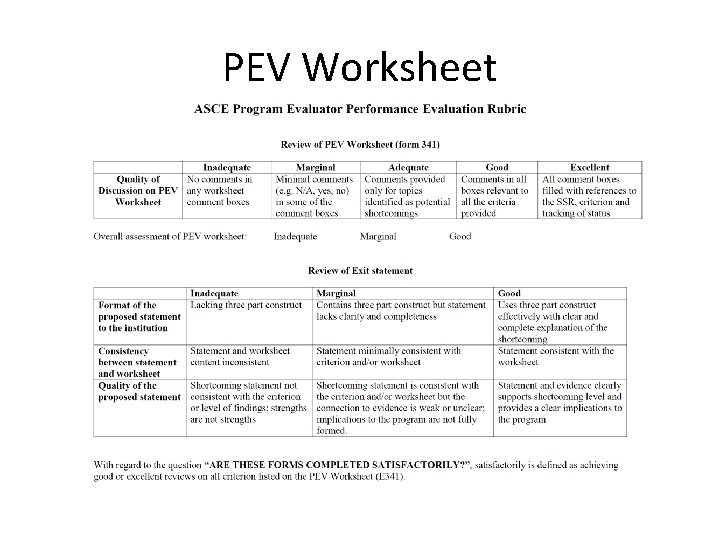
PEV Worksheet
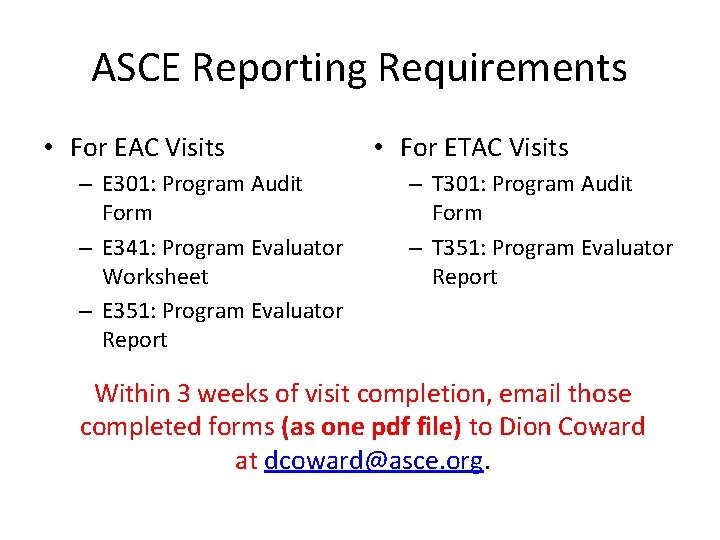
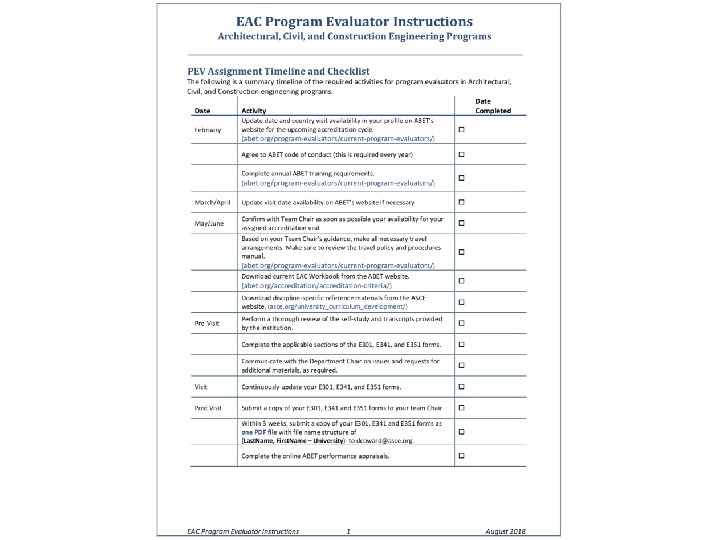
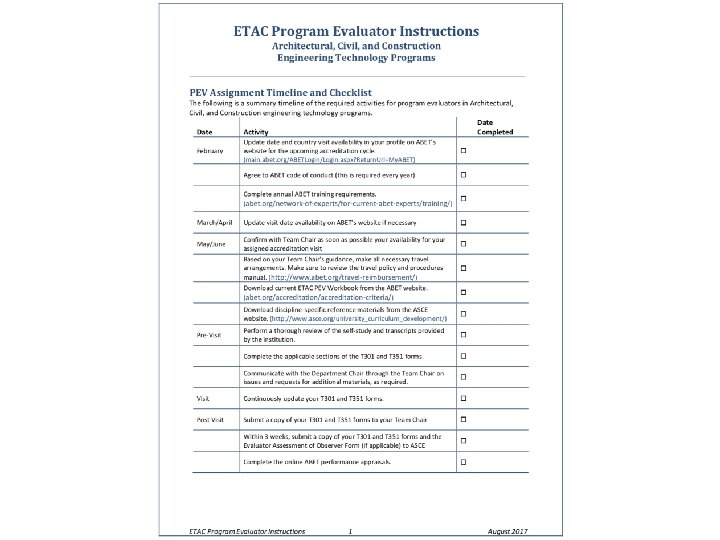
ASCE Reporting Requirements • For EAC Visits – E 301: Program Audit Form – E 341: Program Evaluator Worksheet – E 351: Program Evaluator Report • For ETAC Visits – T 301: Program Audit Form – T 351: Program Evaluator Report Within 3 weeks of visit completion, email those completed forms (as one pdf file) to Dion Coward at dcoward@asce. org.
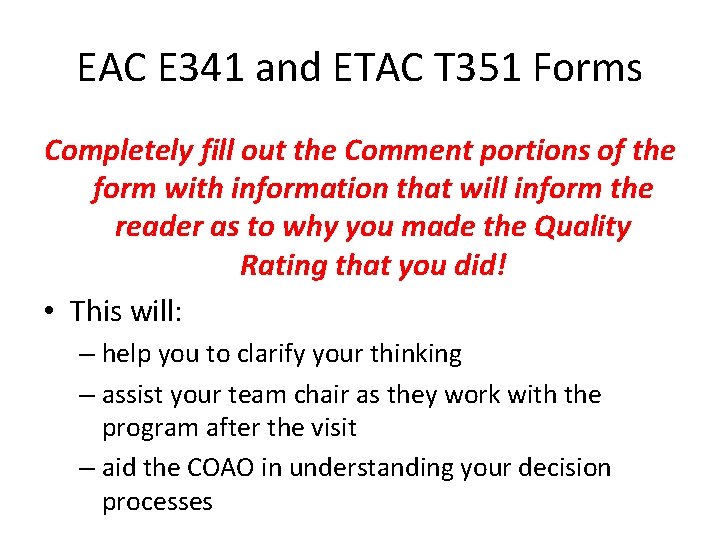
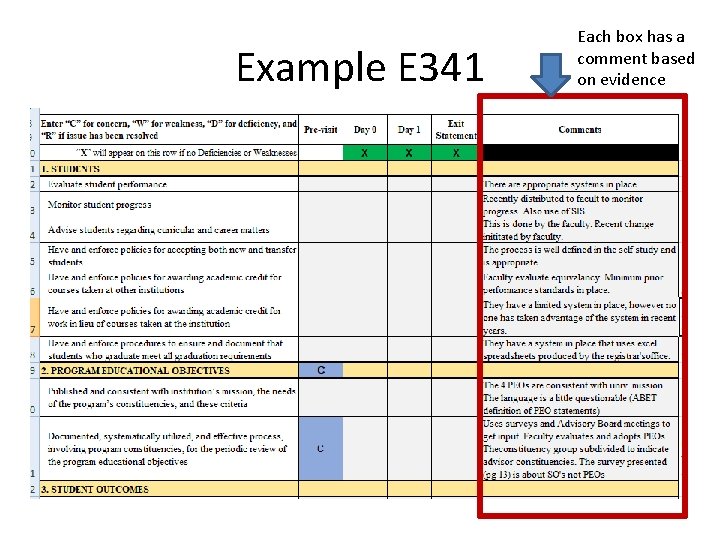
EAC E 341 and ETAC T 351 Forms Completely fill out the Comment portions of the form with information that will inform the reader as to why you made the Quality Rating that you did! • This will: – help you to clarify your thinking – assist your team chair as they work with the program after the visit – aid the COAO in understanding your decision processes
Example E 341 Each box has a comment based on evidence
Program Criteria • Program Criteria are provided on the ABET Website Under Accreditation • Commentary on the ASCE website is helpful in understanding and interpreting a Program’s actions with respect to the criteria – https: //www. asce. org/accreditation-and-abet/
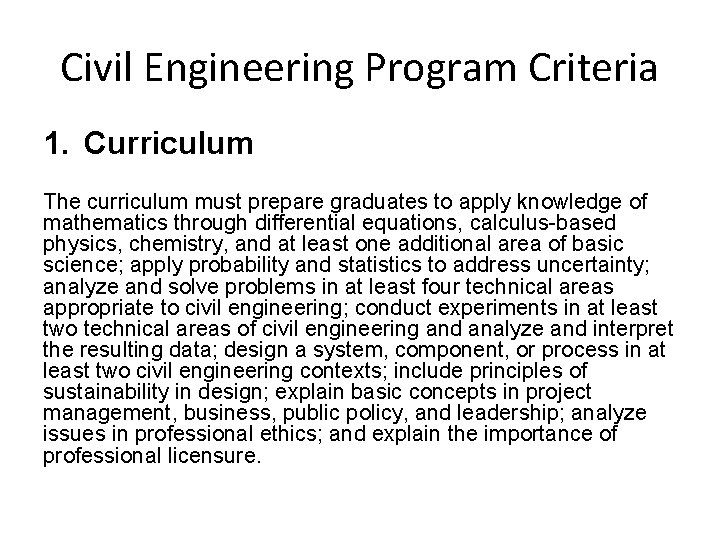
Civil Engineering Program Criteria 1. Curriculum The curriculum must prepare graduates to apply knowledge of mathematics through differential equations, calculus-based physics, chemistry, and at least one additional area of basic science; apply probability and statistics to address uncertainty; analyze and solve problems in at least four technical areas appropriate to civil engineering; conduct experiments in at least two technical areas of civil engineering and analyze and interpret the resulting data; design a system, component, or process in at least two civil engineering contexts; include principles of sustainability in design; explain basic concepts in project management, business, public policy, and leadership; analyze issues in professional ethics; and explain the importance of professional licensure.
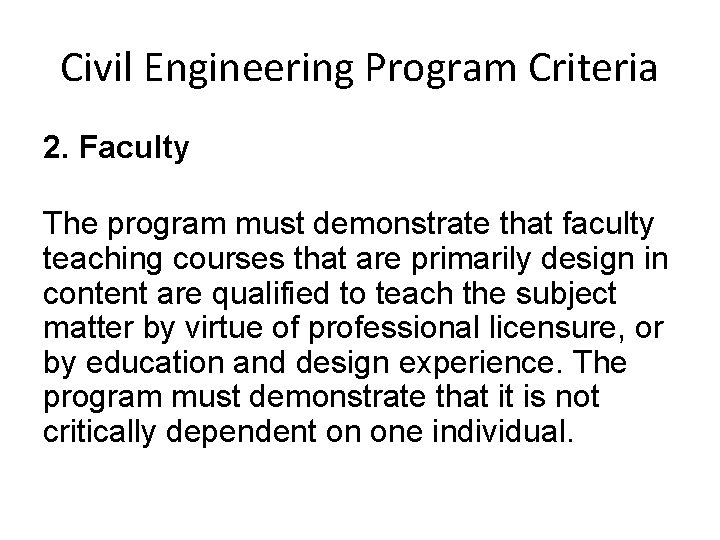
Civil Engineering Program Criteria 2. Faculty The program must demonstrate that faculty teaching courses that are primarily design in content are qualified to teach the subject matter by virtue of professional licensure, or by education and design experience. The program must demonstrate that it is not critically dependent on one individual.
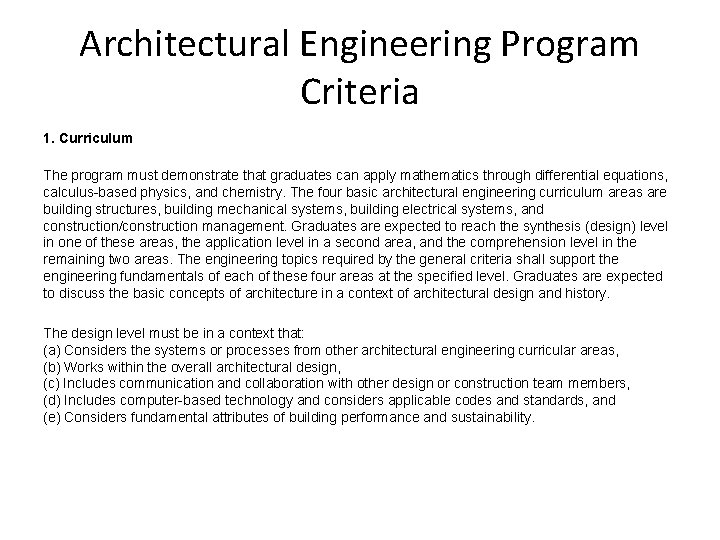
Architectural Engineering Program Criteria 1. Curriculum The program must demonstrate that graduates can apply mathematics through differential equations, calculus-based physics, and chemistry. The four basic architectural engineering curriculum areas are building structures, building mechanical systems, building electrical systems, and construction/construction management. Graduates are expected to reach the synthesis (design) level in one of these areas, the application level in a second area, and the comprehension level in the remaining two areas. The engineering topics required by the general criteria shall support the engineering fundamentals of each of these four areas at the specified level. Graduates are expected to discuss the basic concepts of architecture in a context of architectural design and history. The design level must be in a context that: (a) Considers the systems or processes from other architectural engineering curricular areas, (b) Works within the overall architectural design, (c) Includes communication and collaboration with other design or construction team members, (d) Includes computer-based technology and considers applicable codes and standards, and (e) Considers fundamental attributes of building performance and sustainability.
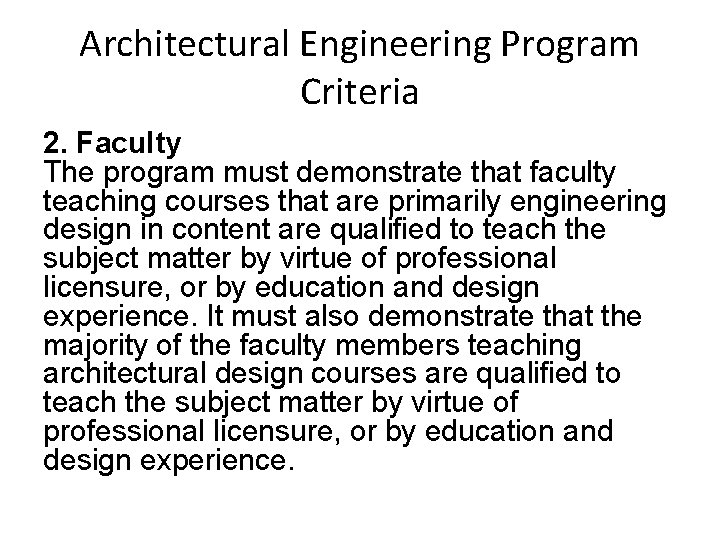
Architectural Engineering Program Criteria 2. Faculty The program must demonstrate that faculty teaching courses that are primarily engineering design in content are qualified to teach the subject matter by virtue of professional licensure, or by education and design experience. It must also demonstrate that the majority of the faculty members teaching architectural design courses are qualified to teach the subject matter by virtue of professional licensure, or by education and design experience.
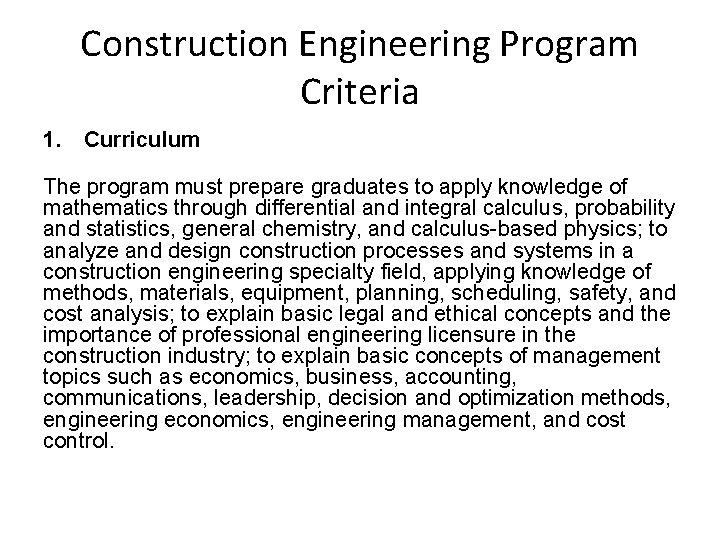
Construction Engineering Program Criteria 1. Curriculum The program must prepare graduates to apply knowledge of mathematics through differential and integral calculus, probability and statistics, general chemistry, and calculus-based physics; to analyze and design construction processes and systems in a construction engineering specialty field, applying knowledge of methods, materials, equipment, planning, scheduling, safety, and cost analysis; to explain basic legal and ethical concepts and the importance of professional engineering licensure in the construction industry; to explain basic concepts of management topics such as economics, business, accounting, communications, leadership, decision and optimization methods, engineering economics, engineering management, and cost control.
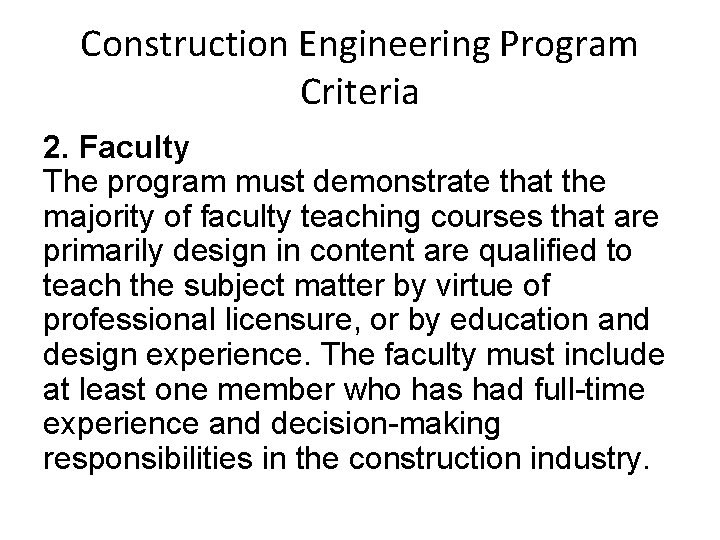
Construction Engineering Program Criteria 2. Faculty The program must demonstrate that the majority of faculty teaching courses that are primarily design in content are qualified to teach the subject matter by virtue of professional licensure, or by education and design experience. The faculty must include at least one member who has had full-time experience and decision-making responsibilities in the construction industry.
BEST PRACTICES
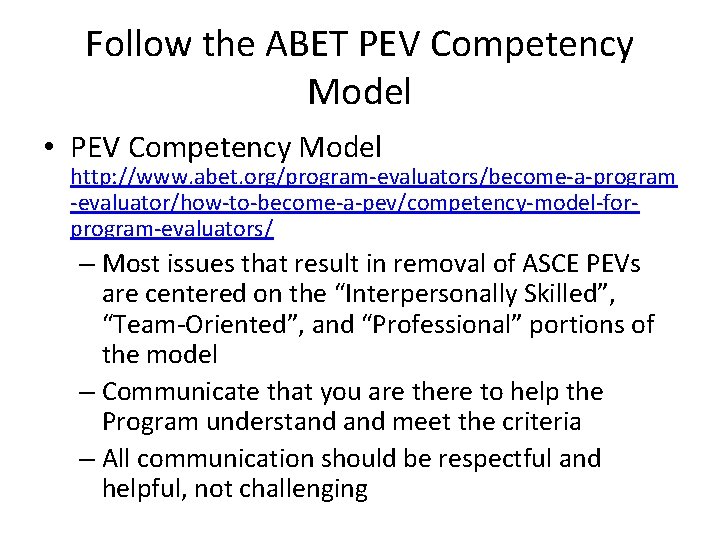
Follow the ABET PEV Competency Model • PEV Competency Model http: //www. abet. org/program-evaluators/become-a-program -evaluator/how-to-become-a-pev/competency-model-forprogram-evaluators/ – Most issues that result in removal of ASCE PEVs are centered on the “Interpersonally Skilled”, “Team-Oriented”, and “Professional” portions of the model – Communicate that you are there to help the Program understand meet the criteria – All communication should be respectful and helpful, not challenging
Read ASCE PEV Instructions • Submit your work according the timeline and checklist found in the instructions • Submit your final documents to Dion Coward at dcoward@asce. org within 3 weeks of the visit
Avoid Reading Too Much Into the Criteria • The program criteria for faculty states “The program must demonstrate that it is not critically dependent on one individual” does not require two individuals in each program area. The program should explain how they would continue with the loss of any individual. There are many ways to do this. • For ETAC, Criterion 3 only requires that you can identify the required elements in the published criteria. There is no requirement for assessment of the a-k/a-i in Criterion 3. • Criterion 4 only requires assessment for own published Student Outcomes, not explicitly the elements of Criterion 3.
Be Open Minded • Be open to innovative ways of meeting the criteria • Programs don’t have to do things the way that you would • You may not want to adopt their practices, but if they satisfy the criteria, then they are okay
Developing the Exit Statement • First sentence must begin with the official name of the program • Describe the program as factually as possible. Include program’s administrative location at the institution. • Information may be obtained from the materials provided, from the previous review, or from the program’s website. Be sure to check the currency of the information with the program chair. • At a minimum, give: – The current number of students enrolled – The current number of faculty members – The number of graduates in the academic year prior to the visit • For a new program include the formal start date, and year of its initial graduates.
Be Mindful of the 3 Part Construct • Each shortcoming should have three components, the: – Applicable part of the criterion, using the exact language from the Criteria or APPM where possible. Each shortcoming should start with the phrase “This criterion requires that a program ……. . ” – Observed facts that are inconsistent or potentially inconsistent with the stated criterion or APPM element – Negative impact on the program of the inconsistencies or potential inconsistencies
MOST COMMON SHORTCOMINGS
Most Common Shortcomings • Criterion 2 – For EAC, the program’s PEOs are stated as outcomes – For both EAC and ETAC, the process for establishing and confirming PEOs do not involve constituencies identified in the self-study
Most Common Shortcomings • Criterion 3 – For ETAC, some elements of the specified learned capabilities are not found in the program’s published student outcomes – For EAC, some of the specified outcomes are not found in the program’s published student outcomes
Most Common Shortcomings • Criterion 4 – This is the most commonly sited criterion – Issues revolve around • Ineffective assessment data (grade based, not a representative sample, tools that don’t provide useful information, no direct measures, etc…) • The program does not “close the loop”. The data are not evaluated, or data-based decisions concerning program improvement are not made, or implemented changes are not evaluated for effectiveness
Most Common Shortcomings • Program Criteria – Curriculum • One or more elements of the curriculum is not met or is weakly addressed – Faculty • Faculty teaching design are not qualified by virtue of licensure, or by education + design experience • The program is critically dependent on one individual
Other Shortcomings • Previous “common” shortcomings are not the only shortcomings seen in program evaluations • By completing the ABET forms, you may uncover other shortcomings • Shortcomings are often common across programs at an institution
Questions? Contact Dion Coward at dcoward@asce. org