
ASC Topic 606 Revenue Recognition Technology Presented by
ASC Topic 606 Revenue Recognition Technology Presented by Brent Peterson and Josh White | January 30, 2019 1
Revenue Guidance Eliminates transaction and industry-specific guidance Replaces it with a principles-based approach Objective • To establish the principles that an entity shall apply to report useful information to users of financial statements about the nature, amount, timing, and uncertainty of revenue and cash flows arising from a contract with a customer Core principle • Recognize revenue to depict transfer of goods or services to customers in an amount that reflects the consideration to which the entity expects to be entitled in exchange for those goods or services | 2 2|
Lessons Learned • Requires significant judgment • This takes lots of time and careful analysis • Similar fact patterns with slight differences can result in different accounting results. • • Be careful not to just look at other competitors and public company examples as a substitute for use of thoughtful judgement in applying ASC 606. It’s very easy to fall into this trap. 3
Principles Based – Easy, Right? Standard Basis for conclusions Transition Resource Group minutes and Issue Papers AICPA Financial Reporting Executive Committee (Fin. REC, formerly Ac. SEC) • 16 industry groups, including Software Entities 4
Overview of Guidance and Transition Considerations 5
Revenue Guidance Five-Step Model 1. Identify the contract(s) with the customer. 2. Identify the performance obligations in the contract(s). 3. Determine the transaction price. 4. Allocate the transaction price to the performance obligations in the contract. 5. Recognize revenue when or as the entity satisfies a performance obligation. 6
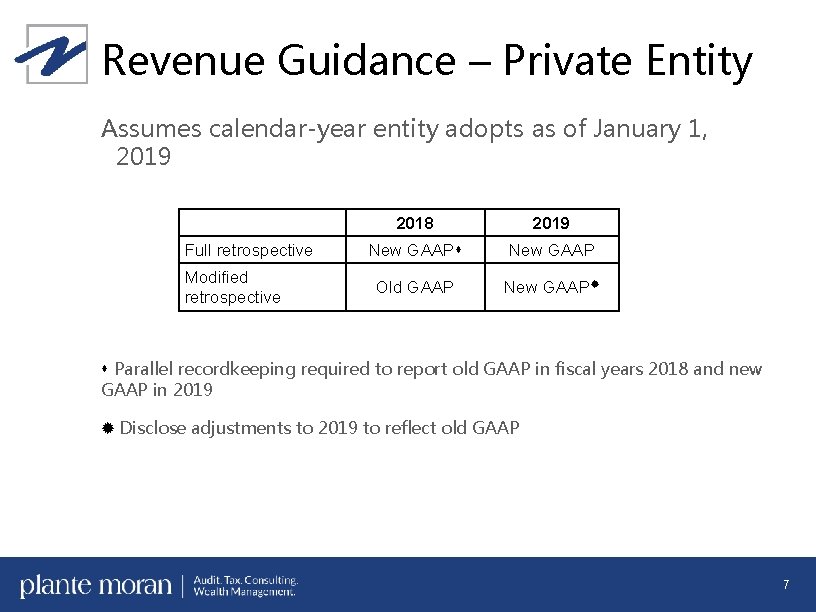
Revenue Guidance – Private Entity Assumes calendar-year entity adopts as of January 1, 2019 Full retrospective Modified retrospective 2018 2019 New GAAP Old GAAP New GAAP Parallel recordkeeping required to report old GAAP in fiscal years 2018 and new GAAP in 2019 Disclose adjustments to 2019 to reflect old GAAP 7
ASC 606 Transition Observations • Modified retrospective adoption seems to be the unanimous choice for Companies which have adopted to date. • A few private entities have also early adopted ASC 606 using the modified retrospective method. • • New business models are driving early 606 adoption vs. applying ASC 605 for a short period. Simple application on the surface is significantly more complex than anticipated. • Identifying PO’s • Allocating transaction price to PO’s using relative selling price 8
Step 1: Identify the Contract(s) • Performance obligations and payment terms are clearly identified • Collectibility must be “probable” • Enforceable rights • Can be written, oral, or implied • Commercial substance 9
Step 1: Identify the Contract(s) with the Customer Upfront fees • If refundability is contingent on termination, substantive termination penalty • Related to the transfer of a promised good or service, evaluate as a potential PO • Option to acquire additional goods or services (e. g. , renewals), evaluate as material right recognizable upon lapse of right or provision of related goods or services • Advance payment for promised goods or services (set up and implementation) 10

Step 1: Identify the Contract(s) Contract Modifications Factors to evaluate Is there an increase in the scope of distinct goods or services present? Does the contract price change by an amount reflective of the standalone selling prices* of additional goods or services added under current circumstances? Treat as a separate contract Treat as a modification prospectively Treat as a modification with cumulative adjustment to current period earnings Yes No N/A Effects of modification on Treatment reflects the both transaction price and cancellation of the original progress are reflected as an contract and origination of a adjustment to revenue at the new contract modification date *Adjustment of typical standalone selling price may be appropriate if selling or other costs would be avoided. 11
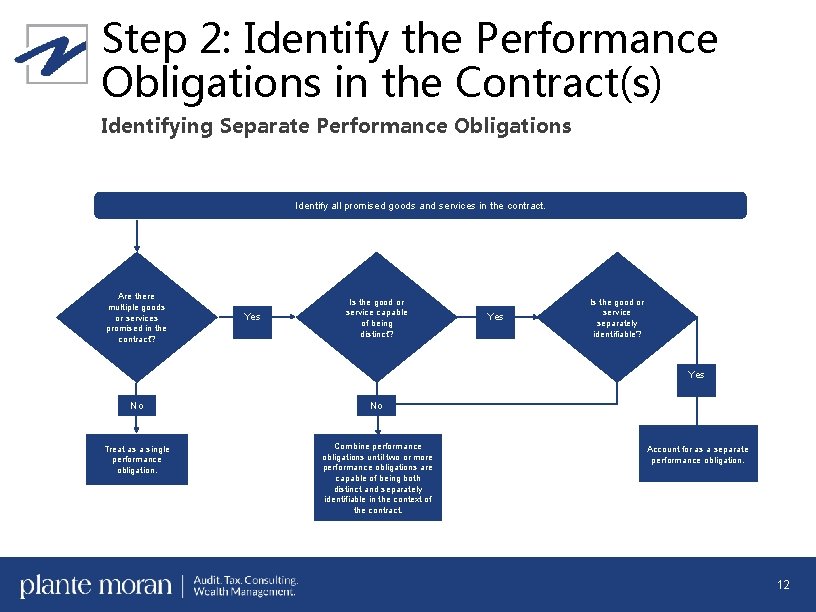
Step 2: Identify the Performance Obligations in the Contract(s) Identifying Separate Performance Obligations Identify all promised goods and services in the contract. Are there multiple goods or services promised in the contract? Yes Is the good or service capable of being distinct? Yes Is the good or service separately identifiable? Yes No No Treat as a single performance obligation. Combine performance obligations until two or more performance obligations are capable of being both distinct and separately identifiable in the context of the contract. Account for as a separate performance obligation. 12
Lessons Learned • Scope Considerations • • Fulfillment activities do not result in the transfer of a distinct good or service to the customer even if separately priced in a contract. Careful review of hardware and appliance deliverables is needed to determine if they are subject to ASC 840 or 842 and not in scope of ASC 606. • Would items be considered depreciable capital assets or inventory related? 13
Step 2: Identify the Performance Obligations • Capable of Being Distinct • The customer can benefit from the good or service either on its own or together with other resources that are readily available to the customer. • Readily available resources are goods or services that are sold separately (by the entity or by another entity) or • Resources that the customer has already obtained (from the entity or from other transactions or events). 14
Step 2: Identify the Performance Obligation Separately identifiable The promised good or service is not separately identifiable (distinct within the context of the contract) when supported by the following indicators: o The entity provides a significant service of integrating the goods or services into the bundle of goods or services for which the customer has contracted. The good or service is an input to produce the output specified in the contract. o The goods or services are highly interdependent or interrelated with other goods or services. o The good or service significantly modifies or customizes another good or service promised in the contract. 15
Step 2: Identify the Performance Obligation Separately Identifiable • The goods or services are highly interdependent or interrelated with other goods or services. • • Especially challenging to apply Transformative relationship vs. dependency/functional relationship Simple example in the standard is antivirus software More difficult application when multiple services are provided under a managed service approach. 16
Step 2: Identify the Performance Obligations Series • Both criteria must be met: • Each distinct good or service in the series that the entity promises to transfer to the customer would meet the criteria to be a performance obligation over time. • The same method would be used to measure the entity’s progress toward complete satisfaction of the performance obligation to transfer each distinct good or service in the series to the customer. 17
Step 2: Identify the Performance Obligations • Additional licenses (services) or usage – requires judgment • Must a purchasing decision be made? • Material right? • Contract modification? • Cumulative catch-up? • Prospective? • Are usage-based fees required for additional usage? 18
Step 2: Identify the Performance Obligations in the Contract(s) Customer Options and Material Rights 19
Special Rules • Licenses • Symbolic IP licenses (e. g. , brand, logo, copyrighted character franchise rights) • Generally tied to licensor and will change based upon licensor activity • License represents “right to access” • • Applicable regardless of whethere are ongoing activities Recognize revenue over time • Functional IP licenses (e. g. , software, film, music) • License represents “right to use” • Recognize revenue usually at a point in time • If ongoing activities required and customer is contractually or practically required to use updated IP, recognize over license term 20
License or Saa. S? • Licenses include both: 1. Contractual right to take possession of software during the hosting period and 2. Customer can run software on its own or unrelated third-party hardware 21
License Guidance • Contracts must include a license of IP in order to apply the licensing guidance • Term and perpetual licenses qualify • Revenue recognized when or as control is transferred • Exception to normal variable consideration accounting • Licensing royalty recognition when usage occurs, subject to satisfaction constraint • Lag-based royalty recognition not permitted 22
Special Rules – Sales or Usage-Based Royalties Predominately Related to IP • No analogies permitted • No revenue from intellectual property license until both: • License (or renewal, if applicable) period has begun • Necessary information to benefit from license has been transferred 23
License or Saa. S? – Hybrid Contracts • Hybrid arrangement: Combination on-premise software and some hosted content and/or functionality • Distinct within the context of the contract? • Sold by other vendors • Independent functionality • Impact of combination on overall utility • Significant interaction between the two potential POs 24
Step 3: Determine the Transaction Price • Definition: Amount the vendor expects to be entitled to for transferring goods or services • “Amount of consideration” might not be obvious • • • Variable amounts (discounts, allowances, returns, etc. ) Constraint on variable amounts Financing component Noncash consideration Consideration payable to customer • Exclusion = sales or usage-based royalty for IP license • Estimate judgement • Limit estimate constraint • Probable significant reversal of cumulative revenue will not occur • Reconsider each period! 25
Step 3: Determine the Transaction Price • Financing Component • Indicator exists: • Consideration ≠ cash price • More than one year between transfer of good/service and payment • Indicator does not exist: • Payment delay for business reason to resolve a future variable fee • Customer discretion to pay in advance • Practical expedient if time period is less than one year 26
Step 3: Determine the Transaction Price • Variable Amounts • Usage-based fees • Volume discounts • Reseller return rights • Pricing concessions • Service-level guarantee penalties • As invoiced recognition allowable to the extent invoiced amount is reflective of value transferred to customer — may be precluded by minimums or caps, if substantive 27
Step 3: Determine the Transaction Price • Variable consideration • Must estimate as part of transaction price • Expected Value – several possible outcomes, probability weighted. May be most relevant if many contracts and outcomes exist (i. e. price protection adjustment). • Most likely Amount – Single most likely amount most representative. Likely more relevant if only a few outcomes exist (i. e. on-time performance bonus). • Subject to constraint that a significant reversal of previously recognized revenue will not occur in the future • Thoughtful assessment is needed as outcome is generally not binary (i. e. all or none). • Transaction based fees, caps and limits on consumption may present unique challenges requiring estimation. 28
Step 4: Allocate the Transaction Price to the Performance Obligations in the Contract Allocation Objective • 606 -10 -32 Measurement - General: The objective when allocating the transaction price is for an entity to allocate the transaction price to each performance obligation (or distinct good or service) in an amount that depicts the amount of consideration to which the entity expects to be entitled in exchange for transferring the promised goods or services to the customer. 29
Step 4: Allocate the Transaction Price to the Performance Obligations in the Contract • Allocation is based on relative standalone selling price (SASP) to each PO • Price an entity would sell promised goods or services separately to a customer • Use observable transactions if they exist — otherwise: • Expected cost plus margin • Adjusted market assessment • Residual approach OK (if highly variable or uncertain) • Allocate variable consideration or discount proportionally unless: • Have objective evidence to support other allocation • Subsequent changes in estimate follow inception allocation 30
Step 4: Allocate the Transaction Price to the Performance Obligations in the Contract SASP • Material rights • Licenses always sold with PCS • Specified upgrade rights • Remix rights • “Free” goods or services 31
Step 5: Recognize Revenue When or as the Entity Satisfies a Performance Obligation • Recognize when or as performance obligation is satisfied by the transfer of control of goods or services to the customer • Focus on control, rather than solely risks and rewards • Control evidenced by: • Ability to direct the use of the asset • Right to obtain substantially all remaining benefits of the asset • Preventing others from directing use of and obtaining the benefits from the asset 32
Step 5: Recognize Revenue When or as the Entity Satisfies a Performance Obligation • Transfer of control evaluated to determine if: • Transfer occurs over time • Transfer occurs at a point in time • Control may pass at a point in time or over time • “Over time” generally earlier recognition for goods and services as delivery or completion is not necessary • “Point in time” generally earlier for IP licenses (not requiring ongoing support) as it would happen at the start of a license, rather than over term 33
Step 5: Recognize Revenue When or as the Entity Satisfies a Performance Obligations Satisfied over Time • The customer simultaneously receives and consumes the benefits of the entity’s performance as it occurs • Would another entity not need to substantially reperform the work completed to date? • The entity’s performance creates or enhances an asset the customer controls as the asset is created or enhanced • The entity’s performance does not create an asset with alternative use, and the entity has an enforceable right to payment for performance completed to date | 3434|
Point in Time vs. Over Time Recognition • Enforceable right to payment for performance completed to date • • • Payment schedule or milestones alone do not satisfy this attribute Need to recover costs incurred plus reasonable margin Should satisfy throughout contract period 35
Step 5: Recognize Revenue When or as the Entity Satisfies a Performance Obligations Satisfied at a Point in Time • Recognize when transfer of control occurs • Indicators of the transfer of control: • Entity has a right to payment • Customer has legal title to the asset • Customer has physical possession of the asset • Customer bears significant risks and rewards of ownership of the asset • Customer has accepted the asset 36
Step 5: Recognize Revenue When or as the Entity Satisfies a Performance Obligation Over Time Recognition • Two methods: • Output (milestones, billings)* • Input (labor, cost, hours) • If performance is even passage of time • Practical expedient • Entity has right to payment that corresponds to value to customer of work/service completed to date recognize when right to invoice *Preferable 37
Step 5: Recognize Revenue When or as the Entity Satisfies a Performance Obligation • Recognition Pattern • Stand ready • Series • Specified upgrades • Specified limited technical support • Customer options 38
Principal vs. Agent Considerations • Indicators that an entity controls the specified good or service before it is transferred to the customer include, but are not limited to: • The entity is primarily responsible for fulfilling the promise to provide the specified good or service • The entity has inventory risk before the specified good or service has been transferred to a customer • The entity has discretion in establishing prices for the specified good or service 39
Contract Costs • Cost guidance is new • Incremental costs of obtaining contract are an asset • Practical expedient expense costs as incurred if amortization period would be one year or less • Direct costs to fulfill a contract are an asset if they enhance resources to satisfy performance obligations in the future • Direct labor and materials • Allocation of costs that directly relate • Costs chargeable under the contract • Other costs incurred solely as a result of the arrangement | 4040|
Costs to Obtain Contracts Common Challenges • One-year practical expedient may not apply if renewals are specifically anticipated and renewal commissions are not commensurate • Allocations of managers and reseller sales commissions • Tiered plans may require estimates for accruing and capitalizing commissions 41
Revenue Guidance Systems, Processes, and Controls • Must align entire revenue process to five steps in guidance • Contract initiation to cash collection • More judgments and estimates • Reviewing contracts • Assessing collection criteria • Assessing contract modifications • Estimating variable consideration • More new disclosures impact all companies • Two sets of controls during transition? 42
Revenue Guidance – Other Considerations • Financial measures • Valuations • Bonus plans • Debt covenants • Income taxes • Earn-out clause in acquisition agreement • Other contracts with financial metrics 43
Implementation Advice • Need to evaluate and group all significant revenue generating activities • Determine composition of contracts for each significant revenue stream • Homogenous • Individually unique • Perform deep dive into each key contract (or group) assessing all 5 steps under ASC 606 • A much better understanding of the business model is required for ASC 606 vs. ASC 605 for accounting purposes 44
Implementation Advice • Documentation of all key judgments is crucial • • Common problem in implementation Need to have a clear documented roadmap as to how each step was applied to the business model. • Thoughtful analysis will help avoid misapplication issues during a future event or transaction. • Need to start with the 5 step model under ASC 606, not from the ASC 605 lens, identifying potential changes. 45
Questions? 46
- Slides: 46