
Asbestos Exposure Occupational Safety and Health Standards for
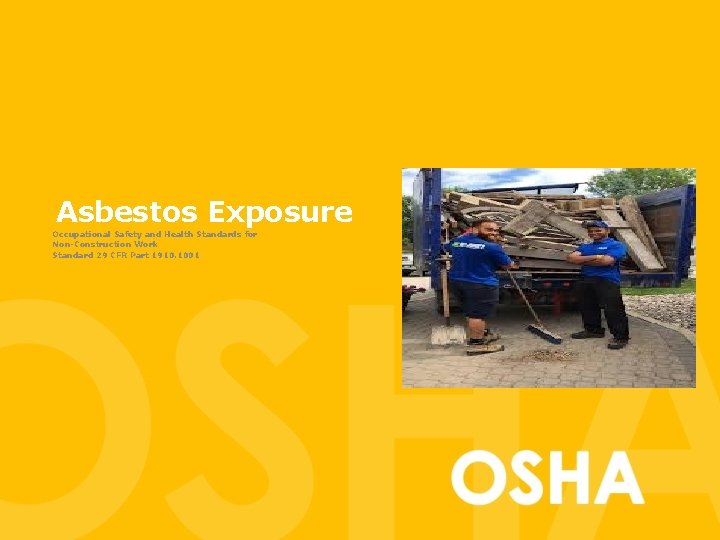
Asbestos Exposure Occupational Safety and Health Standards for Non-Construction Work Standard 29 CFR Part 1910. 1001

Asbestos Exposure: Agenda In today’s session, you will learn about: ▪ Asbestos ▪ Potential dangers ▪ Tips for safe handling

What is Asbestos? Asbestos is a term used for a group of naturally occurring fibrous minerals with high tensile strength, flexibility and resistance to heat, chemicals and electricity. Asbestos can be found in products such as: ▪ ▪ ▪ ▪ Pipe insulation Brake pads and clutches Floor tiles Roofing felts and shingles Ceiling tiles Fire-resistant drywall Acoustical products Spray-on fireproofing
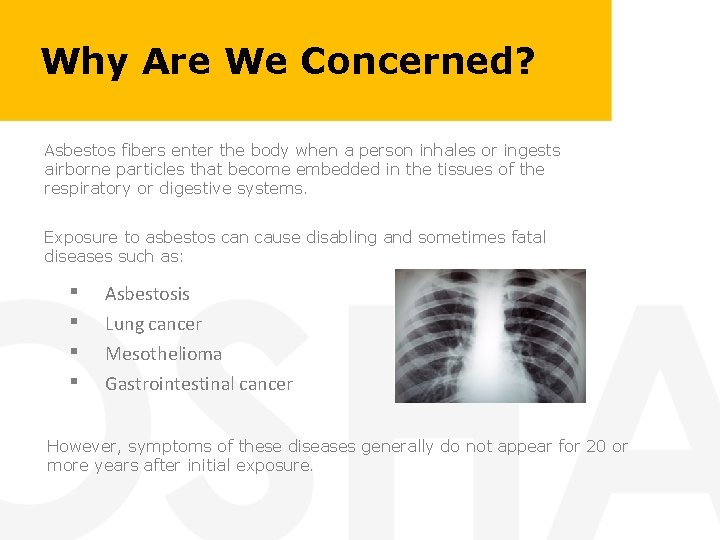
Why Are We Concerned? Asbestos fibers enter the body when a person inhales or ingests airborne particles that become embedded in the tissues of the respiratory or digestive systems. Exposure to asbestos can cause disabling and sometimes fatal diseases such as: ▪ ▪ Asbestosis Lung cancer Mesothelioma Gastrointestinal cancer However, symptoms of these diseases generally do not appear for 20 or more years after initial exposure.

Exposure Potential OSHA regulations apply to any incident were workers come in contact with asbestos. Exposures may occur while: ▪ ▪ ▪ Removing or encapsulating asbestos-containing material (ACM). Producing asbestos-containing products. Installing asbestos-containing products. Cleaning up asbestos spills/emergencies. Transporting, disposing, storing, containing and housekeeping involving asbestos or asbestoscontaining products.
Initial Monitoring Before the start of any asbestos-related work, an assessment of possible exposure levels must be made. Permissible exposure limits (PEL) The proper control methods will be used to ensure that 1800 -GOT-JUNK? employees are not exposed to: Time-weighted average limit - an airborne concentration of asbestos in excess of 0. 1 f/cc as an eight-hour timeweighted average(TWA). Excursion limit - an airborne concentration of asbestos in excess of 1 f/cc as averaged over a sampling period of 30 minutes.
Safe Clean-Up – Regulated Areas ▪ Whenever exposure levels exceed the PEL, establish a regulated area to reduce the spread of any asbestos disturbed during the project. ▪ Regulated areas should be marked off with plastic sheeting or negative pressure enclosures to reduce exposure to other employees working nearby. ▪ Signage should be posted at all entrances to note the existence of the regulated area and the hazard it presents.
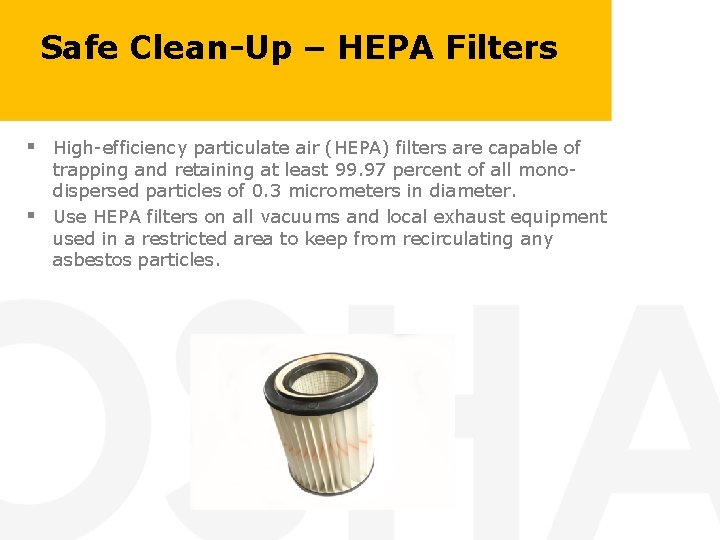
Safe Clean-Up – HEPA Filters ▪ ▪ High-efficiency particulate air (HEPA) filters are capable of trapping and retaining at least 99. 97 percent of all monodispersed particles of 0. 3 micrometers in diameter. Use HEPA filters on all vacuums and local exhaust equipment used in a restricted area to keep from recirculating any asbestos particles.
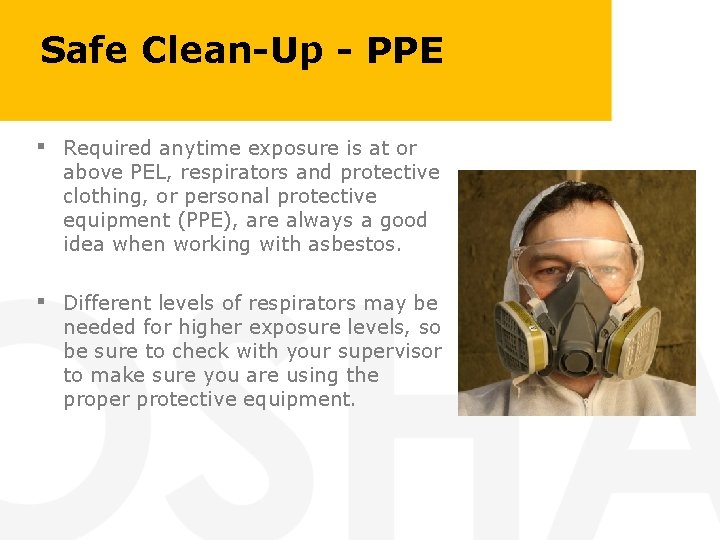
Safe Clean-Up - PPE ▪ Required anytime exposure is at or above PEL, respirators and protective clothing, or personal protective equipment (PPE), are always a good idea when working with asbestos. ▪ Different levels of respirators may be needed for higher exposure levels, so be sure to check with your supervisor to make sure you are using the proper protective equipment.
Safe Clean-Up - Removal ▪ No matter what form ACM takes, there are some standard procedures that can limit the amount of asbestos that is released into the air. ▪ Always try to keep ACM as intact as possible during removal. Make as few cuts as possible, and avoid unnecessary breakage of ACMs like flooring tiles and roofing shingles. ▪ Bag or wrap ACM immediately after removing it and store it in leak-proof containers.
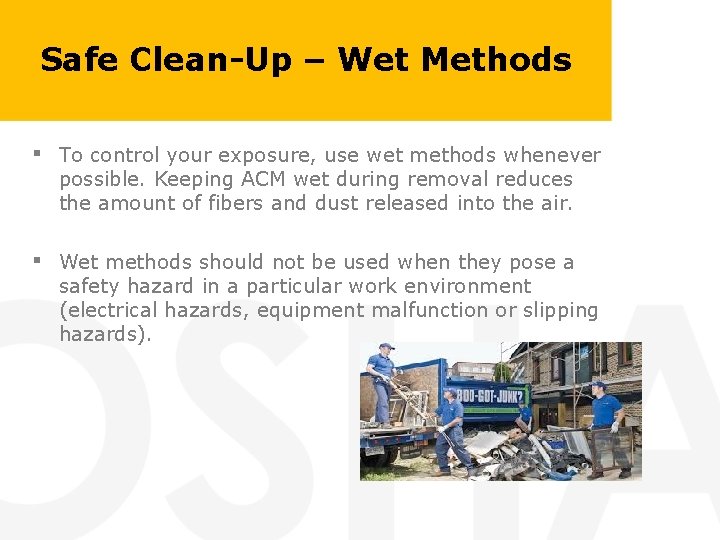
Safe Clean-Up – Wet Methods ▪ To control your exposure, use wet methods whenever possible. Keeping ACM wet during removal reduces the amount of fibers and dust released into the air. ▪ Wet methods should not be used when they pose a safety hazard in a particular work environment (electrical hazards, equipment malfunction or slipping hazards).
Safe Clean-Up The following work practices are asbestos-related work: prohibited for all ▪ High-speed abrasive disc saws not equipped with a point-of-cut ventilator or enclosure with HEPA-filtered exhaust air. ▪ Using compressed air to remove asbestos or ACM unless the compressed air is used with an enclosed ventilation system. ▪ Dry sweeping, shoveling or other dry cleanup of dust and debris. ▪ Employee rotation to reduce exposure.
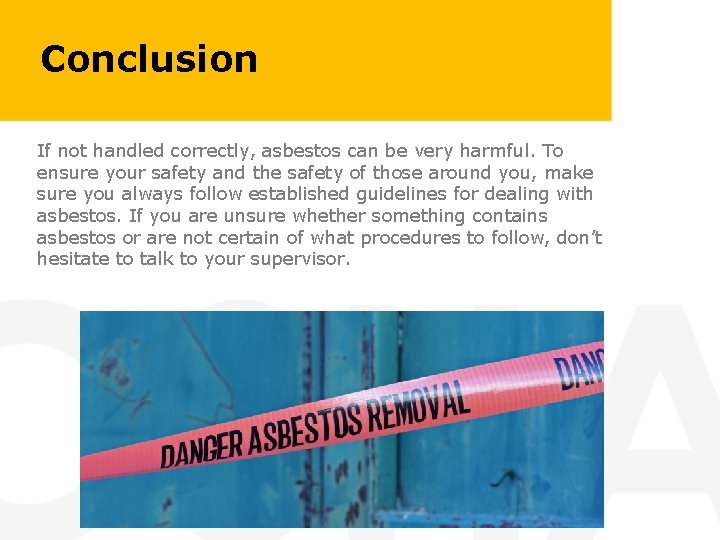
Conclusion If not handled correctly, asbestos can be very harmful. To ensure your safety and the safety of those around you, make sure you always follow established guidelines for dealing with asbestos. If you are unsure whether something contains asbestos or are not certain of what procedures to follow, don’t hesitate to talk to your supervisor.

For More Information This program and many others are provided FREE of charge to Liberty Insurance Agency Clients. Contact Jason Rigby, CRM For more information on how we can help your 1 -800 -GOT-JUNK? Franchise: jasonrigby@libertyins. com / Office: 412 -5714 Ext. 255 / Mobile: 412 -610 -2303
- Slides: 14