
ASAS Thematic Network Seminar Airport Applications Billy Josefsson
ASAS Thematic Network Seminar Airport Applications Billy Josefsson, LFV Brighton, 11 - 13 October 2004
Overview • • Expected benefits What is it? Where can it be used? Impact on roles, procedures, technical aspects? • Examples • Summary
Expected benefits • Safety -Awareness between actors e. g. to prevent RWY incursion • Efficiency -Facilitate planning and best use of resources • Capacity -Increase throughput by providing awareness • Environment -less taxi time, more efficient procedures e. g. de-icing ARL • Cooperative values -Learn more about each others operations -A prerequisite for efficient cooperation
What, where, when? • ASMGCS system -ADS-B equipped vehicles • Stockholm ARLANDA airport • Bus coordination system -22 buses and 17 vehicles • Frankfurt, Heathrow, Innsbruck, Prague et more
Objectives of ‘Package I’ (short history lesson) • Focus on operational applications suited for core European high-density traffic areas without excluding other areas • Operational airborne and ground user needs for ADS-B are considered • Develop the operational and technical standards required for the early implementation of ADS-B applications
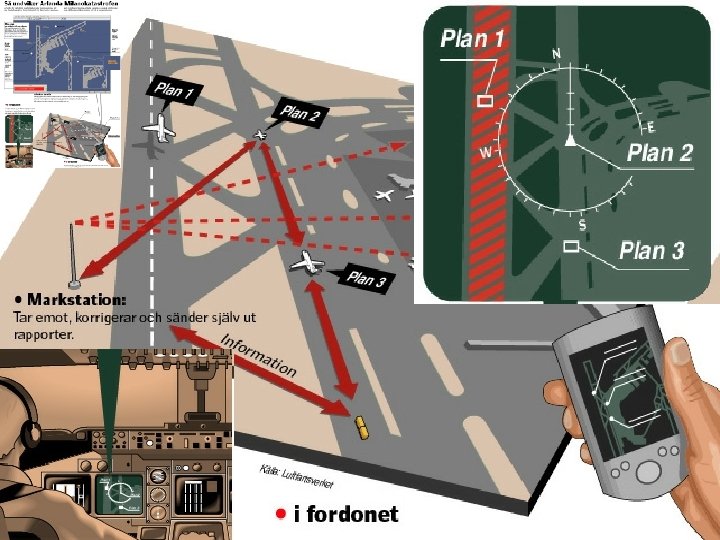
Enhanced traffic situational awareness on the airport surface (ATSA-SURF) • Definition: This application provides the flight crews with an “enhanced traffic situational awareness” on the airport surface for both taxi and runway operations, in all weather conditions. The objectives are to improve safety (e. g. at taxiway crossings, before entering a runway, on pushback) and to reduce taxi time in particular during low visibility conditions or at night and……………
Airport surface surveillance ADS-B-APT • Definition: This application will provide a new source of surveillance information for a safer and more efficient ground movement management at airports with or without SMGCS. Airport ground vehicles can also be fitted with the necessary equipment and displayed on an airport map, together with aircraft. • ADS-B –APT (GS) + ATSA-SURF (AS) = Prerequisite for a safe and cost efficient cooperative environment with the same view of the operations based on the same data
Roles of actors and impact • Same but more “in the loop” • Enable proactive work, planning ahead with less resources • A more efficient “cut” between actors involved in the turnaround process and between ATC and Pilot
Changes to current situation operational perspective • Little for ATC • Medium for Aircraft operations • Major for vehicles, bus coordination, drivers
Anticipated changes and consequences… • Technical small and big • Procedures, medium • Air/ground cooperation, medium
Status of Arlanda ADS-B APT and ATSA SURF • ARLANDA, 22 buses and 17 vehicles • Site Acceptance Test = OK Regulator 1: st approval = OK Training = OK • Safety Case, 70 % ready November 2004 • Evaluation and fine tuning of parameters on-going
Technical solutions, Arlanda • 2 VHF channels • Ground station ( ADS-B, GRAS, TIS-B) • Transponders in vehicles and aircraft, displays will increase potential • Reference system / transponder • INFO-B in use • Bus coordinator function active • Information visible on ASMGCS in TWR
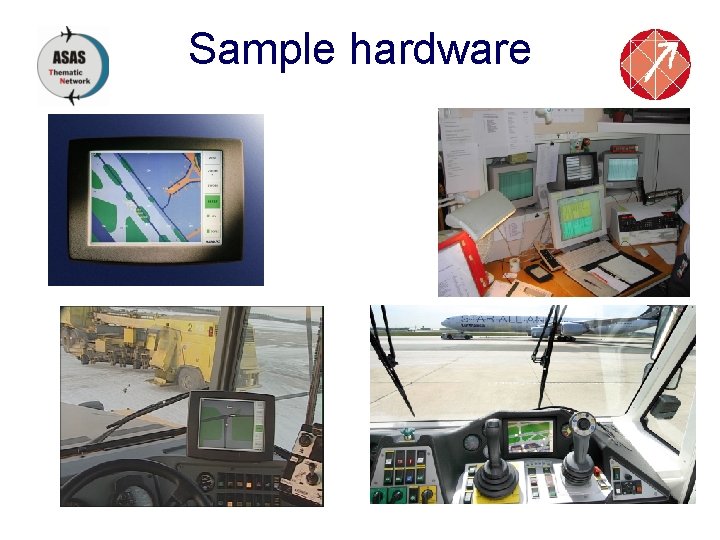
Sample hardware
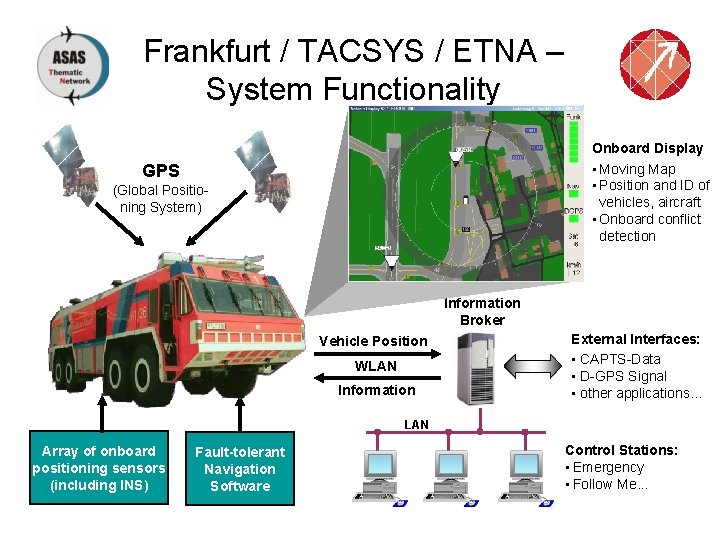
Frankfurt / TACSYS / ETNA – System Functionality Onboard Display • Moving Map • Position and ID of vehicles, aircraft • Onboard conflict detection GPS (Global Positioning System) Information Broker Vehicle Position WLAN Information External Interfaces: • CAPTS-Data • D-GPS Signal • other applications. . . LAN Array of onboard positioning sensors (including INS) Fault-tolerant Navigation Software Control Stations: • Emergency • Follow Me. . .
Costs and Incentives • Changes small or BIG • Costs involved – low to medium • Potential incentives: – Safety, cost-efficiency • Benefits are mostly collective • Airport investment policies “As Little As Possible”. Focus on short term Ro. I or very clear request from customer • Collective benefits requires collective investments
Case for Airport Applications applicable to ARLANDA • Case 1 -Bus coordination and vehicles • Case 2 -SAS “minitrucks” • Case 3 -Fire squad
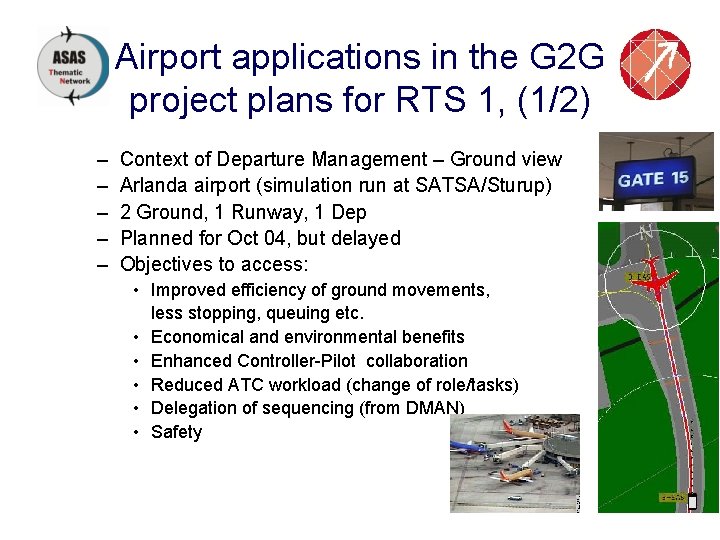
Airport applications in the G 2 G project plans for RTS 1, (1/2) – – – Context of Departure Management – Ground view Arlanda airport (simulation run at SATSA/Sturup) 2 Ground, 1 Runway, 1 Dep Planned for Oct 04, but delayed Objectives to access: • Improved efficiency of ground movements, less stopping, queuing etc. • Economical and environmental benefits • Enhanced Controller-Pilot collaboration • Reduced ATC workload (change of role/tasks) • Delegation of sequencing (from DMAN) • Safety
Airport applications in the G 2 G project plans for RTS 1, (2/2) – Objectives to access: • Improved Tactical traffic management in TMA (climb) – Benefits during departure operations (feasibility) – Sequencing and Merging from 2 airports (feasibility) – Context of DMAN Planning – Challenges: • • Pilot feasibility only partially addressed Controller/Pilot collaboration strategy Opportunity for taxi rules to enhance concept Climb-out operations controversial
Summary • Activities in the CDM and SWIM area are believed to further put requirements on high performance airport applications. • The costs for introducing ADS-B APT and ATSASURF are low compared to the airborne case, however most of the values are collective and therefore requires collective investments accompanied with a clear business case. • Airport applications are promising and enable safe and cost efficient operations with focus on supporting the turnaround process and at the same time improving safety.
- Slides: 20