
ASALEVEL BIOLOGY 3 1 8 Inorganic ions presentation
AS/A-LEVEL BIOLOGY 3. 1. 8 Inorganic ions presentation To be used alongside AQA AS/A-level Biology inorganic ions teaching notes 1 of x Version 1. 0 Copyright © 2015 AQA and its licensors. All rights reserved.
Atoms • All matter is made up of atoms • Each atom is made of three types of particle: – neutrons, with no charge – protons, with a positive charge – electrons with a negative charge • The neutrons and protons form the nucleus • The electrons orbit around the nucleus • In an atom, the number of protons is the same as the number of electrons (so no overall charge) 2 of x Version 1. 0 Copyright © 2015 AQA and its licensors. All rights reserved.
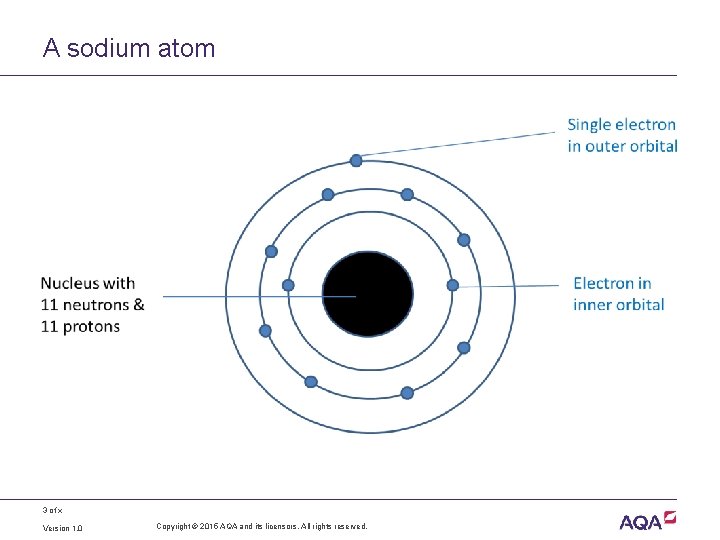
A sodium atom 3 of x Version 1. 0 Copyright © 2015 AQA and its licensors. All rights reserved.

Stability of atoms • Each atom has one or more orbitals of electrons • Atoms are more stable if their outer orbital is full • Stability is achieved by either gaining or losing electrons from the outer orbital 4 of x Version 1. 0 Copyright © 2015 AQA and its licensors. All rights reserved.
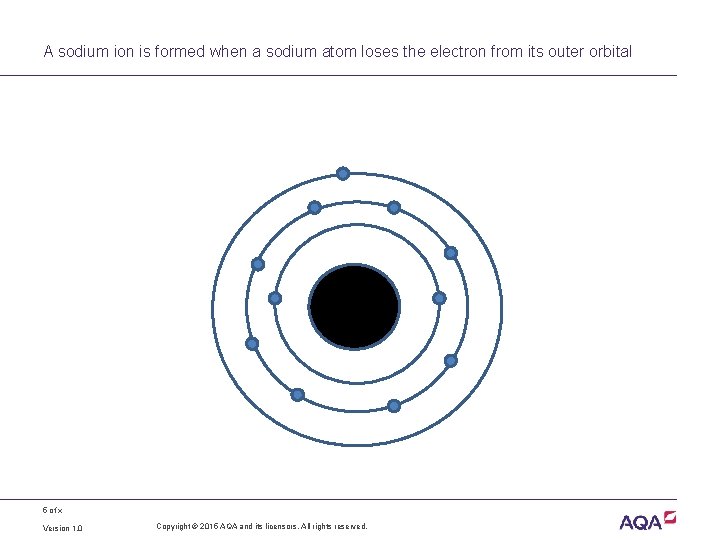
A sodium ion is formed when a sodium atom loses the electron from its outer orbital 5 of x Version 1. 0 Copyright © 2015 AQA and its licensors. All rights reserved.

Ions are formed when an atom gains, or loses, electrons • If an atom loses one or more electrons, it becomes a positively charged ion • If an atom gains one or more electrons, it becomes a negatively charged ion • If placed in an electric field, ions will migrate to the electrode with the opposite charge – Negatively charged ions migrate to the positive electrode (anode), so are called anions – Positively charged ions migrate to the negatively charged electrode (cathode), so are called cations 6 of x Version 1. 0 Copyright © 2015 AQA and its licensors. All rights reserved.
Representing ions • A sodium ion still has 11 protons but having lost one electron it only has 10 electrons, ie it has a positive charge • Na (atom) – 1 electron = Na+ (sodium ion) • Some atoms gain electrons • If a chlorine atom gains one electron it becomes a negatively charged chloride ion • Cl (atom) + 1 electron = Cl– (chloride ion) 7 of x Copyright © 2015 AQA and its licensors. All rights reserved.
Some ions are complex • They contain more than one atom, eg, – nitrate (NO 3–) – phosphate (PO 43–) 8 of x Copyright © 2015 AQA and its licensors. All rights reserved.
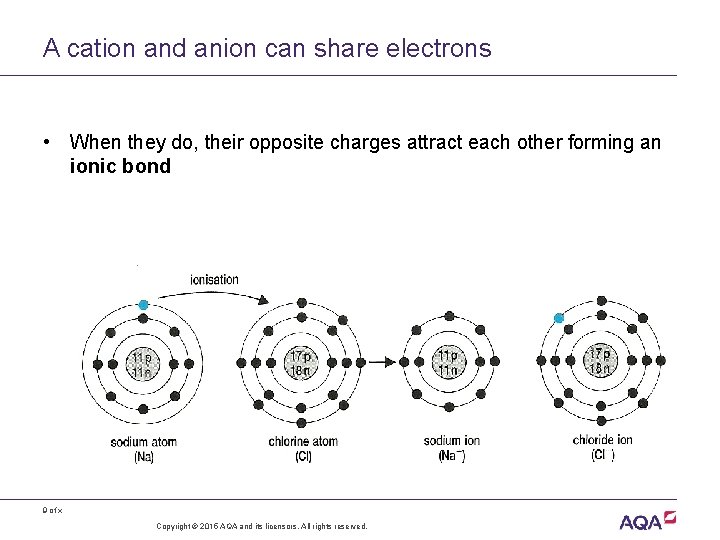
A cation and anion can share electrons • When they do, their opposite charges attract each other forming an ionic bond 9 of x Copyright © 2015 AQA and its licensors. All rights reserved.
Acknowledgements Diagram on slide 9 Rowland, M. , 1992, Biology, Thomas Nelson & Sons Ltd 10 of x Copyright © 2015 AQA and its licensors. All rights reserved.
- Slides: 10